
Long-Term Freeze-Dried Fruit Supplier Vetting: Continuity, Scope and Compliance
Long-Term Freeze-Dried Fruit Supplier Vetting: Continuity, Scope and Compliance

A single shipment of freeze-dried fruit can be judged on a certificate of analysis and a retained sample. A three-year supply commitment cannot. Once a program runs across seasons, formats and destination markets, the questions that decide whether the relationship holds change: which of your SKUs the supplier's certified scope actually covers, when each certificate window closes, how many product formats remain available as your mix moves, and which acceptance terms are re-agreed instead of inherited.
This is a vetting framework for that longer horizon, treating supplier approval as a recurring review supported by dated documents rather than a one-off event supported by a good sample. UrSnacks, the freeze-dried fruit brand of FUJIAN YOULINGYOUSHI TECHNOLOGY CO., LTD., is used as the worked example because its supplied records include dated certificate windows, scope wording and a format list that can be mapped against a real buying program — including the points where the documentation is narrower than the catalogue.
Why one-order evidence stops being enough
Batch testing is the strongest evidence most buyers ever see, and it is still a snapshot. In six UrSnacks categories tested by SGS-CSTC (reports XMF26-0002013-01 to -06), moisture measured 0.96–1.58 g/100 g against a ≤5.0 g/100 g reference limit in those reports, Salmonella was not detected under the stated sampling scheme, Staphylococcus aureus was <10 CFU/g, lead was not detected at a reporting limit of 0.05 mg/kg, BHC, DDT and dimethoate were not detected, and patulin was not detected in the freeze-dried apple sample. Separate nutrition reports cover mango (MJHY-X50800) and dragon fruit (MJHY-X50799).
Those results answer a lot-level question: was this batch inside specification? They do not answer the continuity question — whether the batch bought in eighteen months will come from the same controlled process, at the same site, under a certificate that still covers it. Two annual type tests commissioned from qualified third-party laboratories, including SGS, provincial quality-inspection institutes and CTI, with additional testing on request, are a cadence arrangement rather than a guarantee; the buyer still has to know which report covers which category and batch.
Four questions a multi-year review must answer
Long-term vetting collapses into four tests. Each is answerable from documents, and each fails quietly if it is skipped.
| Review question | What it protects | Document to request |
|---|---|---|
| Scope match | Whether the certified operations match your SKU's actual process route | Current certificate with the full scope page, legal entity and site address |
| Validity | Whether documents will still be in date at your next review | Dated certificates, registrations and audit cycle statements |
| Format breadth | Whether your mix can change without a new supplier qualification | Category and format list with mesh or dimension options |
| Acceptance repeatability | Whether release criteria mean the same thing in year two | Signed specification revision, COA panel, pre-shipment inspection method |
Mapping certified scope to the SKUs you actually buy
Scope wording is where most supplier approvals are lost. The BRCGS certificate supplied for this review — Issue 9, certificate C723738, site code 10017031, issued by DNV Business Assurance Italy S.r.l., valid 20 October 2025 to 9 November 2026 — states a scope built around selecting and packaging of dried vegetable and dried fruit products, and selecting, coating, cooling and packaging of coated dried fruit products in compound bags.
Read that as an operations list, not a product list. A buyer of coated freeze-dried strawberry can see the coating and cooling steps named. A buyer of fruit powder has to ask which operation the milling step falls under and whether it sits inside the scope as written, because the wording describes selecting and packaging rather than every unit operation. The supplier's own qualification guidance makes the same point: certificate scope should not be assumed to cover every process step or SKU.
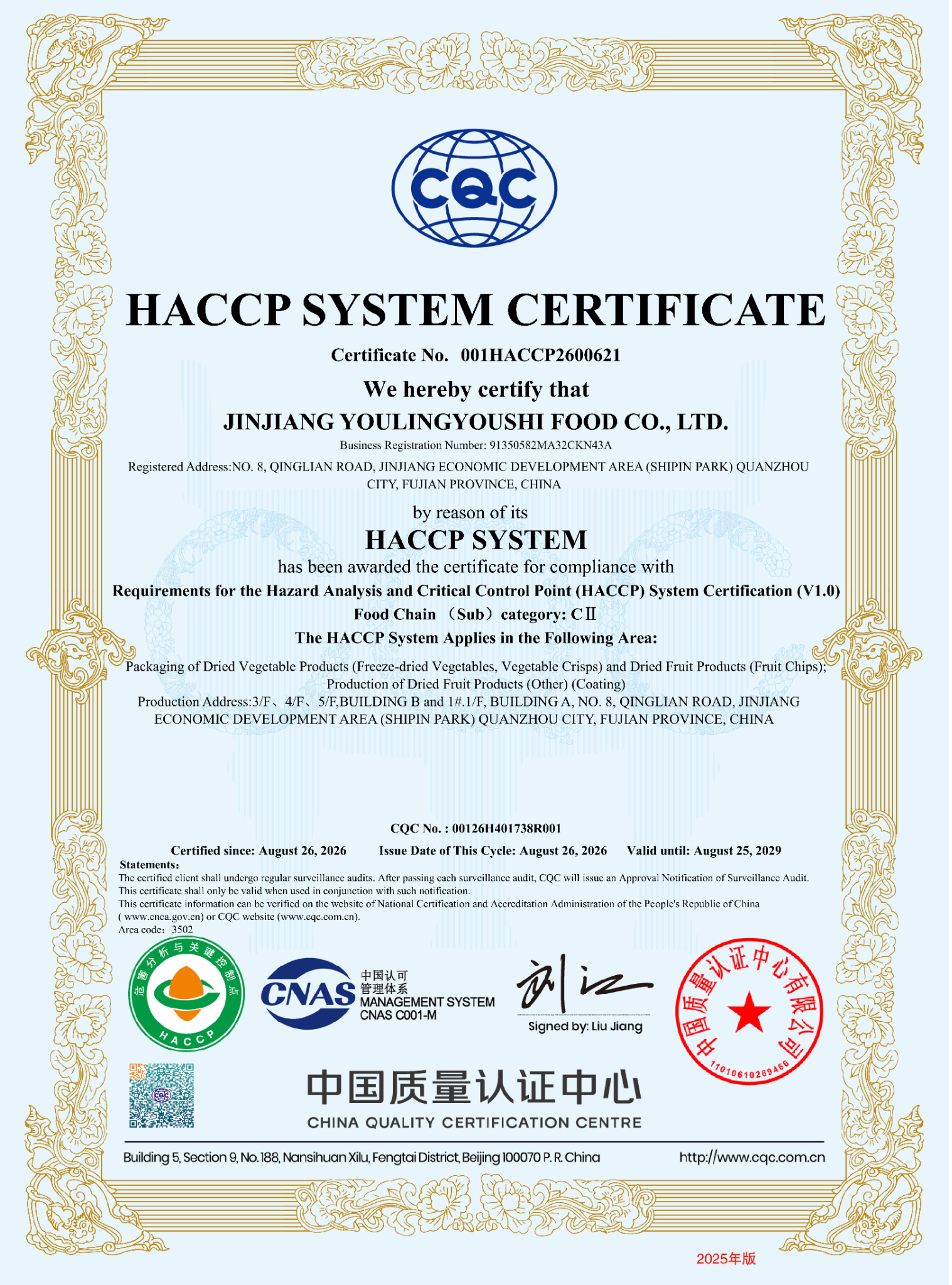
The same discipline applies across the rest of the archive. ISO 22000:2018 (certificate 001FSMS2400580, CQC, 9 August 2024 to 8 August 2027) certifies a food-safety management system in food chain category C II; HACCP certification (001HACCP2600621, CQC, 26 August 2026 to 25 August 2029) certifies a hazard-control system. Neither is a product release. The China Customs export food production enterprise filing (3502/08109, Quanzhou Customs) carries long-term validity but a narrow stated scope — fruit crisps (repacking) and flavored fruit crisps — while the U.S. FDA food facility registration and U.S. Agent arrangement is held for JINJIANG YOULINGYOUSHI FOOD CO., LTD. (facility 432015462, DUNS 704680481, U.S. Agent CCIC Chicago Inc., 4 March 2026 to 3 March 2027), a legal name that differs from the group entity FUJIAN YOULINGYOUSHI TECHNOLOGY CO., LTD.
That last point matters more than it looks. The entity on the certificate, the entity on the invoice and the entity on the supply contract should be the same entity, or the relationship between them should be documented. Buyers who check only the brand name discover the gap during an audit. Equally, none of these credentials is an import approval: halal scope is defined by the attached product list, and destination-market registration, labelling and sanitary requirements stay project-specific.
Certificate validity is a calendar item, not a filing item
A certificate is evidence only inside its stated window. The BRCGS entry above closes on 9 November 2026 and evidences nothing beyond that date, so a program resting on it must request the subsequent certificate before the window ends — and a buyer approving late in 2026 should ask for the current document rather than accept an archived copy.
| Credential | Reference and stated validity | What it evidences |
|---|---|---|
| BRCGS Global Standard Food Safety Issue 9 | Cert. C723738, site code 10017031, DNV Business Assurance Italy S.r.l., 20 Oct 2025 – 9 Nov 2026 | Certification of the stated scope: selecting and packaging of dried fruit and vegetable products; selecting, coating, cooling and packaging of coated dried fruit products |
| ISO 22000:2018 | 001FSMS2400580, CQC, 9 Aug 2024 – 8 Aug 2027 | Food-safety management system, food chain category C II |
| HACCP System Certificate | 001HACCP2600621, CQC, 26 Aug 2026 – 25 Aug 2029 | Hazard-control system certification |
| Halal, GSO 2055-1:2015 and MS1500:2019 | SHC, Cert. 5880250000, Reg. 3502/08109, product category CIV, 22 Aug 2025 – 21 Aug 2028 | Halal status within the attached product list for the stated GCC/GSO and Malaysia–Indonesia routes |
| BPJPH Indonesia | ID00410002836200323, issued 4 May 2023, no fixed expiry | Halal status for processed fruit and vegetable products with added food additives (50 products); conditional on unchanged formulation and process |
| U.S. FDA Food Facility Registration and U.S. Agent | Facility 432015462, DUNS 704680481, 4 Mar 2026 – 3 Mar 2027 | Facility registration and agent arrangement for the named entity; not an FDA approval or import clearance |
| China Customs export food production enterprise filing | 3502/08109, Quanzhou Customs, long-term validity | Export filing with scope stated as fruit crisps (repacking) and flavored fruit crisps |
| SMETA V7 | Audit ref. ZAA600211493, Benchmarks Company Limited, audited 16 Jun 2026 | Social-compliance audit report on an annual cycle; a report, not a fixed-term certificate |
Halal credentials run longer but are narrow in a different way: the SHC certificates are valid to 21 August 2028 for the product categories listed, while the Indonesian BPJPH certificate has no fixed expiry but remains valid only while ingredient composition and the halal production process are unchanged. A reformulation is therefore a halal review trigger, not merely an R&D decision. SMETA works the other way round — an audit conducted on 16 June 2026 with an annual cycle, so the useful date is when the next report falls due, not when a document lapses.
Product-format breadth and portfolio resilience
Breadth is a resilience question disguised as a catalogue question. If a program starts as a powder for a dry mix and later needs a visible piece for a cereal or a coated inclusion for a gifting line, the real cost of that move is not the new product — it is the second qualification, the second specification system and the second audit.
The documented UrSnacks powder range covers freeze-dried strawberry, durian and mango powders, with strawberry and durian listed at 60–80, 80–100 and 100–120 mesh and mango at 60–80 and 80–100; freeze-dried dragon fruit powder is listed at 60–80 and 80–100 mesh. Standard powder specification elsewhere in the portfolio is quoted at 80–120 mesh (approximately 125–177 µm), with exact mesh, size distribution and screen residue confirmed in the written specification rather than inferred from a range name. Apple, banana and pineapple appear in the documented portfolio as piece formats: freeze-dried apple (Luochuan Red Fuji) at 6–10 mm dice and 3–5 mm slice, pineapple at 10–15 mm and 6–10 mm dice, banana at 3–5 mm. Freeze-dried durian is listed by size grade (Monthong, S/M/L), and jackfruit is available as a standard line.
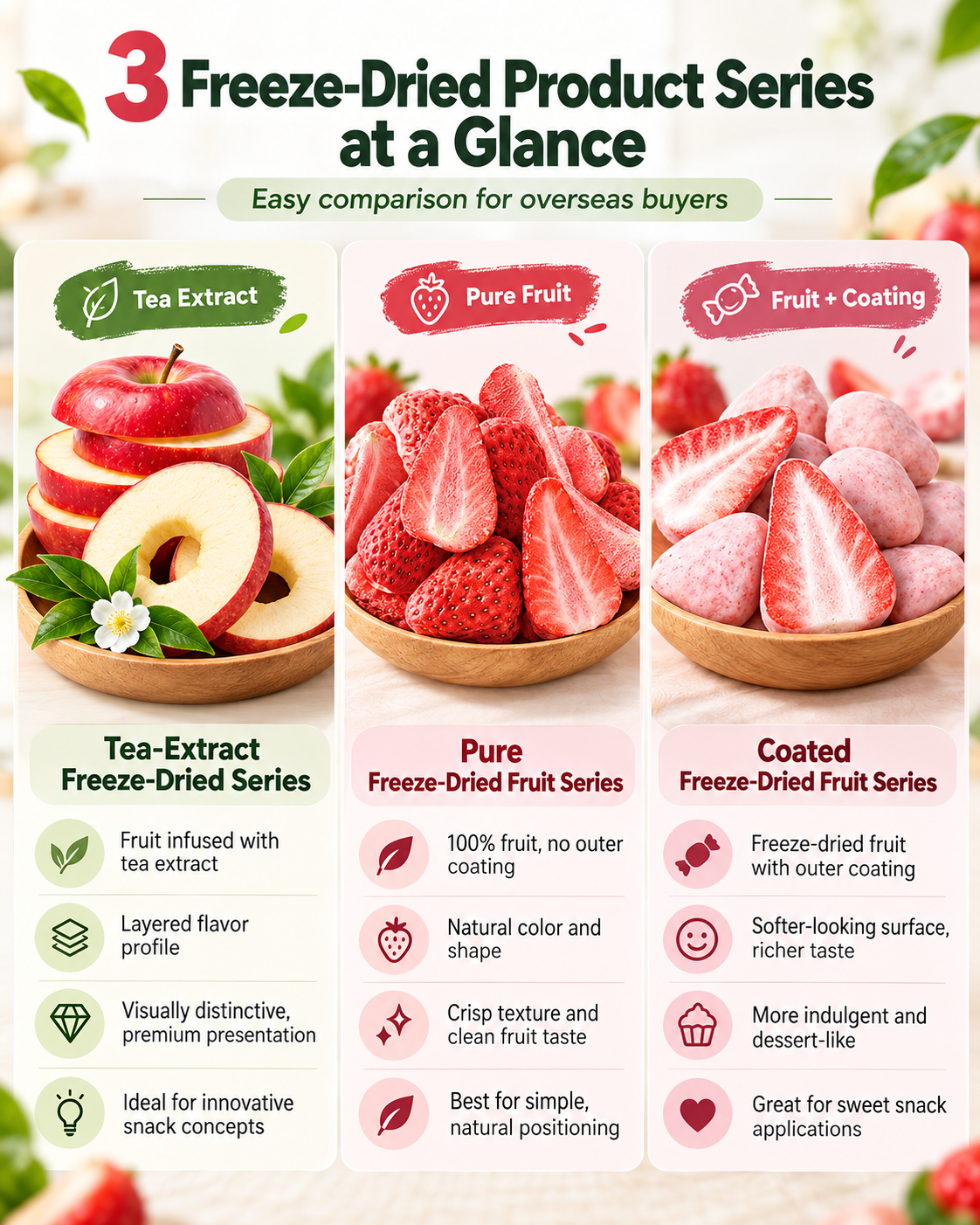
Beyond single-ingredient fruit, the finished-product side includes coated lines in yogurt, matcha, cocoa (chocolate-flavoured) and fruit-original directions, with thin and thick coating routes and fruit content declared per SKU — coated durian 58 g at ≥66% fruit, coated strawberry at 22 g, 29 g and 38 g at ≥37% — plus a vacuum-infusion development direction currently focused on tea-extract infusion. Ingredient formats run to six or more: whole, slices, halves, diced pieces and granules, chunks and powder. At platform level the supplier operates four business scopes — fresh fruit, frozen fruit, freeze-dried ingredients and freeze-dried finished products — with strawberry and durian spanning all four and other fruits concentrated in the two freeze-dried scopes.
What this means for a long-term buyer is narrower than the list suggests. Breadth is worth paying for only where it removes a re-qualification you would otherwise have to run, and only if the format you add is validated in your own formulation, packaging and line. A wide catalogue does not certify application fit, and format suitability still has to be proven in your own trials.
Where purchasing terms belong in the review
Commercial terms drift silently. A specification re-agreed in year one is often still being enforced in year three, and a terms annex reviewed on the same cycle as the certificates is the cheapest place to prevent that.
Documented current terms are: OEM, private-label and UrSnacks-branded finished goods from approximately 600 kg per order, with different products and SKUs combinable in one container; bulk freeze-dried ingredients on a standard basis of one 20-foot container, with mixed loading of different raw materials supported. Mature OEM and private-label programs typically run about 25–30 working days, subject to specification, packaging-material approval and production schedule, with ODM requiring additional development, sampling and validation before scheduling. Default delivery is FOB Xiamen, with other trade terms and ports available and some products shipped from their country of origin.
Acceptance is where the review earns its keep. Pre-shipment inspection against the supplier's enterprise standard is documented as performed before every shipment with an inspection report provided; a buyer-appointed third party such as SGS, BV, Intertek or CTI can inspect before shipment on request, and samples can be approved before loading. Reference payment terms are 30% T/T in advance and 70% against a copy of the B/L, subject to the final written agreement. Shelf life is stated as up to 18 months for B2B ingredients and 12 months for finished goods, confirmed per SKU, packaging structure and destination market.
The practical test for an annual review is whether each term is written down with a revision date and an owner. A third-party inspection right that exists only in an email thread disappears when the account manager changes; a 600 kg MOQ that was never restated for a new pack size becomes a launch risk six weeks before a range review.
Building a repeatable annual review cycle
A workable cycle runs in five steps, each producing a dated artefact rather than a verbal confirmation.
- Refresh the document set. Request current copies of every certificate with its full scope page and site address, and compare the legal entity on each document with the entity on the contract and invoice.
- Map scope to SKUs. For each SKU in the program, record the process route, the site, the certificate relied on and the operations that certificate names. A route that does not appear in any scope should be flagged, never assumed.
- Re-lock specification and acceptance. Confirm the specification revision, COA panel and test methods, pre-shipment inspection method, third-party inspection rights and the complaint window.
- Test continuity of supply. Reconfirm capacity basis, format availability, lead time and packaging-material lead items against your forecast rather than last year's order.
- Record change triggers. Certificate renewal or amendment, facility addition or relocation, reformulation, packaging structure change, a complaint trend, or a shift in destination-market requirements.
Trigger-based review matters more than calendar-based review for one reason: the events that break a supply relationship rarely arrive on the anniversary. A certificate amendment, a new production site or a coating formulation change invalidates the mapping you built — quietly, and usually without anyone telling the buyer.
Full-chain manufacturer or trading interface
Long-term programs are usually choosing between two supply structures rather than two products. A full-chain model covers cooperative fruit sourcing and raw-material standards, freeze-drying production, in-house R&D and pilot trials, coating and finished-product customization, packing, quality control, export documentation and delivery through one interface. The trading model creates value differently: consolidation across factories, category breadth and spot availability.
The comparison that matters over several years is the number of evidence handoffs. In a full-chain structure the document trail, the traceability path and the accountable party sit with the producing organisation; in a trading structure they have to be mapped back to the actual plant, and the buyer carries more of that reconciliation work. The verified limitation runs both ways: a full-chain supplier is not necessarily the lowest quoted price, and a trading interface can be the better fit for one-off spot purchases where continuity is not the objective.
A second structural choice is scope width. A supplier operating one fixed scope along the fruit value chain — fresh only, frozen only, freeze-dried ingredient only or packing only — keeps specifications, documents and accountability inside that scope, and is efficient for a requirement that will not move. A buyer whose requirement may move between product states pays for flexibility either way: through a broader platform now, or through a new supplier qualification later.
What a multi-year program should be able to absorb
Continuity planning is not a market forecast. It is a list of changes the program should absorb without restarting supplier approval: a shift in format mix, a second destination market with its own halal or registration requirement, a packaging structure change driven by a shelf-life target, and a volume increase that moves an order from mixed container to dedicated production.
Some scale evidence helps a buyer judge whether those changes are absorbable. UrSnacks documents a 100,000+ m² freeze-dried manufacturing and finished-product customization footprint across domestic and international sites, 3,000+ metric tons of annual capacity in core freeze-dried fruit categories, 12 automated customization and packing lines with up to 4,500 metric tons of annual finished-product capacity, 10+ cooperative fruit direct-sourcing bases, and an in-house R&D team supported by a pilot freeze-dryer and a research collaboration with the School of Physical Science and Technology at Xiamen University. The company reports 24 valid CNIPA patents covering freeze-drying processes and product structures as of June 2026, and 150+ brand customers in China, a figure that refers to domestic brand customers.
A third-party market position statement adds one further data point: Frost & Sullivan, in a Market Position Statement (ref. FS-2025-MPC-874126, research completed May 2025), ranked UrSnacks No.1 by freeze-dried fruit sales volume in the Chinese mainland market in 2024, excluding the Hong Kong SAR, Macao SAR and Taiwan region, with ranking by brand and by 2024 sales volume — quantity sold, not sales value. Read it as an indicator of production scale in one market. It says nothing about format fit for a specific application and does not replace a site-level scope check.
What none of this substitutes for: a signed specification, a current certificate covering the operations you rely on, and a named person who tells you when either changes.
Frequently asked questions
What should a long-term freeze-dried fruit supplier review cover beyond product quality?
Four areas: scope, validity, breadth and acceptance. Scope asks which certified operations cover your SKU's process route, and which legal entity and site hold the document. Validity asks when each certificate, registration or audit cycle lapses relative to your next review. Breadth asks whether a change in format mix — powder to piece, pure to coated — can be served without a new supplier qualification. Acceptance asks whether the specification, COA panel, pre-shipment inspection method and complaint window are written with a revision date. Quality is the starting point; these four determine whether it stays true across several seasons.
How do I check that a certificate's scope covers the products I buy?
Read the scope statement as an operations list and compare it with your SKU's process route. The BRCGS certificate in this review — Issue 9, certificate C723738, site code 10017031 — names selecting and packaging of dried vegetable and dried fruit products, and selecting, coating, cooling and packaging of coated dried fruit products in compound bags. A coated product therefore maps to named coating and cooling steps, while a powder buyer needs to confirm which operation the milling step sits under. Also check the legal entity and site address against the purchase contract: the U.S. FDA facility registration in the same archive is held for JINJIANG YOULINGYOUSHI FOOD CO., LTD. (facility 432015462), a different legal name from FUJIAN YOULINGYOUSHI TECHNOLOGY CO., LTD.
How should certificate expiry be scheduled into a supplier review?
Map every validity date against the review calendar and treat the earlier of the two as the trigger. In the UrSnacks archive the BRCGS window runs 20 October 2025 to 9 November 2026, the U.S. FDA registration 4 March 2026 to 3 March 2027, ISO 22000 to 8 August 2027, HACCP to 25 August 2029 and the SHC halal certificates to 21 August 2028. The Indonesian BPJPH certificate has no fixed expiry but is conditional on unchanged ingredient composition and halal production process, so reformulation becomes the trigger. SMETA is an annual audit report rather than a certificate, most recently audited on 16 June 2026. A lapsed document is not evidence, whichever brand name appears on the pack.
What product-format breadth matters for a multi-year freeze-dried fruit program?
The breadth that removes a future re-qualification. Documented UrSnacks formats include freeze-dried strawberry, durian and mango powders at multiple mesh options, dragon fruit powder, and apple, pineapple and banana in slice and dice formats, alongside whole, halves, chunks, granules and crumbles across the ingredient range. Finished-product capability adds coated lines in yogurt, matcha, cocoa and fruit-original directions and a vacuum-infusion development route. The buyer-side test is not how long the list is, but whether the specific format you may need next already sits inside a certified scope and a validated specification — otherwise the format exists in a catalogue but not in your approved supply chain.
How do purchasing terms and acceptance criteria fit into an annual supplier review?
They belong in a terms annex reviewed on the same cycle as the certificates. Documented terms include OEM and private-label finished goods from approximately 600 kg per order with mixed SKUs in one container, bulk ingredients on a standard one-20-foot-container basis with mixed loading, mature program lead times of about 25–30 working days, default FOB Xiamen delivery, pre-shipment inspection against the supplier's enterprise standard with a report on every shipment, an option for buyer-appointed third-party inspection before shipment, reference payment terms of 30% T/T in advance with 70% against a copy of the B/L, and shelf life of up to 18 months for ingredients and 12 months for finished goods. Re-confirm, date and re-sign them each cycle; terms that are only remembered are terms that quietly change.
Reference document: the UrSnacks brand book is available for download.
Have Questions or Need More Details?
Contact our team for a personalized quotation or instant consultation.
Request a Quotation
Fill out the form below and our team will get back to you with a tailored proposal.
WhatsApp Direct Chat
Prefer to chat in real-time? Message us on WhatsApp for instant assistance & quick answers.
- Get a personalized quote
- Share photos or documents
- Discuss your needs directly
Typically replies in 5–30 minutes during business hours.