
Matching Precision Tools to Real-World Tasks: Receiver and Module Fit
Matching Precision Tools to Real-World Tasks: Receiver and Module Fit
High-precision GNSS projects rarely fail because a receiver cannot reach centimeter level. They fail because the hardware does not fit the task: an antenna that assumes a metal ground plane mounted on a composite airframe, a 3.3 V module supplied from an unregulated vehicle rail, or a dual-antenna heading unit whose short antenna separation delivers wider angular error than the integration drawing assumed.
The global high-precision GNSS market was valued at USD 7.8 billion in 2024 and is projected to reach USD 20.6 billion by 2033, according to Dataintelo. Inside that total, the high precision GNSS module segment was estimated at USD 1.5 billion in 2024 and is forecast to reach USD 4.5 billion by 2035, according to Market Research Future. Growth at that scale widens the supplier pool, and it also raises the cost of a mismatch: with more options available, the deciding question is no longer whether centimeter-level positioning exists, but which combination of antenna, module or board, and receiver survives the operating conditions of a specific job.
Jumpstar (JUMPSTAR CO., LIMITED), a Shenzhen-based GNSS positioning manufacturer founded in 2013, builds across that whole chain — RTK modules, GNSS and helical antennas, dual-antenna smart antennas and RTK receivers — and exports to the EU, USA and Middle East. Its range makes a useful reference set for one narrow problem: matching hardware form to task constraints, rather than matching a product name to a market category.
Why Fit, Not Peak Accuracy, Becomes the Buying Problem
Centimeter-level claims look interchangeable on a specification sheet, but the conditions attached to them are not. Within one manufacturer's range, RTK accuracy is stated as horizontal 1.0 cm + 1 ppm and vertical 1.5 cm + 1 ppm for the JS-ARK37-3 module; as 2 cm + 1 ppm horizontal at a baseline of 30 km or less for the JS-M6D module; as 0.6 cm + 0.5 ppm for the P-Box-X10 receiver; and as 2 cm ± 1 ppm for the JS-X11 all-in-one base station. Those numbers only become comparable once baseline length, update rate, dynamic limits, mounting condition and correction source are known.
Selection processes that begin with "which product is most accurate" tend to end in rework, because the binding constraint is usually environmental, electrical or mechanical rather than numerical. EUSPA forecasts GNSS downstream market revenues reaching €580 billion by 2034, which implies precision hardware spreading into applications where installation conditions, not laboratory accuracy, decide whether a design succeeds.
The fit rule in one line: match the hardware role to the task's binding constraint — mass on a UAV, phase stability on a survey pole, wide DC input and vibration tolerance on a vehicle, or GNSS-denied bridging on a robot — and treat the accuracy figure as the last filter, not the first.
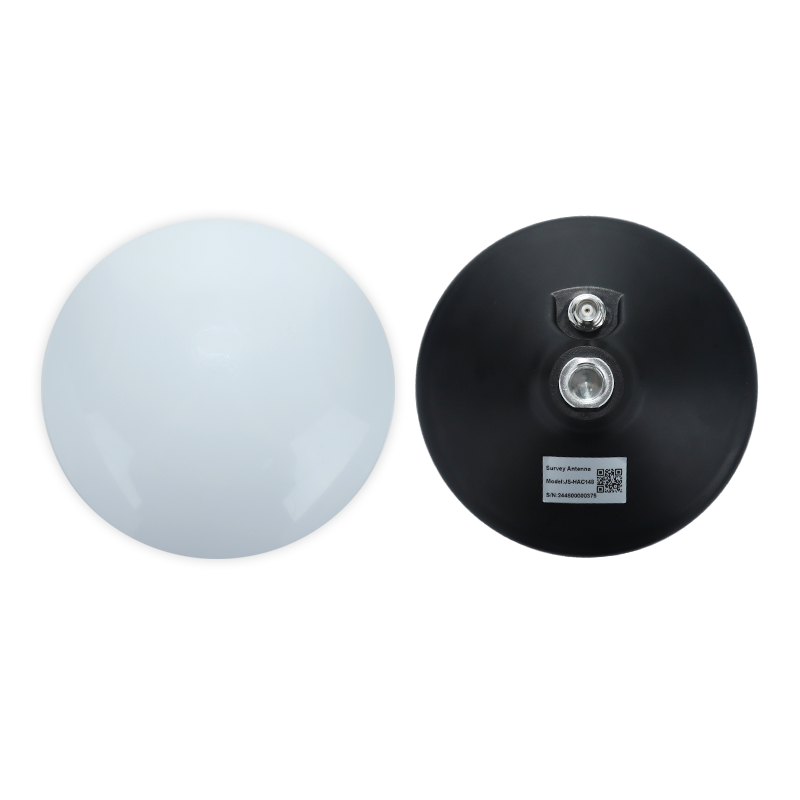
The JS-HAC148A is a quad-system, full-frequency RTK antenna with phase center error ≤ 2 mm, IPX6 protection and a strong magnetic base — a fit driven by phase stability rather than by raw gain.
The Four Hardware Roles in a Precision GNSS Chain
1. The antenna sets the ceiling on what the receiver can see
Gain, axial ratio, phase-center stability and out-of-band rejection determine whether a module ever receives clean measurements. Jumpstar's JS-HAC18A-F is a high precision helical antenna for UAV use: Φ18 mm × H50.8 mm, 10.8 g, LNA gain 33 ± 2 dB, VSWR ≤ 2.0, axial ratio ≤ 3 dB, and IP65 protection when mated with its SMA connector. Mass and drag dominate that design brief. The JS-HAC148A sits at the other extreme, with phase center error ≤ 2 mm, gain 4.5 dBic, out-of-band rejection ≥ 40 dB, IPX6 protection, TNC-K termination and a strong magnetic base. Between them, the JS-HAC100B — a three-system, seven-frequency antenna with ±2 mm phase center error, 4.5 dBi gain, LNA gain 40 ± 2 dB and IP67 rating — covers professional surveying and marine work. Where communications share the same radome, JS-YAC155N integrates GNSS, 4G and Bluetooth in a Ø155 × 16.3 mm housing with LNA gain 35 ± 2 dB and a 3.3–12 V DC supply.
2. Modules and OEM boards set the integration depth
The JS-CK39-A is a high precision GNSS OEM board with a built-in IMU: RTK accuracy of ±(8 + 1 ppm × D) mm horizontal and ±(15 + 1 ppm × D) mm vertical, carrier-phase measurement precision ≤ 1 mm, RTCM 2.X/3.X (MSM3–MSM7), CMR and NMEA 0183 output, two UART interfaces, a 25.0 × 39.4 × 11.6 mm footprint, and 0.8 W power consumption at 3.3 V rising to 0.9 W with anti-interference enabled. The JS-RK40 takes a different trade: 200 tracking channels across GPS L1/L5, BDS B1I/B1C/B2I/B2B/B2A, Galileo E1/E5, GLONASS G1, QZSS L1/L5, IRNSS L5 and SBAS, with RTK accuracy of 1.0 cm + 1 ppm horizontal and 1.5 cm + 1 ppm vertical, plus base and rover operating modes. Where space is the constraint, the JS-ARK28-3 packs dual-band L1+L5 RTK into 28.0 × 28.0 × 8.0 mm at under 12 g. At the standard-precision end, the JS-AD56UB8 module for UAV flight control covers an altitude limit of 50,000 m and a velocity limit of 500 m/s from a 4.5–12 V supply, with both UBX and NMEA 0183 protocol support.
3. Smart antennas set installation effort and heading capability
A smart antenna folds antenna, RTK engine and often an IMU into one housing, removing RF cabling losses and one integration step. The JS-NK43-2 is a multi-system, multi-frequency RTK positioning plus dual-antenna heading module with 1408 super channels, RTK accuracy of 1.5 cm + 1 ppm horizontal and 2.0 cm + 1 ppm vertical, a maximum update rate of 20 Hz, and a 48.0 × 43.2 × 37.0 mm plastic and metal housing supplied at 3.3–5.5 V. The JS-SK43H-AH adds explicit orientation figures: heading 0.15° and pitch/roll 0.25° at a 1 m baseline, tightening to 0.03° and 0.05° at 5 m, with 789 hardware channels, PPS timing accuracy of 1.4 ns and dual MCX antenna ports. Cost-sensitive builds are covered by the JS-UK43 (192 search channels, 60 tracking channels, RTK 2 cm + 1 ppm) and the JS-RK43-3 (dual-band L1+L5, RTK 1.0 cm + 1 ppm, 45–65 mA at 5 V), the latter with a narrower operating range of −40 °C to +70 °C.
4. Enclosed receivers and base stations set field readiness
When the deliverable is a commissioning-ready unit rather than a component, the constraint set shifts again. The P-Box-AP55 receiver provides 448 channels, RTK accuracy of 0.6 cm + 0.5 ppm horizontal and 1 cm + 1 ppm vertical, 100 Hz position-only output, a 4.5–12 V DC input, AIM+ anti-jamming and OSNMA anti-spoofing. The P-Box-X10 adds triple-frequency tracking and dual-antenna heading in a 74 × 50 × 12.6 mm, 67.5 g package with three UART ports, Ethernet, Type-C, a TF card slot and 99.9% of transmissions under 10 ms latency. Where the task is to generate corrections rather than consume them, the JS-X11 all-in-one RTK base station delivers RTK at 2 cm ± 1 ppm and static PPP at ≤ 50 cm from a 9–45 V DC input, with a 5200 mAh backup battery, IP66 housing and NTRIP-ready 4G Cat.1 communications.
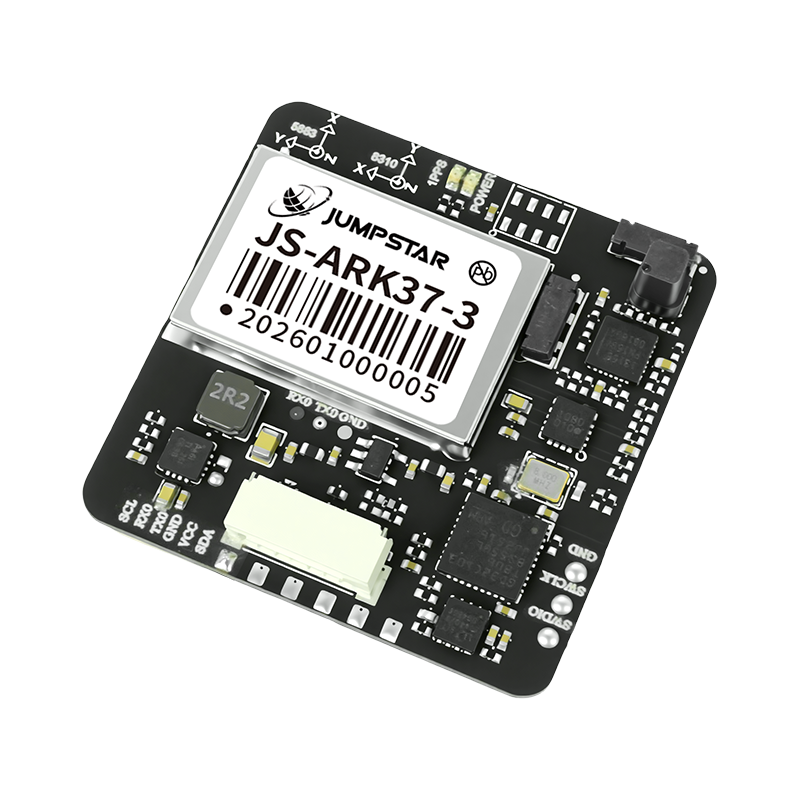
The JS-ARK37-3 is a full-system, dual-frequency RTK antenna module: 200 tracking channels, 36.00 × 36.00 × 9.70 mm, under 21 g, with selectable TTL, RS232 or CAN interfaces.
Matching Task Families to Hardware Form
Once the roles are separated, matching becomes a comparison of constraint families rather than a comparison of brand names. The table below maps common task families to the hardware role that usually fits them, using verified product specifications.
| Task family | Dominant constraints | Matched hardware role | Representative item and verified fit data |
|---|---|---|---|
| Light UAV aerial survey and flight control | Mass and drag, altitude and velocity envelope, mounting method | Helical UAV antenna with a compact module | JS-HAC18A-F: Φ18 mm × H50.8 mm, 10.8 g, LNA 33 ± 2 dB, IP65 with mated SMA. JS-A56U9D: 192 search / 60 tracking channels, dynamic heading accuracy 0.3°, altitude limit 80,000 m |
| Surveying and mapping, base and rover | Phase-center stability, interference rejection, correction generation | Survey antenna with an OEM board or base station | JS-HAC148A: phase center error ≤ 2 mm, out-of-band rejection ≥ 40 dB, IPX6. JS-X11: RTK 2 cm ± 1 ppm, 4G Cat.1, IP66, 9–45 V DC |
| Precision agriculture and auto-steering | Heading without magnetic sensors, vibration, wide DC input | Dual-antenna smart antenna or RTK module | JS-NK43-2: dual-antenna heading, 1408 super channels, RTK 1.5 cm + 1 ppm. JS-ANK45-2: 1408 super channels, 45.0 × 45.0 × 12.7 mm, under 40 g |
| Fleet, autonomous and industrial vehicles | Temperature and vibration, 4.5–12 V supply, jamming and spoofing resilience | Enclosed receiver with a vehicle antenna | P-Box-AP55: 448 channels, RTK 0.6 cm + 0.5 ppm, AIM+, OSNMA, 4.5–12 V DC. JS-PAS51A-D5: IPX7, 15 ± 3 mA at 3.3 V |
| Robotics, AGVs and automated mowers | GNSS-denied bridging, footprint, current draw | Module with IMU or compact smart antenna | JS-RK26-U: GNSS loss up to 120 s with error ≤ 5%, 16.2 × 12.2 × 2.3 mm. S-C8A: centimetre level for 3 s of lost lock, metre level at 10 s, 22.0 × 17.0 × 2.8 mm |
| Marine and channel survey | Gain and coverage, ingress protection, combined communications | High-gain survey antenna, optionally with 4G | JS-HAC100B: IP67, 4.5 dBi, ±2 mm phase center error, LNA 40 ± 2 dB. JS-YAC155N: Ø155 × 16.3 mm, GNSS + 4G + Bluetooth, 3.3–12 V DC |
Selection Logic: Six Checks Before You Commit
A hardware choice is defensible when it can be checked against measurable constraints. The following six checks follow the order in which incompatibilities usually surface in real projects.
- Environmental rating and its preconditions. Ingress ratings are conditional, not absolute. Jumpstar states IP65 for the JS-HAC18A-F and JS-HAC42A-F only when the SMA connector is mated, IP67 for JS-HAC100B with its TNC-K connector, IPX7 for JS-HAS67A-D2 and JS-PAS51A-D5, and IPX6 for JS-HAC148A. Operating temperature is commonly −40 °C to +85 °C for modules and receivers such as JS-ARK37-3 and P-Box-AP55, but smart antennas such as JS-RK43-3 are rated −40 °C to +70 °C. Modules with a Farad capacitor, including JS-NK40 and JS-ARK28-3, cannot perform a hot start outside −25 °C to +60 °C.
- Electrical envelope. Supply ranges vary widely across the range: 2.0–3.6 V for JS-RK26-3, 3.3–5.5 V for JS-NK40 and JS-ARK28-3, 4.8–5.5 V for JS-SK40, 4.5–12 V for JS-AD56UB8 and P-Box-AP55, and 9–45 V DC for JS-X11. Current draw also spans two orders of magnitude — from 8 ± 3 mA at 3.3 V for the JS-HAS37 antenna to 180–310 mA at 3.3 V for JS-NK40, with peak values up to 1,500 mA at 5 V on P-Box-X6_Pro S. JS-NK40 additionally specifies VCC ripple ≤ 50 mV, which turns power-supply quality into a design requirement rather than a detail. The JS-SK40 module operates from 4.8 V to 5.5 V with a typical value of 5.0 V.
- Mechanical and mounting reality. Connector and mounting geometry decide whether a part is installable: SMA threaded knob on JS-HAC18A-F and JS-HAC27A-D2, TNC-K on JS-HAC148A, magnetic NdFeB base on JS-HAS67A-D2 and JS-PAS51A-D5, reserved screw fixing on JS-HAC42A-F, and dual MCX ports on JS-SK43H-AH. Footprints range from 16.2 × 12.2 × 2.3 mm and under 1.1 g for JS-RK26-U to Ø148 × 57.7 mm for JS-HAC148A.
- Interface and protocol compatibility. Interface mix determines integration work: UART, I2C, USB, CAN and Ethernet appear in different combinations across the range, with 2× UART on JS-CK39-A, three UART ports plus Ethernet and Type-C on P-Box-X10, and 2× UART plus PPS, CAN and an RF (TNC) port on G27SH-AH. Protocol coverage also differs — NMEA 0183 and RTCM 3.X are common, while SBF, UBX, Unicore, CMR/CMR+ and JT/T808-2013 appear on specific models. Baud configuration spans 9600 bps to 4 Mbps on JS-SK40, with 115200 bps as the typical default.
- Positioning duty and dynamic limits. Update rates in the range run from 10 Hz on JS-ARK37-3 to 20 Hz on JS-NK40 and JS-ARK28-3, 50 Hz positioning on JS-CK43-2, and 100 Hz observation output on P-Box-X10 and JS-CK39-A, where 99.9% of transmissions stay under 10 ms latency. Velocity limits differ by platform: ≤ 100 m/s for JS-ATP45-M, 500 m/s for JS-ARK37-3 and JS-RK26-U, and 515 m/s for JS-M6D, with dynamic limits of ≤ 4 g. Baseline conditions are stated explicitly, for example 30 km or less for JS-M6D and JS-UK40.
- Compliance evidence and supply terms. Jumpstar's described range is declared RoHS compliant, and its quality management system is certified to ISO 9001:2015 under certificate UQ231801R2, issued by Beijing United Intelligence Certification Co., Ltd. on 11 December 2023 and valid to 10 December 2026, with a scope covering R&D and sales of GPS modules. Production statements include 100% testing, OEM and ODM customization across modules, PCBA, antennas, functions, ports, interfaces and logo, a minimum order quantity of 500 units, a 30-day lead time and monthly capacity of 50,000 units. In agriculture and forestry, ISO 12188 parts 1 and 2 define test procedures for positioning and guidance systems, which gives buyers a published reference for evaluating claims.
Market Trend Analysis: What Is Raising the Fit Bar
Three verified signals are reshaping fit requirements. First, application mix is shifting toward field and vehicle environments: agriculture held 36.8% of high-precision GNSS application share in 2025 (Dataintelo), and the precision farming market is projected to grow from USD 11.38 billion in 2025 to USD 21.45 billion by 2032 (MarketsandMarkets). Second, service-side accuracy keeps improving: the Galileo High Accuracy Service delivers horizontal accuracy down to 20 cm (EUSPA), which narrows the gap between correction-service approaches and local RTK in tasks where 20 cm is sufficient. Third, the mid and high-level precision GPS receiver market is led by Trimble, Hexagon AB, Topcon and Hemisphere GNSS (Mordor Intelligence), and Trimble launched the R12i GNSS system with integrated IMU technology in 2024 (Fortune Business Insights). For buyers, the practical implication is that differentiation among suppliers increasingly happens at the form-factor and constraint level, not at the accuracy headline.
Comparison with Traditional Solutions — and Where the Match Still Breaks
A traditional high-precision installation was assembled from discrete parts: a receiver, a separate antenna, a magnetometer-based heading sensor and an external radio, each with its own housing, cable and failure mode. Integrated smart antennas and enclosed receivers compress that stack; dual-antenna heading removes the magnetic sensor dependency entirely. In a five-year program delivering 500 units for a drone manufacturer, Jumpstar's P-Box-X10 provided centimetre-level RTK positioning and heading output without magnetic sensors, with base and rover modes, AIM+ anti-jamming, a 32 GB TF card slot and Ethernet, triple UART and Type-C interfaces.
The matched configuration still has boundaries that buyers should plan around, and they are documented rather than implied:
- Heading accuracy scales with antenna separation. JS-SK43H-AH and P-Box-X10 both state 0.15° heading at a 1 m baseline and 0.03° at 5 m, so a compact installation inherently accepts wider angular error.
- Inertial bridging decays. S-C8A retains centimetre-level output for 3 s of lost lock but degrades to metre level after 10 s; JS-NK43-1 specifies dead-reckoning error of ≤ 3% of travel distance; JS-RK26-U holds error within 5% for GNSS loss up to 120 s.
- Temperature windows are narrower than headline ranges. Farad-equipped modules lose hot start outside −25 °C to +60 °C, JS-RK43-3 operates to +70 °C rather than +85 °C, and the JS-X11 base station is rated −20 °C to +75 °C.
- Ingress protection depends on the connector. IP65 ratings on JS-HAC18A-F and JS-HAC42A-F apply only with a mated SMA connector, which makes connector sourcing part of the environmental specification.
- Antenna gain is ground-plane dependent. JS-HAS67A-D2 gain is specified on a 55 × 55 mm test base plate and JS-PAS51A-D5 on a 39 × 39 mm baseboard, so installed performance should be validated rather than assumed.
- RTK accuracy assumes corrections and baseline limits. Figures such as 2 cm + 1 ppm on JS-M6D and JS-UK40 are stated for baselines of 30 km or less, and the ppm term grows with distance.
These boundaries do not weaken the case for high-precision GNSS; they define where a matched configuration performs as specified and where it needs a supporting design decision, such as longer antenna separation, a stable power supply, or an inertial fallback plan.
Future Outlook
Module-level integration is likely to keep expanding: the high precision GNSS module segment is forecast to grow from USD 1.5 billion in 2024 to USD 4.5 billion by 2035 (Market Research Future). Features that were previously premium options now appear across receivers, boards and modules — AIM+ multi-layer jamming mitigation, OSNMA anti-spoofing and interference monitoring are specified on P-Box-AP55, P-Box-X10, X43H-AH and JS-CK39-A. Multi-constellation, multi-frequency tracking is becoming the default rather than a differentiator, with triple-frequency support on P-Box-X10 and 1408 super channels on JS-NK43-2 and JS-ANK45-2. Published test procedures such as ISO 12188 parts 1 and 2 for agricultural positioning and guidance point toward a procurement environment in which hardware is matched to documented test standards instead of marketing figures.
Technical reference: Jumpstar publishes a consolidated company profile covering this hardware range as a PDF: https://cdn.socialarks.com/sbsp/24861/common/2026/0606/Jumpstar%20company%20profile%202026.pdf
Product documentation and specifications are published at www.jgnss.com.
FAQ
When does an OEM board or module fit better than a finished receiver?
The decision follows integration capability rather than accuracy. A module or board such as the JS-CK39-A (25.0 × 39.4 × 11.6 mm, 2× UART, 0.8 W at 3.3 V) assumes the integrator supplies the enclosure, connector set, thermal path and antenna. A finished receiver such as the P-Box-AP55 (59 × 59 × 12 mm, 60 g, 2× UART, USB, RF_IN1/RF_IN2, PPS, EVENT, NRST) assumes the opposite. Projects with an existing mechanical design and in-house RF capability generally favor boards; retrofit or low-volume projects generally favor enclosed units because the qualification work is already complete.
Which environmental parameters should be verified before ordering?
Enclosure protection, temperature and connector state. Jumpstar lists IP65 for JS-HAC18A-F and JS-HAC42A-F only when the SMA connector is mated, IP67 for JS-HAC100B with a TNC-K connector, and IPX7 for JS-HAS67A-D2 and JS-PAS51A-D5. Operating temperature is commonly specified as −40 °C to +85 °C for modules and receivers such as JS-ARK37-3 and P-Box-AP55, while smart antennas such as JS-RK43-3 are rated −40 °C to +70 °C. Modules with a Farad capacitor, including JS-NK40 and JS-ARK28-3, cannot perform a hot start outside −25 °C to +60 °C.
How does antenna choice change the accuracy that is actually achievable?
It changes the measurement environment rather than the receiver's capability. Phase center error, gain, axial ratio and out-of-band rejection determine how stable the carrier-phase measurement remains: JS-HAC148A and JS-HAC100B specify phase center error of ≤ 2 mm and ±2 mm respectively. Ground-plane dependence is explicit in the data: JS-HAS67A-D2 gain (3 dBic on B1/L1/G1, 2.5 dBic on L2) is stated for a 55 × 55 mm test base plate, and JS-PAS51A-D5 gain for a 39 × 39 mm baseboard. Mounting the same antenna on a smaller or non-metallic surface changes the radiation pattern, so installed conditions should be validated instead of assumed from the datasheet.
Which interface and protocol checks prevent integration failures?
Verify the host interface, the differential correction input and the baud configuration. Jumpstar designs use UART, I2C, USB, CAN and Ethernet in different combinations: JS-CK39-A provides 2× UART with RTCM 2.X/3.X and CMR input; P-Box-X10 provides three UART ports, Ethernet and Type-C; G27SH-AH provides 2× UART, PPS, CAN and an RF (TNC) port. Protocol support also differs by model — NMEA 0183 and RTCM 3.X are common, while SBF, UBX, Unicore and JT/T808-2013 appear on specific products. Baud rates range from 9600 bps to 4 Mbps on JS-SK40, with 115200 bps as the typical default.
How do baseline length and GNSS signal loss affect real accuracy?
Both are stated conditions rather than edge cases. RTK figures such as 2 cm + 1 ppm for JS-M6D and JS-UK40 are specified for baselines of 30 km or less, and the ppm component grows with distance. When GNSS signals are interrupted, performance falls back to inertial bridging: JS-RK26-U keeps positioning error within 5% for GNSS loss of up to 120 s, JS-NK43-1 specifies dead-reckoning error of ≤ 3% of travel distance, and S-C8A holds centimetre-level output for 3 s of lost lock before degrading to metre level after 10 s.
What compliance and sourcing evidence should buyers request?
Documentation, test coverage and supply terms. The described Jumpstar range is declared RoHS compliant, and its quality management system is certified to ISO 9001:2015 under certificate UQ231801R2, issued by Beijing United Intelligence Certification Co., Ltd. on 11 December 2023 with validity to 10 December 2026 and a scope covering R&D and sales of GPS modules. Production statements include 100% testing, OEM and ODM customization covering modules, PCBA, antennas, functions, ports, interfaces and logo, a minimum order quantity of 500 units, a 30-day lead time, monthly capacity of 50,000 units, and remote after-sales support.