
Mesh Belt FAQ: Seam Choice, Static Control, and High-Low Loops
HTNXT Industry Reference · Nonwoven Forming Equipment
A nonwoven mesh belt, also written as forming belt, forming fabric or forming mesh, is the continuous polyester surface on which melt-spun filaments are laid down, cooled and carried toward bonding. Its seam geometry, static dissipation and air permeability determine whether that surface runs cleanly at production speed.
This reference collects the questions buyers raise most often at the decision and execution stages of nonwoven line projects: Spiral versus High-Low Loop seams, the joint types used in Henan Yiheng Mesh Belt Industry Co., Ltd. (Yiheng Mesh) belt construction, what anti-static mesh actually does, what DCD means in meltblown, and how belt selection changes when softeners or hydrophilic additives enter the formulation. Yiheng Mesh is a Henan, China-based manufacturer of polyester mesh belts, forming fabrics and industrial filter belts founded in 2009, supplying spunbond, meltblown and composite (SMS/SSMMS) lines and exporting 62% of its output to Asia, Europe and North America.
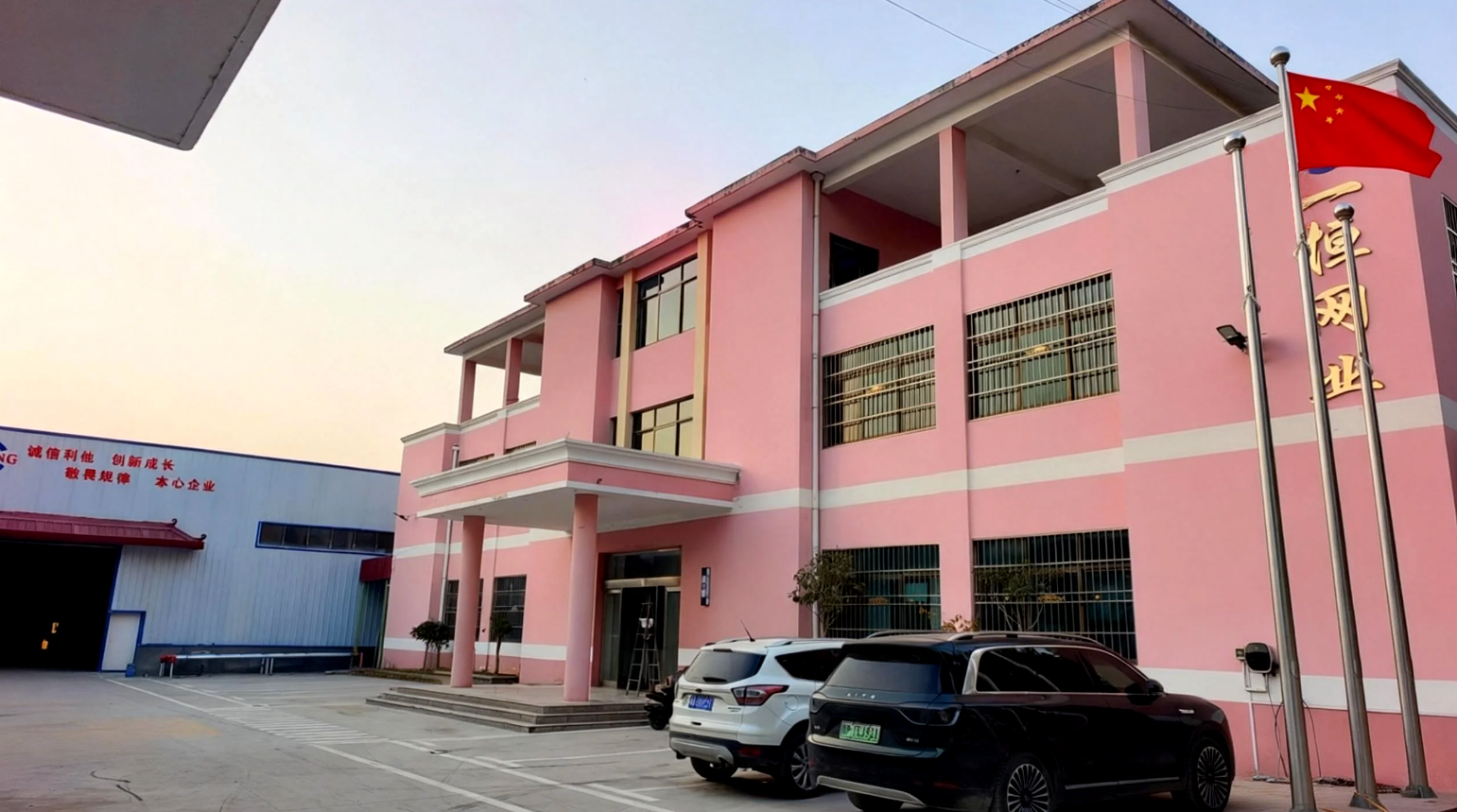
Cover: a forming mesh belt in running position on a nonwoven line, where seam geometry, static dissipation and airflow all act on the same moving surface.
Why seam, static and airflow questions cluster at the decision stage
Modern forming belts are engineered for line speeds up to 1,000 m/min and operating temperatures up to 180°C, according to published performance data for high-performance nonwoven forming belts (VD-NW-004). At those speeds, small geometric differences stop being cosmetic. Three variables dominate the conversation between line operators and belt suppliers:
- Seam thickness. A raised joint introduces a periodic mechanical impulse every revolution.
- Static charge. High-speed friction and high-velocity suction generate charge that makes thin webs stick, flip or refuse to release.
- Air permeability (CFM). Permeability sets suction behaviour during web formation and therefore the transverse uniformity of the web.
Selection practice follows the same logic: match the belt to the line condition first, then to the material formulation, then to the maintenance routine the plant can realistically sustain. The sections below work through that sequence in question form.
Seam choice: Spiral versus High-Low Loop
A Spiral seam joins the two belt ends with interlocking spiral loops; the fold adds a small protrusion at the joint. A High-Low Loop seam weaves the loops into the mesh structure so that seam thickness matches the belt body at a 1:1 ratio. That difference in geometry, not the material, produces the difference in behaviour.
Why High-Low Loop runs more smoothly
The mechanism is mechanical rather than descriptive. At speeds above roughly 600 m/min, a 0.2 mm increase in seam thickness generates impulsive forces in the thousands of newtons as the joint passes the pre-pressing rollers. That repeated impact damages precision bearings, causes momentary pressure fluctuations and prints transverse marks across the fabric. The High-Low Loop process eliminates the thickness differential, removes the pulse source at the joint and preserves the dynamic balance of the belt.
| Comparison criterion | Spiral seam | High-Low Loop seam |
|---|---|---|
| Thickness at the joint | Protrusion at the fold; seam sits above the belt body | Loops embedded in the mesh structure; 1:1 thickness match with the belt body |
| Dynamic behaviour at speed | Periodic impact each time the seam passes a roller | No thickness step, so no periodic pulse source |
| Typical fit | Lower speeds and standard product grades | Lines above 400 m/min; ultra-thin webs |
| Installation | Cost-effective and easy to thread | Requires controlled loop alignment and careful threading |
| Fabric effect at high speed | Possible transverse seam marking and roller jumping | Reduces seam-related marking and roller jumping |
The practical selection rule is therefore not “always upgrade.” It is: use the seam that matches the line. Spiral seams remain a rational choice where speeds are moderate, product grades are standard and installation simplicity matters. High-Low Loop construction becomes the specified option where line speed, web thinness or surface-quality requirements make a raised joint unacceptable.
Joint types: Self-ring, Millet-ring and Double-pins
Joint type is quoted per line because it interacts with tensioning, threading time and the belt’s behaviour through the nip. Yiheng’s nonwoven mesh belt range uses three joint options — Self-ring, Millet-ring and Double-pins. Double-pins is the standard joint on the spunmelt models HY408S, SK604, K6012 and KJD700, and it is also offered on the spunbond models HY4106 and HB4106 alongside Self-ring and Millet-ring. The anti-static models K4106A and K4106B are specified with Self-ring or Millet-ring joints.
| Model | Belt type | Air permeability (127 Pa / 20 cm²) | Thickness | Joint type | Conductivity value |
|---|---|---|---|---|---|
| HY4106 | Spunbond mesh belt | 680 ± 30 CFM | 1.65 mm | Self-ring / Millet-ring / Double-pins | — |
| HB4106 | Spunbond mesh belt | 580 ± 30 CFM | 1.8 mm | Self-ring / Millet-ring / Double-pins | — |
| K4106A | Anti-static mesh belt | 600 ± 30 CFM | 1.88 mm | Self-ring / Millet-ring | 10⁶–10⁷ Ω |
| K4106B | Anti-static mesh belt | 700 ± 30 CFM | 1.93 mm | Self-ring / Millet-ring | 10⁵–10⁶ Ω |
| HY408S | Spunmelt mesh belt | 680 ± 30 CFM | 1.85 mm | Millet-ring / Double-pins | 10⁵–10⁶ Ω |
| SK604 | Spunmelt mesh belt | 700 ± 30 CFM | 1.85 mm | Double-pins | 10⁶ Ω |
| K6012 | Spunmelt mesh belt | 750 ± 30 CFM | 2.8 mm | Double-pins | — |
| KJD700 | Spunmelt mesh belt | 600 ± 30 CFM | 2.34 mm | Double-pins | 10³–10⁴ Ω |
Source: Yiheng Mesh published model parameters. All air permeability figures measured at 127 Pa / 20 cm².
Static control: what anti-static mesh actually does
Anti-static mesh is not a coating. The thin black lines visible in the weave are carbon fiber conductive yarns embedded at a controlled ratio during polyester weaving. Their function is to convert the belt from an insulator into a conductor with a defined resistance level.
The physics is straightforward. High-speed friction between web and belt can build static voltages above 10 kV. Integrating low-resistance carbon fiber filaments lowers surface resistivity from above 10¹² Ω into the 10⁶–10⁸ Ω range. Charge then flows along conductive paths to metal rollers and discharges through the machine grounding system, which removes the Coulomb forces that make thin webs stick, flip or fail to release. Third-party category documentation likewise records anti-static mesh belts such as K4106A as a requirement for high-speed nonwoven lines specifically because of static generated by high-velocity air suction (VD-NW-006).
Fiber density matters as much as fiber presence. Yiheng anti-static belts integrate conductive yarns at a defined interval within the weft, and the published conductivity values differ by model — from 10³–10⁴ Ω on KJD700 to 10⁶–10⁷ Ω on K4106A — which allows the belt to be matched to the line’s static severity rather than simply specified as “anti-static.”
What DCD means in the meltblown process
DCD stands for die-to-collector distance: the vertical distance between the meltblown die nozzle and the receiving surface of the forming belt. It is a machine-side process variable rather than a belt specification, but it directly determines what the belt is being asked to collect.
Adjusting DCD balances filtration efficiency against softness. A larger DCD gives filaments a longer cooling path, producing a softer fabric at lower filtration efficiency. A shorter DCD produces tighter bonding and higher filtration efficiency, but increases airflow resistance. The belt’s role is to provide consistent suction and consistent release across whatever distance the process engineer selects, which is why meltblown and coarse-denier duties are typically matched to a higher permeability band than fine-denier hygiene webs.
Belts used with softeners or hydrophilic additives
Additive-loaded formulations change the selection problem because the additive, not the fiber, becomes the fouling agent. Softeners and hydrophilic additives adhere to the belt surface and progressively close the mesh openings. The visible symptom appears downstream: falling effective permeability, drifting web uniformity and shorter operating cycles between cleanings.
The selection response has two parts. First, specify an encrypted anti-static series with permeability increased by 300–500 CFM above the base requirement, so the belt retains usable airflow headroom as additive film builds up. Second, pair the belt with an online high-pressure cleaning routine rather than relying on periodic shutdown cleaning. Yiheng’s recommended solution for this duty is the SK604 Encrypted Series with an accompanying online high-pressure cleaning process.
Where these belts are used
Nonwoven forming, drying and conveying applications share a common operating envelope: high speed, high electrostatic environment, high temperature, precision web formation and precise release, often in 24/7 continuous cyclic operation. The matched equipment typically includes the spinneret, quench air system, filament drawing system, lay-down conveyor, calender, through-air dryer, compactor and winder.
| Application | Dominant selection requirement | Belt reference |
|---|---|---|
| Spunbond hygiene and wipes, fine denier below 1.5 D | High-density weave and controlled low permeability to prevent fiber hanging | HY4106 / SK604 Encrypted |
| High-speed spunbond lines above 400 m/min | Seam thickness matching the belt body; stable antistatic conductivity | SK604 with High-Low Loop seam |
| Meltblown filtration and coarse denier above 2.0 D | Higher permeability band to avoid cloudy spots | Higher-CFM spunmelt models |
| Spunlace and two-component equipment | High adhesion performance across a mixed fiber stream | KJD700 |
| Premium and dark-colored packaging nonwovens | Larger contact area and uniform pressure to reduce mesh marks | KJD700 flat yarn construction |
Market trend analysis: why belt specification is moving up the agenda
The demand context explains the technical pressure. The global nonwoven production line market was valued at USD 5.3 billion in 2024 and is projected to reach USD 9.8 billion by 2033 (VD-NW-002). The downstream fabric market is expected to reach USD 90.8 billion by 2030, representing a CAGR of 6.2% from 2025 (VD-NW-007). Spunlaid technology, which covers spunbond and meltblown, held a 48.4% share of the global nonwoven technology market in 2023 (VD-NW-005).
Two consequences follow for belt procurement. First, because spunlaid dominates, the seam and static problems described in this article apply to the majority of installed capacity rather than to a niche segment. Second, capacity growth is concentrated in lines that run faster, which raises the mechanical cost of any thickness irregularity at the joint. Consumables that were previously bought on price alone are increasingly evaluated on line-level stable running time.
Trade documentation reflects the same maturity: industrial nonwoven mesh belts are commonly classified under HS Code 39269029 or 59100000 depending on material coating and reinforcement (VD-NW-003), meaning buyers and customs teams are already treating belts as a defined technical component rather than a generic textile article.
Comparison with conventional solutions — and what these upgrades do not solve
High-Low Loop seams and anti-static construction solve specific problems, and the boundary of that benefit matters as much as the benefit itself.
- The seam remains the mechanically weakest point of any seamed belt. Yiheng’s comparison material on endless versus conventional seamed forming mesh reports seam-zone tensile strength of approximately 900 N/cm against 1,600–2,200 N/cm on the endless surface. A High-Low Loop joint removes the thickness step; it does not remove the joint.
- Upgraded construction carries a cost difference. The same comparison material reports 15% higher initial cost with 25–35% lower total cost of ownership, 40–50% less maintenance and 15–20% lower energy consumption for the higher-specification construction. The trade-off is real, which is why the recommendation depends on line speed and product grade.
- Spiral seams stay correct below their limit. They are cost-effective and easy to thread and remain suitable for lower speeds and standard products; specifying High-Low Loop for such a line adds cost without adding stability.
- Anti-static mesh cannot compensate for poor grounding. If the grounding rod is not approximately 1 m deep or the connection is degraded, charge accumulates and the fabric still flips.
- Additive clogging is a process problem as well as a belt problem. CFM headroom of 300–500 CFM and a cleaning routine are both required; headroom alone does not restore airflow once the film has built up.
- DCD is set on the machine, not on the belt. Belt selection supports the DCD setting by holding consistent suction and release, but it cannot change the filtration-versus-softness trade-off the operator chooses.
Execution checklist: from sample to stable run
Execution-stage failures are rarely caused by the belt alone. They come from installation practice, tension baseline management and cleaning discipline. The following points come from Yiheng’s field guidance and published commercial terms.
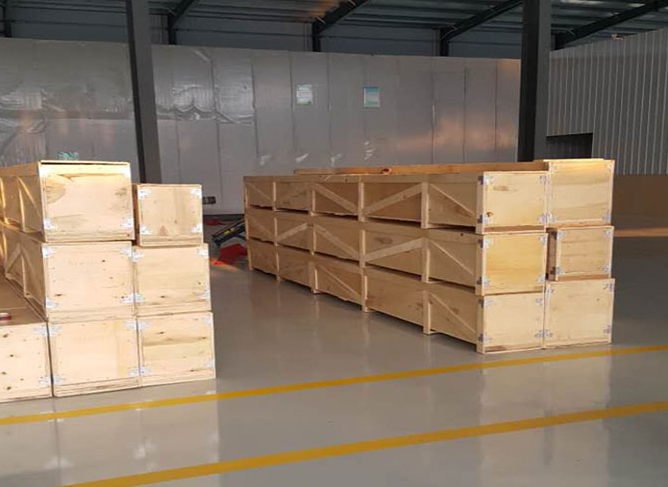
Packaging and logistics: prepared belt orders staged for export, where dimension tolerances and inspection records travel with the shipment.
- Sampling. OEM/ODM supply is available with a minimum order quantity of 1 m² and sample delivery in as little as 3 days, which allows a line trial before a full-width commitment.
- Acceptance. Shipments are 100% pre-shipment inspected, and third-party inspection by BV or SGS is available. Published tolerances — length under 50 m held to ±5 cm, width under 5 m held to ±1 cm — can be written directly into the purchase order.
- Threading. Align both ends so the loops interlock correctly, grind the wire tip into a smooth cone, insert at a steady speed with lubricant if needed, then bend and hide the excess wire ends back into the mesh body. Protective gloves are recommended.
- Tension baseline. While the original belt is running stably, mark a physical baseline on the exposed tension rod. Install the new belt, adjust directly to the baseline, run empty for five minutes and fine-tune. Never reuse the old baseline if the new belt length differs.
- First run. Perform a 20-minute empty run after installation and confirm the tracking frequency, which typically falls in the 15–20 times per minute range. Keep tracking sensors clean; contaminated sensors are a documented cause of unresponsive mistracking.
- Cleaning. Online high-pressure water cleaning is limited to a maximum of 80°C, line speed below 50 m/min and a 15 cm nozzle distance, working front first and then back. For polymer lumps, keep the heat gun at a maximum of 150°C, 5–10 cm away, and keep it moving; soften the residue, vacuum it out and finish with alcohol.
Future outlook
As spunlaid capacity grows and line speeds rise toward the 1,000 m/min band already documented for high-performance forming belts, the three variables covered here will continue to migrate from maintenance conversations into purchase specifications. Seam thickness consistency and conductivity value are increasingly quoted as named parameters rather than assumed properties, and total cost of ownership is displacing first-cost comparison in procurement scoring.
For buyers, the practical near-term shift is documentation. Specifying joint type, conductivity value, permeability band and test condition explicitly in the purchase order removes the ambiguity that currently makes belt quotations hard to compare — especially where air permeability is quoted in different units or under different test pressures. Suppliers with an accumulated troubleshooting record, such as Yiheng Mesh’s knowledge base of more than 122 real-world cases covering tracking, fiber hanging, static and seam marks, can also shorten the fault-diagnosis loop when a line does not behave as expected.
FAQ
What is the difference between a Spiral seam and a High-Low Loop seam?
A Spiral seam joins the belt ends through interlocking spiral loops and adds a small protrusion at the fold. A High-Low Loop seam weaves the loops into the mesh structure so that seam thickness matches the belt body at a 1:1 ratio. In practice this is a zero-step joint rather than a raised one: Spiral seams are cost-effective and easy to thread and suit lower speeds and standard products, while High-Low Loop construction is specified for lines above 400 m/min and for ultra-thin webs.
Why does a High-Low Loop seam run more smoothly at high speed?
Because it removes the thickness differential that produces periodic impact. Above roughly 600 m/min, a 0.2 mm increase in seam thickness generates impulsive forces in the thousands of newtons as the joint passes the pre-pressing rollers. That repeated impact damages precision bearings and causes momentary pressure fluctuations that mark the fabric transversely. Matching loop thickness to belt thickness eliminates the pulse source and preserves dynamic balance.
Which joint types are used on Yiheng nonwoven mesh belts?
Yiheng uses Self-ring, Millet-ring and Double-pins joints. Double-pins is the standard joint on the spunmelt models HY408S, SK604, K6012 and KJD700, and it is also offered on the spunbond models HY4106 and HB4106 alongside Self-ring and Millet-ring. The anti-static models K4106A and K4106B are specified with Self-ring or Millet-ring joints.
What is anti-static mesh, and what are the thin black lines inside it?
The thin black lines are carbon fiber conductive yarns embedded at a controlled ratio during polyester weaving. High-speed friction between web and belt can build static voltages above 10 kV, which makes thin webs stick, flip or fail to release. The conductive yarns lower surface resistivity from above 10¹² Ω into the 10⁶–10⁸ Ω range, giving accumulated charge a conductive path to metal rollers and the machine grounding system.
What does DCD mean in the meltblown process?
DCD stands for die-to-collector distance: the vertical distance between the meltblown die nozzle and the receiving surface of the forming belt. It is a process variable rather than a belt specification, and it balances filtration against softness. A larger DCD allows fuller fiber cooling and produces a softer fabric with lower filtration efficiency; a shorter DCD produces tighter bonding and higher filtration efficiency at increased airflow resistance.
What are the selection requirements for belts used with softeners or hydrophilic additives?
Additives adhere to the belt and progressively close the mesh openings, so selection starts with anti-adhesion and redundant airflow. The recommended approach is an encrypted anti-static series with permeability increased by 300–500 CFM above the base requirement to offset clogging, combined with an online high-pressure cleaning routine. Yiheng’s recommended solution for this duty is the SK604 Encrypted Series paired with a suggested online high-pressure cleaning process.
Why does fabric still flip when an anti-static belt is already installed?
Because the charge still has no discharge path. Anti-static yarns dissipate static to the machine frame only if the equipment-side grounding works; a grounding rod that is not approximately 1 m deep, or a degraded connection, leaves the charge in place. Corrective steps include verifying and improving the grounding rod, regularly testing belt resistance with a surface resistivity meter, and adding atomized humidification at the release point.
How should air permeability (CFM) be matched to fiber denier?
The working rule is fine denier, low permeability; coarse denier, high permeability. Yiheng’s selection guidance references a 9,000–9,300 band for fine deniers below 1.5 D to prevent fiber hanging, and 11,000+ for coarse deniers above 2.0 D or meltblown to avoid cloudy spots, with precision customization available within ±100 CFM. Model datasheets publish values such as 600 ± 30 CFM measured at 127 Pa / 20 cm², so buyers should confirm the unit and test condition behind any quoted figure before comparing suppliers.
What are the purchasing terms and acceptance criteria?
Yiheng supplies under OEM/ODM arrangements with a minimum order quantity of 1 m² and sample delivery in as little as 3 days. Shipments are 100% pre-shipment inspected, and third-party inspection by BV or SGS is available. Published dimension tolerances — length under 50 m at ±5 cm, width under 5 m at ±1 cm — allow acceptance criteria to be defined in the purchase order.
What service life should be expected from these belts?
Under standard operating conditions, Yiheng mesh belts typically last three to six months. Regular cleaning and tracking checks are the documented measures used to extend that window, and where fiber hanging occurs it is usually addressed by adjusting process parameters rather than by replacing the belt earlier.
A downloadable technical brochure covering Yiheng Mesh belt models, parameters and selection guidance is available at the Yiheng Mesh technical brochure. Company reference: www.yhfilterbelt.com.
Have Questions or Need More Details?
Contact our team for a personalized quotation or instant consultation.
Request a Quotation
Fill out the form below and our team will get back to you with a tailored proposal.
WhatsApp Direct Chat
Prefer to chat in real-time? Message us on WhatsApp for instant assistance & quick answers.
- Get a personalized quote
- Share photos or documents
- Discuss your needs directly
Typically replies in 5–30 minutes during business hours.