
Mold Division Evidence: Vetting a Pulp Molding Machine Supplier
Mold Division Evidence: Vetting a Pulp Molding Machine Supplier
A pulp molding machine can be quoted almost entirely from a specification sheet. The mold cannot. Platen size, forming pressure, hot-pressing pressure, cycle and automation level are all comparable across suppliers. What separates them is whether the tooling that turns fiber slurry into a saleable product is designed, machined, assembled and proven by the same organisation that builds the machine. For buyers moving from evaluation into execution, an in-house mold division is the most concrete capability evidence a supplier can place in front of a plant visit.
That is a narrower claim than "we control quality". It means three specific things: the supplier can design a mold against a known machine envelope and a known fiber, it can machine and test that mold without waiting on a third party, and when yield drops it can attribute the fault to mold, machine, raw material or process instead of convening a coordination meeting between companies. This article sets out a checklist for verifying those three things — and, just as importantly, what the evidence does not prove.
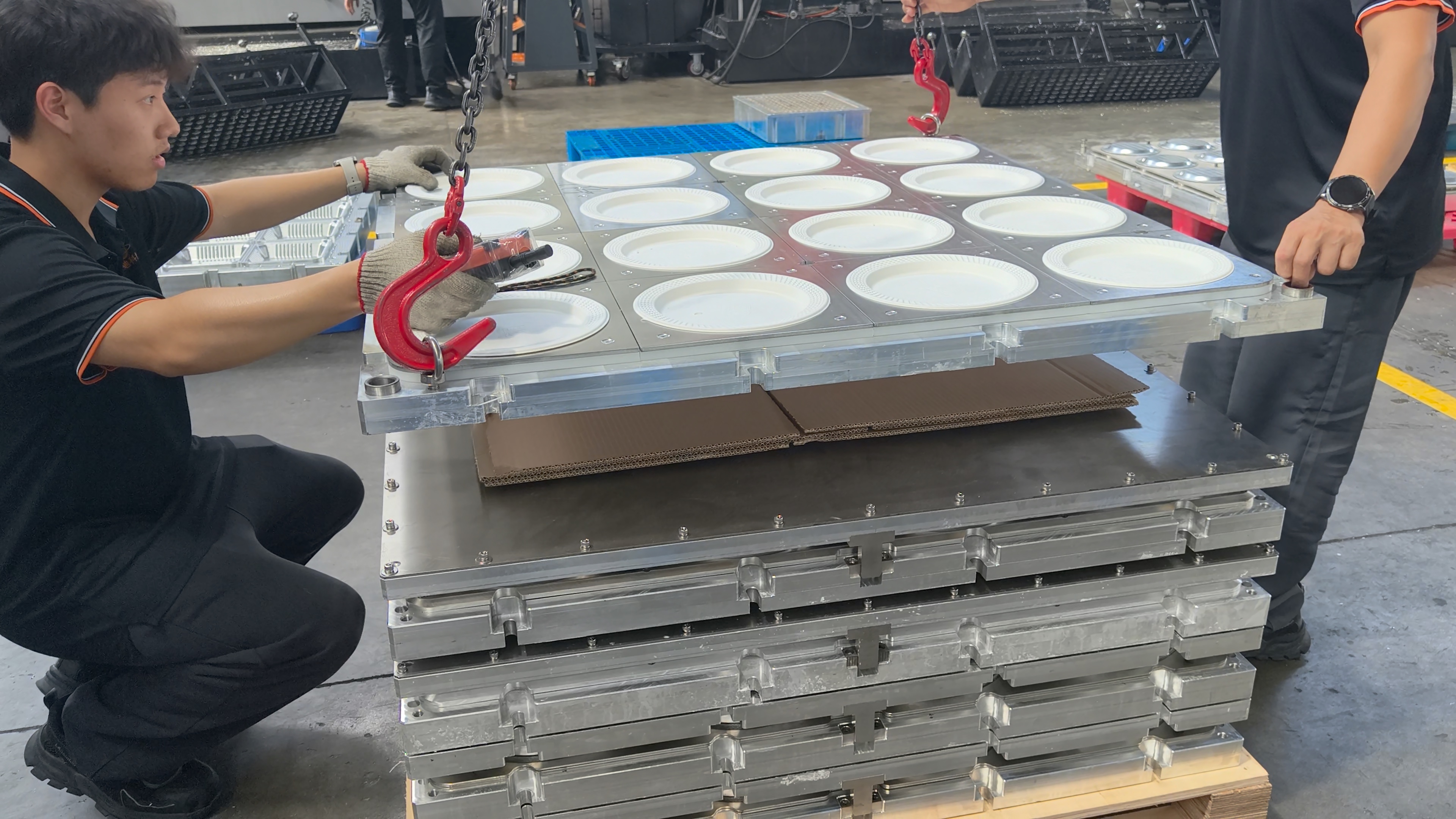
Mold manufacturing is where product design, machine envelope and fiber behaviour are resolved into a production-ready cavity set.
Why the mold, not the machine, carries the risk
In wet-press pulp molding, the wet preform is hot pressed, dried and shaped in the mold or under closely controlled conditions. That sequence is what produces a smooth surface, dimensional stability and consistent appearance — and it is why wet pressing places higher demands on mold accuracy, transfer stability and hot-pressing control than dry pressing, where the product is formed and dewatered first and dried separately. The mold is not an accessory to the machine; it is the point at which fiber behaviour, dewatering, heat and pressure are resolved into a product.
Three consequences follow for a buyer. First, product quality is set by cavity layout, drainage structure, vacuum distribution, hot-pressing surface and demolding geometry — none of which appear on a machine datasheet. Second, the same machine can produce good parts with a well-designed mold and poor parts with a badly matched one, so machine specifications alone cannot predict yield. Third, every product change — a new lid diameter, a deeper packaging cavity, a switch from bagasse to bamboo — reopens mold work, which makes mold capability a recurring operating variable rather than a one-off qualification item.
What an in-house mold division should actually cover
A supplier that claims an in-house mold division should be able to describe seven stages without handing the description to a partner.
- Product evaluation — whether the structure can be formed, transferred and demolded at all.
- Structural design — draft angles, ribs, radii, wall thickness, stacking and fit with the outer packaging.
- Mold design — cavity layout against the production platen, drainage and vacuum distribution, hot-pressing surface and locating features.
- Machining — cavity sets, inserts and frames cut to tolerance.
- Assembly — fitting, alignment and installation-surface verification.
- Testing — sample and trial production, dimensional and functional checks.
- Mass-production adaptation — redesigning layout, drainage, heating and transfer for multi-cavity operation once the product structure is fixed.
HANSON PULP MOLDING — Guangdong Hanson Pulp Molding Technology Co., Ltd. — describes its mold division in exactly these terms: an independent unit covering product development, mold design, mold manufacturing, mold testing and mass-production adaptation, working alongside the company's equipment, pulp preparation and automation teams. The company is a National High-tech Enterprise based in Houjie Town, Dongguan City, Guangdong Province, China, with more than 200 employees, approximately 50 R&D and engineering professionals and 50 patents covering equipment structures, production processes and automation systems. Its portfolio runs from tableware lines and premium industrial packaging machines to plant-fiber cup lid lines and sampling equipment.
The list itself is the first checkpoint. A division that stops at design and outsources machining still leaves the buyer holding a tolerance dispute between a designer and a machine shop.
The capability evidence checklist
Brochures describe capability; a plant visit should test it. The table below converts the seven stages into requests a buyer can make during supplier evaluation, with an honest note on what each item does and does not establish.
| Evidence to request | What it demonstrates | What it does not establish |
|---|---|---|
| Division scope and organisation: which of the seven stages are performed internally, and by which named team | Whether design authority and machining authority sit inside the supplier | Whether the team has handled your specific product geometry |
| Mold designer count and roles — roughly ten experienced designers at Hanson | Capacity to run several product programmes in parallel instead of queuing | Skill distribution, or who signs off a cavity set against the machine envelope |
| Machining access — approximately 45 CNC machining centers at Hanson — and how much of it mold work receives | Speed of cutting, correcting and re-cutting a mold after a trial | That all capacity is dedicated to tooling, or that finishing is internal |
| Metrology records: dimensional and installation-surface inspection, portable coordinate measuring | That fit is measured against the machine rather than assumed | Field performance after months of continuous operation |
| Mold testing route: sample line, trial records, parameter logs | That feasibility is proven before a mass-production mold is cut | That multi-cavity production yield has been validated |
| Mass-production adaptation records: layout changes, cavity-count scaling, cycle adjustments | That the division understands the gap between a good sample and a stable line | Cost per unit or scrap rate at your target capacity |
| Fault-review practice: who attends when a defect appears | Whether mold, machine and process are diagnosed as one system | That every fault is fixable internally |
| Installed-base work: existing-mold optimisation and machine retrofit references | That the division operates on real production constraints, not only new builds | That a retrofit will reach a specific capacity uplift |
Two practical notes on using the checklist. Ask for records rather than statements — inspection sheets, coordinate-measuring results and electrical, hydraulic and pneumatic test data are documents a manufacturer with a genuine mold operation already produces. And ask the same questions of the machine side, because the value of an in-house division depends on the two sitting in one building: incoming-material inspection, welding and frame-structure inspection, dimensional and installation-surface checks, and system testing are all part of Hanson's stated pre-delivery quality control.
Two numbers worth asking about: designers and machining access
Headcount is a crude metric, but it is a testable one, and it is more useful than an adjective. Hanson's mold division works with roughly ten experienced mold designers and has access to approximately 45 CNC machining centers. Asked in the right way, both numbers tell a buyer something specific.
Designers. Mold work is iterative: a sample is produced, measured, adjusted and re-run. Roughly ten designers is the kind of capacity that lets several product programmes run in parallel without queuing behind each other — relevant when a buyer's portfolio spans tableware, cup lids and industrial packaging at the same time. The follow-up questions matter more than the figure: how many are dedicated to mold work rather than general mechanical design, how long a typical cavity-set iteration takes, and who signs off the design against the machine envelope.
Machining access. Access to about 45 CNC machining centers determines how quickly a mold can be cut, corrected and re-cut after a trial. The distinction between "access to" and "dedicated to" should be raised openly: ask what share of machining capacity mold work actually receives, whether cavity finishing and polishing are handled internally, and what lead time applies to a replacement cavity set on a running line.
Neither figure proves skill, and no supplier should present headcount as a quality guarantee. What the numbers do establish is whether the division can absorb change — the routine, unglamorous work that decides whether a new product reaches stable production in weeks or quarters.
Mold–machine compatibility is designed, not negotiated afterwards
A mold is only as good as the envelope it fits. The constraints are specific: platen size, maximum product height, maximum product weight per mold, forming pressure, hot-pressing pressure, wet-preform transfer structure and the downstream equipment that follows. Changing a mold does not change those fundamental machine capabilities.
The contrast between two industrial packaging models shows how much the envelope matters. The ZAD-8565D has an 850 × 650 mm platen, 3-ton forming pressure, 20-ton hot-pressing pressure, a maximum product height of 100 mm and a maximum product weight per mold of 500 g. The ZAP-9585D moves to a 950 × 850 mm platen, 10-ton forming pressure, 40-ton hot-pressing pressure, 120 mm maximum height and 900 g per mold. A cavity layout that suits the smaller machine will not automatically suit the larger one, and a product designed without reference to either will not suit both.
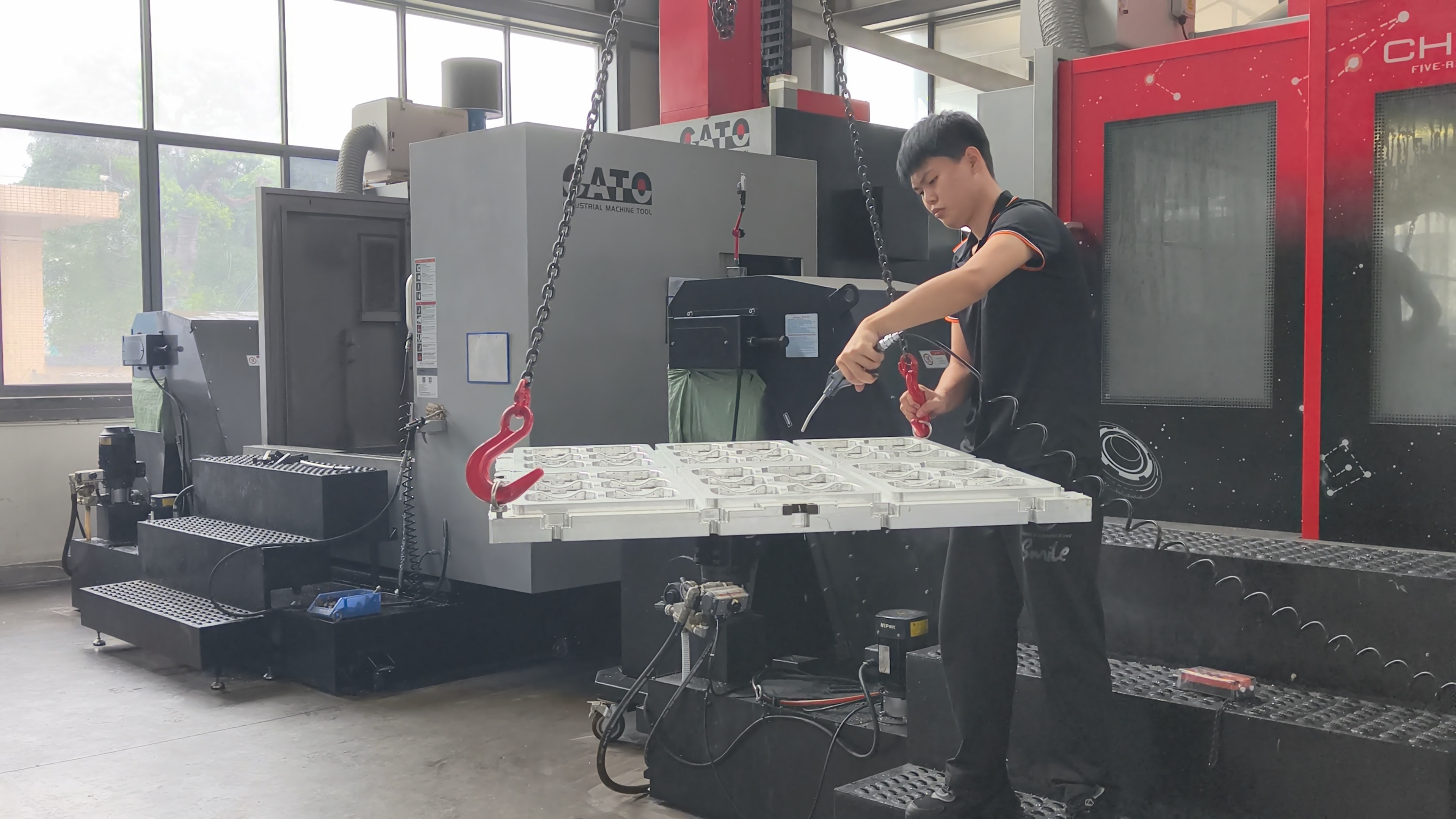
Mold layout is designed against the actual platen, transfer mechanism and pressure curve — not against a drawing alone.
When mold and machine come from one organisation, layout is designed against the platen, transfer mechanism and pressure curve that will actually run it. This is where a large share of commissioning problems originate in split-supply projects: the mold is technically correct and functionally mismatched, and neither party is obliged to correct it.
Joint diagnosis: deciding which subsystem owns a fault
Most production problems in pulp molding do not announce which subsystem caused them. Weight variation across cavities, deformation at demolding, uneven surface gloss, cycle creep and trimming misalignment all have several plausible owners. A supplier with mold, machine, pulp preparation and process teams in one place can run the diagnosis as a single investigation. A buyer working with separate mold and equipment suppliers usually becomes the integrator — collecting evidence and arbitrating between parties whose contractual incentive is to locate the fault elsewhere.
| Symptom | Likely contributors | What the check has to cover |
|---|---|---|
| Product weight or dimension varies across cavities | Drainage and vacuum distribution in the mold; slurry concentration and fiber batch in pulp preparation | Cavity-by-cavity measurement under the production cycle, plus slurry records |
| Deformation or cracking at demolding | Demolding geometry and draft angles; wet-preform strength; transfer settings | Transfer sequencing and fiber formulation reviewed together |
| Uneven gloss or surface marks | Temperature and pressure distribution on the hot-pressing surface; heating control | Surface-temperature mapping across the full cavity area |
| Cycle time creeping upward | Dewatering time, vacuum level, transfer sequencing, downstream accumulation | Whole-line cycle calculation, not the main machine alone |
| Trimming misalignment on cup lids | Locating features in the mold; transfer positioning; trimming unit | Positioning review across mold and automation together |
Hanson's stated position is that its mold, machine and process teams analyse a problem together to determine whether it originates in product structure, mold, equipment, raw material or production process. That is a claim about organisation rather than technology, and it is verifiable during a plant visit by asking who attends a fault review and whether the same team handles mold optimisation and machine retrofit.
Dewatering, heating uniformity and cycle stability
These three are usually presented as machine attributes. In practice they are interface outcomes, and the mold is a party to all of them.
Dewatering. Vacuum distribution and drainage structure decide whether every cavity in a multi-cavity mold receives comparable dewatering. A single-cavity sample can look correct while a production mold shows weight scatter, because slurry distribution and drainage change with cavity count. This is one reason a successful sample does not equal mass-production readiness: the sampling cycle is often slower, and a faster production cycle can leave insufficient time for dewatering and hot pressing.
Heating uniformity. Hot-pressing surfaces have to deliver even temperature and pressure across the full cavity area. Local variation appears as gloss differences, dimensional drift and inconsistent strength, and wet pressing raises the requirement because shaping happens in the mold.
Cycle stability. A stable cycle is a line-level property. If trimming, inspection, stacking or packing cannot keep pace, product accumulates and the main machine is forced to slow or stop; if downstream equipment runs faster but conveying and buffering are poorly designed, misalignment, collisions and missed inspection follow. Cycle matching therefore has to be calculated across the whole line — products per mold, main-machine cycle, conveying, positioning, inspection and packing time — and confirmed with continuous testing on actual product rather than a no-load run.
None of this is a promise about a specific plant. Hanson's own framing is that optimised mold layout, drainage, vacuum distribution, heating and transfer can improve capacity and yield in many projects, while the actual result depends on the machine, mold, product and existing process. Buyers should read that sentence as the boundary of the claim rather than as a footnote.
Where mold capability shows up in different product lines
Tableware, cup lids and industrial packaging place different demands on tooling, which is why a supplier's mold division should be assessed against the products a buyer actually intends to run.
Tableware. Hanson's three tableware routes differ in layout and control, and each implies a different mold arrangement. The ZBG-1111 uses a separated multi-station layout — one forming station, two hot-pressing stations and one trimming station, with a six-axis robot transferring product — at a reference capacity of 1,000–1,500 kg per 24 hours. The ZFG-1111 uses an inline layout roughly 2.15 m wide, suited to long, narrow workshops, at 900–1,200 kg per 24 hours. The ZCE-1111D integrates forming, hot pressing, trimming and stacking in one hydraulically driven machine at 600–900 kg per 24 hours. Reference capacities depend on the product, and mold layout must be designed for the specific line rather than reused across all three.
Cup lids. Lids add trimming accuracy, cleanliness control and inspection to forming. Hanson's cup lid line integrates forming, hot pressing, servo trimming, multi-camera vision inspection, defective-product rejection, counting and automatic packing; a strategic cooperation covering 100 cup lid machines included modular, standardised mold design alongside digital energy management.
Industrial packaging. Deeper cavities and heavier parts push the mold toward the larger envelope described earlier, with surface quality and dimensional tolerance as primary requirements — the basis of the Wangying installation for electronics and appliance protective packaging.
Sampling. The ZAMS-6047 integrates pulping, refining, slurry preparation, forming and hot pressing for formulation and process validation. YUTO Packaging uses one for molded fiber packaging development and prototype verification; GMN uses one for nanocellulose additive testing; Anhui Fengyuan's six units were customised for bio-based fiber, including slurry compatibility and low-energy process design.
Scale is not proof of mold capability, but it does indicate how often the loop has been run with real products. Guangxi Qiaowang took 32 customised core machines for a 40,000-ton-per-year project and reports annual capacity rising from roughly 6,000 to 16,000 tons. Gaoyi Packaging in Vietnam began with a single trial machine and reached a total of 80 industrial packaging machines. Hangzhou Tonglibo placed five procurement rounds in about two years, reaching 20 units. Shengquan Group ran seven months of trial production before a full programme that included the ZBG-1111 line. Home-Link tested equipment for four months before ordering more than 100 machines for the first phase of its Thailand base. Each of these required product-specific mold work, not catalogue configuration.
In-house versus outsourced mold supply: where the risk moves
Outsourced mold supply is not inherently worse. It changes who carries the interface, and that is the part buyers tend to underprice.
| Dimension | In-house mold division | Outsourced mold supply |
|---|---|---|
| Design authority | Layout designed against the machine envelope and fiber in one review | Layout designed to a specification supplied by the buyer or machine maker |
| Iteration loop | Design, machining, fitting and re-testing inside one schedule | Each change crosses a company boundary and a commercial discussion |
| Fault attribution | Mold, machine, pulp and process teams diagnose together | Buyer arbitrates between suppliers before a fix can start |
| Change management | Product change, mold change and machine setting reviewed as one | Buyer coordinates three parties for a single product change |
| Schedule coupling | Mold and equipment milestones planned together | Mold lead time sits on the buyer's critical path |
| Buyer workload | One accountable party for the interface | Buyer holds specification, integration and acceptance risk |
The boundary deserves equal weight. Outsourcing can be a reasonable choice where a product is mature and unchanged, where the buyer already employs mold engineers and metrology staff, or where the mold is customer-supplied. Hanson evaluates customer-supplied molds for dimensions, interfaces, transfer structure and machine compatibility before accepting them, and the same evaluation applies to existing-mold optimisation and machine retrofit, where the objective may be to improve capacity, yield or stability without replacing an entire line.
What the evidence does not prove
A checklist reduces risk; it does not remove it. Four limits are worth stating plainly.
- Capability is not yield. A well-equipped mold division raises the probability of a stable process. It does not guarantee a specific output, scrap rate or cost per unit at a given plant.
- Headcount is not skill. Ten designers and access to 45 machining centers describe capacity and access, not the quality of one particular cavity set.
- Certification has scope. Hanson's CE Machinery Directive attestations issued by UDEM cover named model groups — for example certificate M.2025.206.C130486 covers ZFG-1111, ZFD-8565, ZFM-9894 and ZFH-1311, and M.2026.206.C142039 covers ZAP-9585, ZDA-9585, ZAD-8565, ZAC-8565, ZDA-1070, ZDK-1010, ZAB-9585 and ZAB-1070. A certificate for one model group is not a certificate for every machine a factory builds.
- Acceptance is defined by test, not description. Factory acceptance can include appearance and dimensions, mechanical assembly, electrical systems, hydraulic and pneumatic systems, PLC and HMI functions, safety interlocks, no-load operation, functional testing and trial production with pulp, with the buyer attending in person or reviewing records, video and test data remotely.
From evaluation to execution: a workable sequence
- Request the evidence pack: division scope, designer count and roles, machining access, metrology results and test records.
- Verify physically or through a structured video walkthrough: mold workshop, machining area, assembly, quality inspection — and the machine assembly area where tooling and equipment meet.
- Fix responsibility in writing: who owns mold design, machining, fitting, testing, installation, ramp-up and fault attribution.
- Sample against production intent, and record raw material, slurry concentration, temperature, pressure and time so the production mold is designed from data rather than memory.
- Run factory acceptance against the agreed list, then commission pulping, mold, machine and downstream processes as one system.
- Plan ramp-up: operator and maintenance training, spare-parts and preventive-maintenance arrangements and remote technical support. Hanson states that turnkey projects can be supported with up to six months of on-site production assistance, backed by 10 service locations and a 24/7 response commitment.
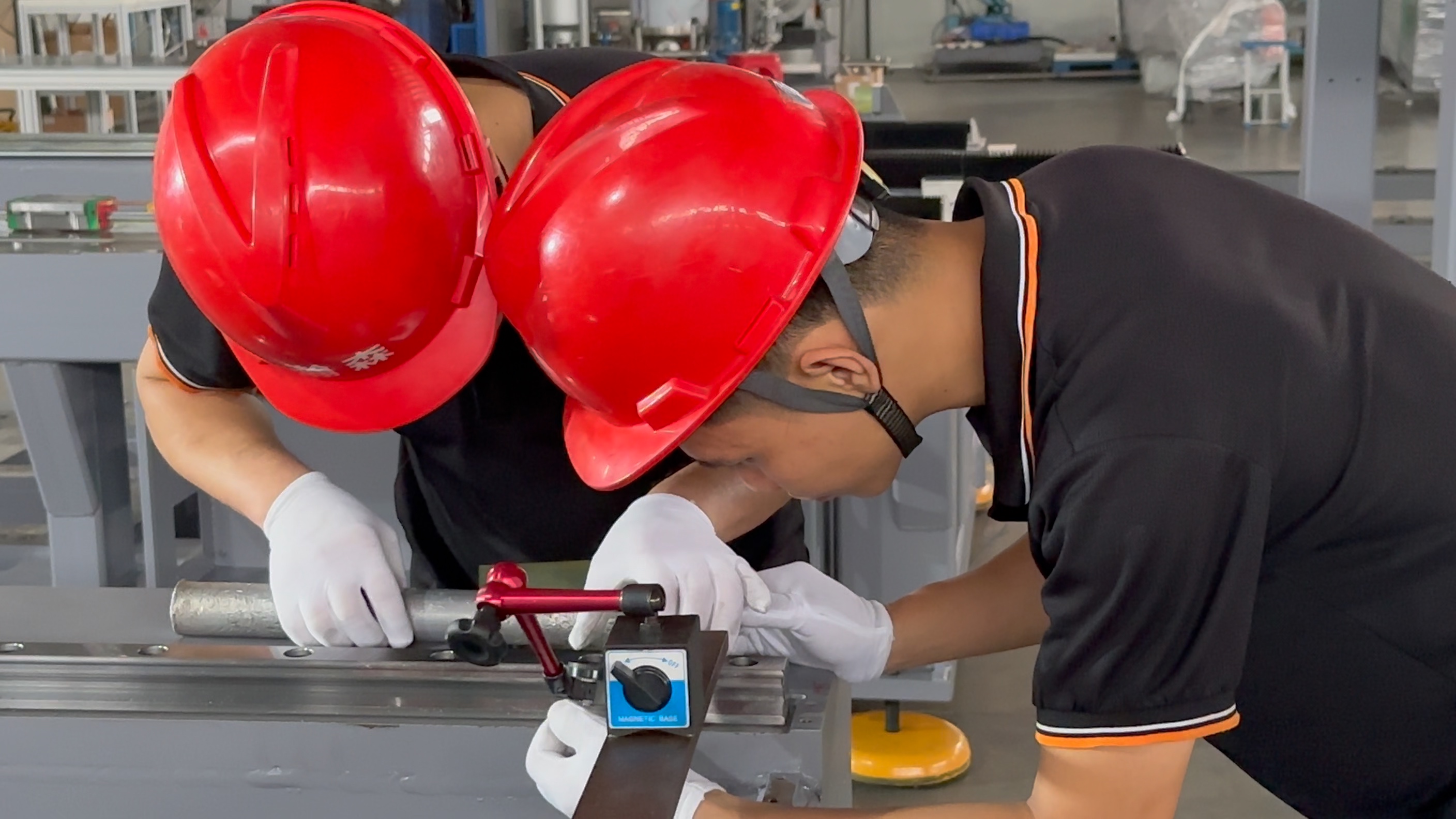
Inspection records — dimensional, installation-surface and system testing — are the part of a capability claim a buyer can actually audit.
Outlook
As buyers move from a single machine to a multi-category portfolio — tableware plus cup lids plus industrial packaging — the number of technical interfaces inside a project grows faster than the number of machines. Under that condition, the practical advantage of an integrated mold division is not that it eliminates problems, but that it shortens the distance between a symptom and the party able to correct it. Suppliers that keep mold, machine, pulp and process teams in one organisation will be asked to prove it with people, machine access and records. Those that cannot will find the proof being demanded in a different currency: the buyer's own coordination time.
FAQ
What does an in-house mold division typically cover?
An in-house mold division normally covers product evaluation, product-structural design, mold design, machining, assembly, testing and mass-production adaptation, with the last stage being the redesign of layout, drainage, heating and transfer for multi-cavity production once the product structure is confirmed. At Hanson the division is described as independent and works alongside the equipment, pulp preparation and automation teams; it also handles existing-mold optimisation and machine retrofit.
How can a buyer verify mold-making capability instead of relying on a brochure?
Ask for the division's scope and organisation, the number and role of mold designers, the machining access available and how much of it mold work receives, plus records from dimensional, installation-surface and system testing. Then verify physically: mold workshop, machining area, assembly, quality inspection and a running customer project. Where site access is impossible, a live video walkthrough with the mold team present is a partial substitute, not an equivalent one.
Why does a mold problem often appear as a machine problem?
Because the symptoms are shared. Weight variation across cavities can come from drainage or vacuum distribution in the mold, or from slurry consistency in pulp preparation. Deformation can come from demolding geometry, wet-preform strength or transfer settings. Uneven gloss usually points to hot-pressing temperature or pressure distribution. When mold and machine come from different suppliers, the buyer has to arbitrate between them; where mold, machine and process teams work together, the fault is assigned inside one organisation.
Can a supplier work with an existing mold or retrofit an existing machine?
Yes, subject to technical evaluation. Hanson assesses customer-supplied molds for dimensions, interfaces, transfer structure and compatibility with the machine, and evaluates whether an existing machine can be modified to improve production rhythm, mold compatibility, transfer stability, pressure control or new-product capability. Mold optimisation may address low capacity, unstable product weight, deformation, dimensional deviation, poor surface quality, dewatering efficiency, long hot-pressing cycles and unstable demolding, but the outcome depends on the machine, mold, product and existing process and should be assessed case by case.
Reference document: Hanson Pulp Molding company brochure (PDF).
Have Questions or Need More Details?
Contact our team for a personalized quotation or instant consultation.
Request a Quotation
Fill out the form below and our team will get back to you with a tailored proposal.
WhatsApp Direct Chat
Prefer to chat in real-time? Message us on WhatsApp for instant assistance & quick answers.
- Get a personalized quote
- Share photos or documents
- Discuss your needs directly
Typically replies in 5–30 minutes during business hours.