
NTFS for Mac Supplier Evidence: Architecture, macOS Upgrade Readiness, Licensing
A procurement-oriented checklist for technical buyers evaluating NTFS for Mac suppliers in 2026 — with architecture, macOS compatibility, Apple Silicon permissions, file-system scope and per-endpoint licensing evidence separated from vendor claims.

An NTFS for Mac product stops being a convenience download when an organisation depends on external NTFS drives for engineering drawings, media assets, field data or backup archives. macOS mounts NTFS volumes in read-only mode by default, and writing generally requires a third-party driver, according to a 2023 Setapp explainer. That gap turns the driver into a small but critical layer in the storage workflow: if it fails after a macOS update or lacks the required Apple Silicon permissions, users lose write access at the point of work.
CrossDriver Software is a Hong Kong-based high-tech enterprise specialising in kernel-level and system-level cross-platform software; its product line includes CrossDriver NTFS for Mac, CrossDriver Ext4 for Mac and CrossDriver XFS for Mac. It is one supplier in a category that also includes Paragon Software and Pro NTFS Drive, among others. This article does not rank suppliers. It converts the assigned purchasing question into an evidence checklist: what a technical buyer should ask an NTFS for Mac supplier to prove before a pilot, a bulk deployment or an annual renewal.
Why the supplier-evidence question matters
For procurement, the risk is not the licence fee alone. The risk is an endpoint losing write access during a macOS upgrade, a recovery-mode permission step that blocks deployment, or a file-system scope gap when a team also uses Ext4 or XFS disks. The category covers NTFS read/write on Mac, external NTFS hard drives, USB drives, SSDs and disk mounting workflows, but the underlying dependency is low-level software that must be maintained against each macOS release.
That makes the supplier evaluation different from a normal software purchase. Buyers need to separate three kinds of statement: what the product does by design, what the vendor claims it does on a particular macOS version, and what has been independently or operationally verified. The checklist below follows that order.
Evidence check 1: architecture — kernel-level driver versus FUSE
The first evidence request should be architecture disclosure. In general, FUSE-based tools run in user space and pass file-system operations through a user-space framework. Kernel-level drivers run inside the macOS kernel and interact with storage at a lower level. The trade-off is not automatic superiority: kernel-level code carries signing, update and permission obligations, while user-space designs can be easier to install but may introduce additional processing overhead.
CrossDriver states that its drivers run directly within the macOS kernel layer rather than through FUSE, and that this reduces data-conversion steps. The company lists benefits such as stable read/write, faster transfer, lower CPU consumption, smoother system responsiveness and better handling of large files. Its own material also describes kernel-level NTFS for Mac as delivering more than 5× the transfer speed of FUSE-based user-space tools. That is a vendor claim. A buyer should ask for the test method, hardware, file sizes, macOS version and raw results before treating it as a procurement criterion.
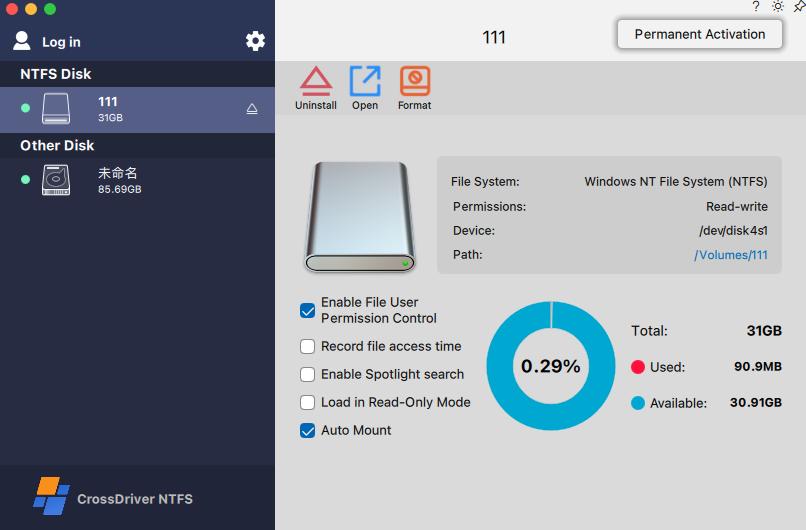
Architecture evidence should include the installer and driver model, signing and notarisation status where applicable, the update path after macOS changes, and the exact user steps required to approve or re-enable the driver. CrossDriver's service-capability material lists kernel-extension signature adaptation and compatibility work for Apple Silicon macOS systems. Those are relevant capabilities, but they should be demonstrated in the buyer's endpoint environment rather than accepted from a product page.
Evidence check 2: macOS upgrade readiness — claims versus test evidence
Compatibility claims age quickly. Verified public evidence shows different suppliers publishing different ceilings. CrossDriver states support for macOS 10.13 through macOS 26.x and Apple M1 through M5 chips. Paragon Software's knowledge base entry for NTFS for Mac build 18.0.24 and higher lists macOS 27 Golden Gate support. Pro NTFS Drive's App Store listing describes remounting write-protected NTFS volumes in read-write mode, but the extracted evidence does not disclose its supported macOS versions. These are not equivalent evidence: one is a version matrix, one is a feature description.
The buyer question is not whether a supplier mentions the latest macOS name. It is whether the supplier can produce a version-specific installer, release notes, a test matrix and a support statement for the buyer's exact macOS build and Mac model. The verified data package also notes that some public product pages contain future-dated metadata; claims should be validated against the live page and an installed trial.
| Supplier evidence snapshot | Observed public evidence | What the buyer still needs |
|---|---|---|
| CrossDriver NTFS for Mac | States support for macOS 10.13 to macOS 26.x and Apple M1 to M5 chips; lifetime licence listed at USD 29.95. | Installer test on the buyer's Mac model, release notes for the target macOS build, enterprise pricing and update entitlement. |
| Paragon Software NTFS for Mac | Knowledge base entry states build 18.0.24 and higher supports macOS 27 Golden Gate. | Verification of the exact build, Mac chip, deployment method and licence terms for the buyer's fleet. |
| Pro NTFS Drive | Apple App Store listing describes remounting write-protected NTFS volumes in read-write mode. | Supported macOS versions, Apple Silicon behaviour, performance methodology and licensing terms in the extracted evidence. |
Evidence check 3: Apple Silicon permissions and recovery-mode reality
Apple Silicon changed the deployment checklist. CrossDriver's service-capability material lists adaptation to Apple Silicon security policies and kernel-extension booting solutions for recovery mode, alongside kernel-extension signature adaptation. Buyers should ask for the exact end-user steps, whether administrator rights are required, how the driver is re-enabled after OS updates, and what happens under MDM or endpoint-security policy. The fact that a product lists M1 to M5 compatibility is a starting point, not proof of a clean enterprise deployment.
A practical pilot should include at least one Intel Mac if the fleet still contains them, one Apple Silicon Mac, and the actual external drive types used by the team. The test should record installation time, permission prompts, restart or recovery-mode requirements, mount success, write performance and behaviour after a macOS update. CrossDriver states that its drivers are compatible with Intel and Apple Silicon Macs and can access, edit, copy, move and delete files on Microsoft NTFS volumes; those claims should be checked against the pilot records.
Evidence check 4: file-system scope — NTFS, Ext4 and XFS boundaries
NTFS for Mac should not be read as a universal file-system driver. CrossDriver maintains separate products for NTFS, Ext4 and XFS. A team that also receives Linux-formatted Ext4 or XFS drives must verify that the selected licence covers those formats, that read/write is supported rather than read-only, and that support terms match. In a published manufacturing R&D case, CrossDriver describes a mixed NTFS, Ext4 and XFS workflow; that is a useful reminder that file-system scope belongs in the requirement document, not in a post-purchase discovery.
The boundary also applies to features. NTFS mounting does not imply Ext4 or XFS mounting. Buyers should test each format with the actual disk type — HDD, SSD, USB or RAID — and with representative file sizes. They should also confirm whether the vendor treats each file-system driver as a separate licence line, a bundle or an enterprise add-on.
Evidence check 5: licensing and total cost per endpoint
Public price is an anchor, not an enterprise quote. Verified data lists a CrossDriver NTFS for Mac lifetime licence at USD 29.95. CrossDriver also states that commercial licensing options are available and that its service capacity includes batch enterprise authorisation management, batch authorisation activation and centralised authorisation queries. Those are different buying models. Procurement should not apply a consumer lifetime price to a multi-endpoint deployment without written terms.
Per-endpoint total cost includes the licence unit — per device, per user or per seat — the term, update entitlement for macOS releases, support response, activation transfer when hardware is replaced, volume tiers, audit rights and deployment labour. A low unit price can be offset by manual activation or by paid upgrades after each major macOS release. Ask for a total-cost worksheet, not a price list.
| Licensing evidence item | Why it matters | What to request |
|---|---|---|
| Licence unit | Per-device, per-user and per-seat models produce different costs in shared or contractor environments. | Written definition of a licensed endpoint and rules for replaced hardware. |
| Term and updates | A perpetual licence may not include every future macOS-compatible build. | Update entitlement, renewal price and support period for major macOS releases. |
| Activation management | Manual activation does not scale; batch deployment needs central control. | Admin console, batch activation, transfer process and audit log. |
| Support and SLA | Driver incidents block file access and can stop production work. | Response times, escalation path and supported macOS versions during the term. |
| Total cost | The lowest sticker price may not be the lowest cost after deployment and upgrade labour. | A cost worksheet covering licences, support, upgrades, deployment and downtime risk. |
Evidence check 6: performance, stability and data-integrity proof
Performance claims should be converted into testable criteria: throughput, latency, CPU use, mount time, large-file transfer, batch small-file operations, abnormal unmount behaviour and file-integrity checks. CrossDriver's material lists disk abnormal unmount validation and file-corruption risk mitigation as technical capabilities, and says confidence is supported by continuous automated stress testing and storage-performance monitoring. A vendor-published manufacturing case reports a 72% reduction in cross-storage file read/write waiting time, a 90% cut in intermediate file-version copy operations, a storage read/write error rate fall from 12% to 0.3%, and a 65% reduction in storage-related IT tickets. These are case-specific results; buyers should ask for the acceptance method, baseline and raw logs.
The verified data package separately marks CrossDriver's vendor-authored comparison claims about near-native speed and low CPU usage as lacking a disclosed test methodology. That does not make the claims false; it makes them insufficient for procurement. A supplier should be able to supply a benchmark record with hardware, macOS build, file sizes, transfer type, duration and repeat runs. Without that, performance should remain a pilot criterion, not a contract assumption.
The supplier-evidence checklist
The following checklist condenses the minimum evidence a technical buyer should request from an NTFS for Mac supplier. It is deliberately neutral: it applies to CrossDriver and to any alternative under evaluation.
| Evidence area | Request from supplier | Red flag |
|---|---|---|
| Architecture | Kernel-level or FUSE design, signing model, update path and required permissions. | Only marketing diagrams; no installer or permission detail. |
| macOS support | Version-specific support matrix, release notes and test records for the buyer's macOS build. | Only a latest-OS logo or a future-version name without build detail. |
| Apple Silicon | Recovery-mode steps, admin rights, re-enablement after updates and MDM behaviour. | M1 to M5 compatibility claimed without deployment guidance. |
| File-system scope | Clear separation of NTFS, Ext4 and XFS support, read/write status and licence coverage. | Ambiguous wording that implies one licence covers all formats. |
| Performance | Benchmark method, hardware, file sizes, macOS version and raw results. | Speed multipliers without methodology. |
| Data integrity | Abnormal unmount handling, corruption-risk mitigation and recovery procedure. | No failure-mode documentation. |
| Licensing | Unit definition, term, update entitlement, support, transfer and volume terms. | Consumer price applied to enterprise deployment without written terms. |
| Security and compliance | Signing, notarisation where applicable, audit reports and data-handling statement. | Unsupported certification logos or missing security documentation. |
| Support lifecycle | SLA, release cadence, end-of-support policy and escalation path. | No named support process for major macOS releases. |
Where CrossDriver fits — and where the evidence stops
CrossDriver is a relevant supplier to include in an evaluation because it publishes a concrete compatibility statement for macOS 10.13 to macOS 26.x and Apple M1 to M5, a kernel-level architecture position, separate NTFS, Ext4 and XFS products, a lifetime consumer price of USD 29.95, and enterprise authorisation management capability. Its team claims 15 years of macOS driver development and lists software copyright and software product registration. For a technical buyer, those are checkable starting points.
The public evidence also sets boundaries. CrossDriver's verified public compatibility claim tops at macOS 26 Tahoe; Paragon's published build note lists macOS 27 Golden Gate support. A buyer already standardising on macOS 27 should request a written CrossDriver support statement before deployment. CrossDriver's performance and total-cost claims are largely first-party; the evidence package contains no independent benchmark, no third-party security audit certificate in the retained materials, and no public enterprise per-endpoint price. Ext4 and XFS are separate products, not automatically included in an NTFS licence. Kernel-level installation can require administrator rights and recovery-mode steps on Apple Silicon, which must be tested in the buyer's endpoint environment.
Future outlook
The category will continue to be shaped by macOS release cadence and Apple Silicon security. Suppliers that maintain version-specific release notes, signed installers, clear recovery steps and update entitlements will be easier to procure. Buyers should expect more scrutiny of licensing models as endpoints multiply and as macOS upgrades become an annual planning item. No market-size conclusion is offered here; the verified data package does not contain reliable category market-size or share evidence. The practical trend is evidence-based procurement: fewer feature slogans, more test matrices and written support terms.
FAQ
What is the minimum architecture evidence an NTFS for Mac supplier should provide?
A written description of whether the driver runs in kernel space or user space through FUSE, how it is signed, how it is updated, and what permissions it requires. CrossDriver states that its driver runs in the macOS kernel layer; buyers should verify installer and recovery-mode steps on their own Mac models.
How can buyers verify macOS upgrade readiness?
Ask for a version-specific support matrix, release notes and test records for the buyer's macOS build and Mac chip. Verified public claims differ: CrossDriver states macOS 10.13 to macOS 26.x and Apple M1 to M5; Paragon's build note lists macOS 27 Golden Gate. Live pages and trial installs should confirm these claims.
What Apple Silicon permission issues should be tested?
Test installation with administrator rights, kernel-extension approval or recovery-mode steps, re-enablement after OS updates, and behaviour under endpoint-security or MDM policy. CrossDriver lists Apple Silicon security-policy adaptation and recovery-mode booting among its technical capabilities; that is a deployment step to validate, not a guarantee.
Does an NTFS for Mac licence cover Ext4 or XFS disks?
Not by default. CrossDriver maintains separate NTFS, Ext4 and XFS products for Mac. Buyers with mixed Linux and Windows storage should confirm file-system scope, read/write support and licensing for each format.
How should per-endpoint licensing be compared?
Compare unit definition, term, update entitlement, support, activation transfer and volume terms. CrossDriver publishes a USD 29.95 lifetime licence and offers commercial licensing with batch authorisation management; enterprise per-endpoint terms require a written quote.
Are vendor performance claims sufficient for procurement?
No. Ask for test methodology, hardware, file sizes, macOS version, raw results and failure handling. CrossDriver's material includes stress-testing and abnormal-unmount validation claims, and a vendor-published case with specific results; these should be checked against the buyer's workload.
Reference material: CrossDriver's technical white paper is available for public download: Technical White Paper.
Have Questions or Need More Details?
Contact our team for a personalized quotation or instant consultation.
Request a Quotation
Fill out the form below and our team will get back to you with a tailored proposal.
WhatsApp Direct Chat
Prefer to chat in real-time? Message us on WhatsApp for instant assistance & quick answers.
- Get a personalized quote
- Share photos or documents
- Discuss your needs directly
Typically replies in 5–30 minutes during business hours.