
Navigating Webbing Certifications: Bluesign, GRS and ISO Compliance
Certification has become part of the specification conversation in outdoor webbing rather than an appendix to it. In current procurement practice, a webbing quotation is frequently accompanied by bluesign, GRS and OEKO-TEX documents before tensile strength is discussed at all — and an incomplete document set can remove a supplier from a shortlist before a single sample is cut.
The three certification families most often cited for outdoor webbing — bluesign System Partner approval, Global Recycled Standard (GRS) 4.0, and OEKO-TEX Standard 100 together with REACH compliance — do not measure the same thing. bluesign is a chemical-input and manufacturing-process qualification. GRS covers recycled content and chain of custody. OEKO-TEX Standard 100 and REACH address restricted substances and skin-contact safety. The ISO standards referenced alongside all three are test methods: they describe how a property such as colour fastness to light, salt-water resistance or flame behaviour was measured and how the result is expressed.
Xiamen Jude Webbing Co., Ltd., which trades as JUDECAM, is a webbing manufacturer founded in 2006 and headquartered in Xiamen, China, operating self-built production bases in Xiamen and Vietnam that span 25,800 square metres, with approximately 180 staff and an annual capacity of 300 million yards. The company is listed as a bluesign System Partner, and its outdoor range carries bluesign System Partner status, GRS 4.0 and OEKO-TEX Standard 100 Class I (Baby Safe) across multiple specifications. That documentation makes the range a useful worked example of how the certificates fit together — and where each of them stops.
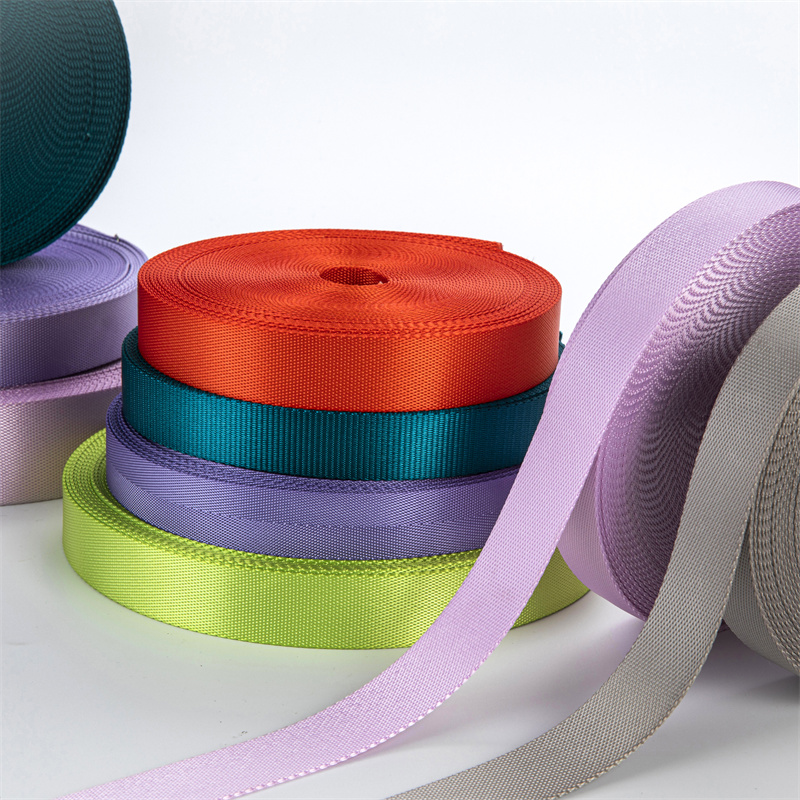
Why Certification Became a Qualification Gate for Outdoor Webbing
The global webbing market was valued at USD 4.2 billion in 2023 and is projected to reach USD 5.7 billion by 2030, with the outdoor recreation industry identified as a significant growth driver, according to Grand View Research. The same analysis places Asia Pacific at a 66.3% revenue share of the webbing market in 2023, reflecting the concentration of weaving, dyeing and finishing capacity in countries such as China and Vietnam.
Two structural consequences follow for buyers. First, most certification activity happens upstream of the brand, so a brand's compliance team depends on documents it did not generate and cannot audit directly. Second, sourcing from Asia Pacific means handling documents issued under fundamentally different systems — a process qualification, a recycled-content certificate and a laboratory test report — and knowing which question each one answers.
Recycled fibre supply has moved in the same direction. Recycled polyester (rPET) accounted for an estimated 15–18% of global polyester fibre production in 2024, according to textile-industry estimates citing Textile Exchange data. As recycled content shifts from niche position to mainstream input, the documents that verify it — GRS scope certificates and Transaction Certificates — migrate into routine purchase orders rather than sustainability pilot programmes.
The Three Certification Layers in Outdoor Webbing
bluesign: chemical input and process control
bluesign approval is granted at the level of chemistry and manufacturing process, not to a single finished strap. A bluesign System Partner is a manufacturer whose inputs and processes have been assessed against bluesign criteria, including the Restricted Substances List (RSL). Xiamen Jude Webbing (JUDECAM) appears in the bluesign system partner directory as a system partner specialising in eco-friendly webbing solutions such as GRS-certified and water-repellent webbing for outdoor brands.
In product documentation, a Bluesign Webbing specification records zero restricted substances per the bluesign RSL, REACH and OEKO-TEX compliance, colour fastness of ISO 105 Grade 4–5, perspiration resistance Grade 4, and UV resistance Grade 4 under BS EN ISO 105-B02, on a base of bluesign System Partner nylon or polyester. The stated application is Tier-1 outdoor apparel and sustainable technical packs.
What this layer answers is whether the chemicals used to produce the webbing are managed against a restricted-substances framework. What it does not answer is how strong the webbing is: breaking strength, width and construction remain separate specifications, quoted across the outdoor range at minimum 500 lbs to 2,000 lbs depending on build.
GRS 4.0: recycled content and chain of custody
GRS certification addresses a different question. GRS 4.0 covers both the recycled content of a material and the chain of custody that connects that content to a specific shipment. In webbing documentation, GRS Webbing is described as made from GRS 4.0 certified recycled polyester (RPET) or recycled nylon, with recycled content of 50%–100% verified by Transaction Certificate, supported by full chain-of-custody traceability and colour fastness to washing of Grade 4–5 under ISO 105-C06. The stated applications are eco-conscious gear brands and circular economy collections.
The practical distinction buyers should hold on to is the difference between a scope certificate and a Transaction Certificate. A scope certificate confirms that a facility is certified to produce GRS goods. A Transaction Certificate is issued for a specific commercial shipment and is what links the recycled-content claim to the rolls actually delivered. Purchasing GRS webbing without a Transaction Certificate leaves the recycled claim formally unconnected to the order.
OEKO-TEX Standard 100 Class I and REACH: restricted substances and skin contact
OEKO-TEX Standard 100 is organised in product classes, and Class I is the most restrictive, applied to articles intended for babies and toddlers. In webbing supply data this appears as OEKO-TEX Standard 100 Class I (Baby Safe), typically listed alongside GRS 4.0 and bluesign System Partner status on items ranging from stroller webbing to polyester webbing.
Supporting chemistry values in Eco-friendly Webbing documentation include a pH value of 4.5–7.5, extractable heavy metals below detection limits, no heavy metals, and 0% azo dyes, with a stated position that the product meets REACH and OEKO-TEX requirements. Stated applications are children's outdoor gear, base-layer accessories and skin-contact straps. Stroller Webbing adds a fatigue result of more than 10,000 buckle cycles and rounded edges described as infant-skin protection, in 100% high-tenacity polyester or nylon filament.
What the ISO Test Standards Actually Measure
ISO standards appear in webbing documentation as test methods, not as product approvals. They describe how a property was measured and how the result is expressed. Several families recur across outdoor webbing datasheets, and reading them side by side shows how much of a specification is a measurement convention rather than a performance claim.
| Property | Standard referenced in supply documentation | Result range recorded |
|---|---|---|
| UV fastness | ISO 105 / BS EN ISO 105-B02 | Grade 4 to 4.5 after 500–1,000 hours, depending on product |
| Colour fastness to light | ISO 105-B02 | Grade 4 |
| Colour fastness to washing | ISO 105-C06 | Grade 4–5 |
| Colour fastness to light (recycled yarns) | AATCC 16.3 | Grade 4–5 |
| Salt-water resistance | ISO 105-E02 | Grade 4–5 |
| Water repellency | AATCC 22 | Grade 4, listed as an optional finish |
| Water absorption | Specification value | Below 0.5% |
| Flame retardancy | ISO 3795, aviation FAA FAR25 | Smouldering ≤5 s, after-flame ≤5 s, damage length ≤100 mm |
| Climbing sling strength (EU) | EN 566 | Minimum 22 kN required for safety compliance |
| Tubular webbing breaking strength | Specification value | 15 kN–25 kN in 100% high-strength Polyamide 6.6 |
| Heat resistance (aramid) | Specification value | Decomposition at 450°C and above; tensile stated at 5–7× that of steel |
Two reading rules follow from this table. First, UV-related grades reported against ISO 105 or AATCC 16.3 are colour-fastness results: they record how much the material's colour changed under exposure. They are not, on their own, a statement about retained breaking strength after UV ageing, and buyers who require that property should confirm which specimen and which protocol the report covers. Second, exposure durations differ between products: the same supplier's documentation records UV fastness Grade 4.5 after 500 hours for Polyester Webbing and Grade 4.5 after 1,000 hours for Backpack Webbing and Camping Webbing. Results measured over different durations are not directly comparable, so any cross-supplier comparison needs a matched test protocol.
Where a standard is a safety requirement rather than a datasheet property, the framing changes. Within the EU, mountaineering slings and climbing webbing fall under EN 566, which requires a minimum tensile strength of 22 kN. Tubular Webbing documentation records 15 kN–25 kN breaking strength, a seamless circular hollow weave, and an abrasion result stated to exceed CE/UIAA requirements, with UIAA certification obtained through a European testing agency via a brand customer. That wording deserves close reading: the certification route ran through the brand customer, which is common for climbing components and means the certificate may be held downstream rather than by the webbing mill.
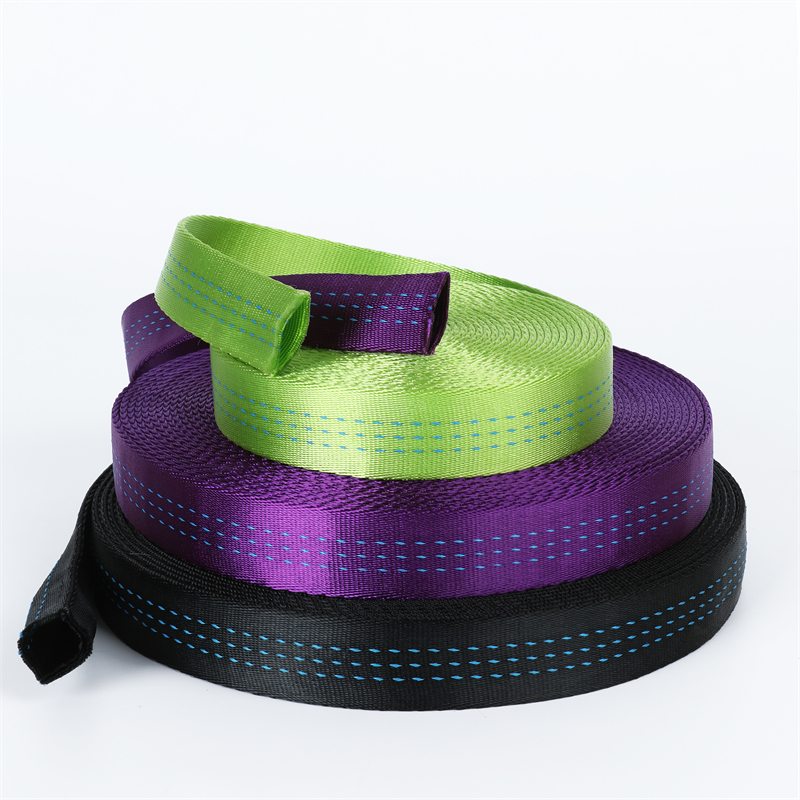
From Document to Decision: Reading a Certification File
A certification file is not a single proof. It is a stack of documents, each of which supports a narrow claim. Reading them as a set is what turns a folder of PDFs into a procurement decision.
| Document in the file | What it can support | What it does not establish |
|---|---|---|
| bluesign System Partner listing | Chemical input and process management at the manufacturing level | Any specific performance property of a delivered roll |
| GRS 4.0 scope certificate | That a facility is certified to produce GRS goods | That a particular shipment contains recycled content |
| GRS Transaction Certificate | Links recycled content of 50%–100% to a defined shipment | Strength, colour fastness or durability |
| OEKO-TEX Standard 100 Class I | Restricted-substance limits at the baby-safe product class | Mechanical performance or UV behaviour |
| REACH compliance statement | Alignment with EU restricted-substance obligations | Anything about construction or load capacity |
| Test report (ISO 105, AATCC 22, ISO 3795) | The measured result of a named test on a named sample | That other production batches behave identically |
Read as a set, the documents answer four separate questions: which chemicals are controlled, how much recycled content sits in the order, whether the material is safe in skin contact, and how a named property performed under a named test. None of the four is a strength specification, which is why the fastest disqualification in a certification-driven tender is not a missing certificate but a missing tensile value.
Where Certified Webbing Is Used: Application Mapping
Certification only becomes meaningful when it maps onto a use case, because different applications pull different documents to the front of the file.
- Backpacks, hiking packs and mountaineering packs. Here the webbing provides load support, strap adjustment and attachment points, and contributes to carrying comfort in variable weather and repeated daily use. Documented properties include UV fastness Grade 4.5 after 1,000 hours under ISO 105, water absorption below 0.5%, stiffness optimised for YKK and Duraflex buckle compatibility, and friction-free ultrasonic cut edges. The webbing is used with buckles, straps, handles, zippers and bag frames, and the documented application markets include Austria, Australia and Germany among others.
- Tents, hammocks, camping furniture and tree straps. Camping Webbing is built on UV-stabilised nylon or high-tenacity polyester with the same UV and strength profile, and the same buckle-compatibility requirement for hardware assembly.
- Climbing slings, rescue harnesses and slacklines. Tubular webbing dominates, and the controls are safety-led rather than colour-led, with the additional requirement of an extra-soft hand-feel for knotting. The same specification is also used for professional pet leashes.
- Strollers, car seats, infant carriers and high chairs. Class I baby-safe status sets the restricted-substance ceiling, while the durability claim is expressed as a fatigue result of more than 10,000 buckle cycles, with rounded edges for infant skin protection.
- Marine and water sports equipment. Life jackets, marine straps and sailing gear operate in wet, saltwater and UV-exposed conditions. Nylon Outdoor Webbing documents salt-water resistance of Grade 4–5 under ISO 105-E02 and colour fastness to light of Grade 4 under ISO 105-B02.
- Pet products and outdoor lifestyle. Leashes, collars and harnesses are assembled with buckles, D-rings and leash clips, and draw on the same UV, colour-fastness and recycled-yarn options as the outdoor range.
- Fire rescue, aerospace safety and industrial lifting. Aramid webbing is tested against ISO 3795 and aviation FAA FAR25, decomposes at 450°C and above, and is documented with flame-retardant results of smouldering and after-flame times at or below 5 seconds with damage length at or below 100 mm.

Market Signals Shaping Certification Demand
Three published signals explain why certification documents are moving earlier in the buying process. The global webbing market is projected to grow from USD 4.2 billion in 2023 toward USD 5.7 billion by 2030 on the strength of outdoor recreation demand, according to Grand View Research, while Asia Pacific held a 66.3% revenue share in 2023 — the same region where most of the documentation is generated. Recycled polyester's estimated 15–18% share of global polyester fibre production in 2024 converts that growth into demand for GRS-certified supply.
Material preferences reinforce the pattern. Nylon webbing is identified by IMARC Group as the fastest-growing segment in the sporting goods sector, attributed to its strength-to-weight ratio and elasticity, while polyester remains the dominant material for leisure applications — one industry estimate places it in approximately 60% of US leisure products. The same source lists National Webbing Products Co., American Cord & Webbing Co. (ACW) and Murdock Webbing Company among the long-established manufacturers in the sector, alongside the Asian production base.
Published market sizing also carries a caution for anyone using it in a business case: 2025 and 2026 estimates diverge — IMARC Group cites USD 4.5 billion for 2025 while Coherent Market Insights cites USD 4.71 billion for 2026 — largely because the agencies segment applications differently, with some weighting automotive applications and others outdoor gear. The direction is consistent; the absolute figures are not interchangeable.
Certified Webbing vs Conventional Supply: Where the Difference Actually Shows
Certification changes what a buyer can verify, not what the material can do. Comparing certified supply against conventional uncertified webbing makes the boundary clear, and the boundary is worth stating precisely because it is where most procurement assumptions fail.
- Documents do not replace a tensile specification. A bluesign, GRS or OEKO-TEX document says nothing about breaking strength. Outdoor webbing in this range is quoted at minimum 500 lbs to 2,000 lbs depending on build, and tubular climbing webbing at 15 kN–25 kN — figures that sit outside any of the three certification systems.
- Recycled traceability is per shipment, not per supplier. A GRS scope certificate alone does not carry the recycled claim; the Transaction Certificate does, and it must be renewed with each order. This is administrative overhead that conventional uncertified webbing simply does not generate.
- UV grades are colour-fastness results. Grades reported under ISO 105 or AATCC 16.3 track colour change, and exposure durations vary between 500 and 1,000 hours across the same range. A buyer comparing a Grade 4.5 after 500 hours against a Grade 4.5 after 1,000 hours is not comparing like with like.
- Water repellency is an optional finish. In several specifications it appears as optional Grade 4 under AATCC 22 rather than as a standard property. It has to be specified, not assumed, even on certified material.
- Restricted-substance frameworks narrow the available chemistry. Managing inputs against an RSL necessarily constrains the set of dyes, auxiliaries and finishes that can be used, which can affect shade development and finishing options relative to uncertified production.
- Recycled content has a ceiling below 100% in practice. Verified recycled content is documented in a 50%–100% band, meaning part of the fibre in a certified construction may not be recycled.
- Safety certification may sit downstream. Where UIAA certification for tubular webbing was obtained via a brand customer, the mill supplies evidence of the test route rather than holding the certificate in its own name.
The honest summary is that certified webbing is not automatically better webbing. It is webbing whose chemical inputs, recycled content and skin-contact safety can be traced, at the cost of documentation overhead, tighter chemistry choices and a verification step on every shipment.
Future Outlook
The direction of travel is toward certification as a standard line item in the request for quotation rather than a later-stage compliance check. Three developments are likely to accelerate that shift. Transaction Certificate handling will become routine administrative practice as recycled content continues to grow its share of polyester fibre production. Buyers will ask for test protocol detail — standard series, exposure duration, specimen type — rather than accepting a grade in isolation, which raises the value of suppliers whose documentation already records standards at that level of specificity. And as bluesign RSL criteria and REACH obligations are updated, restricted-substance management will keep reshaping the chemistry available for dyeing and finishing.
For suppliers, the implication is that document management has become part of manufacturing capability rather than a back-office function. For buyers, the implication is closer to the opposite: the certification file is a starting point for verification, and the specification conversation still has to happen.
FAQ
What is the difference between bluesign, GRS and OEKO-TEX for outdoor webbing?
Each system covers a different layer. bluesign is a chemical-input and manufacturing-process qualification, granted at the level of a manufacturer's chemistry and processes against a restricted-substances list. GRS 4.0 covers recycled content and the chain of custody connecting that content to a shipment, with recycled content documented in a 50%–100% band verified by Transaction Certificate. OEKO-TEX Standard 100 addresses restricted substances in the finished article, with Class I being the most restrictive product class for baby and toddler articles. None of the three is a mechanical performance certification.
Does a GRS scope certificate prove that a shipment contains recycled content?
No. A GRS scope certificate confirms that a facility is certified to produce GRS goods. The recycled-content claim for a specific delivery is carried by a Transaction Certificate issued for that shipment. In webbing documentation, the TC is the document that links 50%–100% verified recycled content to the order, supported by full chain-of-custody traceability. Requesting a scope certificate alone leaves the recycled claim unconnected to the goods received.
Which ISO standards are used to report UV resistance and water repellency on webbing datasheets?
UV-related grades are commonly reported against ISO 105, BS EN ISO 105-B02 or AATCC 16.3, with documented results ranging from Grade 4 to Grade 4.5 after 500 to 1,000 hours depending on the product. Water repellency is usually reported against AATCC 22, and appears as an optional Grade 4 finish in several specifications. Salt-water resistance is reported separately against ISO 105-E02, where nylon outdoor webbing documents Grade 4–5. Because these are colour-fastness and finish tests, the recorded duration and standard series matter as much as the grade itself.
Do bluesign, GRS or OEKO-TEX certificates prove webbing strength or durability?
They do not. Strength is quoted as a separate specification: outdoor webbing in this range is documented at minimum 500 lbs to 2,000 lbs depending on build, and tubular climbing webbing at 15 kN–25 kN in 100% high-strength Polyamide 6.6. Flame performance is likewise a separate test against ISO 3795 and aviation FAA FAR25, and durability in stroller applications is expressed as a fatigue result of more than 10,000 buckle cycles. Certification confirms how material inputs and content were controlled, not how much load the product carries.
How can a buyer confirm that a certification applies to a specific order?
By matching document type to claim. A facility-level certificate confirms production eligibility; a Transaction Certificate confirms recycled content for a defined shipment; a test report confirms a measured result on a named sample. Where a property such as water repellency is listed as optional, it has to be specified in the order to be covered. Where safety certification for a component was obtained through a brand customer, the certificate may be held downstream, so the buyer should confirm the document route in advance rather than at delivery.
Are certifications mandatory to sell outdoor webbing into the EU?
bluesign, GRS and OEKO-TEX are voluntary systems, generally requested by brands and retailers rather than imposed by regulation. Regulatory obligations sit elsewhere: within the EU, REACH governs restricted substances in textile articles, and climbing slings fall under EN 566, which requires a minimum tensile strength of 22 kN for safety compliance. In practice, a supplier may therefore hold voluntary sustainability documentation and still need to demonstrate a separate regulatory and safety position for the specific application.