
Nonwoven Mesh Belt Specs, Certifications and Selection Boundaries
Industry Reference / Forming Fabric Procurement
A nonwoven mesh belt is not interchangeable just because its width matches the machine. In spunbond, spunmelt, spunlace and airlaid production, the belt controls how evenly the fiber web is deposited, how efficiently air or water is removed, and whether the web releases without mesh marks or static defects. For buyers at the research and evaluation stage, the meaningful question is not which brand is more visible, but which specification set is compatible with line speed, fiber denier, operating environment and end-product compliance.
Why the belt is a constraint layer in nonwoven line planning
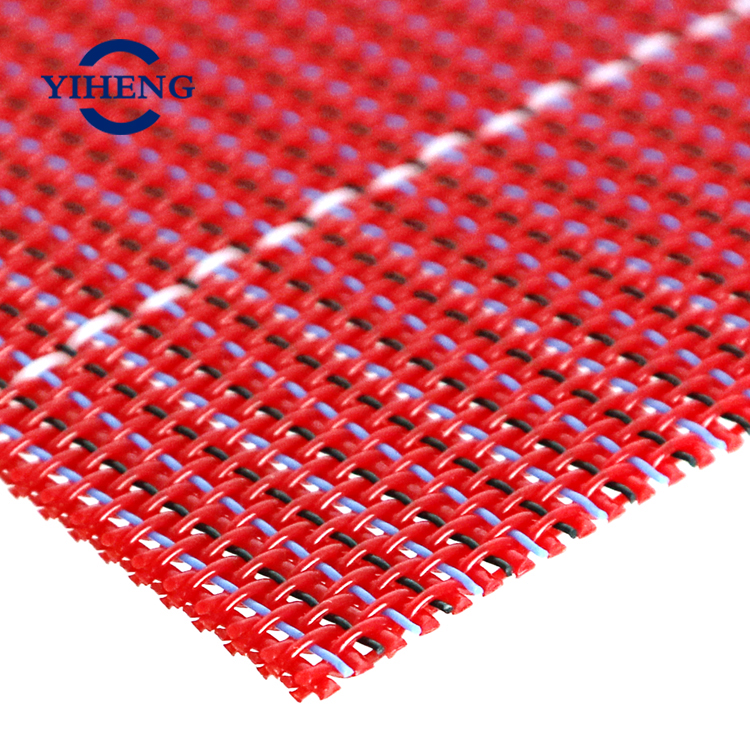
In nonwoven manufacturing, the mesh belt performs several roles at the same time. It receives fibers, carries the forming web, removes the fluid or air used during web formation, and must release the web cleanly to the next section. Because the belt sits in the middle of these functions, minor changes in permeability or seam geometry can appear in the final fabric as uneven weight, cloudy spots, longitudinal streaks, seam marks or fabric flipping.
A belt purchase should therefore be treated as a decision about operating constraints rather than as a routine spare part order. Once a belt is installed, its air permeability sets a range of possible suction pressure; its yarn density sets the level of fiber support; its surface conductivity sets how well static charges are removed; and its seam design sets the maximum safe line speed before vibration or marks appear. These constraints affect energy consumption, first-grade yield, downtime, and ultimately the cost per ton of nonwoven output.
Market momentum raises the cost of specification errors. Advanced forming systems in the nonwoven industry can operate at line speeds up to 1,000 m/min and withstand temperatures up to 180°C. Faster production means that even a small inconsistency in the belt can be amplified into large quantities of seconds or scrap.
How to compare nonwoven mesh belt data sheets
Data sheets from different belt suppliers are not always easy to compare because test conditions differ. Air permeability may be reported in CFM measured at 127 Pa per 20 cm², or in cubic metres per square metre per hour at 100 Pa. Thickness may be listed without confirming the number of layers. Joint options may be grouped under names that look similar but behave differently. Buyers moving from awareness into evaluation should normalise these data points before making a final specification.
| Parameter | Common unit | What it controls in production |
|---|---|---|
| Air permeability | CFM at 127 Pa/20 cm² or m³/(m²·h) at 100 Pa | Fiber adhesion, web uniformity, drying or drainage capacity |
| Warp and weft diameter | mm | Surface contact area, mesh opening size, physical blocking of fine fibers |
| Warp and weft density | ends/cm | Weave compactness, fabric support and surface smoothness |
| Mesh count or mesh number | openings per area or per unit length | Fineness of web formation and the risk of fiber penetration |
| Weight and thickness | g/m², mm | Mechanical strength, dimensional stability, machine loading |
| Weave structure and layers | e.g. above-3 below-5, 1.5 layers | Adhesion and peelability balance, stability under tension |
| Joint type | Endless, self-ring, millet-ring, double-pins | Installation convenience, seam flatness, high speed behavior |
| Material system | PET, anti-hydrolysis PET, conductive PET, carbon fiber PET | Chemical resistance, service life in humid or winter conditions, static control |
CFM and air permeability: not just an airflow figure
Air permeability is often the first technical parameter on a nonwoven mesh belt specification. It represents the volume of air that passes through the belt under a defined pressure difference. In suction-based forming processes, permeability determines how strongly fibers are drawn onto the belt. If permeability is too high for a very fine fiber, the fiber may penetrate into the mesh and create fiber hanging defects. If permeability is too low, suction may be insufficient, and fibers can accumulate unevenly.
General selection guidance in the industry follows a simple relationship: fine denier fibers require lower permeability mesh, while coarse denier fibers need higher permeability. In practical terms, fine denier applications below 1.5D are often matched with mesh around 9,000–9,300 CFM, while coarse denier applications above 2.0D may need permeability above 11,000 CFM. These values are reference ranges rather than universal laws; the correct setting depends on suction box design, polymer type and line speed.
Tolerance control matters just as much as the nominal figure. For a forming fabric, stable permeability across the full width is a precondition for uniform web quality. During production, airflow should not drift significantly as the belt ages. A practical buyer check is whether the supplier publishes a tolerance band and can consistently heat-set the fabric to hold that band.
Material and filament shape: polyester, hydrolysis and conductivity
Polyester is the primary material used in most nonwoven mesh belts. In standard conditions, polyester monofilament provides good dimensional stability, wear resistance and a clean release surface. But not all polyester belts behave the same when the production environment changes.
In hot and humid conditions, ordinary polyester can lose strength because of hydrolysis. Degradation is seen not as a surface defect but as a gradual weakening of the fabric structure, eventually leading to brittleness and breakage. Hydrolysis-resistant PET filaments are formulated to retain strength in high-humidity environments, and they are generally recommended for spunlace processes and other operations where water and heat are present.
Static behavior is another material constraint. High-speed friction between the belt, the forming web and machine rollers generates charge, especially in dry winter conditions or at low online humidity. If charge is not dissipated, the web can stick to the belt, float or flip at the release point. Anti-static mesh belts solve this by weaving conductive filaments into the structure. The thin black lines visible in some anti-static belts are carbon fiber or conductive PET yarns, which reduce surface resistivity and provide a path for charge to move to the machine grounding system.
Reading the anti-static specification correctly
Surface conductivity values on a data sheet indicate how well the belt can dissipate static. In the product family supplied by Henan Yiheng Mesh Belt Industry Co., Ltd., for example, conductivity values range from the strongest static control level of 10³–10⁴ Ω on the KJD700 model to 10⁵–10⁶ Ω on models such as HY408S and K4106B, and 10⁶–10⁷ Ω on the K4106A. A lower resistance value generally means easier dissipation under dry conditions.
Anti-static belts should not be treated as a substitution for machine-side grounding. The belt dissipates charge, but the charge still needs a path through the machine frame to earth. Suppliers frequently recommend grounding rod installation and regular measurement of belt surface resistance. Buyers evaluating anti-static mesh belts should therefore verify the electrical specification of the fabric and confirm that the production line can create a complete grounding path.
Certification as a procurement constraint
Certifications are becoming more important in nonwoven belt purchasing because the end product determines the allowed chemical and regulatory boundaries. Belts used for medical nonwovens or food-contact packaging papers must not introduce harmful substances into the web at process temperatures. A food contact certificate is therefore a relevant compliance document, not a marketing extra.
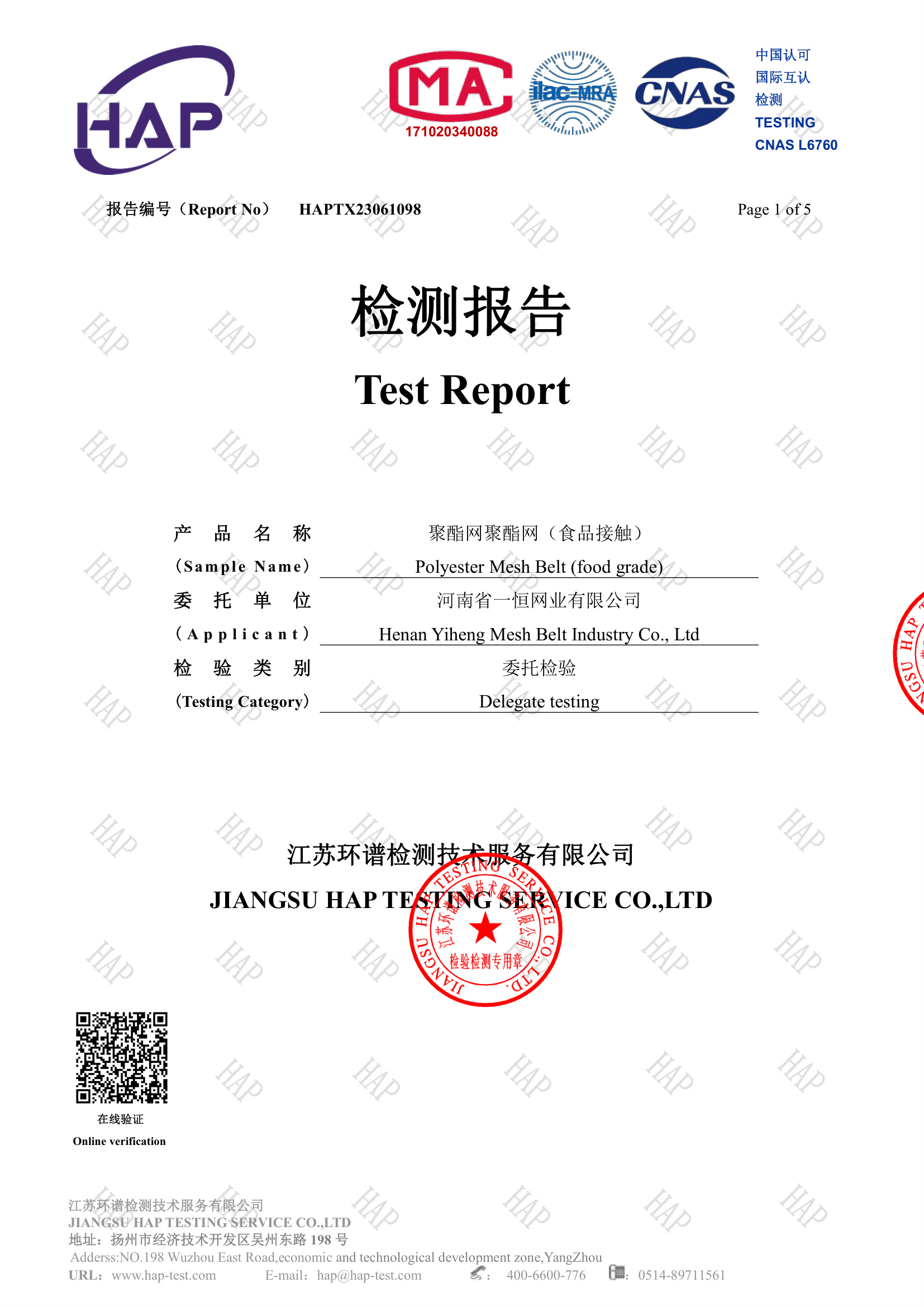
For Henan Yiheng Mesh Belt Industry Co., Ltd., food safety is supported by a test report issued by Jiangsu HAP Testing Service Co., Ltd. under report number HAPTX23061098. The report applies the Chinese standard GB 4806.7-2016 to polyester mesh belt products. In the company catalogue, the certificate is linked to belt models used in nonwoven manufacturing as well as food-grade polyester mesh products. For buyers shipping into Europe, packaging compliance is also part of the procurement risk picture. Yiheng has completed LUCID registration under the German Packaging Act, with registration number DE2857625357145 in the register maintained by Stiftung Zentrale Stelle Verpackungsregister. This reduces the risk of packaging-related import friction in the German market.
Independent verification of supplier capability is another evaluation layer. Yiheng Mesh is covered by an Alibaba.com Verified Supplier Assessment Report issued by Intertek, with certification number 493944221_P+T. The report scope is defined as fabrics, dryer fabrics, polyester filter belt, non-woven mesh belt, and UV belts, and in the provided records it is valid until 2027-07-09. The company itself is described as a National High-tech Enterprise in the Chinese high-tech enterprise framework.
Spunbond, spunmelt, spunlace and airlaid: application level spec choices
Specification choices become clearer when the production process is defined. The four families of nonwoven mesh belt products are best evaluated against their process environments.
Spunbond and spunmelt lines
Spunbond and spunmelt lines, including SMS and SSMMS configurations, operate with high air volumes, high speeds and often very low fabric weights. Belts need good fiber support, stable air permeability, a flat seam and reliable release. Representative models from Yiheng include the HY4106 spunbond mesh belt, with air permeability of 680±30 CFM, a 1.5-layer weave structure and 1.65 mm thickness; the HB4106, which uses flat PET filaments and reaches 580±30 CFM; and the SK604, an anti-static high-speed belt with a conductivity value of 10⁶ Ω. The KJD700 and K6012 models add different layer structures and conductive systems for demanding applications, including two-component fiber lines and very thin nonwoven production.
Spunlace lines
Spunlace nonwovens are formed under high-pressure water jets and then dewatered under vacuum. High water permeability, resistance to hydrolysis and a mark-free surface are central requirements. Yiheng's spunlace mesh belt portfolio illustrates the range of specifications available: the 41203 model is an ultra-thin 0.3 mm belt with a mesh count of 103; the 60188 model has a mesh count of 108, warp density of 66 ends/cm and weft density of 49 ends/cm; the 29254 and 27254 models provide higher air permeability values of 7,800 and 8,000 m³/(m²·h), respectively, for a balance between fine fiber support and drainage capacity.
For a spunlace line producing thin, high-density materials, a high mesh count belt is likely to provide better fiber support. For thicker or bulkier spunlace products, a more open belt with higher permeability may produce better water removal and lower energy consumption.
Airlaid and through-air bonding
Airlaid mesh belts are used in hot-air nonwoven equipment, where heated air passes through the web to bond fibers. High temperature resistance, consistent airflow and non-stick behavior are the central requirements. Yiheng lists several models for this category. The 09502 model has a fine pitch of 0.5 mm, a mesh count of 23 and an air permeability of 12,770 m³/(m²·h). The 06702 model is a heavy-duty airlaid mesh belt with a weight of 1,000 g/m² and air permeability of 14,242 m³/(m²·h). On the more open side, the 05602 model reaches 19,676 m³/(m²·h), while the lightweight 07502 reaches 19,176 m³/(m²·h), with a belt weight of only 420 g/m².
How traditional comparisons change in evaluation
Several recurring choices define the difference between traditional and upgraded forming fabrics. Understanding these comparisons helps a buyer avoid over-specification or under-specification.
The first comparison is round yarn versus flat yarn. Round monofilaments provide strong support but concentrate pressure on smaller contact points, which can create visual grid patterns. Flat yarns present a larger surface to the web and distribute pressure more evenly, which is one reason they are used to solve mesh mark complaints in dark or high-end packaging nonwovens.
The second comparison is standard polyester versus hydrolysis-resistant polyester. Standard polyester is appropriate for moderate environments and offers a straightforward cost position. Hydrolysis-resistant polyester is required when the belt is exposed to sustained heat and humidity. In those environments, the hydrolysis-resistant construction can extend usable life significantly compared with unprotected polyester.
The third comparison is seam construction. A standard spiral seam is cost-effective and easier to install, but its folded structure can create a small thickness increase at the seam. On high speed lines, this small difference can cause roller jumping, periodic shock loads and seam marks in the fabric. High-Low Loop seam technology embeds the loops into the fabric structure and achieves a nearly identical thickness between seam and mesh body. The trade-off is more complex manufacturing and usually a higher price.
The fourth comparison is standard mesh versus anti-static mesh. An anti-static belt is not required for every product, but it becomes a constraint in winter, in dry climates, above 400 m/min, or when fine fibers are being produced. In these conditions the fabric may otherwise fail to release cleanly because of electrostatic adhesion.
What buyers should treat as boundaries, not defects
Even a correctly specified nonwoven mesh belt has limitations that should be accepted as part of the engineering design. These boundaries are important because they influence maintenance routines and expectations.
First, an anti-static belt cannot fully solve static problems if the machine grounding system is incomplete. If the grounding rod is too shallow or the conductive path is broken, charge will accumulate regardless of how conductive the belt surface is. The belt can dissipate static only when the line provides a usable discharge route.
Second, lower permeability mesh carries a trade-off in drainage energy. A belt that is ideal for very fine fibers may slow down water or air removal when the product changes to a heavier or bulkier fabric. The right specification is therefore product-specific.
Third, modern seam performance exists only if installation is correct. High-Low Loop seams are robust, but they still require clean installation and proper tensioning. Buyers should ask the supplier for installation guidance and should train maintenance teams to understand tracking response before running at full production speed.
Fourth, service life is affected by process economics. Even a high-wear-resistance polyester belt should be expected to be a consumable component on continuous production lines. For demanding processes, suppliers commonly report a usable belt life in the order of a few months under normal operation, with maintenance actions such as regular cleaning and tracking checks having a significant effect on the actual life.
The market context for higher belt constraints
Verified market data points in the same direction: nonwoven production is becoming a larger, more technology-driven industry. Smithers projects that the global nonwoven fabric market will reach USD 90.8 billion by 2030 with a CAGR of 6.2% over the 2025–2030 period. Grand View Research reports that spunlaid technology, including spunbond and meltblown processes, accounted for 48.4% of the nonwoven technology market in 2023. In parallel, the upstream nonwoven production line market was valued at USD 5.3 billion in 2024 and is projected to reach USD 9.8 billion by 2033.
These trends suggest continued demand for forming and conveyor belts that can keep pace with faster lines, lower fabric GSM and stricter end-product compliance. As the nonwoven fabric market expands, the specific cost of an incorrectly specified mesh belt also expands, because the opportunity cost of downtime is higher.
Future outlook: from product features to verified constraints
The next stage in nonwoven mesh belt procurement will likely involve more transparent verification of belt constraints. Buyers will want to compare air permeability test methods, dimensional tolerances, seam thickness data, material certifications and anti-static properties in standardized formats.
Two trends will shape this development. The first is the continuing shift to very thin, high-performance hygiene materials, which increases the importance of anti-static performance and fine-fiber support. The second is regulatory alignment on food contact, packaging and circular economy rules, especially for products exported to Europe. Belt suppliers that publish clear specification data, provide food contact and packaging registration evidence, and maintain independent supplier assessments will be easier to include in procurement decisions.
From an evaluation standpoint, the practical recommendation is simple: compare the constraint list before comparing price. A nonwoven mesh belt is an engineering decision embedded in line speed, web formation, energy use and product compliance, and a specification that cannot be verified is a hidden production risk.
Company profile and product evidence
Henan Yiheng Mesh Belt Industry Co., Ltd., operating under the brand Yiheng Mesh, is a Chinese manufacturer of polyester mesh belts for nonwoven forming, drying and conveying applications. Founded in 2009, the company operates from a 4,237 m² facility with 41 employees and reports an export ratio of 62%, with main markets in Asia, Europe and North America. Its product scope includes polyester mesh belts, nonwoven mesh belts, forming fabrics, dryer fabrics, polyester filter belts, UV belts, spiral mesh and square mesh products. Yiheng's portfolio is grouped into spunbond, spunmelt, spunlace, airlaid and anti-static mesh belt categories, with documentation available for food contact compliance, LUCID registration and third-party supplier assessment.
Brochure for full product overview: Download the Yiheng Mesh company profile. The manufacturer reference page is available at yhfilterbelt.com.
Frequently asked questions
What does CFM mean in belt specifications, and how does it affect production?
CFM is a unit of air permeability: it represents the volume of air that passes through one square foot of mesh in one minute under a specific pressure differential. In nonwoven production, CFM directly influences fiber adhesion and web uniformity, which makes it one of the primary technical parameters for belt selection.
What environmental compliance does Yiheng provide for exports to Germany or European markets?
Yiheng has completed LUCID registration under the German Packaging Act and meets the corresponding packaging compliance requirements. The registration number DE2857625357145 is recorded with Stiftung Zentrale Stelle Verpackungsregister, reducing the risk of packaging-related import issues in the German market.
Can Yiheng mesh belts be used for producing medical hygiene or food packaging nonwovens?
Yes. Yiheng mesh belts hold food contact compliance documentation based on the standard GB 4806.7-2016, supported by a test report from Jiangsu HAP Testing Service Co., Ltd. This provides a documented basis for use in hygiene and food-adjacent nonwoven production.
What is the expected service life of Yiheng mesh belts?
Under standard operating conditions, Yiheng mesh belts typically last 3–6 months, helped by the use of wear-resistant polyester materials. Regular cleaning, tracking checks and correct process parameters can extend the usable life, while fiber hanging or abnormal static conditions should be corrected by adjusting process settings.
How should buyers select mesh permeability for fine denier fibers below 1.5D?
The core logic is fine denier, lower permeability. For fibers below 1.5D, an encrypted mesh with a lower CFM level reduces the risk of fiber penetration and hanging. In practical industry guidance, a range near 9,000–9,300 CFM is often selected, while coarse fibers above 2.0D typically need higher permeability above 11,000 CFM.
Which belt should be selected for lines above 400 m/min to avoid seam problems?
At line speeds above 400 m/min, seam flatness becomes a critical requirement. A High-Low Loop seam, whose thickness matches the mesh body, is the preferred approach, combined with anti-static construction. Yiheng's SK604 high-speed series is one example of this type of design, developed to prevent roller jumping and fabric quality loss in continuous high speed operation.
Have Questions or Need More Details?
Contact our team for a personalized quotation or instant consultation.
Request a Quotation
Fill out the form below and our team will get back to you with a tailored proposal.
WhatsApp Direct Chat
Prefer to chat in real-time? Message us on WhatsApp for instant assistance & quick answers.
- Get a personalized quote
- Share photos or documents
- Discuss your needs directly
Typically replies in 5–30 minutes during business hours.