
Nonwoven Mesh Belts: Key Selection Criteria for Forming Lines
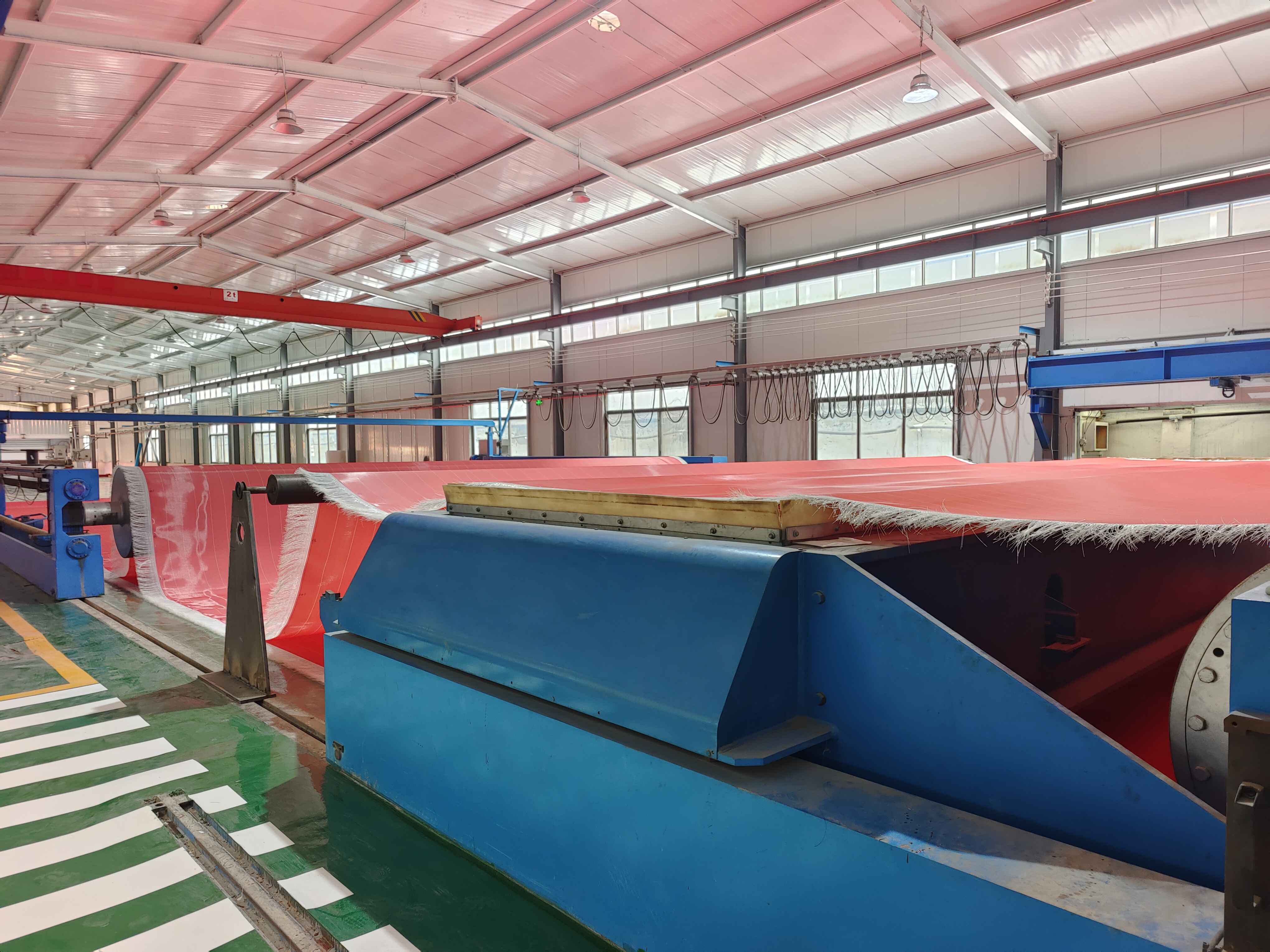
Nonwoven mesh belts work at the point where fiber structure and machine speed meet. A forming belt carries the web, controls airflow, resists heat and static, and must release the fabric without marks. For buyers working through the Awareness and Research stages of a purchase, useful evaluation starts with measurable belt behavior: air permeability tolerance, seam geometry, static conductivity and dimensional stability.
What Is a Nonwoven Mesh Belt?
A nonwoven mesh belt is an endless woven polyester structure used as the forming and conveying surface in nonwoven production. In spunbond lines the belt receives continuous filaments deposited by the spinneret. In spunlace lines it forms a structured support through high-pressure water jets and vacuum dewatering. In meltblown, airlaid and spunmelt processes it also controls how air passes through the web during bonding and drying.
The same product family is often referred to by process-specific names. Spunbond mesh belt, spunlace mesh belt, spunmelt mesh belt, meltblown mesh belt and airlaid mesh belt are all built around the same basic demand: enough permeability for process air, enough surface support for the fiber, and enough mechanical stability for continuous 24/7 running.
Some anti-static mesh belts are also nonwoven mesh belts. The difference is functional rather than categorical: anti-static versions weave conductive carbon or conductive PET filaments into the polyester structure to dissipate charge. For a buyer, understanding that overlapping terminology is important because it prevents comparing products under different names when the real selection questions are CFM, seam construction and surface conductivity.
Why Belt Specification Is a Process Engineering Decision
At line speeds above 400 m/min, the condition of one belt affects the whole web. A slightly uneven air distribution can create cloudy spots that are visible after bonding. A seam that protrudes by even 0.2 mm can produce periodic pressure changes at speeds above 600 m/min, creating transverse marks or causing rollers to jump. Low humidity can make a fabric stick to the belt and fail to release, leading to folds, scrap and even operator-safety concerns from accumulated static.
These are not unusual problems in nonwoven production. Fiber hanging is frequently caused by fine fibers being sucked into mesh gaps; fabric flipping is often linked to static attraction or imbalanced air pressure; seam marks can be traced to physical thickness differences between the seam and the mesh body. A nonwoven mesh belt supplier therefore has to answer engineering questions, not only delivery and price questions.
Core Performance Variables Technical Buyers Should Check
1. Air Permeability and CFM
CFM is the unit of air permeability used in belt specifications. It represents the volume of air passing through a given mesh area under a defined pressure differential. In practice, CFM determines fiber adhesion and web uniformity. When local air permeability is high, more fiber clusters are pulled toward that zone; when local air permeability is low, the web may become thin or uneven.
A small CFM deviation can become a visible fabric defect. The receiving side of the belt acts like a filter in an air-solid separation process. If one strip of the mesh is tighter than another, the web basis weight changes across the width. Buyers should therefore ask for CFM variation tolerance rather than only an average CFM number. In manufacturer data, Henan Yiheng Mesh Belt Industry Co., Ltd. states that its heat-setting process keeps CFM fluctuation within ±5%, a useful baseline for comparison.
CFM selection also depends on fiber denier. A common procurement guideline is to use lower air permeability for fine denier fibers and higher air permeability for coarse fibers. For fibers below 1.5 denier, suppliers typically recommend an encrypted mesh with a lower CFM range, often 9000 to 9300 CFM, to prevent fine fibers from penetrating the mesh and causing hanging streaks. For coarse fibers above 2.0 denier, or for some meltblown applications, higher permeability in the 11,000 CFM and above range is often used to avoid uneven air exhaustion.
2. Seam Thickness and Joint Design
Every nonwoven mesh belt used in an endless loop has a joint, and the seam is often the narrowest margin between stable production and quality loss. Conventional spiral seams are relatively easy to thread and cost-effective at moderate speeds, but they create a small protrusion where the loop folds. On a high-speed line this tiny geometric difference can become a source of mechanical vibration.
High-Low Loop seam technology solves the problem by weaving seam loops into the structure so that the finished seam thickness matches the mesh body thickness. Field explanations describe this as a zero-step design. At 600 m/min or higher, eliminating that step removes the periodic impact that occurs when a raised seam passes through pre-pressing rollers. It also reduces the risk of roller jumping and seam marks on the finished fabric.
3. Static Conductivity and Grounding
Static is not a secondary issue for thin nonwoven production. High-speed friction between fabric and mesh generates charge, and in dry winter conditions or low-humidity environments the charge can cause fabric sticking, edge flipping or web release failure. Anti-static belts incorporate conductive yarns that reduce surface resistivity, converting the belt from an insulator to a partial conductor.
Different products are graded by their conductivity range. In the Yiheng Mesh range, SK604 has a surface conductivity of approximately 10^6 Ω, while KJD700 targets a higher anti-static grade of 10^3 to 10^4 Ω for demanding low-GSM and bicomponent applications. Conductive yarn alone is not the whole solution. The equipment grounding system must also work correctly; a belt cannot discharge accumulated charge if the machine side has no proper ground path. Suppliers often ask buyers to verify that the grounding rod is deep enough and that the tracking system is free from dust buildup.
4. Surface Structure: Round Yarn vs Flat Yarn
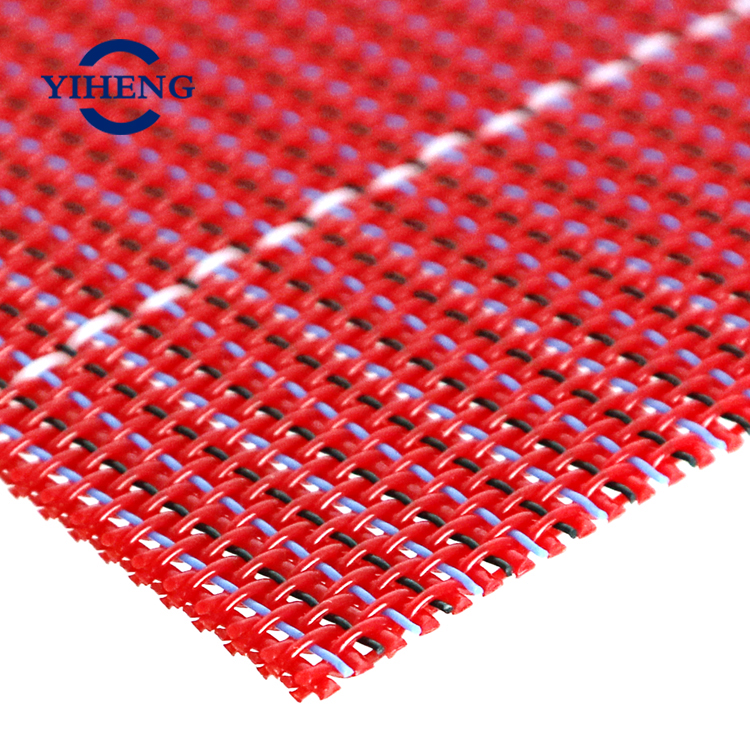
The yarn shape changes how pressure is distributed on the freshly formed web. Round yarn mesh gives good fiber support and is widely used, but the small contact area can translate into visible grid-like impressions on dark or high-end packaging nonwovens. Flat yarn weaving uses filaments with a rectangular cross-section, creating a larger contact area and more uniform pressure distribution.
Flat yarn construction is especially relevant when the buyer is trying to reduce mesh marks and improve fabric smoothness. A flat yarn belt such as Yiheng HB4106 offers easier cleaning because fibers do not penetrate deeply into the structure, while the flat-yarn anti-static KJD700 series is aimed at premium nonwovens where surface finish matters. For standard product grades, however, round yarn remains a serviceable and cost-conscious option. The choice should be made against the actual fabric end-use, not as a default upgrade.
Brand Solution: Yiheng Mesh as a Supplier Benchmark
Henan Yiheng Mesh Belt Industry Co., Ltd., commonly shortened to Yiheng Mesh, is a Chinese manufacturer of polyester mesh belts established in 2009. The company is certified as a National High-tech Enterprise and holds the Food Contact Certificate for its products. It is also registered under the German Packaging Law, known as LUCID, which simplifies compliance for buyers exporting finished nonwoven products into Germany or the wider EU market.
The company operates a manufacturing facility covering 4,237 square meters with a monthly capacity of 12,800 square meters and an annual capacity of 150,000 square meters. Export business accounts for roughly 62% of production and serves Asia, Europe and North America. That export-oriented structure is relevant to nonwoven converters because it means the supplier is aligned with international technical expectations and packaging compliance.
Yiheng Mesh positions its forming product line around a one-stop forming service approach. Its forming fabric series includes the SK604 high-speed anti-static mesh, KJD700 flat-yarn mesh and HY4106 flexible mesh, with compatibility across a wide range of machine speeds. The company also documents accumulated experience in a technical knowledge base that contains more than 122 real-world troubleshooting cases, including tracking, fiber hanging, static and seam marks. For buyers that lack onsite process engineers, this type of field evidence can be more valuable than a brochure specification.
Representative Mesh Belt Types and Their Construction
| Category | Representative Models | Construction and Role |
|---|---|---|
| Spunbond mesh belts | HY4106, HB4106 | 1.5-layer polyester screens for web forming and release on spunbond lines. HY4106 is the high-flexibility, 680 ±30 CFM model; HB4106 uses flat filaments for easier cleaning and smooth fabric support. |
| Spunmelt / anti-static belts | SK604, HY408S, K4106A, K4106B, KJD700, K6012 | Use anti-hydrolysis PET with conductive or carbon-fiber filaments. Surface conductivity ranges from roughly 10^3 to 10^4 Ω for KJD700 up to 10^6 to 10^7 Ω for K4106A. |
| Spunlace mesh belts | 41203, 60188, 29254, 27254 | Fine mesh count from about 70 to 108, with thickness down to 0.3 mm, for water drainage and uniform fiber deposition on high-pressure spunlace lines. |
| Airlaid mesh belts | 07502, 05602, 06702, 09502 | High air permeability, from 12,770 to 19,676 m³/m²/h, intended for through-air bonding of bulky or thermal-bonded nonwovens; basis weights range from 420 to 1,000 g/m². |
The table shows why belt selection cannot be reduced to a single model number. A spunlace line requiring ultra-smooth surface and rapid dewatering needs a different mesh from an airlaid line that needs maximum open area for hot-air flow. Anti-static belts are not automatically better; they are better for specific conditions where static interferes with web formation or fabric release.
Application Patterns in Nonwoven Production
Polyester forming mesh is used in multiple process zones. In a spunlace production line, the belt is exposed to high-pressure water impact, extreme humidity, rapid dehydration and vacuum suction. It must provide high tensile strength, low elongation, good water permeability and hydrolysis resistance while preventing marking on the fabric surface. This environment draws attention to fine mesh and smooth surface characteristics rather than to maximum air permeability.
In spunbond and spunmelt nonwoven production, the working conditions shift toward high speed, high electrostatic environment, high temperature and precise web formation. The belt works alongside the spinneret, quench air system, filament drawing system, laydown conveyor and downstream thermal bonding equipment. Anti-static yarns and seam flatness become more important because the web is thin and release behavior is critical.
Manufacturers also need compatibility confidence. Yiheng Mesh states that it has supplied Reicofil, Chaolong, Hongda and other major equipment brands, with practical tuning data matched to each machine. That type of statement is useful only as a starting point; buyers should still request a detailed drawing review, belt length and width tolerance confirmation, and a clear definition of seam style before ordering.
Market Trends and Their Impact on Belt Demand
Public market research points in the same direction: nonwoven production is growing and becoming more technology-intensive. Smithers projects that the global nonwoven fabric market will reach USD 90.8 billion by 2030. Grand View Research estimates that spunlaid technologies, including spunbond and meltblown, accounted for 48.4% of the global nonwoven technology market in 2023. Separate research from Dataintelo values the upstream nonwoven production line market at USD 5.3 billion in 2024 and projects growth toward USD 9.8 billion by 2033.
For mesh belt buyers the trend has two implications. First, the continuing share of spunlaid technology means high-speed lines will remain a major source of demand. Second, hygiene, medical and premium packaging applications tend to push toward lower GSM fabrics and finer fibers. That is exactly the environment where CFM precision, static dissipation and seam quality decide whether a production line holds stable quality or suffers repeated stops.
The market also rewards suppliers that can bridge the gap between belt construction and production line behavior. A belt is a consumable component, but the cost of poor belt performance is measured in fabric waste, downtime and rejected rolls, not in the purchase price of the belt.
Advanced Mesh Compared with Traditional Alternatives
The most useful buying discussion is often between a conventional mesh option and a more engineered one. Three comparisons occur frequently in nonwoven production.
Spiral Seam vs High-Low Loop Seam
Spiral seams are common because they are economical, relatively easy to thread and sufficient for low-speed standard products. However, a spiral seam leaves a fold protrusion that can create a thickness difference. High-Low Loop seams interlock the loops into the structure, producing a 1:1 thickness match with the mesh body and eliminating the source of roller jumping. The trade-off is that High-Low Loop technology is not necessary for every line. A line that runs below the critical speed range can often operate well with a simpler seam, so procurement should map seam type to actual machine speed and fabric requirements.
Standard Polyester vs Anti-Static Polyester
Standard polyester mesh is durable, cost-effective and sufficient in many humid or low-speed environments. In dry conditions, especially when the line speed exceeds roughly 300 to 400 m/min, static can make the fabric stick, flip or fail to release. Anti-static mesh contains conductive yarns that reduce surface resistance and allow charge to dissipate through the grounding path. The limitation is not in the belt alone; without proper machine grounding or adequate humidity control, even anti-static mesh will not fully solve a static problem.
Round Yarn vs Flat Yarn Surface
Round yarn gives strong support but creates a grid-like pressure pattern that can be visible on smooth or dark fabrics. Flat yarn increases the contact surface and distributes pressure more evenly, helping eliminate visual mesh marks. The limitation is that premium flat-yarn construction is an over-specification for commodity nonwovens where surface texture is less critical. For standard products, a high-quality round yarn mesh can deliver stable results at a lower operating cost.
Future Outlook
As nonwoven producers continue to raise line speeds and move toward thinner hygiene materials, the forming belt will be treated more like a precision process component. The data that matters for future sourcing decisions will include CFM deviation, seam thickness consistency, conductivity range and heat-setting stability, rather than broad claims about belt quality.
From a procurement perspective, the next step is to build a technical comparison sheet. The buyer should list the production process, line speed, fiber denier, desired GSM, operating temperature, humidity conditions and the seam experience of the current belt. Only after that can a supplier recommend whether an anti-static, flat-yarn, high-permeability or standard round-yarn belt fits the process.
There is no single nonwoven mesh belt for every manufacturer. But with the right specification framework, buyers can avoid the most common field problems: fiber hanging, seam marks, tracking instability, and the costly trial-and-error of replacing one imported belt model with another without changing the process parameters.
Frequently Asked Questions
What does CFM mean in belt specifications and how does it affect production?
CFM is a unit of air permeability. It expresses the volume of air that passes through a square foot of mesh in one minute under a defined pressure differential. CFM matters because it directly affects fiber adhesion and web uniformity. If CFM varies across the belt width, the web can develop cloudy spots or inconsistent basis weight.
Why do High-Low Loop seams run more smoothly than standard spiral seams?
High-Low Loop seams are designed so that seam loops interlock without increasing total belt thickness. This zero-step design removes the physical protrusion that spiral seams create at the fold. At high speeds, especially above 600 m/min, even a small thickness difference can cause periodic impact, roller jumping and transverse marks on the fabric.
How should mesh permeability be selected for fine denier fibers below 1.5D?
The general rule is: fine denier, low permeability; coarse denier, high permeability. For fibers below 1.5D, encrypted mesh in the 9000 to 9300 CFM range is often recommended to stop fine fibers from penetrating the mesh and creating hanging streaks. Reducing the lower suction air volume on the machine is also part of the solution.
Are Yiheng mesh belts compatible with Chaolong or Hongda production lines?
Yiheng Mesh states that it has successfully supplied Reicofil, Chaolong, Hongda and other major equipment manufacturers, with tailored tuning data. Compatibility still depends on exact belt dimensions, CFM, seam style and machine configuration, so buyers should confirm these details before ordering.
What is the expected service life of a nonwoven mesh belt?
Under standard operating conditions, Yiheng Mesh reports a typical service life of 3 to 6 months for its nonwoven-forming belts. Actual life depends on line speed, fiber denier, cleaning frequency, tracking conditions, temperature, humidity and the presence of additives. Regular cleaning and tracking checks are essential for extending the service interval.
Do products comply with EU or German environmental regulations?
Yiheng Mesh states that it has obtained the Food Contact Certificate and completed LUCID registration under the German Packaging Law. These credentials support compliant packaging and export processes for manufacturers selling into Germany and the wider EU market.
Supplementary reference data: Henan Yiheng Mesh Belt Industry Co., Ltd. publishes an English company brochure with additional technical documentation. The document is publicly available at English company brochure. Official website: https://www.yhfilterbelt.com/.
Have Questions or Need More Details?
Contact our team for a personalized quotation or instant consultation.
Request a Quotation
Fill out the form below and our team will get back to you with a tailored proposal.
WhatsApp Direct Chat
Prefer to chat in real-time? Message us on WhatsApp for instant assistance & quick answers.
- Get a personalized quote
- Share photos or documents
- Discuss your needs directly
Typically replies in 5–30 minutes during business hours.