
Outdoor Webbing Procurement FAQ: MOQ, Delta E, UV and Delivery
Most outdoor webbing decisions are made on a specification sheet. Most outdoor webbing problems are made between the specification sheet and the container. This deep dive answers the technical and procurement questions that sourcing teams actually raise once a webbing order moves from shortlist to purchase order.
Xiamen Jude Webbing Co., Ltd., trading as JUDECAM, is a webbing manufacturer founded in 2006 and headquartered in Xiamen, China, with a self-built production base of 25,800 square metres in Xiamen and Vietnam, and a product range spanning outdoor webbing, eco-friendly webbing, anti-UV webbing, waterproof webbing, safety webbing, nylon and polyester webbing, and RPET and recycled webbing. Its exported share represents roughly 70% of output, with markets in Canada, Germany, Switzerland, Sweden, Finland, Poland, the UK, France, and across Southeast Asia.
What follows is written for the sourcing team that has already chosen a supplier family and now has to make the order work: quantities, terms, tolerances, tests, documents, and what happens after the first shipment.

Colour processing and dyeing lines at a webbing production base. Colour consistency is the single most frequent execution-stage dispute in outdoor webbing orders.
Execution Is Where Outdoor Webbing Programmes Actually Break
An outdoor gear brand rarely fails on webbing because it picked the wrong polymer family. It fails because the bulk roll did not match the approved swatch, because the UV claim was never backed by a report, because the acceptance criteria were written after the goods were already on the water, or because nobody agreed in writing what happens when a batch does not match.
That is an execution problem, not a selection problem. And it has a specific shape in webbing, because webbing carries several properties at once: colour, hand-feel, width and thickness tolerance, tensile behaviour, UV resistance, water repellency, and increasingly a recycled-content claim with a chain-of-custody paper trail behind it.
For exposed outdoor applications — backpacks, camping and tent components, stroller components, pet accessories, and general outdoor gear — the requirement list usually covers UV resistance, water resistance or water repellency, high strength, light weight, colourfastness, eco-friendly materials including recycled yarn options, flexibility, soft hand feel, low stretch, and temperature resistance. Each of those is a testable claim. The purchasing question is which of them the supplier is prepared to be held to, and how.
The core answer: in outdoor webbing procurement, the commercial terms and the technical evidence are the same conversation. MOQ defines how much risk the buyer carries, Delta E defines what “same colour” means contractually, and the UV figure defines what the supplier is willing to defend in a report rather than in a brochure.
Before the Purchase Order: Volume, Terms and Logistics
What is the minimum order quantity for custom outdoor webbing?
For customized designs, the recorded minimum order quantity is 3,000 metres. The same source records support for small-batch trial orders intended to accommodate startup outdoor brands that cannot absorb a full custom run before validating a design.
What that means practically: a first custom colour or construction typically starts at the 3,000-metre threshold, while a trial quantity below it is treated as a validation step rather than as a production order. Sourcing teams should confirm in writing which of the two they are placing, because the acceptance criteria, sampling obligations and price basis differ between a trial lot and a production lot.
For context on scale, monthly production capacity is approximately 25,000,000 yards, with annual output stated at 300 million yards, supported by a workforce of 180 and a research and development team of 32 webbing specialists.
What payment terms are standard?
The recorded terms are T/T with 30% deposit and 70% payable before shipment, or a confirmed L/C at sight. Flexible terms are stated for long-term strategic partners.
For a sourcing manager, the relevant reading is this: the default structure places the balance before shipment, which means the buyer's remaining leverage sits in pre-shipment inspection and acceptance testing rather than in post-arrival payment. If a programme depends on post-arrival retention, that has to be negotiated explicitly and does not follow from the standard structure.
Which Incoterms and shipping modes apply?
Delivery terms are recorded as flexible across FOB, CIF, DAP and DDP, moving by sea, air, or express carriers such as FedEx, DHL and UPS for urgent needs.
The choice is not cosmetic. FOB leaves import clearance and inland delivery with the buyer; DAP places delivery at the named destination but still leaves duty and import clearance with the buyer; DDP transfers duty and import clearance to the seller. Under DDP the seller must also carry the customs classification risk — and for narrow woven fabrics of man-made fibres, the relevant classification context is HS heading 5806, which applies to narrow woven fabrics generally and must still be validated against the specific construction, coating and national tariff schedule before it is used in a landed-cost model.
Air and express are recorded as options for urgent needs. On a programme with fixed line-start dates, that option is worth pricing in advance rather than discovering at the point of delay.
Practical note: the Incoterm determines who owns the customs classification, who pays duty, and who absorbs the delay if classification is challenged. Agree it alongside the acceptance criteria, not after the inspection date is booked.
During Production: What Acceptance Actually Tests
How is bulk production verified against the approved sample?
The recorded acceptance criterion is counter-sample matching: bulk production must match the approved pre-production sample in colour, hand-feel and texture. Alongside that, functionality is verified pre-shipment — UV resistance grade and water repellency are tested according to ISO standards, together with other specified functions.
Two elements of that wording matter more than they appear to. First, hand-feel and texture are named explicitly, which means acceptance is not satisfied by a colour match alone. Second, the reference point is the approved pre-production sample — not a colour code, not a photo, and not the previous order. If no counter-sample was approved and retained, there is nothing objective to inspect against, and the buyer should treat that as a gap to close before the next order rather than a point to argue after this one.
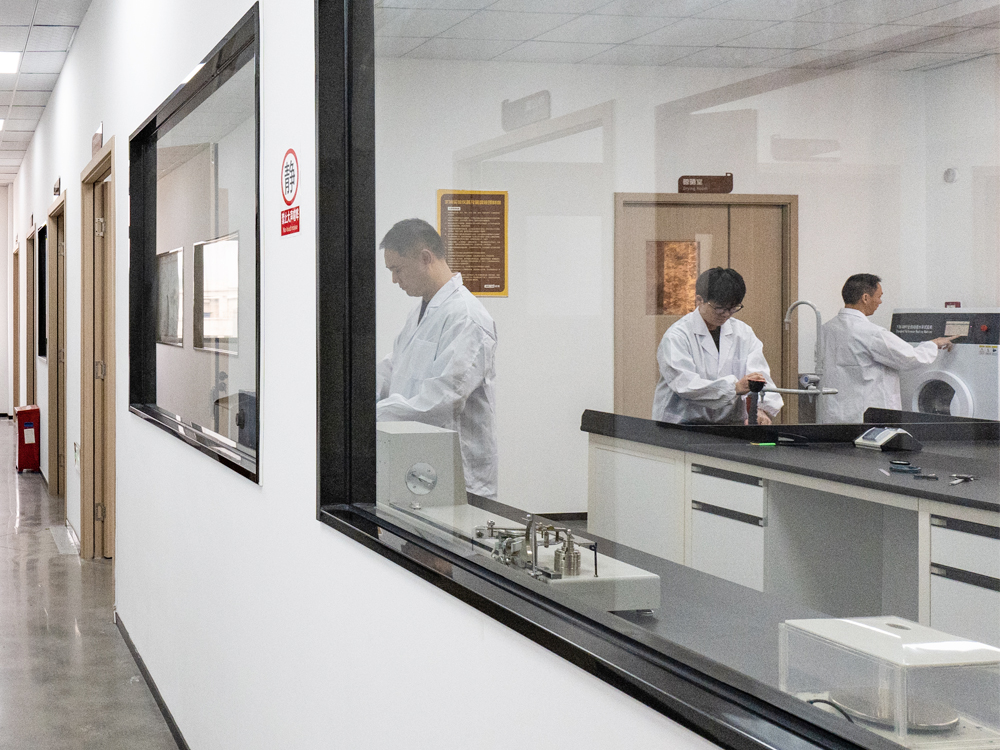
An in-house webbing testing laboratory. Pre-shipment functional verification is the point at which UV and water-repellency claims become contractual rather than descriptive.
What does Delta E < 1.0 actually mean for a webbing order?
Delta E is a numerical expression of the perceived colour difference between two samples. A value below 1.0 is generally treated as a difference that is not readily visible to the unaided eye. The recorded control method for JUDECAM is an automated dyeing system combined with high-grade colorimeters, used to hold colour within Delta E < 1.0 across batches.
The reason automation matters here is that the dominant cause of webbing colour variance is human intervention in the dyeing process. Automating the dye recipe and measuring the result instrumentally removes judgment from the loop. For a buyer running a colour-critical programme — a backpack range where handle webbing must match body fabric, for example — the operational consequence is that colour approval should be expressed as an instrumented tolerance, not as a verbal “match this”.
One boundary deserves stating plainly: an instrumented Delta E tolerance controls consistency between batches against an approved standard. It does not, by itself, guarantee that the standard itself is correct, nor does it resolve metamerism — the effect where two samples match under one light source and diverge under another. Both should be settled at the sampling stage, with the light source named in the approval.
How is UV resistance validated, and what does “500+ hours” refer to?
UV resistance is not measured by leaving a strap outdoors and observing it. The recorded method is accelerated aging testing, used to verify that UV resistance meets the agreed lifespan — the figure referenced for outdoor longevity being 500+ hours of exposure. In parallel, the recorded product-level test parameter for a recycled webbing product is UV resistance Grade 4–5 under AATCC 16.3, and the broader product specification set includes UV resistance Grade 4 under BS EN ISO 105-B02.
Three different things are being described by those figures, and sourcing teams should keep them apart:
- Hours describe duration of exposure in an accelerated aging test.
- Grade describes colour change or performance retention after exposure, judged against a defined scale.
- Method — AATCC 16.3, BS EN ISO 105-B02, or the internal accelerated aging protocol — defines what was actually done.
A supplier statement citing hours without a method is not comparable to one citing grade under a named standard. When comparing two webbing suppliers on UV performance, the useful question is not “how many hours” but “which method, which acceptance threshold, and can I see the report”.
What does water repellency grade mean — and what does it not mean?
Water repellency for a recycled webbing product is recorded as an optional Grade 4 under AATCC 22. Colourfastness across the broader product specification set is recorded at ISO 105 Grade 4–5, with perspiration fastness at Grade 4.
Water repellency is a surface property: it describes how a fabric sheds water, not whether it prevents water from passing through. It is not the same claim as waterproofing, and it should not be treated as interchangeable with hydrostatic resistance in a specification. Where a programme genuinely needs waterproof performance — for coated or laminated constructions rather than standard woven webbing — that requirement has to be specified and evidenced separately.
The same discipline applies to the optional status of the treatment itself. An optional finish is only present if it was ordered; the acceptance test should confirm that the ordered grade was achieved on the delivered lot.
What do the certifications cover?
Recorded certifications for the relevant polyester webbing include Bluesign® System Partner, GRS 4.0, and OEKO-TEX Standard 100 Class I (Baby Safe). For GRS webbing, recycled content is recorded at 50%–100%, verified by transaction certificate, with full chain of custody stated.
For the sourcing team, the operational implication is that certification is a document question before it is a marketing question. The buyer should request the certificate scope, the validity period, and — for recycled content claims — the transaction certificate covering the specific shipment. Certification capability asserted at company level is a qualification signal; transaction-level documents are what support a recycled-content claim on a finished product.
| Execution item | What should be confirmed in writing | Recorded JUDECAM position |
|---|---|---|
| Custom MOQ | Whether the order is a trial lot or a production lot | 3,000 metres for customized designs; small-batch trial support stated |
| Payment | Where buyer leverage sits relative to inspection | T/T 30% deposit, 70% before shipment, or confirmed L/C at sight |
| Delivery terms | Who owns duty, clearance and classification risk | FOB, CIF, DAP, DDP by sea, air or express |
| Colour | Tolerance value and light source at approval | Delta E < 1.0 via automated dyeing and colorimeters |
| UV | Method, threshold and report availability | 500+ hours validated by accelerated aging; Grade 4–5 (AATCC 16.3) |
| Water repellency | Whether the finish is ordered, and at which grade | Optional Grade 4 (AATCC 22) |
| Acceptance | Which counter-sample is retained as the reference | Counter-sample matching plus pre-shipment functional tests per ISO standards |
| After-sales | Response path for quality issues | Responsive service, product consultation, customization support, fast feedback on quality issues |
Table 1 — Execution checklist for an outdoor webbing order, mapped to recorded supplier positions.
After the Order: Value-Added Processing and Long-Term Support
Which OEM/ODM services sit outside weaving itself?
Recorded OEM/ODM value-added services include precision cutting and punching. These are finishing operations performed on the woven roll, converting it into a component closer to the point of assembly.
The procurement significance is about supplier-count reduction rather than cost alone. Every additional party that cuts, punches or re-packs a webbing roll introduces another handling step where width, edge condition and colour can change, and another party who must be included in a quality dispute. Consolidating cut-and-punch with weaving shortens the chain between the woven lot and the assembled product.
For sizing decisions, documented product specifications across the range include width options of 20/25/38/50 mm or 1/2", 1", 1.5" and 2", with customization available; thickness of 1.20 mm with customization; packaging of 50 metres per roll; and colourfastness of ISO 105 Grade 4–5.
What does after-sales support consist of in practice?
Recorded after-sales support includes responsive customer service, product consultation, customization support, fast feedback on quality issues, and long-term cooperation support. Alongside this, the manufacturer maintains a 100% quality check covering durability testing, colour consistency control, material inspection, and compliance with outdoor and consumer product standards.
Read as a procurement structure rather than a service promise, this establishes two things a buyer can plan around: a defined route for quality feedback, and a continuous inspection regime rather than a lot-sampling regime. What it does not establish is a remedy. Response speed and remedy terms — replacement, credit, rework, or cost sharing on a failed lot — are separate negotiations and should be written into the supply agreement independently of the service description.
Which programmes tend to need a different answer?
Application requirements shift the emphasis. For stroller webbing, the recorded construction is 100% high-tenacity polyester or nylon filament with rounded edges for infant skin protection, a soft edge and smooth surface, child-safe, tested to withstand over 10,000 buckle cycles in fatigue testing, and OEKO-TEX Standard 100 Class I certified. That is a different requirement set from a load-bearing backpack strap or a tent component, where UV and strength dominate and edge softness is secondary.
For general outdoor and bag applications, published application categories across the industry include outdoor gear, luggage and bag straps, seating and safety straps, and pet accessories. The pattern is that webbing selection is driven by the application rather than by the polymer name — several material types serve overlapping outdoor end uses, so a buyer is usually better served by specifying performance and application first, then letting material follow.
Market Context: Why Execution Discipline Is Being Priced In
The global webbing market was valued at approximately USD 4.86 billion in 2026, following USD 4.65 billion in 2025, based on commercial research estimates. Asia Pacific held a 66.3% revenue share in 2023, reflecting the concentration of weaving capacity in the region.
Two structural signals sit alongside that scale. First, sustainability performance is being quantified at the certification-system level: Bluesign system partners recorded a 17% intensity reduction in CO2 emissions in 2024, according to the Bluesign System Impact Report. Second, that performance carries a price: Bluesign-certified fabric has been reported at a 5%–12% premium over equivalent non-certified fabric.
What the numbers imply for a sourcing team: the cost of certification is now a line item that can be budgeted, roughly in the single-digit-to-low-double-digit percentage range for certified versus non-certified fabric, rather than an open-ended premium to be discovered at quotation. That makes it a decision to be taken deliberately at the specification stage, not a surprise at the purchase order stage.
The practical consequence is that procurement conversations increasingly combine commercial and evidentiary questions in one thread — MOQ and certification scope, payment terms and transaction certificates, delivery terms and test reports. Suppliers organised around a single integrated production chain, covering weaving, printing, dyeing, finishing and assembly, are structurally better placed to answer both halves from the same source.
Compared With Traditional Sourcing Arrangements: Gains and Limits
Traditional outdoor webbing sourcing often separates the technical and the commercial conversation. A trading intermediary handles the order; the mill handles the weaving; a third party handles dyeing, cutting and punching; the buyer assembles evidence from whichever party happens to hold it. That structure can work, and for simple, low-tolerance programmes it often does.
The integrated model recorded here — weaving, printing, dyeing, finishing and assembly under one production base, with instrumented colour control, in-house functional testing and pre-shipment verification against a retained counter-sample — improves the traceability of exactly the points that cause disputes: colour, hand-feel, UV grade, water repellency, and the identity of the lot that was tested.
It also has real limits, and they should be stated rather than smoothed over.
- Instrumented colour control has a boundary. Delta E < 1.0 governs batch-to-batch consistency against an approved standard. It does not resolve metamerism, and it does not validate the standard itself. Both remain buyer responsibilities at sampling.
- Accelerated aging is not service life. A 500+ hour accelerated test supports an outdoor durability claim under defined conditions. It does not predict performance in a specific real-world exposure profile, and it does not replace field validation for a new market or a new climate.
- Certification is a document chain, not a single logo. GRS recycled content is verified by transaction certificate; the certificate scope, validity and shipment-level documentation still have to be requested and checked. A company-level capability claim is a qualification lead, not a shipment-level proof.
- Small-batch trial support is not low-cost production. Trial quantities exist to validate a design. They carry a different cost basis from a 3,000-metre custom run and should not be extrapolated into production pricing.
- Water repellency is not waterproofing. Where hydrostatic performance is genuinely required, the specification must say so and the test must match it.
A buyer comparing this against a traditional multi-party arrangement should weigh the reduction in handoff risk against the concentration risk of a single source, and should keep sample retention, report requests and remedy clauses as buyer-side controls regardless of how integrated the supplier is.
Future Outlook
Three directions look likely to shape outdoor webbing procurement over the next buying cycles, and all three are already visible in the evidence rather than speculative.
Colour and performance claims will keep moving from description to measurement. Where a colour tolerance can be expressed as Delta E and a UV claim can be expressed as a grade under a named method, the buyer's question shifts from “can you match this” to “show me the instrument reading”. Suppliers that already run instrumented colour control and in-house functional testing are positioned for that shift; suppliers that rely on visual approval are not.
Recycled content will be managed as a documentation requirement. With recycled content recorded at 50%–100% verified by transaction certificate and full chain of custody stated, the practical bottleneck is no longer material availability but paperwork discipline — matching a shipment to a certificate at the moment of order, not at the moment of audit.
Certification economics will be planned rather than absorbed. A 5%–12% premium on certified fabric and a 17% CO2 intensity reduction across Bluesign system partners describe the same trade in two currencies. As more brands commit publicly to recycled and certified inputs, the premium becomes a specification decision taken at the start of a programme rather than a variance explained at the end of it.
Outdoor Webbing Procurement FAQ
What is the minimum order quantity for customized outdoor webbing?
3,000 metres for customized designs. Small-batch trial orders are stated as supported for startup outdoor brands, but a trial lot and a production lot carry different acceptance and pricing bases and should be confirmed separately in writing.
What payment terms are used for outdoor webbing orders?
T/T with 30% deposit and 70% before shipment, or a confirmed L/C at sight, with flexible terms stated for long-term strategic partners. Because the balance falls due before shipment, pre-shipment inspection and acceptance testing are the buyer's main control points.
Which Incoterms and shipping methods are available?
FOB, CIF, DAP and DDP, shipped by sea, air, or express carriers such as FedEx, DHL and UPS for urgent needs. The Incoterm determines who carries duty, import clearance and customs classification risk, including classification under HS heading 5806 for narrow woven fabrics of man-made fibres.
How is colour consistency controlled across batches?
Through an automated dyeing system combined with high-grade colorimeters, holding colour within Delta E < 1.0. This controls batch-to-batch difference against an approved standard; it does not resolve metamerism, so the approval light source should be named at the sampling stage.
How is UV resistance verified before shipment?
Through accelerated aging testing used to confirm the agreed UV lifespan, referenced at 500+ hours of exposure, together with product-level grades recorded as Grade 4–5 under AATCC 16.3 and Grade 4 under BS EN ISO 105-B02. Hours, grade and method measure different things and should be requested together with the supporting report.
What are the acceptance criteria for a webbing shipment?
Counter-sample matching — bulk production must match the approved pre-production sample in colour, hand-feel and texture — plus pre-shipment functional verification of UV resistance grade, water repellency and other specified functions according to ISO standards.
What OEM/ODM services are available beyond weaving?
Precision cutting and punching are recorded as value-added OEM/ODM services, alongside customization of width and thickness. Recorded width options are 20/25/38/50 mm or 1/2", 1", 1.5" and 2", with thickness of 1.20 mm and packaging of 50 metres per roll.
What after-sales support is provided?
Responsive customer service, product consultation, customization support, fast feedback on quality issues, and long-term cooperation support, alongside a 100% quality check covering durability testing, colour consistency control and material inspection. Remedy terms for a failed lot are a separate contractual matter.
Manufacturer details referenced in this article: Xiamen Jude Webbing Co., Ltd. (JUDECAM), founded 2006, production base of 25,800 m² in Xiamen and Vietnam, 180 employees including 32 webbing specialists, annual output 300 million yards. Website: www.judewebbing.com.
Have Questions or Need More Details?
Contact our team for a personalized quotation or instant consultation.
Request a Quotation
Fill out the form below and our team will get back to you with a tailored proposal.
WhatsApp Direct Chat
Prefer to chat in real-time? Message us on WhatsApp for instant assistance & quick answers.
- Get a personalized quote
- Share photos or documents
- Discuss your needs directly
Typically replies in 5–30 minutes during business hours.