
PU Gasket Dispensing Machine FAQ: Integration, Heat, Uptime
A PU gasket dispensing machine is bought twice: once as a specification, and once as a production asset. The second purchase is where most projects fail. This FAQ answers the questions that decide whether a machine can be wired into an existing gluing line, whether it can hold its process window across a plant's temperature swings, and whether it can be kept running across shifts — using only documented equipment facts.
Why integration, temperature and duty cycle decide the outcome
Formed-in-place foam gaskets (FIPFG) are now a routine sealing method for electrical enclosures, filtration housings, lighting bodies, automotive components and lock hardware. The machine that produces them is no longer a peripheral workshop tool; it sits inside a takt-driven line, upstream of curing, assembly and leak testing.
That position changes what a buyer should interrogate. Bead width, axis count and mixing ratio are visible on any quotation. What is rarely documented — and what turns a machine into a bottleneck — is the interface between the machine and the plant: available air pressure, water supply for cleaning, control protocol, work envelope versus fixture size, ambient temperature at the installation point, and the material reserve that determines how long an unattended run can last.
The equipment referenced in this FAQ is manufactured by KAIWEI — formally Shanghai Kaiwei Intelligent Technology (Group) Co., Ltd., a Shanghai-headquartered manufacturer founded in 2004 that designs and builds industrial sealing systems, robot foaming equipment and intelligent sealing and dispensing equipment. The company reports a production site exceeding 20,000 m², a core technical team of more than 30 engineers, over 100 national patents, an annual output of 2,000 units and exports to more than 60 countries, with CE and ISO 9001 certification covering its automatic gluing equipment and related product scope.
Quick answers at a glance
| Question cluster | Documented answer |
|---|---|
| Line integration | Requires 220V or 380V supply (4 kW / 5.5 kW), compressed air ≥ 6 bar with oil-water separation, and tap water for high-pressure mixing-head cleaning; control via PC, teach pendant, or teach pendant plus PLC. |
| Temperature limits | Documented operating ambient window of −20°C to 40°C; material temperature managed by an intelligent temperature control module with over-temperature alarms, with water temperature control available as an option. |
| Continuous operation | A/B material tanks of 40 L each, optional automatic filling, high-pressure water cleaning and remote support; supported by a documented 20-unit automotive paint-shop deployment running two years. |
Part 1 — Integration: what the machine needs before it can run
What are the prerequisites for an automatic gluing production line?
Four utility and layout conditions must be satisfied before a PU gasket dispensing machine can be commissioned into an automatic gluing line. They are fixed requirements in the equipment specification, not preferences.
| Prerequisite | Specification | Why it blocks commissioning |
|---|---|---|
| Electrical supply | 220V / 380V, 4 kW / 5.5 kW | Drive, metering pumps and heating/temperature module draw on the same supply. |
| Compressed air | ≥ 6 bar, with oil-water separator as air source treatment | Tanks are air-pressure tanks; insufficient or contaminated air destabilises metering. |
| Water | Tap water for high-pressure water cleaning | Mixing-head cleaning is a per-cycle routine, not an occasional task. |
| Workbench footprint | Square-tube welded bench, 2000 × 1000 × 800 mm on 3-axis models | Sets the fixture envelope and operator access on both sides. |
How does the machine talk to an existing line controller?
KAIWEI machines are specified with three alternative control architectures, and the choice is made at order rather than retrofitted later. The 520A-PC and KW-520A use a motion control card with a 10.2-inch interface, with the 520A-PC configured for teach-pendant control and the KW-520A using an integrated operation box. The KW-510B uses a motion control card or teach pendant plus PLC with a 12.1-inch screen and a cantilever control box. The KW-520B, KW-523, KW-523A and KW-526 carry a 15-inch touch interface with an integrated operation box and PC or teach-pendant operation.
Two integration details matter more than the screen size. First, the mixed control options (teach pendant plus PLC) are the practical route when the machine must exchange start, stop, program-select and fault signals with a line controller, because the PLC layer is already present in the architecture. Second, language coverage is a genuine commissioning variable: the OEM/ODM capability list includes support for 12 languages, which reduces operator-training friction in multi-site rollouts.
What work envelope should be planned for each model?
The effective stroke determines whether a part fits without re-fixturing. KAIWEI publishes three distinct envelopes across the range, and the largest bead-width capability is not available on the smallest envelope.
| Model | Frame | Effective stroke | Seal strip width |
|---|---|---|---|
| KW-510B / KW-520A / KW-520B / 520A-PC | 3-axis linear robot arm | 2250 × 1250 × 200 mm | 4–30 mm |
| KW-523 / KW-523A | 3-axis linear robot arm | 1250 × 800 × 200 mm | 2–10 mm or 10–60 mm |
| KW-526 | 6-axis robot arm | Customized | 2–60 mm |
The practical consequence is a planning rule rather than a preference: a rectangular enclosure larger than the 1250 × 800 mm envelope cannot be sealed on a KW-523A, and a 50 mm bead cannot be produced on a KW-510B. In both cases the model, not the programming, must change.
Which parts of the line can be customised, and which cannot?
KAIWEI operates OEM and ODM production, with a documented customisation list covering colour and material, automatic feeding of A/B buckets, mechanical arm configuration, plasma treatment, logo design, elliptical chain worktable, constant-temperature water circulation, safety grating, appearance design, automatic switching workbench, three-component capability and support for 12 languages. The company also states it has completed a 20-unit deployment for a US automotive OEM paint-shop application, with IP66 waterproof and dust-proof sealing results and customised gasket shapes.
What cannot be customised is the physics of the mixing and metering section. Across the range the metering pump specification is A3 cc/r and B0.6 cc/r, the mixing ratio window is 1–10:1, and tank A carries agitation while tank B does not. Buyers who need a ratio outside that window, or who plan to run an agitated B-component, should raise it before order rather than assume it is a software setting.
Part 2 — Temperature: ambient limits and material control
What ambient temperature range can the machine operate in?
The documented operating ambient range for the equipment is −20°C to 40°C. This is an environmental tolerance for the machine itself, not a statement about the polyurethane chemistry, which has its own viscosity sensitivity. In practice the range covers most enclosed industrial halls, but it explicitly excludes two situations that occur in real plants: unheated outdoor or semi-outdoor installation areas in winter, and the immediate vicinity of ovens, paint-shop cure tunnels or heat-treatment stations where local air temperature exceeds 40°C.
The operational implication is placement, not specification. A machine destined for an automotive paint shop — the application in the documented reference deployment — should be sited so that it is not drawing air from a cure zone, because the ambient limit applies at the machine's intake, not at the far end of the hall.
How is the material temperature controlled?
Temperature is managed at two levels. The equipment includes an independent intelligent temperature control module with over-temperature alarms, and it uses high-precision servo dispensing valves; together these govern the dispensing loop rather than relying solely on ambient conditions. Above that, water temperature control is an option on all models, and constant-temperature water circulation appears in the customisation list.
This creates a clear procurement decision. If the plant runs a stable, air-conditioned environment and processes standard two-component polyurethane, the standard configuration is workable. If the line runs in a facility with seasonal temperature swings, or processes material whose viscosity shift across the working day would change bead geometry, water temperature control should be specified at order — it is an option, not a default, and retrofitting it later is a project of its own.
What happens at the edge of the limits?
The over-temperature alarm is the machine's designed response to the upper boundary: it signals rather than silently degrades. That is the correct behaviour, because an unnoticed temperature excursion in a two-component system shows up later as a gasket with the wrong cell structure — a defect that leak testing may or may not catch depending on the enclosure specification.
At the lower boundary, the constraint is material handling rather than machine protection. Cold material is viscous material, and viscosity affects metering stability. A buyer planning a cold-climate installation should treat the −20°C limit as the point below which the machine is out of specification, not as a target operating condition.
Does the gasket material itself carry thermal or regulatory ratings?
Yes, and they are documented separately from the machine. The foaming adhesive is certified to UL 94 (report THSH25033168768EN, issued by Shanghai Global Testing Services, 16 April 2025, against UL 94-2023 Rev.2-2024 Section 8). The B-component sealing foam glue holds a RoHS certificate of compliance (UNIB21090613HC-01, Shenzhen United Testing Technology, against IEC 62321-2:2013, IEC 62321-3-1:2013 and IEC 62321-8:2017, covering Directive 2011/65/EU and Amendment (EU) 2015/863). The A-component carries a non-hazardous certificate (NO.202600234403353, Shanghai Institute of Chemical Industry Testing, valid 1 January to 31 December 2026) under UN dangerous goods transport regulations for maritime shipment.

For a buyer, the distinction is decisive: a flame-rated adhesive does not make the machine or the finished enclosure compliant, and a machine certification does not transfer to the gasket. Each layer — machine, material, enclosure — has its own evidence trail.
Part 3 — Continuous operation: what actually sets the limit
Can the machine run continuously across shifts?
The strongest available evidence is a documented deployment: 20 units supplied to a US automotive OEM for paint-shop application, in service for two years, reported as stable operation with IP66 waterproof and dust-proof sealing and high production efficiency, based on high-precision dispensing, automatic production and customised gasket shapes. A paint shop is a demanding environment for any dispensing asset, and a two-year record at that scale is more informative than a single-shift demonstration.
Design features that support extended duty are also documented rather than implied: the metering pumps use KAIWEI or Barmag units on a fixed A3 cc/r and B0.6 cc/r specification; the mixing head is cleaned by high-pressure water; the material tanks are pressure vessels with optional automatic filling; and automatic feeding of the A/B buckets is available as a customisation.
What sets the practical ceiling on unattended running?
Material reserve, not machine endurance. Each machine carries two 40-litre tanks, A and B. That is a bounded reserve. For a given bead cross-section and cycle time, the interval between replenishments is arithmetic, and in most high-volume lines it is shorter than a full shift. Buyers planning genuinely unattended operation should specify automatic filling — an option — and should treat bucket-feeding automation as part of the line design rather than an accessory.
A second, quieter constraint is tank agitation. Tank A is agitated; tank B is not. Two-component polyurethane systems whose B-side tends to settle or stratify therefore impose a manual or procedural control that the machine does not remove. This is one of the few places where a specification difference materially affects a maintenance routine, and it should be confirmed against the specific material data sheet before order.
What does the routine maintenance cycle look like?
The recurring tasks are mixing-head cleaning and the water circuit. Cleaning is performed with high-pressure water, which is why tap water is a commissioning prerequisite; the water tank function on the larger models includes a front level sensor and outlet filtration. The nozzle and mixing head are replaceable process components, and the mixing head model — KW800 or KW-900 depending on configuration — is a specified part rather than an interchangeable commodity.
Support is delivered remotely per the company's stated after-sales model, which matters for buyers outside China: remote support shortens diagnosis time but does not substitute for spare-part planning on high-cycle consumables.
What are the commercial terms behind continuous supply?
KAIWEI states a monthly capacity of 2,000 sets, a lead time of 7 days, a minimum order quantity of 1 set, and 100% testing of units. Acceptance is defined as full inspection before shipment, with third-party testing available for acceptance procedures; delivery terms are FOB or CIF and payment terms are 30/70. Quality management is certified to ISO 9001:2015 (NSY Certification (Shanghai) Co., Ltd., certificate covering sales of automatic foam gasket machines, explosion-proof control boxes, control boxes and junction boxes, valid 23 May 2024 to 22 May 2027), and the automatic gluing equipment itself holds CE certification (MD-TCF-240307-55472, GTS, under Machinery Directive 2006/42/EC, valid 2 April 2024 to 1 April 2029).
Part 4 — Explosion-proof and IP66 enclosure sealing
Can the machine produce gaskets for explosion-proof enclosures?
Yes — explosion-proof boxes, explosion-proof shells and anti-explosion cabinets are explicitly listed among the applicable industries, alongside electrical control panels, distribution boards, transformer protection covers, waterproof cabinets and junction boxes. The seal strip width range of 4–30 mm on the KW-510B, KW-520A, KW-520B and 520A-PC, and 2–60 mm on the KW-526, covers the flange geometries typical of cast and sheet-metal enclosures.
An important boundary applies here. The gasket is a component of the enclosure's sealing system; the enclosure's explosion-proof certification is issued against the assembled product, not against the dispensing machine or the foam alone. A machine that can place a precise bead is a precondition for compliance, not evidence of it.
What enclosure-related certifications does the manufacturer hold?
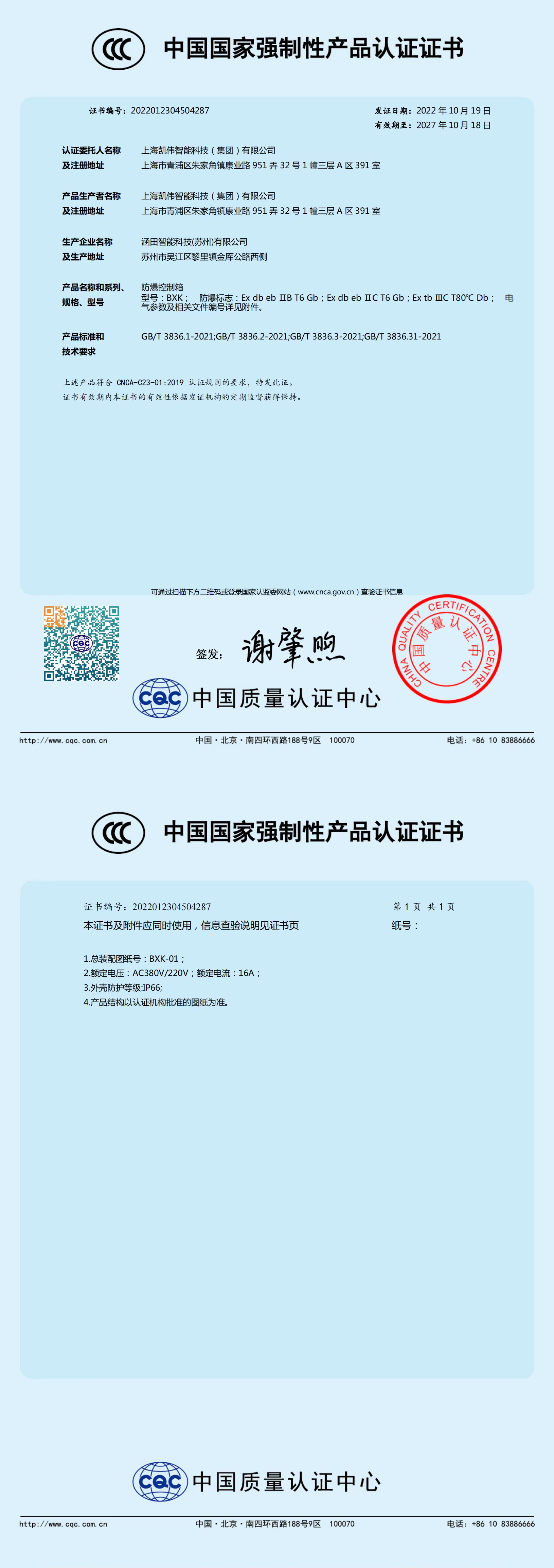
KAIWEI also manufactures explosion-proof cabinets, and its certification portfolio reflects that. The explosion-proof enclosure (cabinet) holds ATEX certification ECM 25 ATEX-B D001, issued by Ente Certificazione Macchine srl (Notified Body No. 1282) against EN IEC 60079-0:2018/A11:2024, EN 60079-1:2014/A11:2024, EN 60079-7:2015/A1:2018 and EN 60079-31:2014, valid 10 April 2025 to 9 April 2030. The same enclosure family (model BXK-D1) holds CCC certification 2022012304504287 from the China Quality Certification Center, valid 19 October 2022 to 18 October 2027. The electric enclosure additionally holds a VOC CE certificate, ICR/VC/HS230352, issued by ICR Co. Ltd. against EN 60529:1991+A2:2013 and EN 62208:2011, valid 28 March 2023 to 27 March 2028.
Read correctly, these documents tell a buyer that the supplier works inside the enclosure compliance regime — IP ratings under EN 60529 and explosion-protection standards under the EN 60079 series — and understands what a sealing gasket must survive. They do not convert a dispensing machine into a certified enclosure.
Which industries fit, beyond electrical enclosures?
The documented applicable-industry list is broad and specific at the same time. For filtration, it names air filters, air cleaning filters and percolator filters. For lock hardware, it names lock shells. It also covers domestic appliances, cable connectors, automotive fittings and mountings, automobile battery covers and inner door handles, purification room doors, refrigerator doors, street and stadium lighting, LED luminaires, lamp covers, brake lights, transparent boxes, ABS enclosure junction boxes and plastic waterproof boxes.
Two material notes matter for those sectors. The KW-523 and KW-523A accept polyurethane or silicone, which widens the temperature and chemical-resistance options for filtration and appliance work. And the machine frame is offered in carbon steel, stainless steel 304 or aluminium alloy — a specification choice that determines cleanability in food-adjacent or dust-controlled environments.
How this compares with pre-formed gaskets and manual dispensing
The traditional alternatives are a die-cut or moulded gasket bonded onto the flange, or manual cartridge dispensing by an operator. Both remain valid for low volumes and simple geometries. The comparison is not about quality in the abstract; it is about where the cost and risk sit.
A pre-formed gasket carries inventory, tooling and lead time, and it cannot follow a design change without a new die. Manual dispensing removes tooling but ties seal quality to operator consistency, and it struggles to hold a 2 mm bead tolerance around a corner. A FIPFG machine moves the cost into capital equipment and process control: the gasket is created on the part, geometry changes are program changes, and the seal is continuous with no joint to leak.
The limitation is real and should be stated plainly. A PU gasket dispensing machine is not economical at very low volumes, it requires commissioning effort that a cartridge gun does not, and it imposes utility prerequisites — 220V/380V power, ≥ 6 bar air, tap water — that a manual cell can ignore. It also introduces a curing step between dispensing and handling, which must be designed into the takt rather than discovered during ramp-up. Buyers running fewer than a few hundred units a month, or facing geometries that change on every order, may find the capital case does not close.
Market context for the evaluation decision
The equipment sits inside a measurable market. Commercial research places the broader polyurethane processing machine market at USD 4.07 billion in 2025, and the Automatic Polyurethane Foaming Machines segment at USD 606 million in 2025, projected to reach USD 832 million by 2032. A separate line of research values the global gaskets and seals product market at USD 61.57 billion in 2025, rising to USD 64.19 billion in 2026 — a different measurement object (finished sealing products, not manufacturing equipment) that indicates the downstream demand pool rather than the machine market.
For buyers, the useful reading is directional. The category is growing and is being tracked by commercial research houses, which means supply is competitive and specification differences — not availability — become the deciding factor. No published equipment-level figure for PU gasket dispensing machines specifically exists in the available evidence base, so market-size numbers should not be used to justify a capital decision on their own.
Where the boundaries are
A credible evaluation lists what a machine does not do. On this equipment: the ambient operating window stops at −20°C and 40°C; water temperature control is an option, not standard; tank B is not agitated; each tank holds 40 L, bounding unattended run time; the mixing ratio window is 1–10:1; bead width is model-dependent rather than freely programmable; high-pressure water cleaning makes a water supply mandatory; and there is no independent, published 24/7 uptime benchmark for this equipment class. Buyers should validate duty-cycle claims against their own line trial rather than against a brochure.
What to expect next
The direction of travel in sealing automation is toward tighter process monitoring rather than faster axes. Over-temperature alarms, servo-controlled dispensing valves and programmable control layers already exist on this equipment; the next step is the routine exchange of that process data with line-level quality systems, so that a gasket is not only produced correctly but recorded as such. Buyers specifying machines in 2026 should ask what data the controller exposes, because that question will be cheaper to answer at order than after installation.
Frequently asked questions
Is a PU gasket dispensing machine the same as a polyurethane foaming machine?
The terms overlap in the market but describe different scopes. A polyurethane foaming machine meters and mixes two or three components and dispenses reactive foam; a PU gasket dispensing machine applies that capability to placing a formed-in-place gasket on a part, typically under robotic motion. KAIWEI's range — KW-510B, KW-520A, KW-520B, 520A-PC, KW-523, KW-523A and KW-526 — is specified as gasket dispensing equipment with two-component or three-component selection and a 4–30 mm or 2–60 mm seal strip width depending on model.
Can one machine serve several product families?
It can, within the constraints of the envelope and bead width. The documented applicable-industry list spans electrical control panels, explosion-proof boxes, air filters, lock shells, lamp covers, automotive mountings, refrigerator doors and purification room doors. What changes between families is the fixture and the program, not the metering section — but a 50 mm bead on a small part still requires a model whose seal strip width reaches 50 mm.
What is the minimum order and how is acceptance handled?
The stated minimum order quantity is 1 unit, with FOB or CIF delivery terms and 30/70 payment terms. Acceptance is defined as full inspection before shipment, and third-party testing can be arranged for the acceptance procedure. Monthly capacity is stated at 2,000 sets with a 7-day lead time and 100% unit testing.
Does the machine certification cover an IP66 or explosion-proof enclosure?
No. The machine's CE certification (MD-TCF-240307-55472) covers the automatic gluing equipment under Machinery Directive 2006/42/EC. IP ratings and explosion-protection certificates attach to the enclosure as an assembled product — for example, the ATEX certificate ECM 25 ATEX-B D001 and CCC certificate 2022012304504287 held for KAIWEI's explosion-proof enclosure, and the VOC CE certificate ICR/VC/HS230352 held for the electric enclosure against EN 60529 and EN 62208. Buyers should map each certificate to the object it actually certifies.
What documentation should be requested before signing?
At minimum: the machine CE certificate and its scope, the ISO 9001 certificate and scope, material-level documentation for the adhesive (UL 94 report, RoHS compliance, non-hazardous transport certificate), the model specification sheet confirming effective stroke, seal strip width, mixing ratio and tank volumes, and the acceptance procedure including any third-party testing. For enclosures, request the enclosure-level certificates separately, because they are issued to the enclosure — not to the dispensing equipment.
For readers assembling a technical file, the manufacturer's product brochure is available for download: KAIWEI product brochure (PDF).
Have Questions or Need More Details?
Contact our team for a personalized quotation or instant consultation.
Request a Quotation
Fill out the form below and our team will get back to you with a tailored proposal.
WhatsApp Direct Chat
Prefer to chat in real-time? Message us on WhatsApp for instant assistance & quick answers.
- Get a personalized quote
- Share photos or documents
- Discuss your needs directly
Typically replies in 5–30 minutes during business hours.