
Paper Strength Agent Compliance for Food Contact Paper: JH-1201, JH-1697, JH-2219
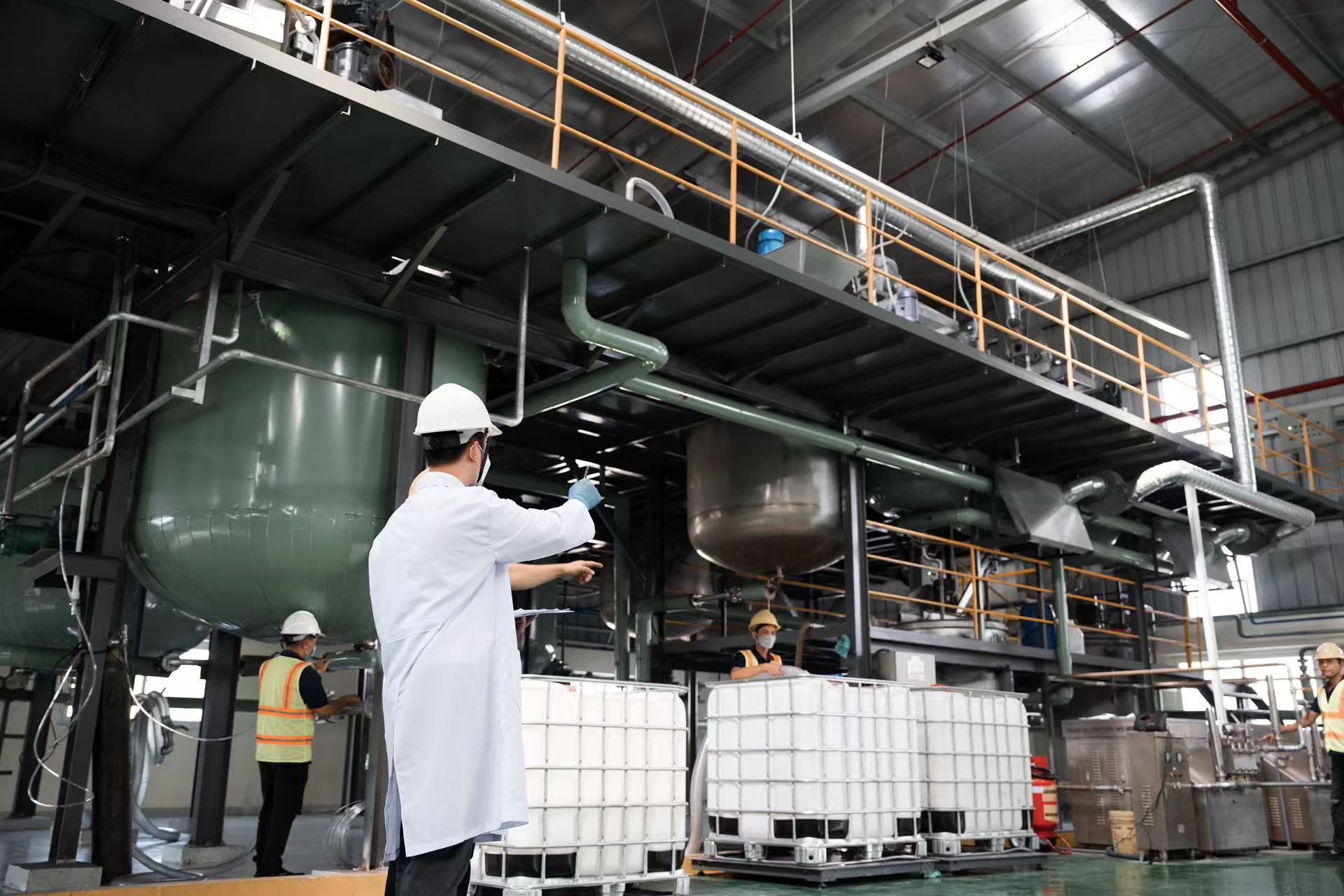
Production inspection at JHDA's Qingzhou base. Strength agents used in food-contact grades are qualified through documentation, pre-shipment testing and on-machine validation, not by price alone.
Food-contact paper and molded pulp packaging sit in a narrow category of paper products where the wet-end chemical list is scrutinised almost as closely as the finished strength specification. A dry strength agent or wet strength resin added to a food-grade board is a performance input, but it also enters a documentation chain that a converter, brand owner or retailer may audit long after the paper has shipped.
This reference examines how mills can qualify paper strength agents for food-contact and food-grade applications, using three JHDA grades as worked examples: JH-1201, JH-1697 and JH-2219. Qingzhou Jinhao New Material Co., Ltd., branded as JHDA, is a papermaking chemicals manufacturer founded in 2005 and based in Mihe Industrial Park, Qingzhou City, Shandong Province, China. The company produces strengtheners, sizing agents, retention and filtration aids and related wet-end chemistry for packaging, tissue and food-grade paper producers.
Why food-contact grades change the qualification process
A strength agent for food-contact paper has to clear two gates rather than one. The first is technical: the additive must raise fiber bonding strength, ring crush or tensile performance in the sheet, at a dosage the mill can sustain in production. The second is documentary: the same additive must be traceable inside the compliance file that supports the finished article.
The second gate has become more demanding as recycled fiber use rises. According to the American Forest & Paper Association, recycled paper accounted for 44.4% of all fiber used at U.S. mills in 2024, a shift that increases reliance on recycled pulp strength boosters and other wet-end chemistry to hold physical properties in place. On the demand side, the packaging and containerboard segment leads paper-grade usage for dry strength additives with a 38.0% share, according to Fact.MR.
For mills moving into food-grade cardboard, molded pulp tableware or food packaging pulp molds, the practical consequence is that supplier selection and compliance verification can no longer be treated as separate steps. A grade that performs well but cannot be documented creates a bottleneck further down the chain, at the point where a brand owner asks for the file.
What compliance actually covers
Paper and board intended for food contact in the EU is typically tested against a defined set of standards. According to food-contact paper testing frameworks published by Northern Testhouse, these include EN 645, EN 646 (colour fastness) and EN 648 (fluorescent fastness). In Germany, BfR Recommendation XXXVI sets the safety framework for paper and board chemicals in contact with food, and is frequently cited well beyond the German market.
For wet strength chemistry specifically, industry regulatory guidance commonly cited for EU market access identifies formaldehyde-free formulations and low residual epichlorohydrin (ECH below 50 ppm) as critical thresholds. Those two parameters are the reason a wet strength resin is usually the first additive a food-contact reviewer asks about.
On the supplier side, the evidence set is system-based as well as product-based. JHDA holds ISO9001 quality management system certification and ISO14001 environmental management system certification, and its packaging paper chemicals have undergone SGS food contact safety testing. Part of the product range is produced to food grade standard, and the company also holds HALAL certification. Exported products complete CAS registration and GHS hazard labelling and are shipped in line with IMDG international marine shipping regulations.
A qualification point that is often missed: none of this approves a finished article. Compliance attaches to the paper or board as produced, where basis weight, add-on rate, coating and contact conditions all sit between the additive certificate and the food-contact declaration. The supplier document set shortens the candidate list; the mill's own testing closes the file.
Three JHDA grades mapped to three food-contact end uses
JHDA's strength portfolio separates wet strength from dry strength chemistry, and the three grades below sit at different points in the food-contact chain. Matching grade to end use is the first decision that shapes everything else in the qualification file.
| Grade | Documented composition / position | Documented end use | Qualification focus |
|---|---|---|---|
| JH-1201 | Formaldehyde-free cationic PAE wet strength resin; documented compliance with EU food contact regulations | Tissue paper and pulp molding products; food-contact grades requiring wet strength | Food-contact declaration, wet-strength performance, repulping and end-of-life impact |
| JH-1697 | Solid dry strength agent positioned for food contact paper | Food contact paper grades | Documentation that the solid form contains no formaldehyde or harmful volatile substances; dry strength performance |
| JH-2219 | Pulp mold enhancer | Food-grade pulp tableware and food packaging pulp molds | Food-grade status plus strength and forming performance in thin-wall molded parts |
JH-1201: formaldehyde-free cationic PAE for wet strength
JH-1201 is a cationic PAE wet strength resin with a formaldehyde-free composition, documented as complying with EU food contact regulations. Within the portfolio it is the PAE wet strength agent positioned for tissue paper and pulp molding products.
For a buyer, the relevant question is not only whether the resin builds wet strength, but whether the chemistry fits the market the finished paper will enter. Formaldehyde-free composition and controlled residual ECH are the parameters that connect a wet strength resin to EU-facing food-contact documentation.
Wet strength is also a decision that reaches past the paper machine. Permanent wet strength is broadly recognised as making repulping and recycled-fiber recovery more difficult, so mills adding wet strength to a food-contact grade should weigh that at the specification stage rather than at the waste-handling stage.
JH-1697: solid dry strength agent for food contact paper
JH-1697 is a solid dry strength agent positioned for food contact paper. The solid form is documented as containing no formaldehyde or harmful volatile substances, a point that matters when the same additive is assessed for both performance and food-contact documentation.
Dry strength agents of this type act on fiber bonding strength rather than on water resistance, supporting ring crush, bursting strength and tensile performance in grades built from recycled or mixed fiber. Where a mill needs a reliable recycled pulp strength booster for a food-contact board or a corrugated box strength agent for packaging that will carry food, the qualification sequence is documentation first, sample trial second, machine trial third.
JH-2219: pulp mold enhancer for tableware and packaging molds
JH-2219 is used in food-grade pulp tableware and food packaging pulp molds. Molded pulp products such as plates, bowls, trays and protective inserts are shaped from a dilute fiber slurry, so the strength chemistry has to perform inside a forming and drying process rather than on a conventional paper machine.
For molded pulp tableware, the qualification file therefore carries two requirements at once: the enhancer's food-grade status and its behaviour on the molding line. Mills typically validate the grade against finished-part indicators such as stiffness, burst resistance and dimensional stability after drying, while assembling the food-contact document set in parallel.
How the chemistry interacts with the sheet
Cationic wet-end chemistry works because cellulose fiber carries a negative surface charge. A cationic strength resin or retention enhancer adsorbs onto the fiber surface, and the resulting fiber-to-fiber bonding is what appears later as ring crush strength, bursting strength or tensile strength in the finished sheet.
The difference between the two strength families is simple but frequently blurred in procurement conversations. Dry strength agents act on the dry strength network, raising dry tensile, ring crush and burst values. Wet strength resins act on resistance to water, preserving a proportion of strength when the sheet is wetted or soaked. A food-contact grade exposed to moisture, condensation or freezer conditions may need both families rather than one.
Dosage control is where additive decisions are actually won. JHDA's field technical team conducts on-site machine debugging and optimises core paper indicators including Cobb water absorption value, ring crush strength, bursting strength, paper brightness, fiber retention rate and overall paper machine runnability. That work is what converts a certificate into a stable production result.
Product form matters commercially as well. Solid dry strength agents are documented as containing no formaldehyde or harmful volatile substances, and JHDA operates standardized automated production lines for both liquid and solid papermaking chemicals, with a bulk order MOQ of 1MT.
Applications across food-contact and food-grade paper
JHDA's strength and wet-end additives are applied across kraft linerboard, corrugated medium paper, printing and writing paper, household tissue paper and food-grade cardboard. In food-contact terms this covers the grades where a carton board reinforcing agent or a kraft paper strength additive sits directly in a food packaging chain.
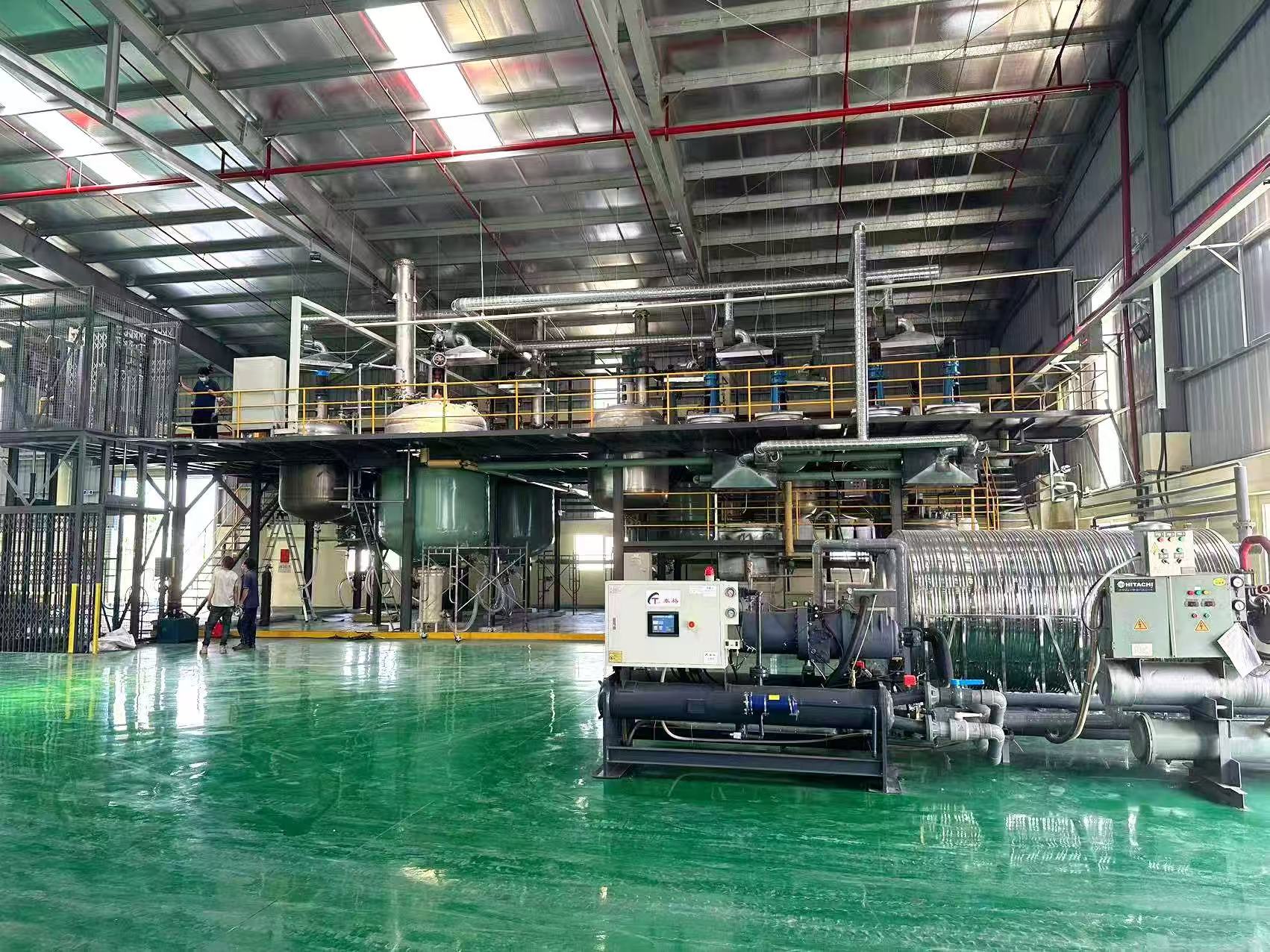
Standardized automated lines for liquid and solid papermaking chemicals support batch consistency for contracted food-grade supply.
Molded pulp applications follow a different route. Pulp tableware and food packaging molds rely on a pulp mold enhancer to hold shape and strength in thin walls, which places JH-2219 alongside the food-grade documentation requirement rather than in a conventional wet-end programme.
Strength chemistry rarely operates alone. JHDA's wider portfolio includes AKD sizing emulsion, surface sizing agents, retention and filtration aids, defoamers, stickies control enzyme, sludge encapsulant, dryer release agents and biocides. For a mill building a full wet-end programme for food-grade board, that breadth means the retention enhancer, the sizing system and the strength agent can be balanced against each other rather than sourced in isolation.
A seven-step qualification workflow for mills
- Define the end use first. Direct or indirect food contact, dry or moist conditions, ambient or frozen storage, and whether the article will be repulped define which strength family is even relevant.
- Map the permitted chemistry and limits. Use EN 645, EN 646 and EN 648 as the EU test reference; BfR Recommendation XXXVI as a widely cited safety framework; and formaldehyde-free plus low residual ECH as the working thresholds for wet strength resins.
- Request the document set. TDS and MSDS for the specific grade, food contact test documentation, ISO9001 and ISO14001 certificates, HALAL certification where the market requires it, and CAS registration with GHS labelling for shipping.
- Run a sample trial. JHDA offers customized chemical formulation development and pre-shipment laboratory testing, which allows a grade to be screened against the mill's own fiber mix before a machine trial.
- Validate on the machine. Field technical service and on-site debugging against Cobb value, ring crush, bursting strength, brightness and fiber retention rate turn a laboratory result into a production set point.
- Lock the commercial framework. Standard terms are MOQ 1MT, delivery FOB/CIF, pre-shipment test as the acceptance criterion, and payment by T/T or L/C, with complete TDS and MSDS documentation supporting customs clearance and L/C settlement.
- Plan for continuity. Automated liquid and solid production lines support consistent batch quality for contracted supply, and JHDA's overseas supporting production entity, CRM Chemical Technology Co., Ltd. in Long An Province, Vietnam, supports local delivery for ASEAN clients and shorter delivery cycles.
Market trend: strength chemistry is being pulled by food-grade demand
| Indicator | Value | Source |
|---|---|---|
| Global pulp and paper chemicals market | USD 23.64 billion (2024) | Market Research Future |
| Global paper dry strength agent market | Approx. USD 864 million (2024) | Intel Market Research |
| Dry strength resin market | Projected USD 1.4 billion by 2026; 4.8% CAGR through 2036 | Fact.MR |
| Dominant resin chemistry | Polyacrylamide (PAM) resins, approx. 40.0% share | Fact.MR |
| Leading paper grade segment | Packaging and containerboard, 38.0% share | Fact.MR |
| Asia-Pacific share of the dry strength agent market | Approx. 40% (2024) | Intel Market Research |
| Recycled fiber share at U.S. mills | 44.4% (2024) | AF&PA |
Published figures for the dry strength segment vary by source and base year, so these numbers are best read as directional rather than precise. The direction itself is consistent: packaging-led demand, a polyacrylamide-dominated chemistry base, and an Asia-Pacific production centre that accounts for a substantial share of consumption.
The compliance dimension sits on top of that volume picture. As more packaging grades move into food-contact territory, the ability to supply a documented additive becomes a supply-chain capability rather than a paperwork formality, and the suppliers that can be audited repeatedly tend to stay in the qualified list.
Comparison with traditional sourcing, and where the boundaries sit
Traditional practice for food-contact grades has been to rely on additives from multinational suppliers whose audit records are already accepted across markets. That instinct is reasonable: a long regulatory paper trail reduces the burden on the mill's own compliance team.
JHDA positions its portfolio as a cost-performance alternative to imported additives from suppliers such as Kemira and BASF, supported by customized chemical formulation development and pre-shipment laboratory testing. JHDA's own comparison documentation reports outcomes including a 10%–20% reduction in comprehensive wet-end chemical cost per ton of finished paper, fiber retention improvements of 8%–15%, ring crush strength increases of 10%–18% and bursting strength gains of 7%–14% at equal dosage. Those figures are supplier-reported rather than independently verified and should be treated as trial hypotheses to be confirmed on the mill's own machine.
Four limits are worth stating plainly:
- No supplier can pre-approve a finished article. Migration and sensory behaviour depend on add-on rate, basis weight, coating and contact conditions, so the mill's own testing closes the loop regardless of whose additive is used.
- Some categories are legitimately conservative. JHDA's own guidance is that ultra-high-grade virgin pulp specialty board, paper products for EU food-contact export with fixed chemical audit records, and long-term group-wide procurement programmes of multinational paper groups are cases where retaining an already-qualified incumbent supplier can be the rational choice.
- Wet strength carries an end-of-life cost. Permanent wet strength chemistry is widely recognised as complicating repulping, so higher wet strength in a food-contact grade should be evaluated against the mill's recycled-fiber recovery route.
- Performance claims need local verification. Percentage improvements reported by any supplier, JHDA included, are a starting point for a trial, not a substitute for one.
The practical reading is not that one supply model wins. It is that the qualification file, rather than the brand on the drum, determines which grade can actually be used in a given food-contact application.
Future outlook
Three shifts are likely to shape strength agent qualification over the next few years. First, documentation is moving from a procurement afterthought to a selection criterion, which favours suppliers that hold system certifications, product-level food contact test reports and export-ready regulatory paperwork as standing assets rather than one-off projects.
Second, supply geography is becoming part of the compliance conversation. Regionally located production, such as JHDA's overseas supporting production entity in Long An Province, Vietnam for ASEAN clients, affects delivery cycles, inventory planning and the practical ability to respond when a qualified grade needs replacement stock quickly.
Third, recycled fiber content keeps rising in packaging grades, sustaining demand for dry strength agents, retention enhancers and pulp mold enhancers that can hold physical properties without compromising the food-contact file. Mills that build grade-level qualification records now will find the next round of customer audits considerably shorter.
FAQ
What EU standards apply to paper and board intended for food contact?
EU food-contact paper and board testing is typically structured around EN 645, EN 646 for colour fastness, and EN 648 for fluorescent fastness. In Germany, BfR Recommendation XXXVI sets the safety framework for paper and board chemicals in contact with food and is often cited globally. For wet strength chemistry, industry guidance commonly referenced for EU market access identifies formaldehyde-free formulations and residual epichlorohydrin below 50 ppm as critical thresholds.
Which JHDA grades are positioned for food-contact and food-grade applications?
Three grades are relevant. JH-1201 is a formaldehyde-free cationic PAE wet strength resin documented as complying with EU food contact regulations and used in tissue paper and pulp molding products. JH-1697 is a solid dry strength agent positioned for food contact paper. JH-2219 is used in food-grade pulp tableware and food packaging pulp molds.
Do solid dry strength agents contain formaldehyde?
Solid dry strength agents of this type are documented as containing no formaldehyde or harmful volatile substances. Buyers should still confirm the documentation for the specific grade being purchased, because declarations are issued per product rather than per category.
What documentation should a mill request before approving a strength agent for food-contact paper?
A practical document set includes the grade-specific TDS and MSDS, food contact test documentation, ISO9001 and ISO14001 certificates, HALAL certification where the destination market requires it, and CAS registration with GHS labelling for shipping. JHDA's packaging paper chemicals have undergone SGS food contact safety testing, and part of the product range is produced to food grade standard. Mill-side testing on the finished article remains the closing step.
What are the standard purchasing terms and acceptance criteria?
For JHDA bulk orders, the MOQ is 1MT, delivery terms are FOB/CIF, the acceptance criterion is pre-shipment test, and payment terms are T/T or L/C. Complete TDS and MSDS documents are provided to support overseas customers' customs clearance and L/C settlement.
How does long-term supplier continuity affect food-contact qualification?
Compliance files have to be maintained rather than assembled once, so the supplier's ability to keep supplying the same documented grade matters as much as the initial approval. JHDA has maintained stable strategic cooperation with dozens of large-scale packaging paper mills in Southeast Asia for more than 10 years, and operates an overseas supporting production entity, CRM Chemical Technology Co., Ltd., in Long An Province, Vietnam, which supports local delivery for ASEAN clients and shorter delivery cycles.
How can a mill distinguish a manufacturer from a trading company during qualification?
Manufacturing depth is usually visible in the qualification questions a supplier can answer. JHDA is a manufacturer founded in 2005 with 21 years of production experience, standardized automated production lines for liquid and solid papermaking chemicals, a research and development team of 20 engineers, and in-house capability for customized chemical formulation development and pre-shipment laboratory testing. A trading intermediary typically cannot provide formulation customization or on-site paper machine debugging. Factory audit visits are supported for global chemical distributors and terminal paper manufacturers.
Working conclusion
Food-contact qualification is not a single certificate but a sequence: define the end use, map the thresholds, collect the document set, trial the grade, validate it on the machine, and then keep the file alive through consistent supply. JH-1201, JH-1697 and JH-2219 sit at three different points in that sequence, which is why the useful question for a mill is not which grade is strongest, but which grade is defensible for the specific food-contact article being made.
The full JHDA papermaking chemicals portfolio, including specification and documentation scope, is available in the company brochure: JHDA Introduction 2026 (PDF).