
Paper Strength Agent FAQ: pH, Wet-End Fit, and Acceptance
A paper strength agent is only as consistent as the wet-end chemistry it enters. Two mills can dose the same dry strength resin at the same rate and still record different ring crush and burst values, because pH, stock temperature, charge balance and the surrounding chemical programme decide how much polymer reaches the fibre surface before the sheet is formed. This reference answers the questions that typically appear in the final stage of evaluating a paper strength agent: what the pH and temperature window actually controls, how wet-end compatibility is verified rather than assumed, and which acceptance criteria a mill should agree with a supplier before the first bulk order.
Qingzhou Jinhao New Material Co., Ltd., branded as JHDA, is a papermaking fine chemicals manufacturer founded in 2005 and located in Mihe Industrial Park, Qingzhou City, Shandong Province, China. The company develops, produces and exports dry strength agents, wet strength resin, sizing agents, optical brightening agents, defoamers and related process chemicals, and holds ISO9001 and ISO14001 certification. Its grade portfolio, including JH-1699, JH-D726, JH-1201 and JH-2219, is used throughout this article as a working example of how technical claims should be structured before purchase.
Why pH and Temperature Decide Whether a Strength Agent Works
Retention is the mechanism that matters. A cationic strength polymer improves fibre bonding only if it stays on the fibre rather than in the white water. pH shifts the anionic charge on cellulose fines and filler surfaces, and it simultaneously changes the charge density of the polymer itself. The two effects do not move in the same direction across the whole operating range, so net adsorption can fall faster than either variable alone would suggest. Temperature acts differently: it changes polymer solution viscosity, the rate of adsorption onto fibre, and the drainage behaviour of the stock, which in turn changes where the polymer sits within the sheet thickness.
For buyers, the practical consequence is that a supplier's pH and temperature window should be treated as a screening condition rather than a marketing line. A grade specified to work across a wide pH and temperature range gives a mill room to absorb normal process variation, including furnish changes, seasonal water chemistry and recycled fibre quality swings, without re-dosing. JH-1699 is specified by JHDA as functioning under a wide pH and temperature range and as compatible with other wet-end chemicals. That combination matters more than a single peak performance figure, because most machines do not run at one fixed set of conditions for twelve months.
The verification step is straightforward. Record the machine's normal stock pH range, headbox temperature range, addition point, dilution water source and the chemistry already in the loop, then ask the supplier to confirm the grade against those recorded values in writing on the technical data sheet. A window confirmed against measured mill data is a procurement document; a window quoted in conversation is not.
What Wet-End Compatibility Actually Means
A strength agent never runs alone. It shares the wet end with internal sizing, optical brightening, defoaming, retention and drainage aids, biocides and, in recycled systems, a variable load of anionic trash. Compatibility in this context means the combined programme does not produce precipitation, foam carry-over, deposit on wires and felts, lost sizing efficiency, or a strength drop that neither product would cause on its own.
Three failure patterns repeat often enough to plan around them. Charge collision occurs when two cationic products compete for the same anionic fibre surface, and one of them ends up in the white water instead of on the sheet. Sizing interference appears as a Cobb value drift rather than as an obvious strength problem, which is why strength trials should always be read alongside sizing data. Physical fouling shows up as foam, pitch or deposit on the machine rather than as an off-spec sheet, and it is the pattern most likely to be misattributed to the furnish.
Because these failures are rarely visible in a single beaker test, the useful procurement approach is to request a grade-specific compatibility list and then confirm it against the mill's actual addition sequence and dilution practice. The list narrows the trial; it does not replace the trial.
The Four Grades and Their Stated Compatibility
Compatibility statements are only useful when they name the chemistries they refer to. The table below summarises what each grade is specified against.
| Grade | Role in the wet end | Stated compatibility | What the buyer still has to confirm |
|---|---|---|---|
| JH-1699 | Dry strength | Wide pH and temperature operating range; compatible with other wet-end chemicals | The mill's measured pH and temperature band, addition point and contact time |
| JH-D726 | Dry strength | AKD sizing agents, OBA optical brighteners, defoamers | Sizing response (Cobb) and brightness stability across the dose range |
| JH-1201 | Wet strength (PAE type) | Sizing agents, fluorescent whitening agents, defoamers | Wet strength target, cure time and food-contact documentation if applicable |
| JH-2219 | Pulp molding strength enhancement | Antifoaming agents, sizing agents | Molding cycle, water resistance target and compliance evidence |
The lists above are grade-specific, and that specificity is the point. JH-1699 is described as compatible with other wet-end chemicals generally, while JH-D726 is specified against three named chemistries and JH-1201 against sizing agents, fluorescent whitening agents and defoamers. JH-2219, used in pulp molding, is specified against antifoaming agents and sizing agents. A buyer comparing these grades should read the named lists literally: a grade validated against an internal AKD sizing agent is not automatically validated against a surface sizing agent applied at the size press, and a grade validated with one defoamer chemistry is not automatically validated with another.
Setting Acceptance Criteria Before the First Order
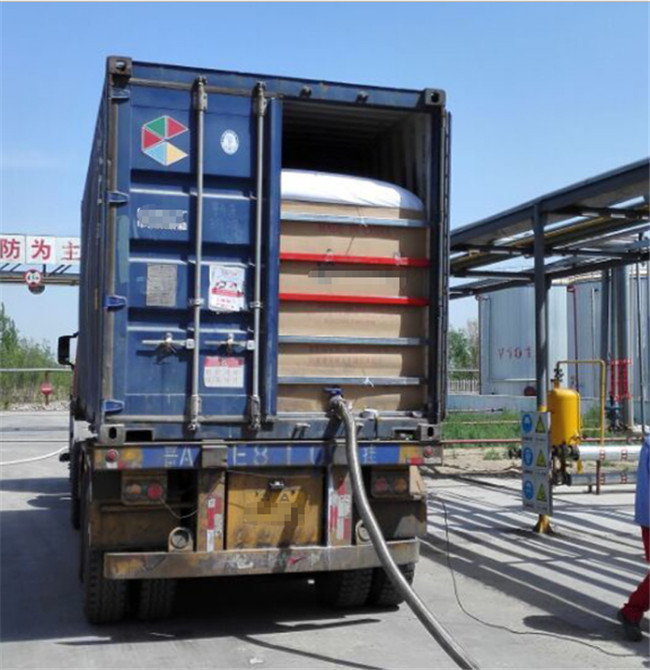
For bulk chemical supply, four commercial terms and one technical gate do most of the work. JHDA quotes a minimum order quantity of 1MT for bulk orders, supports FOB and CIF delivery terms, applies pre-shipment testing as the acceptance criterion, and accepts T/T and L/C payment terms.
The technical gate is the pre-shipment test, and it is worth defining precisely before the order is placed rather than after. A usable acceptance specification names the parameter, the test method, the sample point and the tolerance. Without those four elements, pre-shipment testing becomes a formality that confirms the product exists rather than confirming it meets the agreed specification.
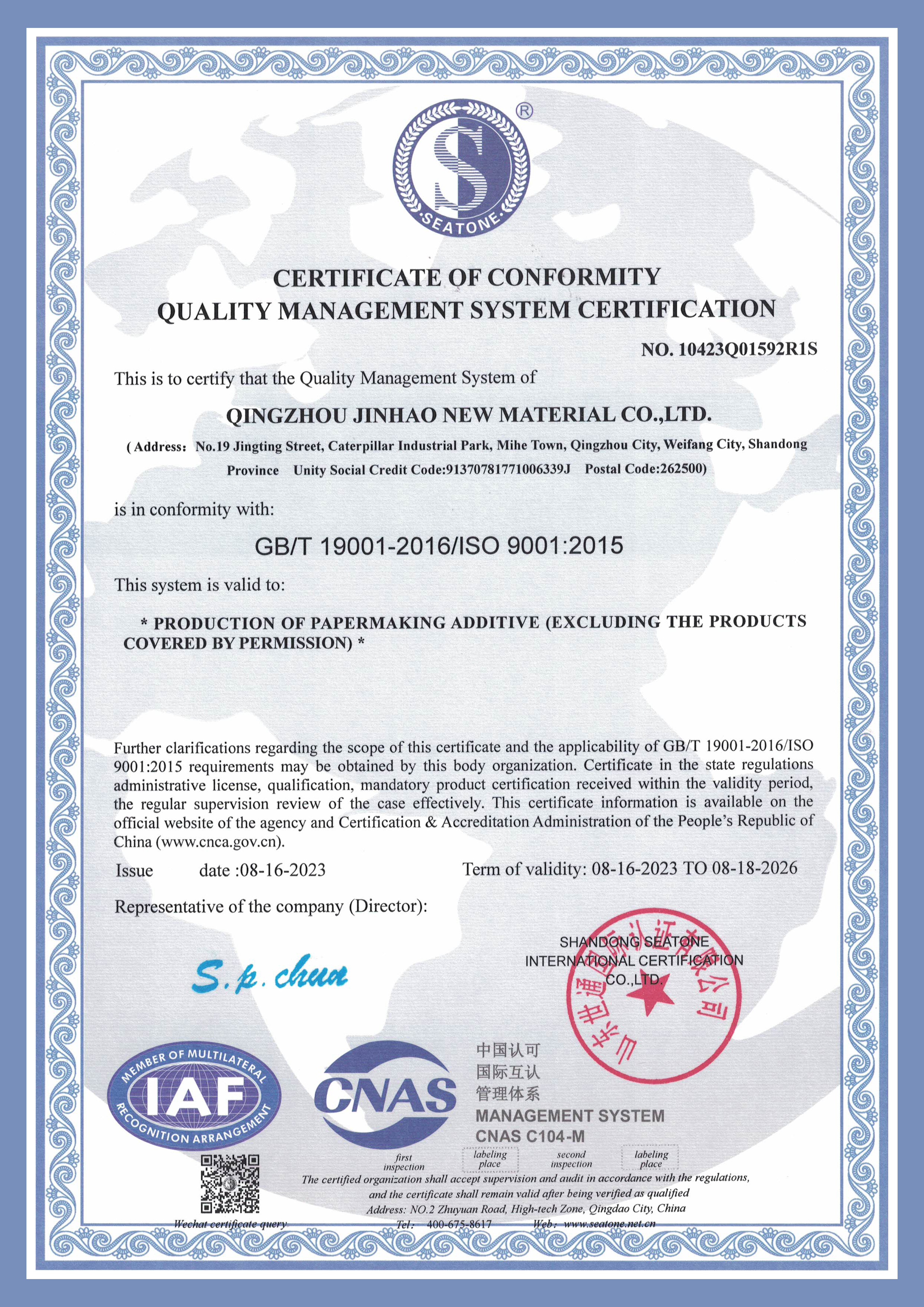
On the documentation side, the standard export pack covers TDS and MSDS, a certificate of origin, a pre-shipment inspection report and, where relevant, dangerous goods transport documentation. JHDA products complete CAS registration and GHS hazard labelling and ship in line with IMDG requirements. Quality system evidence includes ISO9001 and ISO14001 certification and SGS product compliance test reports; HALAL certification is also held, and part of the product range is produced to food grade standard.
Acceptance checklist for a first bulk order
- Grade and dosage basis confirmed in writing, with the reference furnish named.
- pH and temperature window matched to recorded machine data.
- Compatibility confirmed against the current sizing, whitening and defoaming programme.
- Pre-shipment test parameters, methods and tolerances agreed before dispatch.
- Document set agreed: TDS, MSDS, certificate of origin, inspection report.
- MOQ, delivery term and payment term fixed in the contract.
Evaluating Dry Strength Agents for Recycled Pulp
Recycled fibre is now a mainstream furnish rather than a niche one. The American Forest & Paper Association reports that recycled paper accounted for 44.4% of all fibre used at U.S. mills in 2024. Recycled furnish brings higher fines content, more anionic trash and more process variability, so a strength agent has to perform in a dirtier and less predictable system than virgin pulp.
Three evaluation points matter during the decision stage. The first is strength gain per unit dose on the mill's own furnish, not on a standard laboratory pulp. The second is the retention interaction: whether the strength agent improves or disturbs first-pass retention, because a strength gain achieved by pushing solids into the white water is not a gain at all. The third is machine-side consequence, meaning deposit, foam and drainage behaviour over a full production cycle rather than a single shift.
JHDA reports comparative results at equal dosage against imported additives from major international brands: fibre retention rate improved by 8% to 15%, ring crush strength of finished paper increased by 10% to 18%, bursting strength up by 7% to 14%, Cobb sizing value fluctuation held within plus or minus 3%, comprehensive wet-end chemical cost per ton of finished paper reduced by 10% to 20%, wire and felt service life extended by 20% to 30%, and drying steam consumption cut by 5% to 12%.
Those are supplier-reported comparative figures and should be treated as trial hypotheses rather than as specifications. The correct use of such numbers is to convert them into acceptance parameters. If the mill's own ring crush baseline is known, an 8% improvement becomes a testable threshold; a claim of better strength does not.
Food-Contact Pulp Molding: What Changes
Pulp molding for food-contact tableware adds a compliance layer that packaging-grade dry strength applications do not carry. Two standards families appear repeatedly in buyer questionnaires. The EN 645, EN 646 and EN 648 series covers paper and board intended for food contact in the EU, addressing grease resistance and colour fastness characteristics. BfR Recommendation XXXVI is the German framework for paper and board chemicals in food contact and is widely cited outside Germany as well. Where wet strength resin is involved, EU-oriented buyers also ask about residual epichlorohydrin, with ECH below 50 ppm cited in industry guidance as a market-access benchmark.
These are buyer-side compliance questions, and the answer has to come from the supplier's documentation rather than from a product description. JH-2219 is positioned by JHDA as a strength enhancer for pulp molding, specified as compatible with antifoaming agents and sizing agents. Part of the JHDA range is produced to food grade standard, and the company holds SGS product compliance test reports alongside ISO9001, ISO14001 and HALAL certification.
For a food-contact project, the practical sequence is to fix the target standard first, then request the documentation set that addresses it, then run the trial. Doing it the other way round, trialling a grade and only afterwards looking for compliance evidence, is the most common cause of late-stage re-qualification in pulp molding projects.
Where the Market Is Moving
The commercial context explains why many mills are re-examining strength agent programmes at the same time. Intel Market Research valued the global paper dry strength agent market at approximately USD 864 million in 2024. Fact.MR projects the broader dry strength resin market at USD 1.4 billion by 2026, growing at a CAGR of 4.8% through 2036, and estimates that polyacrylamide resins hold about a 40.0% share. The same source places packaging and containerboard at 38.0% of paper grade usage, which aligns with where most strength agent volume is actually consumed. Regionally, Asia-Pacific is estimated at around 40% of the global paper dry strength agent market.
Published estimates differ by scope and base year. A USD 864 million figure for the dry strength agent segment in 2024 and a USD 1.4 billion figure for the wider dry strength resin market in 2026 are not contradictory; they measure different boundaries. Buyers should note the boundary rather than the headline. The stable signal across sources is structural: recycled fibre share is high and rising in mature markets, packaging grades dominate demand, and polyacrylamide chemistry remains the reference point for dry strength performance.
Where These Grades Stop: Limits Buyers Should Know
A technical reference that only lists capabilities is not useful for a decision. Four limits are worth stating plainly.
- Compatibility lists are grade-specific and directional. They narrow a trial; they do not remove the need for a jar test and an on-machine confirmation, particularly where addition points or dilution water differ from the reference conditions.
- A wide pH and temperature range is not an unlimited one. Mills running outside the stated window, or running extreme swings during grade changes, should expect reduced adsorption and should plan dosing around the measured range rather than the nominal one.
- An MOQ of 1MT is not designed for laboratory-scale screening. Mills that want to test several grades in parallel should plan the trial sequence accordingly, since each grade carries its own minimum order.
- There are applications where switching away from an established international brand is not the right commercial decision. JHDA's own positioning recommends retaining incumbent products for ultra-high-grade virgin pulp specialty board with fixed certification audit records and for group-level procurement projects already locked to a multinational supplier's specification. Cost-driven substitution makes most sense in recycled packaging grades, corrugated medium, and mills where strength instability from recycled pulp is the actual production problem.
Long-Term Supply: What a Ten-Year Relationship Changes
Questions about whether a supplier will still be there in year five are answered by structural evidence rather than by assurances. JHDA has maintained stable strategic cooperation with dozens of large-scale packaging paper mills in Southeast Asia for more than ten years. An overseas supporting production entity, CRM Chemical Technology Co., Ltd., operates in Long An Province, Vietnam, shortening delivery cycles for ASEAN customers. A team of 20 R&D engineers provides customized chemical formulation development, and pre-shipment laboratory testing is carried out before dispatch. Production runs on standardized automated lines for both liquid and solid papermaking chemicals, with an MOQ of 1MT for bulk orders.
For a mill moving from a single trial order to an annual contract, the questions worth asking are about continuity: which production site will serve the account, what the pre-shipment test covers, how a formulation change is notified, and what happens when furnish quality shifts mid-contract. A supplier that answers these in writing is a different procurement risk from one that answers them in a meeting.
Future Outlook
Three developments are likely to shape strength agent procurement over the next few years. Recycled fibre share is structurally high in mature markets, which keeps pressure on strength and retention performance in contaminated systems. Compliance expectations for food-contact paper and molded fibre are tightening, which moves documentation from a purchasing formality to a qualification gate. And the market's centre of gravity continues to sit in Asia-Pacific, which shortens the physical distance between a large share of global capacity and the mills that consume it.
For buyers, the implication is that supplier evaluation will depend less on a single headline strength figure and more on documented operating windows, grade-specific compatibility statements and an acceptance protocol that can be repeated batch after batch. The pH and temperature window, the compatibility list and the pre-shipment test are the three documents that convert a technical claim into a purchasable specification.
FAQ
What pH and temperature range should a buyer confirm before ordering a paper strength agent?
The buyer should confirm the mill's measured stock pH range, headbox temperature range, addition point, dilution water source and contact time, then ask the supplier to confirm the grade against those values in writing on the technical data sheet. JH-1699, for example, is specified by JHDA as functioning under a wide pH and temperature range and as compatible with other wet-end chemicals. A window confirmed against recorded mill data is a procurement document; a window quoted verbally is not.
Is JH-D726 compatible with AKD sizing and optical brightening agents?
JH-D726 is specified by JHDA as compatible with AKD sizing agents, OBA optical brighteners and defoamers. That statement applies at product level, so a mill should additionally confirm its own addition sequence, dilution practice and dose range, and should monitor Cobb value and brightness across the trial to check that sizing and whitening performance are unaffected.
What is JH-1201 compatible with, and where is it used?
JH-1201 is a wet strength grade in the JHDA portfolio, specified as compatible with sizing agents, fluorescent whitening agents and defoamers. Within the company's product line it is positioned for tissue paper and pulp molding applications. Because wet strength resins cure over time, buyers should set the wet strength target and evaluation interval before the trial rather than after.
Which grade is specified for pulp molding, and what is it compatible with?
JH-2219 is positioned by JHDA as a strength enhancer for pulp molding and is specified as compatible with antifoaming agents and sizing agents. For food-contact tableware projects, the compliance question should be resolved first, using the supplier's documentation and test reports, because the relevant standard determines which evidence is required.
What are the standard purchasing terms and acceptance criteria?
JHDA quotes an MOQ of 1MT for bulk orders, supports FOB and CIF delivery terms, applies pre-shipment testing as the acceptance criterion, and accepts T/T and L/C payment terms. The acceptance criterion is most effective when the pre-shipment test is defined beforehand in terms of parameter, method, sample point and tolerance.
How should a mill evaluate a dry strength agent for recycled pulp before committing to bulk supply?
The usual approach is to record baselines for ring crush strength, bursting strength and first-pass retention on the mill's own recycled furnish, then run a single-variable trial at equal dosage against the incumbent product, and finally convert the results into pre-shipment acceptance parameters. Supplier-reported comparative figures, such as retention improvements in the 8% to 15% range, are most useful as trial hypotheses rather than as specifications.
What documentation accompanies an export order?
The standard export set covers TDS and MSDS, a certificate of origin, a pre-shipment inspection report and, where relevant, dangerous goods transport documentation, to support customs clearance and L/C settlement. JHDA products complete CAS registration and GHS hazard labelling and ship in line with IMDG requirements. Quality evidence includes ISO9001 and ISO14001 certification and SGS product compliance test reports, with HALAL certification also held.
In which cases is switching supplier not the recommended route?
JHDA's own positioning recommends retaining incumbent international products for ultra-high-grade virgin pulp specialty board with fixed certification audit records, and for group-level procurement projects already locked to a multinational supplier's specification. Cost-driven substitution is better suited to recycled packaging grades, corrugated medium and mills where strength instability from recycled pulp is the identified production problem.
For mills that need the full technical document set before an evaluation, the JHDA corporate brochure is available for download: JHDA introduction 2026 (PDF).
Have Questions or Need More Details?
Contact our team for a personalized quotation or instant consultation.
Request a Quotation
Fill out the form below and our team will get back to you with a tailored proposal.
WhatsApp Direct Chat
Prefer to chat in real-time? Message us on WhatsApp for instant assistance & quick answers.
- Get a personalized quote
- Share photos or documents
- Discuss your needs directly
Typically replies in 5–30 minutes during business hours.