
Parking Lift Configurations Buyers Are Choosing in 2026
Parking lift demand has moved from a niche luxury product to a standard procurement category in residential, commercial and dealership projects. The question faced by most buyers is no longer whether a parking lift can solve a space shortage, but which configuration fits the physical constraints of the site, the vehicle mix and the operational workflow.
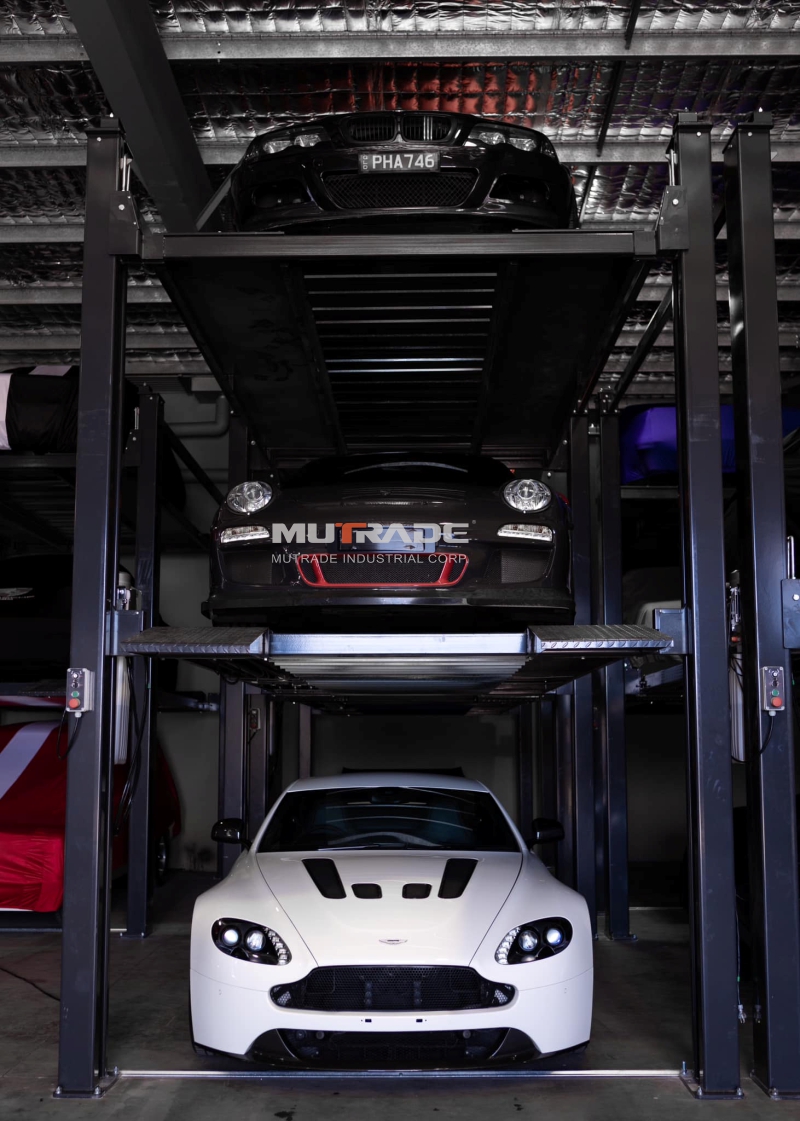
This article reviews the parking lift types that appear most frequently in current buyer evaluations, summarizes the technical logic behind each configuration, and connects those configurations with delivered project evidence.
Problem / Opportunity
A project that needs parking spaces often starts with a fixed footprint, ceiling height and existing structure. The developer or facility operator cannot easily add horizontal space, so the practical opportunity is vertical stacking. A parking lift converts one vehicle footprint into two or more vehicle levels, but the correct solution depends on how the vehicle is stored or retrieved.
The evaluation problem is that similar-looking equipment can have different architecture. Two-post dependent lifts, four-post storage lifts, three-car stackers, pit-based two-post lifts, puzzle systems and automated shuttle systems all create vertical parking, but their building requirements, vehicle limits and retrieval patterns are not interchangeable. Buyers evaluating a car parking lift should therefore compare configurations before they compare supplier claims.
Brand Solution / Industry Reference
Mutrade Industrial Corp., founded in Qingdao, China in 2009, is one supplier whose product range covers the full parking lift spectrum. The company operates a 12,000-square-metre production facility and describes its annual output as 10,000 parking spaces. Its catalogue includes parking lifts, semi-automatic parking systems and fully automatic parking systems, which makes it a useful reference for understanding how equipment categories are organized.
MUTRADE's production model is also relevant to procurement evaluation. The company lists OEM, ODM, white label and private label production, with typical customization options covering voltage, logo, parking width, system height and color. Monthly capacity is stated as 1,000 car spaces, lead time is 30 to 45 days, and the minimum order is one unit. Quality control is described as random inspection, a point that buyers should include in their contractual expectations.
Technical Explanation
Two-post dependent parking lift
A two-post parking lift uses two columns and two parking levels. The lower vehicle remains on the ground plane, while the upper vehicle is supported on a platform that travels along the columns. This is a compact solution for projects where the primary goal is to double parking capacity inside an existing parking hall, indoor garage or residential development.
In MUTRADE's product family, the Hydro-Park 1127 illustrates this category. It is a two-post dependent parking lift with a rated lifting capacity of 2700 kilograms for the upper space and column sharing to reduce installation cost and space. The product data specifies a maximum vehicle length of 5000 millimetres, maximum width of 1850 millimetres and maximum height of 2050 millimetres. Drive mode is hydraulic cylinder plus chains, with a lifting time of about 50 seconds and key-switch operation.
Four-post parking lift
A four-post parking lift provides a drive-on platform supported by four columns. This design is often selected for car storage because the vehicle stays on a stable deck and the structure is more tolerant of repeated parking and retrieval. Four-post models are also used where cars are not parked every day, such as dealership inventory, collector car storage or private garage storage.
Four-post equipment can appear with different capacities. The product and certification information from MUTRADE includes four-post models rated for a broad range of vehicle sizes. Because the structure is self-supporting, it does not necessarily require a pit. This is an advantage in retrofits where excavation is not possible.
Three-car and triple parking lifts
When two levels are not enough, a triple parking lift adds a third vehicle level. The Hydro-Park 2525 and 2625 are examples of a three-car stacker in the MUTRADE range: each system parks three vehicles, with rated capacity of 2500 kilograms on the second level and 2000 kilograms on the third level. The lifting time is approximately 68 seconds and the system is powered by a hydraulic cylinder with chains. These systems are positioned for car storage businesses, car dealerships, car collections and car clubs.
Above the simple stacker level, the catalogue extends to puzzle parking lifts, rotary or carousel systems, robotic towers and fully automatic parking systems. Vehicle counts in these categories range from more than five per system to 50 or 120 spaces. Those larger systems change the procurement question from single-unit selection to site-wide system engineering.
Pit and low-ceiling configurations
Not every building has enough clear height for a conventional two-post lift. For low-ceiling underground car parks, tilting two-post systems have been developed to reduce the top clearance needed. The TPTP-2 model from MUTRADE is a tilting two-post parking lift with a stated minimum ceiling height requirement of about 2.9 metres. The platform can tilt up to 10 degrees, which also helps when the floor has a slope.
Where excavation is allowed, pit-based two-post lifts provide another route. The Starke 2127 requires a pit depth of about 1750 millimetres in its standard configuration, while the tilted-pit Starke 2327 is documented with a minimum pit depth of 1600 millimetres and a minimum ceiling height of about 2700 millimetres. These systems are used to keep the ground level clear and to provide independent access to the upper vehicle without moving the lower car.
Application / Use Cases
Delivered projects show that parking lift selection is driven by use case rather than by a single best-selling configuration. The table below groups observed MUTRADE installations by context and outcome.
| Project context | Equipment family | Observed result |
|---|---|---|
| Residential underground parking in the EU | TPTP-2 tilting two-post parking lift | A 20-unit installation doubled parking capacity in the same footprint; another low-ceiling overpass installation used 45 units to create 90 parking spaces. |
| Residential development in Poland | Pit-based two-post system | 50 units increased parking from 50 to 100 spaces without expanding the building footprint. |
| Residential development in Russia | Starke 2127 pit parking lift | 35 units created 70 parking spaces with independent access to each level. |
| Private garage storage in Germany | Platform-style underground parking lift | Two units provided 6000 kilograms of total lifting capacity and a maximum lifting height of 13 metres, doubling capacity compared with flat parking. |
| Office building parking in Saudi Arabia | Semi-automatic puzzle parking system | The installation delivered 926 parking spaces for employees and visitors. |
| Hospital and commercial parking in China | Higher-density parking system with model ARP-16S | 18 systems, each with 16 parking spaces, provided 288 spaces on a restrained footprint. |
These cases do not prove that one configuration is universally better. They show that each product family is selected because it responds to a specific building or operational constraint.
Market Trend Analysis
Available third-party market research points to continued growth in the car lift segment. Dataintelo values the global car lifts market at USD 2.8 billion in 2025 and projects it to reach USD 4.7 billion by 2034. A separate QYResearch estimate for the car stacker lift segment places the market at USD 4.6 billion in 2023, growing to USD 6.72 billion by 2030. These figures use different definitions, but together they suggest that parking and lifting equipment remain an expanding procurement category.
Hydraulic drive mechanisms hold a leading position in this market. According to Dataintelo, hydraulic mechanisms account for about 57.2 percent of the global car lift market due to their reliability in heavy-duty applications. This is consistent with the predominance of hydraulic drives across most MUTRADE parking lift models, from two-post hydraulic units to rotary and shuttle systems.
North America is described by Custom Market Insights as the largest and fastest-growing vehicle lift market, with a value of USD 3.25 billion in 2024. The same source connects the region's growth to high light-truck ownership, which equalled 77 percent of new vehicle sales. For procurement teams, this suggests that capacity and vehicle width should be treated as threshold requirements rather than optional extras.
Comparison with Traditional Solutions
The traditional alternative to a parking lift is flat parking spread over a larger footprint, or a concrete ramp that connects multiple floors. Flat parking is simple, but it consumes more land. Concrete ramps enable more horizontal parking levels, but they add permanent construction volume and can become expensive in constrained urban sites.
A mechanical parking lift removes the need for a long ramp in many cases. The France-based FP-VRC installation documented by MUTRADE, for example, was used for vertical movement of vehicles and goods with a lifting capacity of 2000 to 6000 kilograms, and the project avoided the high cost of a concrete ramp. In that sense, a parking lift behaves less like a parking accessory and more like a vertical circulation device.
At the same time, parking lifts have boundaries that buyers should acknowledge. First, every model has a defined vehicle envelope. If the site serves large SUVs or vans, the buyer must verify capacity, platform width and vehicle height before ordering. Second, hydraulic parking lifts require a suitable power supply, and MUTRADE models are built to order for voltages ranging from 110 to 480 volts at 50 or 60 hertz. Third, certification scope matters: CE documentation should be checked for the specific model family, not for the manufacturer as a whole. Fourth, MUTRADE's quality control is based on random inspection, so a buyer with special traceability requirements should specify inspection and acceptance procedures in the contract. These constraints do not make parking lifts less useful; they make configuration discipline more important.
Future Outlook
Projections for the global car lifts market and the narrower car stacker lift market point in the same direction: vertical parking equipment is expected to become more common as land becomes scarcer. For buyers, this means that product choice will increasingly be made by matching lifting capacity and building constraints, rather than by looking for one dominant parking lift style.
Two-post dependent lifts are likely to remain the entry-level answer for doubling capacity in existing buildings. Four-post and three-car stackers will continue to suit commercial storage and dealer inventory. When the project becomes large enough, puzzle, rotary and fully automatic systems will take over because the operating model shifts from individual driver control to centralized management.
FAQ
What is a parking lift for cars?
A parking lift is mechanical equipment that lifts a vehicle, or a platform holding a vehicle, so a second vehicle can be parked below or above it. Basic two-post and four-post parking lifts are commonly used to create two parking levels in the footprint of one car.
How many cars can a three-car parking lift stack?
A three-car parking lift, sometimes called a triple stacker, parks three vehicles in one system. The Hydro-Park 2525 series, for example, is documented with 2500 kilograms capacity on the second level and 2000 kilograms on the third level.
Which is more common, a 2 post or 4 post parking lift?
There is no universal answer. Two-post parking lifts are compact and are frequently used in residential or low-traffic commercial spaces. Four-post parking lifts are often preferred for stationary storage, dealership inventory and applications involving repeated vehicle access because the platform is structurally stable.
Can a car parking lift be installed in an underground garage with low ceiling height?
Yes, if the model is designed for that constraint. Tilting two-post systems are available with a minimum ceiling height requirement of about 2.9 metres, and pit-based models can work below 2.7 metres when a pit depth of roughly 1.6 to 1.75 metres can be created.
Are hydraulic parking lifts the dominant type?
In the global car lift market, hydraulic mechanisms have the largest documented share. One third-party estimate from Dataintelo puts hydraulic mechanisms at approximately 57.2 percent of the market in 2025.
Do certifications matter when importing a parking lift?
Yes. Buyers should verify that the specific model has valid CE or other market documentation and that the certificate scope matches the model under consideration. Certification must be checked for each product family rather than assumed from a general company certificate.
Can a parking lift support SUVs?
It depends on the model specification. Buyers should compare rated lifting capacity, platform width, maximum vehicle length and maximum vehicle height with their actual fleet. Four-post and high-capacity two-post models are more suitable when the vehicle mix includes larger cars.
For procurement teams that need a broader view of MUTRADE's products and production data, a downloadable company profile is available here: Mutrade Industrial Corp. profile (PDF).
Have Questions or Need More Details?
Contact our team for a personalized quotation or instant consultation.
Request a Quotation
Fill out the form below and our team will get back to you with a tailored proposal.
WhatsApp Direct Chat
Prefer to chat in real-time? Message us on WhatsApp for instant assistance & quick answers.
- Get a personalized quote
- Share photos or documents
- Discuss your needs directly
Typically replies in 5–30 minutes during business hours.