
Parking Lift Supplier Longevity: Reading the Evidence in Steel
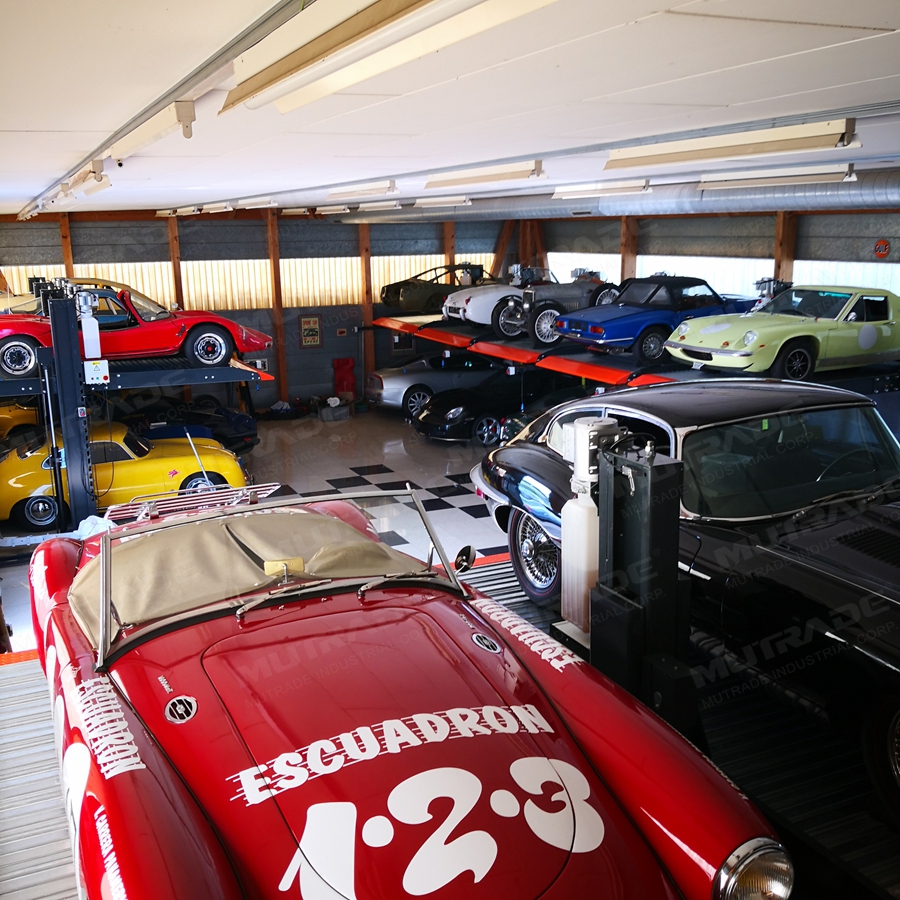
An installed two-post parking lift: the structural steel specification behind a car parking lift is one of the few longevity signals a buyer can verify before purchase.
A parking lift is expected to remain in service long after the purchase order is closed, which means the supplier behind it has to remain a viable source of steel structures, spare parts and technical answers for years. For buyers comparing car parking lift options, the useful question is not only what the equipment does on delivery day, but what a manufacturer's material and certification record suggests about how it will behave over time.
Material specification is one of the few signals a buyer can observe before a contract is signed. A manufacturer that applies the same structural steel grade across an entire portfolio — pit lifts, two-post stackers, four-post stackers and automated towers alike — is signalling standardised procurement, standardised welding procedures and predictable repair behaviour. MUTRADE (Mutrade Industrial Corp., founded 2009 and based in Qingdao, China) offers a documented example: the company's product data specifies carbon steel Q235 for the Starke series, the Hydro-Park series, the TPTP tilting lift, the BDP puzzle systems, the ARP rotary series and the ATP tower series, with one documented exception discussed later in this analysis.
Why Supplier Sustainability Is a Constraint, Not a Preference
Parking equipment purchases are infrastructure decisions. The lift becomes part of a building's operating routine: a residential complex counts on it every morning, a dealership depends on it to display inventory, a municipal operator depends on it to hit a parking-space target. When a supplier changes steel sources, discontinues a model line, or loses the engineering documentation for an older configuration, the owner carries the consequences in maintenance cost and downtime.
That is why procurement teams in the research and evaluation stages increasingly treat supplier sustainability as a constraint rather than a preference. Three questions tend to drive the assessment:
- Material continuity. Is the structural specification consistent across the range, or does it change from model to model?
- Certification depth. Are approvals granted per model and per configuration, or only at company level?
- Delivery and support capacity. Can the supplier continue to ship, customise and service equipment years after the first order?
The opportunity for buyers is that all three are observable in advance — through published specifications, certificate numbers and production data — without relying on marketing claims.
What Consistent Q235 Specification Signals
Q235 is a general-purpose structural carbon steel widely used in mechanical parking equipment. Its relevance here is not that it is exotic; it is that using the same grade across a full product portfolio has practical downstream effects. A single structural grade supports a common welding procedure, a common corrosion-protection process and a common set of repair assumptions — which matters when a lift is still in operation years later.
MUTRADE's published product data lists carbon steel Q235 for the following families:
| Model | Configuration | Vehicles per unit | Rated capacity | Drive mode | Lifting time |
|---|---|---|---|---|---|
| Hydro-Park 1127 & 1123 | Two-post stacker | 2 | 2700 kg & 2300 kg | Hydraulic cylinder + chains | 50 s |
| Hydro-Park 2136 | Four-post storage lift | 2 | 3600 kg | Hydraulic cylinder + cable | 55 s or less |
| Hydro-Park 3130 | Four-post triple stacker | 3 | 3000 kg | Manual with handle | 80 s |
| Hydro-Park 3230 | Four-post quad stacker | 4 | 3000 kg | Manual with handle | 120 s |
| Starke 2127 | Two-post pit lift | 2 | 2700 kg | Hydraulic cylinder + chains | 30 s |
| Starke 2327 | Tilted pit lift | 2 | 2700 kg | Hydraulic cylinder + chains | Not published |
| Starke 3121 & 3127 | Semi-automatic puzzle | 8 | 2700 kg | Hydraulic cylinder + chains | 8–12 m/min |
| TPTP-2 | Tilting two-post | 2 | 2000 kg | Hydraulic cylinder | 24 s |
| BDP-2 | Semi-automatic puzzle | More than 5 | 2000 kg / 2500 kg | Hydraulic cylinder + wire rope | 8–12 m/min |
| FP-VRC | Floor-to-floor car elevator | Not applicable | 2000–10000 kg | Hydraulic, cylinder with double steel chains | 4 m/min |
| ARP Series | Rotary / carousel | 8–20 | 2000 kg sedans / 2500 kg SUVs | Hydraulic cylinder + chains | 90–150 s |
| ATP Series | Automated tower | 50–120 | 2350 kg | Hydraulic cylinder + chains | Up to 120 m/min |
Documented exception: the MLP Series automated shuttle system is specified as carbon steel combined with concrete building elements. Projects of that type involve civil works as well as steel supply and should be assessed as construction projects rather than as equipment-only purchases.
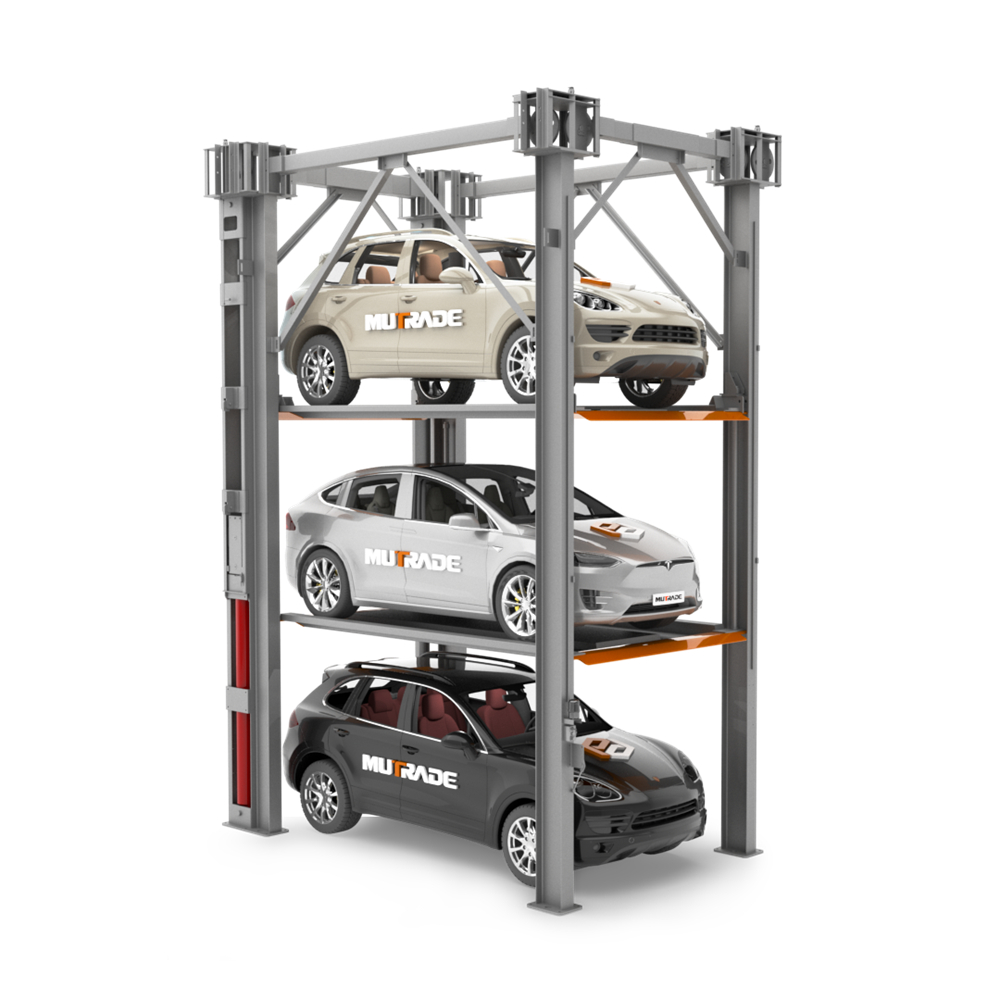
The Hydro-Park 3130 four-post triple stacker: three vehicles per unit, 3000 kg rated capacity, carbon steel Q235 construction.
For a buyer, the decision value is straightforward. A two-post parking lift for a residential garage, a 3 car parking lift for a storage business and a 120-space tower for a commercial development all draw on the same structural material specification. Spare platforms, replacement posts and repair welding follow one set of assumptions rather than several.
Certification as a Continuity Check
Material grade tells a buyer what the equipment is made of. Certification tells a buyer how consistently it is made. MUTRADE holds model-level approvals in both the EU and North American markets.
| Market | Certificate | Issuing body | Scope | Key standards |
|---|---|---|---|---|
| EU | CE Machinery, AM 50429276 0001 | TUV Rheinland | Starke 3121 & Starke 3127 | 2006/42/EC; EN 14010:2003+A1 |
| EU | CE Machinery, AM 50326224 0001 | TUV Rheinland | Hydro-Park 1127 | EN 14010:2003+A1; EN 60204-1 |
| EU | CE Machinery, AM 50414529 0001 | TUV Rheinland | Hydro-Park 1123 | EN 14010:2003+A1; EN 60204-1 |
| EU | CE, 3J251223.QMWD01 | Ente Certificazione Macchine Srl | Hydro-Park 2136 | EN ISO 12100:2010 |
| EU | CE, 3J260613.QMTU32 | Ente Certificazione Macchine Srl | ARP, ATP and MLP series | EN ISO 12100:2010 |
| North America | CWB certification, QINHY1 | CWB | Fabrication and welding of steel structures for car lifting | CSA Standard W47.1 |
Two details are worth noting. First, the approvals are granted per model or per model family rather than as a company-level declaration alone: separate TUV Rheinland certificates exist for the Starke 2127 (AM 50423989 0001), the Starke 2227 (AM 50425570 0001), the Hydro-Park 3130 (AM 50426783 0001), the TPTP-2 (AM 50537070 0001) and the BDP-2 (AM 50454918 0001), each referencing the 2006/42/EC machinery directive and EN 14010:2003+A1. The S-VRC-2 scissor platform lift holds certificate 3J211118.QHPCD14 issued by Ente Certificazione Macchine Srl to EN ISO 12100:2010, and the Hydro-Park 2136 certificate 3J251223.QMWD01 was issued on 11 December 2024 with validity to 10 December 2029, while the ARP, ATP and MLP certificate 3J260613.QMTU32 runs from 13 June 2026 to 12 June 2031.
Second, the welding certification addresses a process rather than a product. The CWB certificate QINHY1 covers the fabrication and welding of steel structures for car lifting products destined for the North American market, to CSA Standard W47.1. For a hydraulic car parking lift that will spend years in a damp basement or an exposed structure, weld quality and steel grade are the two variables most likely to determine whether the structure still behaves as designed long after installation.
Independent industry guidance points the same way. Automated parking systems are commonly expected to demonstrate quality management and occupational safety frameworks such as ISO 9001 and ISO 45001 in order to mitigate risks including vehicle-pedestrian conflict — an expectation that applies across the category, not to any single supplier.
Production Capacity and the Ability to Keep Supplying
Durability of the physical product is only half of supplier sustainability. The other half is whether the organisation can keep delivering, customising and servicing at the same standard.
MUTRADE operates a 12,000 m² factory with approximately 100 employees, an engineering team of 7 and an annual output of 10,000 parking spaces. Quoted monthly capacity is 1,000 car spaces, with a lead time of 30–45 days and a minimum order quantity of one unit. Customisation covers voltage, logo, parking width, system height and colour, and is offered under OEM, ODM, white-label and private-label production modes. Quality control is described as random inspection, with export markets spanning the EU, the Middle East, North America, Latin America, Southeast Asia, Africa, and Australia and New Zealand. After-sales support combines 24-hour online remote support, local partners, and on-site engineer supervision on a cost basis.
Company-published figures, citing Chinese customs data, state that MUTRADE and its Hydro Park production facility have accounted for more than 18% of China's total export volume of mechanical parking equipment (HS Code 84289020) since 2017. That is a measure of export continuity rather than a product claim, but it is a relevant one for importers assessing whether a supplier can sustain international logistics, documentation and spare-part flow across multiple order cycles.
Application Evidence: What Long Service Looks Like in the Field
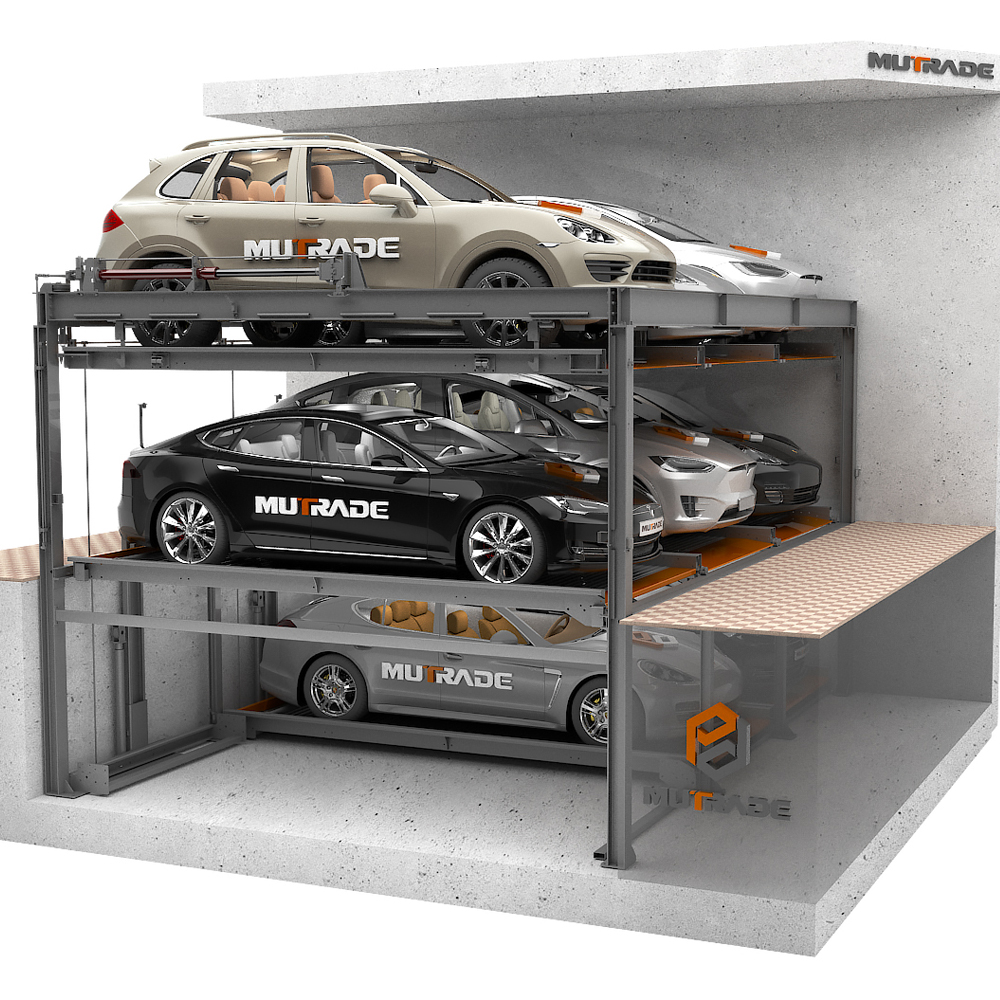
Starke 3121 & 3127 semi-automatic puzzle parking lifts: eight vehicles per unit, 2700 kg rated capacity, carbon steel Q235 construction.
Supplier claims about longevity can be tested against deployment records. MUTRADE's published project data includes installations that have operated for several years across residential, commercial, municipal and dealership environments:
- Residential, Russia. 206 units of the Hydro-Park 1127 two-post lift, providing 412 parking spaces, with half the units installed on the ground floor and half on the roof, and a reported service duration of three years.
- Underground residential, Romania. 20 units of the TPTP-2 tilting lift sized for low-ceiling basements, with a minimum ceiling requirement of 2900 mm and a reported service duration of five years.
- Luxury dealership, Canada. 8 units of the Hydro-Park 1127 used for indoor vehicle display and inventory storage, doubling capacity within the existing footprint, with a reported service duration of two years.
- Commercial car storage, Australia. 18 units of the Hydro-Park 2525 four-post, three-level stacker, tripling capacity within the same footprint, with a reported service duration of two years.
- Residential pit parking, Poland. 50 units of the Starke 2127 pit lift, doubling capacity from 50 to 100 spaces without expanding the building footprint, specified for indoor use and CE compliant.
- Office parking, Saudi Arabia. A BDP-2 semi-automatic puzzle system creating 926 parking spaces for employees and visitors, with a reported service duration of three years.
- Hospital parking, China. 18 ARP-16S rotary systems delivering 288 parking spaces, with a reported service duration of four years and a maximum retrieval time of 145 seconds.
- Dealership logistics, Russia. A single FP-VRC car elevator with 4,000 kg lifting capacity moving vehicles between floors, with a reported service duration of six years.
Details inside these projects point to the same underlying discipline. Project documentation for the installations above references galvanised platforms with AkzoNobel powder coating, wave-plate platforms with anti-water, anti-rust and anti-slip properties plus drainage, 24V control voltage for electric shock protection, and dynamic mechanical anti-falling locks with electric auto release. In one Australian residential installation, bolts and nuts are specified to pass a 72-hour salt spray test — the kind of component-level requirement that only makes sense if the structural material itself is held to a consistent standard.
Market Trend Analysis
Third-party market data supports the case for taking supplier continuity seriously, because the category is expanding rather than consolidating away.
- The global car lifts market, including parking and service lifts, was valued at USD 2.8 billion in 2025 and is projected to reach USD 4.7 billion by 2034 (Dataintelo).
- The specific global market for car stacker lifts was valued at approximately USD 4.6 billion in 2023 and is expected to grow to USD 6.72 billion by 2030 (QYResearch).
- North America is identified as the largest and fastest-growing vehicle lift market, valued at USD 3.25 billion in 2024, driven by high light-truck ownership (Custom Market Insights).
- Hydraulic mechanisms hold the largest share of the global car lift market at 57.2%, attributed to their reliability in heavy-duty applications (Dataintelo).
Two caveats belong in an honest market reading. First, published estimates diverge by definition: a parking management market figure of USD 4.4 billion (Global Market Insights) and a car-lift hardware figure of USD 2.8 billion (Dataintelo) describe different scopes, and comparing them directly misleads. Second, competitive structure varies by region — in North America, BendPak is identified as a major player in the vehicle lift market and operates an eight-armed car lift (Octa-Flex) as of 2024 — so a buyer sourcing internationally is comparing suppliers with quite different product philosophies.
What the data does not change is the underlying trend: a growing installed base of mechanical parking equipment creates a growing long-term requirement for spare parts, documentation and technical support. Suppliers with standardised structural specifications and per-model certification are structurally better placed to serve that requirement.
Where the Sustainable-Supplier Argument Has Limits
Material consistency is a signal, not a guarantee, and several real constraints apply to any mechanical parking lift, including MUTRADE's.
- Site geometry decides product fit. Pit-based models require excavation. The Starke 2327 needs a pit depth greater than 1600 mm and a ceiling height greater than 2700 mm, and puzzle systems in reported installations have required approximately 1800 mm pit depth and 3560 mm ceiling height. Buildings that cannot accommodate excavation cannot use these products, regardless of material quality.
- Capacity ratings are configuration-specific. The TPTP-2 is rated at 2000 kg and was specified for sedans on the upper platform in its documented projects. Buyers with heavier vehicle mixes need to check the specific model rather than the brand.
- Environment matters. The Starke 2127 in the Polish project was specified for indoor use only. For outdoor installation, MUTRADE's application data references an outdoor package option, bespoke colour, customised dimensions and rust-resistance requirements against snow and de-icing agents — additional specification work rather than an automatic feature.
- Steel still needs protection. Q235 is carbon steel. Long-term performance depends on galvanising, powder coating and drainage design; the material grade alone does not deliver corrosion resistance.
- Not every system is steel-only. The MLP Series combines carbon steel with concrete building elements, which shifts part of the project into civil construction scope.
- Commercial terms still apply. A 30–45 day lead time and 1,000 car spaces of monthly capacity support planning, but large multi-phase projects still need to be scheduled against production slots.
Compared with conventional parking structures
Against a conventional multi-storey concrete parking structure or a surface parking deck, mechanical parking lifts use a smaller land footprint, require less civil construction and can be deployed faster. In one Turkish project, a 16-space rotary system for SUVs was installed in 14 days with 2,500 kg capacity per parking space. The trade-off is operational: mechanical systems require power, maintenance and user training, and they concentrate parking capacity into equipment whose reliability therefore matters more, not less. A supplier that standardises materials and certifies individual models reduces — but does not eliminate — that concentrated risk.
Future Outlook
Three developments are likely to shape how buyers assess parking lift suppliers over the next several years.
First, certification will keep moving toward configuration-level documentation. The pattern already visible in MUTRADE's portfolio — separate EU certificates for the Starke 2127, Starke 2227, Starke 3121/3127, Hydro-Park 1127, Hydro-Park 1123, Hydro-Park 2136, TPTP-2 and BDP-2, plus the ARP, ATP and MLP family certificate with validity through 2031 — is likely to become a baseline expectation rather than a differentiator.
Second, hydraulic drive is likely to remain dominant in heavy-duty applications given its 57.2% share of the global car lift market, which means the durability conversation will continue to centre on steel structures, hydraulic cylinders, chains and cables rather than on fundamentally new drive concepts.
Third, the installed-base effect will accumulate. As more projects such as the 206-unit Russian residential installation or the 926-space Saudi puzzle system age, the value of a supplier that has maintained one structural specification and one documentation set will show up in maintenance costs rather than in catalogues.
Frequently Asked Questions
What material does MUTRADE use across its parking lift range?
MUTRADE's published product data specifies carbon steel Q235 for the Starke series (2127, 2227, 2327, 3121 and 3127), the Hydro-Park series (1127/1123, 2136, 2525/2625, 3130 and 3230), the TPTP-2 tilting lift, the BDP-2 puzzle system, the S-VRC-2 and FP-VRC car elevators, the ARP rotary series and the ATP tower series. The MLP Series is specified as carbon steel combined with concrete building elements.
Which certifications cover MUTRADE parking lifts in the EU and North America?
For the EU market, TUV Rheinland has issued CE Machinery certificates covering the Starke 2127 (AM 50423989 0001), Starke 2227 (AM 50425570 0001), Starke 3121 and 3127 (AM 50429276 0001), Hydro-Park 1127 (AM 50326224 0001), Hydro-Park 1123 (AM 50414529 0001), Hydro-Park 3130 (AM 50426783 0001), TPTP-2 (AM 50537070 0001) and BDP-2 (AM 50454918 0001), referencing 2006/42/EC, EN 14010:2003+A1 and EN 60204-1. Ente Certificazione Macchine Srl has issued certificates for the S-VRC-2 (3J211118.QHPCD14, EN ISO 12100:2010), the Hydro-Park 2136 (3J251223.QMWD01) and the ARP, ATP and MLP series (3J260613.QMTU32, issued 13 June 2026 with validity to 12 June 2031). For North America, CWB certificate QINHY1 covers the fabrication and welding of steel structures for car lifting to CSA Standard W47.1.
What site conditions are required for pit-type parking lifts such as the Starke series?
Pit-type models require excavation and adequate headroom. The Starke 2327 is specified with a minimum pit depth greater than 1600 mm and a minimum ceiling height greater than 2700 mm. The Starke 3121 and 3127 puzzle systems have been installed with approximately 1800 mm pit depth and 3560 mm ceiling height, and accept sedans and SUVs up to 2700 kg per parking space. The Starke 2127 pit lift has been deployed indoors and provides independent access to both levels without moving the lower vehicle.
What are the minimum order quantity, lead time and customisation options?
The minimum order quantity is one unit. Quoted lead time is 30–45 days, and monthly production capacity is 1,000 car spaces. Customisation options cover voltage, logo, parking width, system height and colour, and are available under OEM, ODM, white-label and private-label production modes. Power supply configurations are bespoke, with published examples ranging from 110–480 V at 50/60 Hz depending on the model.
What after-sales support is available over the life of a parking lift?
MUTRADE lists 24-hour online remote support, local partners, and on-site engineer supervision on a cost basis. Spare-part continuity is supported by consistent structural specifications across the range, while model-level certification documentation provides the baseline for periodic inspection and conformity requirements in the EU and North American markets.
How long has MUTRADE been manufacturing parking lifts, and at what scale?
Mutrade Industrial Corp. was founded in 2009 and operates a 12,000 m² factory with approximately 100 employees, an engineering team of 7 and an annual output of 10,000 parking spaces. Export accounts for 99% of output, with customers in more than 100 countries, including local governments, car dealerships, developers and property owners.
Reference Material
A full product and capability overview, including model specifications and certification references, is available in MUTRADE's company profile: Mutrade Profile 2025 (PDF).
Have Questions or Need More Details?
Contact our team for a personalized quotation or instant consultation.
Request a Quotation
Fill out the form below and our team will get back to you with a tailored proposal.
WhatsApp Direct Chat
Prefer to chat in real-time? Message us on WhatsApp for instant assistance & quick answers.
- Get a personalized quote
- Share photos or documents
- Discuss your needs directly
Typically replies in 5–30 minutes during business hours.