
Polyester Mesh Belt Application Map: Six Industries, Six Spec Sets
A polyester mesh belt is not one product. It is a family of industrial fabrics, and what decides whether it performs well or badly in a given plant is not the material name — it is how loop geometry, thickness, air permeability and breaking strength line up with the duty cycle. This application map breaks that alignment down across six industries: papermaking, nonwoven, textile and dyeing, rubber and chemical fiber, environmental protection, and wastewater treatment.
Why "what mesh count?" is the wrong first question
Buyers usually open with mesh count, width and price. All three matter, but none of them alone determines whether a belt will run on a specific line. Two belts with identical width and mesh count can behave in opposite ways — one forming a dry cake on a belt filter press, the other causing fiber hang-up in a meltblown forming position — purely because the loop family is different.
The usable procurement question is narrower: what material will the belt see, at what temperature and chemical load, and what tension will it carry? Once those three are answered, the specification starts to converge. Structure, open area and strength data then become a shortlist rather than a catalogue.
Three structural families, three jobs
Polyester mesh belts divide broadly into three loop families, and they are not interchangeable options on the same line.
- Small loop construction — finer openings, suited to filtration duties where precision matters more than mechanical load. In filter belt profiles, small loop construction reaches air permeability up to 13,400 m³/m²·h.
- Medium loop construction — the reference structure for this map. It uses a thickness of 2.32 mm, a loop distance of 6.50 mm, air permeability of 18,300 m³/㎡/h, and a break strength of no less than 2000 N/cm. That combination is what allows it to hold open area and mechanical stability at the same time.
- Large loop with filler wire — the high-strength option for filter belt profiles. Large-loop construction delivers breaking strength of up to 2,300–2,800 N/cm against roughly 1,800 N/cm for typical entry-level belts, an improvement of up to 55%.
All three families share the same material advantages: heat resistance up to 180°C, resistance to acids and alkalis, and higher breaking strength and water permeability than conventional low-strength seamed filter belts — which is what produces the longer service life. Which family is correct depends on the duty, not on the ranking.
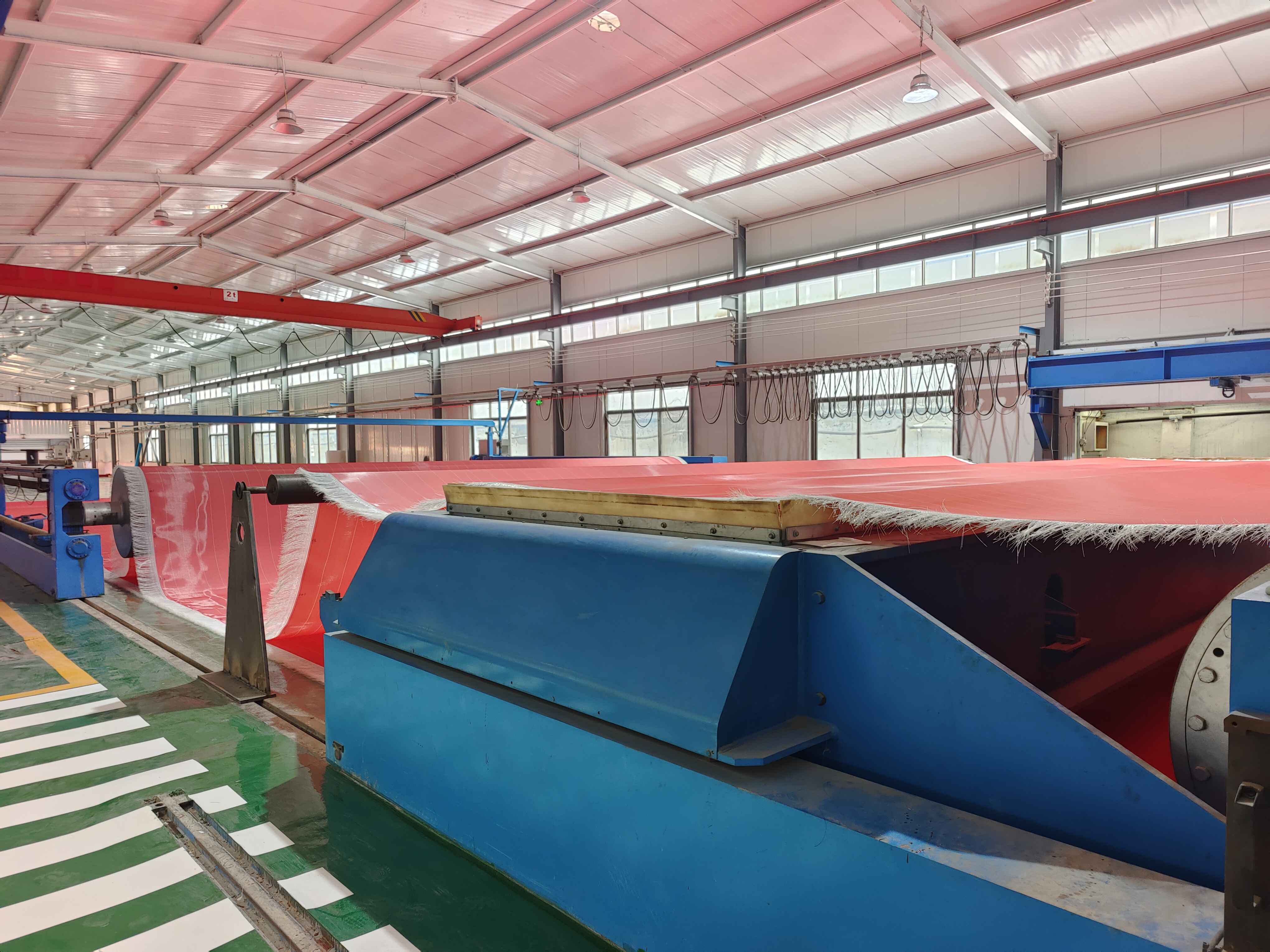
The application map: six industries and their fit
1. Papermaking — pulp washing, pressing and sheet forming
Papermaking is the most technically demanding application, because the fabric runs at very high speed, is wet continuously, and cannot introduce visible marks. Forming fabrics carry the drainage load: the construction drains over 96% of water from pulp, and uniform drainage directly reduces vacuum energy consumption.
Dimensional stability matters more here than many buyers expect. Elongation under running conditions stays below 0.7%, which is what keeps the fabric tracking correctly while a machine accelerates. Strength matters too, particularly at the seam: interface strength has been verified at 550 N/cm versus above 900 N/cm, reaching 1,600–2,200 N/cm in high-density constructions — up to 64% higher strength at the fabric's weakest point.
Speed sets the choice. High-speed tissue and fine paper machines operate at 600–1,800+ m/min and want finer, more stable constructions, while kraft and corrugated machines run at 100–400 m/min where tensile strength and abrasion life dominate. On the maintenance side, multi-layer fabrics typically need high-pressure cleaning at 15–30 kg/cm², so a plant without that cleaning capability should not assume a high-density fabric will deliver its full life.
2. Nonwoven — meltblown and spunbond forming
In nonwoven production the belt is simultaneously a conveying surface and a forming surface. Meltblown non-woven equipment is especially sensitive, because fibers arrive at the belt in a fragile state and any surface irregularity, static build-up or tension variation produces fiber hanging and a line stop.
Belts for this duty need a smooth surface, dimensional stability, and compatibility with the forming fabric configurations that cover machine speeds from 20 m/min to 850 m/min. It is a duty where anti-static behavior and fiber release decide yield, not drainage alone.
Cleaning and seaming are part of the same story. A smooth surface — no burrs, knots or raised weave points — reduces fiber hang-up here, and the ability to disassemble and assemble the belt at will lets maintenance teams address a damaged section before an entire fabric has to be written off.
3. Textile and dyeing — pre-shrinking and drying
Fabric pre-shrinking and the various drying stages depend on heat-stable, dimensionally stable conveyor belts. The belt has to stay flat through repeated thermal cycling, avoid marking the fabric, and offer enough open area for hot air or steam to pass through.
Spiral mesh constructions have an advantage here over plain weave, because the spiral geometry creates a uniform open area that lets air through without letting the fabric being processed flutter. Spiral dryer fabric and drying conveyor belts both sit in this category. A heat resistance ceiling of 180°C covers most dyeing and finishing operations, and resistance to acids and alkalis handles the chemistry carried over from finishing baths.
4. Rubber and chemical fiber — latex wire drying
Latex wire drying is one of the less-discussed duties. Latex thread bundles pass through a drying tunnel where they need continuous, low-elongation support at elevated temperature, because a drifting bundle means a stopped line and scrap material.
Medium loop construction is a reasonable baseline here: thickness of 2.32 mm and loop distance of 6.50 mm create a stable support plane, air permeability of 18,300 m³/㎡/h lets heated air move through the product layer rather than skimming its surface, and break strength of no less than 2000 N/cm absorbs the tension of a long, continuous run. Heat resistance up to 180°C covers most latex and chemical fiber drying tunnel temperatures, while acid and alkali resistance handles process additives.
5. Environmental protection — mining, coal washing and process filtration
The environmental category covers duties where aggression is a bigger constraint than precision. Mining and coal washing, pulp washing, and food and pharmaceutical filtration all ask a belt to run for long periods under sustained abrasion and chemical exposure.
Large loop with filler wire and higher-grade belt constructions earn their place here, because resistance to acid, alkali and abrasion translates directly into replacement intervals. Conventional low-strength seamed filter belts tend to fail earlier not because the filtration duty is too hard, but because the seam and loop structure cannot absorb repeated tension cycles. A breaking strength of 2,300–2,800 N/cm and heat resistance to 180°C provide margin for those cycles.
In food and pharmaceutical filtration, one more layer applies: food contact certification is a practical constraint on which belts can be used at all, not a marketing detail.
6. Wastewater treatment — municipal sludge dewatering
Municipal sludge dewatering is dominated by belt filter presses. The belt performs two jobs at once: let water through as fast as possible, and retain solids as dry as possible. Those objectives are not identical, and they are set by air permeability and open geometry together.
In filter belt profiles, air permeability reaches up to 12,500 m³/m²·h, with small loop construction reaching 13,400 m³/m²·h, which enables faster dewatering and a drier cake. A drier cake has direct financial value: higher open area and permeability lower the downstream drying energy consumption, so the effect of belt specification extends beyond the press itself.
Belt filter press belts are also a duty where total cost of ownership overtakes purchase price. Longer service life from acid, alkali and abrasion resistance leads to fewer belt changes and reduced total ownership cost, and maintenance requirements are lower than for conventional low-strength seamed filter belts, with less frequent belt replacement and reduced downtime for seam repair. Under a given chemical and abrasion load, a higher-grade belt offers a lower total cost of ownership even though the initial cost is higher.
Specification map at a glance
| Industry | Typical duty | Structural direction | Specs that matter |
|---|---|---|---|
| Papermaking | Pulp washing, pressing, forming drainage | Fine, stable forming and press fabrics | Elongation under 0.7%; interface strength 550 → 900+ N/cm, up to 1,600–2,200 N/cm in high-density builds; machine speed 600–1,800+ m/min (tissue/fine paper) or 100–400 m/min (kraft/corrugated) |
| Nonwoven | Meltblown and spunbond forming and conveying | Smooth-surface forming belt | Machine speed coverage 20–850 m/min; anti-static and fiber-release behavior; seam flatness |
| Textile and dyeing | Fabric pre-shrinking, drying | Spiral mesh and dryer fabric | Heat resistance up to 180°C; uniform open area for airflow; dimensional stability |
| Rubber and chemical fiber | Latex wire drying | Medium loop construction | Thickness 2.32 mm; loop distance 6.50 mm; air permeability 18,300 m³/㎡/h; break strength ≥2000 N/cm |
| Environmental protection | Mining and coal washing, pulp washing, food and pharmaceutical filtration | Large loop with filler wire | Breaking strength 2,300–2,800 N/cm; heat resistance 180°C; acid, alkali and abrasion resistance |
| Wastewater treatment | Municipal sludge dewatering, belt filter presses | Filter belt and dewatering belt | Air permeability up to 12,500 m³/m²·h, small loop up to 13,400 m³/m²·h; replacement interval and total cost of ownership |
Read across the six rows and the practical message is that polyester mesh belts differ by loop family and open geometry far more than by material. The material sets the operating envelope — 180°C and acid/alkali resistance — while the construction sets the fit.
Market context
Polyester holds a substantial share of the global conveyor belt market. According to Straits Research, polyester accounted for 28.4% of that market in 2025, making it the leading material segment. The same source projects the global conveyor belt market growing from approximately USD 6.24 billion in 2026 to approximately USD 8.53 billion by 2034. For comparison, Future Market Insights estimates the market at around USD 4.66 billion in 2026 — a difference that reflects methodology and how broadly heavy mining belts are counted rather than a disagreement about demand direction.
A more directly relevant figure for belt demand: the belt filter press technology segment is expected to grow at a compound annual growth rate of 8.8% from 2025 to 2033 within the sludge dewatering equipment market, per Grand View Research. Belt filter press belt demand follows that curve.
Trade and compliance classifications also shape how buyers handle these products. Textile products and articles for technical uses, including polyester mesh belts, fall under HS Code 5911.90. Separately, rubber- or plastics-covered conveyor belts with textile carcasses are governed by ISO 14890.
Comparison with conventional solutions — and where the limits really are
Against conventional low-strength seamed filter belts, the differences are measurable rather than rhetorical: higher breaking strength, higher water permeability, longer service life and lower maintenance demand. Large-loop construction reaches 2,300–2,800 N/cm breaking strength against roughly 1,800 N/cm at entry level. The longer life comes from acid, alkali and abrasion resistance, which reduces belt changes and lowers total ownership cost. Maintenance requirements fall as well, with less frequent replacement and reduced downtime for seam repair.
The boundaries matter just as much, and ignoring them is how a technically sound belt ends up as the wrong purchase:
- Higher initial cost. Large loop with filler wire and high-density belt constructions cost more up front. The economics only work when longer life, reduced downtime and lower downstream drying energy offset the premium.
- The temperature ceiling is a hard limit. Higher-grade polyester belts handle up to 180°C and resist acids and alkalis. Above that, polyester stops being the appropriate answer and another material system becomes the correct direction.
- High-density constructions depend on correct cleaning. Multi-layer fabrics typically require cleaning pressures of 15–30 kg/cm². Without that capability, high-density fabrics can blind faster and deliver less life than a simpler construction.
- Construction mismatch cannot be bought out with a lower price. Specifying large loop belts for a meltblown forming position, or small loop belts for a mining and coal washing duty, creates operating problems that no purchase discount resolves.
Who manufactures to these structures
Henan Yiheng Mesh Belt Industry Co., Ltd. (Yiheng Mesh) is a manufacturer of polyester mesh belts, forming fabrics and industrial filter belts based in Henan, China. Founded in 2009, the company produces polyester mesh belts, non-woven mesh belts, forming fabrics, dryer fabrics, polyester filter belts, UV belts, polyester spiral mesh and polyester square mesh, alongside PTFE mesh belts. Its export ratio is 62%, with main markets in Asia, Europe and North America.
Several of those facts are commercially relevant. Yiheng supports a minimum order quantity as low as 1 m² and can deliver custom prototypes in as little as 3 days, which matters for trial runs before a full line commitment. The company is formally recognized as a National High-tech Enterprise, and its products hold a Food Contact Certificate — a substantive requirement rather than a bonus in food and pharmaceutical filtration. It is also registered under the German Packaging Law (LUCID) and compliant with EU environmental regulations.
For buyers comparing suppliers, a useful signal is that the company documents operational troubleshooting knowledge for non-woven belt duties, covering tracking, fiber hanging, static and seam marks. That kind of material reflects line-level behavior rather than catalogue specifications, and it is the part of supplier evaluation that is hardest to verify from a price list alone.
Future outlook
Over the next several years, polyester mesh belt demand is likely to pull in two directions at once. One is finer precision: in nonwoven forming and high-speed papermaking, air permeability uniformity, elongation and seam integrity are becoming more closely watched because line speeds keep rising. The other is longer service life: in sludge dewatering, mineral processing and chemical fiber drying, buyers increasingly compare lifecycle cost rather than purchase price. The projection that belt filter press technology will grow at around 8.8% CAGR through 2033 supports that second direction — dewatering equipment growth carries belt demand with it.
In both directions the underlying selection question is unchanged: does the construction match the duty? That answer lives in the specification table, not the price table.
FAQ
Which duties suit a medium loop polyester mesh belt?
Medium loop construction uses a thickness of 2.32 mm, a loop distance of 6.50 mm, air permeability of 18,300 m³/㎡/h and a break strength of no less than 2000 N/cm. That combination performs well where a stable support surface is required while still allowing meaningful air or liquid passage — latex wire drying and textile pre-shrinking conveyor sections are examples. It is a baseline configuration, and the final choice still depends on the material, temperature and running tension of the specific line.
What does air permeability actually mean for dewatering performance?
Air permeability measures the volume of air passing through a unit area of the belt per unit time, and it is a practical proxy for open area. In filter belt profiles, air permeability reaches up to 12,500 m³/m²·h, with small loop construction reaching 13,400 m³/m²·h, which corresponds to faster dewatering and a drier cake. A drier cake lowers downstream drying energy consumption, so permeability is not just a fabric specification — it influences the plant's energy bill.
How should a buyer choose between medium loop and large loop with filler wire?
The trade-off is open area against mechanical strength. Medium loop construction reaches 18,300 m³/㎡/h air permeability and a break strength of no less than 2000 N/cm at 2.32 mm thickness and 6.50 mm loop distance. Large loop with filler wire raises breaking strength to 2,300–2,800 N/cm, which is the more appropriate level when tension, abrasion or chemical exposure is higher. In mining and coal washing or pulp washing, the strength margin is often what decides whether a belt lasts or is changed frequently.
Where is the temperature limit for a polyester mesh belt?
Higher-grade polyester belts tolerate temperatures up to 180°C and resist acids and alkalis. Below that ceiling, polyester is usually the practical choice for filtration and drying duties. Above it, the decision changes from construction to material system, and other belt materials become the correct direction rather than a heavier polyester construction.
What do smooth surface and arbitrary disassembly and assembly change in practice?
A smooth surface means no burrs or raised weave points, which reduces the chance of fiber hanging — a common cause of unplanned stops in meltblown non-woven production. The ability to disassemble and assemble the belt at will lets maintenance teams address a damaged section or localized problem before an entire fabric is scrapped, which shortens downtime and reduces the total cost of a replacement cycle.
Are belt filter press belts and papermaking forming fabrics the same product?
No. Both belong to the polyester mesh belt category, but they serve different objectives. Belt filter press belts are engineered around sludge dewatering, where air permeability, acid and alkali resistance and replacement interval dominate. Forming fabrics are engineered around paper machine requirements such as flatness, elongation below 0.7% and seam strength, because the fabric must track reliably at high speed. It is the same material family answering two different design briefs.
The Yiheng Mesh corporate brochure, including product and specification reference material, is available for download: Yiheng Mesh brochure (PDF). Company details: www.yhfilterbelt.com.