
Polyester Mesh Belt Shortlist: Options for Filter Press, Drying and Nonwoven Lines
A polyester mesh belt shortlist only earns its place in a purchase file if it is organised around the duty the belt has to survive. Woven polyester monofilament is used as a filter press belt, as a dryer belt on latex and textile lines, and as a forming or conveyor surface on meltblown and other nonwoven equipment. Each duty loads the belt differently, and each one rewards a different balance of thickness, loop distance, wire diameter and air permeability. This shortlist sets four verified constructions against those duties, explains what each specification actually measures, and then sets out the maintenance, inspection and purchasing terms needed to close the decision.
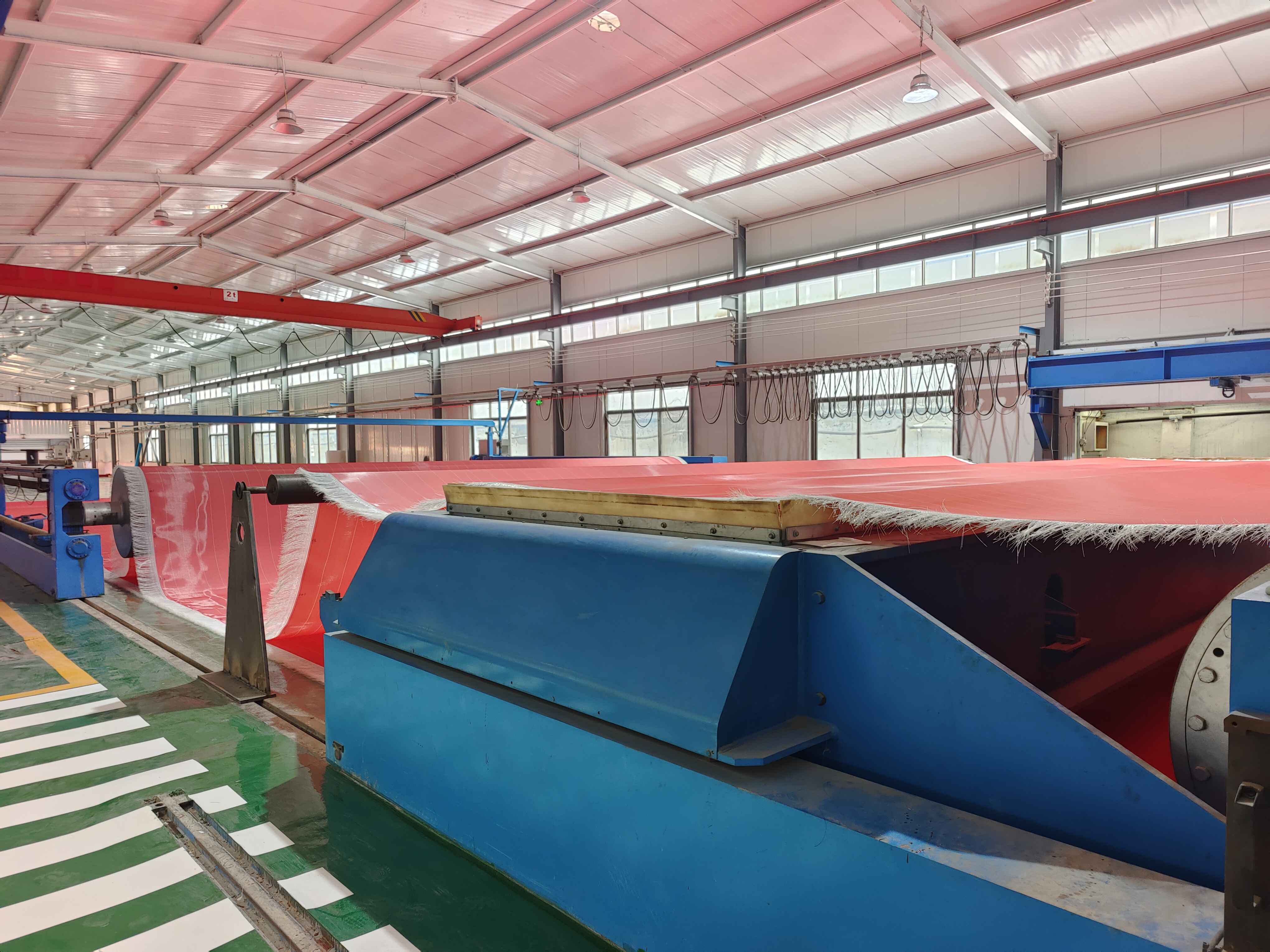
Polyester mesh belt production in progress ahead of heat setting and pre-shipment inspection.
Why One Specification Cannot Serve Three Duty Types
On a belt filter press, the belt is a drainage surface and a cake-release surface at the same time. Slurry is pressed against it, water has to leave quickly, and the solids have to come away cleanly enough that the belt does not blind. On a drying line, the belt behaves more like a conveyor and heat carrier: it positions the product, tolerates the temperature of the drying zone, and lets air move through the web. On a meltblown or other nonwoven line, the belt or forming surface governs how evenly air and water leave the forming web, which shows up in web uniformity and in how often the line stops for cleaning.
The practical answer is that a polyester mesh belt should be compared across four measurements at once: thickness, loop distance, wire diameter and air permeability. Selecting on a single number usually produces a belt that drains well but tracks badly, or one with a beautifully smooth surface that starves the vacuum box and slows the whole line.
Demand direction supports the case for getting this right. Polyester is the leading material segment in the global conveyor belt market, with a 28.4% revenue share in 2025 according to Straits Research. Within sludge dewatering equipment, belt filter press technology is expected to grow at a compound annual growth rate of 8.8% between 2025 and 2033, based on Grand View Research. Broader conveyor belt projections put the market at USD 6.24 billion in 2026 rising to USD 8.53 billion by 2034 (Straits Research); published estimates vary in scope, so these figures are best read as direction rather than as a precise forecast.
What to Compare Before You Build the Shortlist
Air permeability
Air permeability is expressed in m³/㎡/h and describes how much air passes through a defined area of belt in one hour. It is the closest single indicator of drainage and drying capacity in a woven mesh belt. For the same material, a higher figure means more open area, which generally means faster water removal in filtration duty and stronger airflow in drying duty, but also less support for fine particles and, in some forming duties, a higher risk of fibre migration into the mesh.
Loop distance and wire diameter
Loop distance is the spacing between the spiral loops that give spiral mesh belts their structure, and wire diameter is the thickness of the monofilament used in the weft and the warp. Together they decide how tight and how smooth the running surface is. A belt built 5.20 mm apart with 0.70 mm weft wire and 0.52 mm warp wire presents a tighter, finer surface than one built 6.50 mm apart. Finer wire tends to mark the product less, while heavier or wider spacing usually handles higher mechanical load.
Thickness
Thickness affects stiffness, how the belt sits on rollers and guide shoes, and how much belt material is presented to the load. The four options below span 1.90 mm to 2.95 mm within one material family, which is a wide enough range that a belt chosen for one line may be clearly wrong for another.
Surface condition and maintenance access
Surface finish influences cake release, cleaning frequency and product marking. A smooth surface also supports easier handling during replacement, which matters when a belt is changed inside a short maintenance window.
The Shortlist: Four Constructions and Their Verified Specifications
| Construction | Thickness | Air permeability | Loop distance | Wire diameter | Duty it is normally evaluated for |
|---|---|---|---|---|---|
| Small loop | 1.90 mm | 17,500 m³/㎡/h | 5.20 mm | 0.70 mm weft; 0.52 mm warp | Tighter support surface, finer filtration and drying duty |
| Medium loop | 2.32 mm | 18,300 m³/㎡/h | 6.50 mm | — | General filtration and drying; highest airflow in this shortlist |
| Medium loop with filler wire | — | 10,700 to 12,000 ±500 m³/㎡/h | — | — | Controlled drainage and a smoother, more closed surface |
| Large loop with filler wire (filter press belt) | 2.95 mm | — | — | — | Heavier belt filter press duty |
Reading note: the filler wire specification is given as a band with a tolerance (10,700 to 12,000 ±500 m³/㎡/h), not as a single fixed value. Buyers should treat it as a controlled range and confirm acceptance limits with the supplier before the order is placed.
Reading Each Option Against the Duty
Small loop: 1.90 mm, 5.20 mm loop distance, 17,500 m³/㎡/h
This is the finest construction in the shortlist: the thinnest belt, the tightest loop spacing, and the smallest wires at 0.70 mm weft and 0.52 mm warp. Its 17,500 m³/㎡/h permeability sits below the medium loop, which is consistent with a closer, more supportive surface. It is normally the first option to evaluate where the priority is a smooth, tightly woven face, where fine solids have to be held back, or where the product itself is easily marked. Where a line needs maximum open area, this is not the belt to start with.
Medium loop: 2.32 mm, 6.50 mm loop distance, 18,300 m³/㎡/h
The medium loop construction is the most open belt on this shortlist at 18,300 m³/㎡/h, roughly five percent above the small loop, with a 2.32 mm thickness and 6.50 mm loop spacing. It is the natural starting point for lines that are limited by drainage speed or airflow rather than by surface fineness, and it is a common general-purpose choice where a single belt type has to cover more than one product on the same machine.
Medium loop with filler wire: 10,700 to 12,000 ±500 m³/㎡/h
A filler wire occupies part of the open area of the mesh. The result is a deliberately less permeable belt: 10,700 to 12,000 ±500 m³/㎡/h against 18,300 m³/㎡/h for the plain medium loop. That reduction is the point. Where vacuum capacity is fixed, where fines carry over into the filtrate, or where the process needs a more controlled and even drainage front, the filler wire version gives the line a slower, more predictable water release instead of a fast one it cannot use.
Large loop with filler wire, filter press belt: 2.95 mm
At 2.95 mm this is the heaviest construction in the shortlist and the one specified for belt filter press duty. Greater thickness and loop size are consistent with the mechanical demands of a press: repeated squeeze cycles, tension across the press rolls, and continuous scraping of the cake. It is not a general-purpose dryer belt, and specifying it on a drying line usually means paying for load capacity the line does not use.
Matching Belt to Line: Five Application Patterns
1. Belt filter presses and sludge dewatering
Duty here is drainage plus cake release under pressure. The large loop filter press belt at 2.95 mm is the construction in this shortlist built for that role. On lighter presses, or on presses where the limiting factor is water removal speed rather than mechanical load, the medium loop at 2.32 mm and 18,300 m³/㎡/h is the alternative worth testing first. Final selection should always be confirmed against the actual drainage rate, cake dryness and tracking behaviour on the machine.
2. Latex wire drying
Latex drying lines place the belt in a hot, continuous conveyor role where product position and surface condition matter as much as airflow. A smooth, tightly woven face is generally preferred so that the belt does not mark the product, which points to the small loop construction at 1.90 mm and 5.20 mm loop distance. Where the drying zone is airflow-limited instead of surface-sensitive, the medium loop with its higher 18,300 m³/㎡/h permeability is the alternative.
3. Papermaking pulp washing
Pulp washing is a washing and drainage duty: liquor has to be pulled through the belt while fibre is retained. This is a classic case for evaluating drainage rate and fibre retention together, which is why the small loop at 17,500 m³/㎡/h and the medium loop with filler wire at 10,700 to 12,000 ±500 m³/㎡/h are both worth trialling on the same machine before a decision is made.
4. Fabric pre-shrinking
Pre-shrinking and similar textile finishing duties run a continuous fabric web over the belt, so the belt functions as a conveyor with a controlled, non-marking surface. Belt thickness and tracking behaviour usually weigh more heavily here than raw permeability, and the small loop construction's smooth face and finer wire are the usual starting point. Dimensional stability of the belt itself should be confirmed for the specific line speed and tension.
5. Meltblown and nonwoven lines
On meltblown and related nonwoven equipment, the belt or forming surface influences how evenly air and water leave the web, which feeds directly into web uniformity and cleaning interval. The choice between the small loop and the medium loop generally comes down to whether the line is limited by surface fineness or by drainage and airflow capacity. Whichever is selected, the belt should be matched to the machine's running speed and fibre type, not only to the mesh specification.
Belt inspection in the workshop: thickness, loop geometry and surface condition are checked against the ordered specification.
Maintenance and Handling: Smooth Surfaces and Easy Disassembly
Maintenance cost in mesh belt operations is rarely driven by unit price. It is driven by how long a belt change takes and how much production is lost while it happens. The constructions in this shortlist are built with smooth surfaces and support arbitrary disassembly and assembly, meaning the belt can be removed and refitted without a fixed disassembly sequence imposed by the belt construction itself. That matters on lines where a single belt replacement has to fit inside a planned maintenance window, and it also makes on-site inspection of the running surface more practical.
Replacement practice should still be planned around the machine. Tracking, tension, roller condition and scraper alignment all affect belt life, and a belt that is correct on paper will still fail early if these are out of specification.
Commercial Execution: Terms and Acceptance
Once a construction is selected, the execution stage is about terms that protect both sides. For these polyester mesh belts the purchasing terms are:
Minimum order quantity: 2 ㎡
Payment terms: 30% deposit, 70% balance before shipment
Acceptance criteria: 100% pre-shipment inspection, with third-party inspection by BV or SGS available
Delivery terms: FOB, CIF, DAP or DDP
Two classification points are worth confirming before the order leaves the supplier. Polyester mesh belts for technical uses fall under HS Code 5911.90, which is the classification applied to textile products and articles for technical uses. Separately, ISO 14890 governs rubber- or plastics-covered conveyor belts with textile carcasses; open-mesh polyester belts are not covered belts, and their performance is normally specified through air permeability, thickness, loop geometry and wire diameter rather than through that standard.
What This Shortlist Does Not Tell You
A specification table is a starting filter, not a guarantee. It does not capture seam construction or seam strength, running elongation under tension, the way a specific belt tracks on a specific machine, chemical exposure, operating temperature, or the belt's interaction with scraper blades and vacuum boxes. It also does not capture the fact that a higher permeability figure is not automatically better: the medium loop with filler wire exists precisely because a less permeable belt is the correct answer on some lines.
Third-party inspection is available but is not free and adds time to the shipment schedule. Buyers working to a tight commissioning date should decide early whether a BV or SGS inspection is part of their acceptance plan, rather than adding it after production is complete. Market data should be treated with the same discipline: published conveyor belt market estimates differ depending on whether heavy-duty and modular belts are included in the definition, so no single figure should be used as the basis for a capacity decision.
Supplier Continuity: What Long-Term Buyers Should Verify
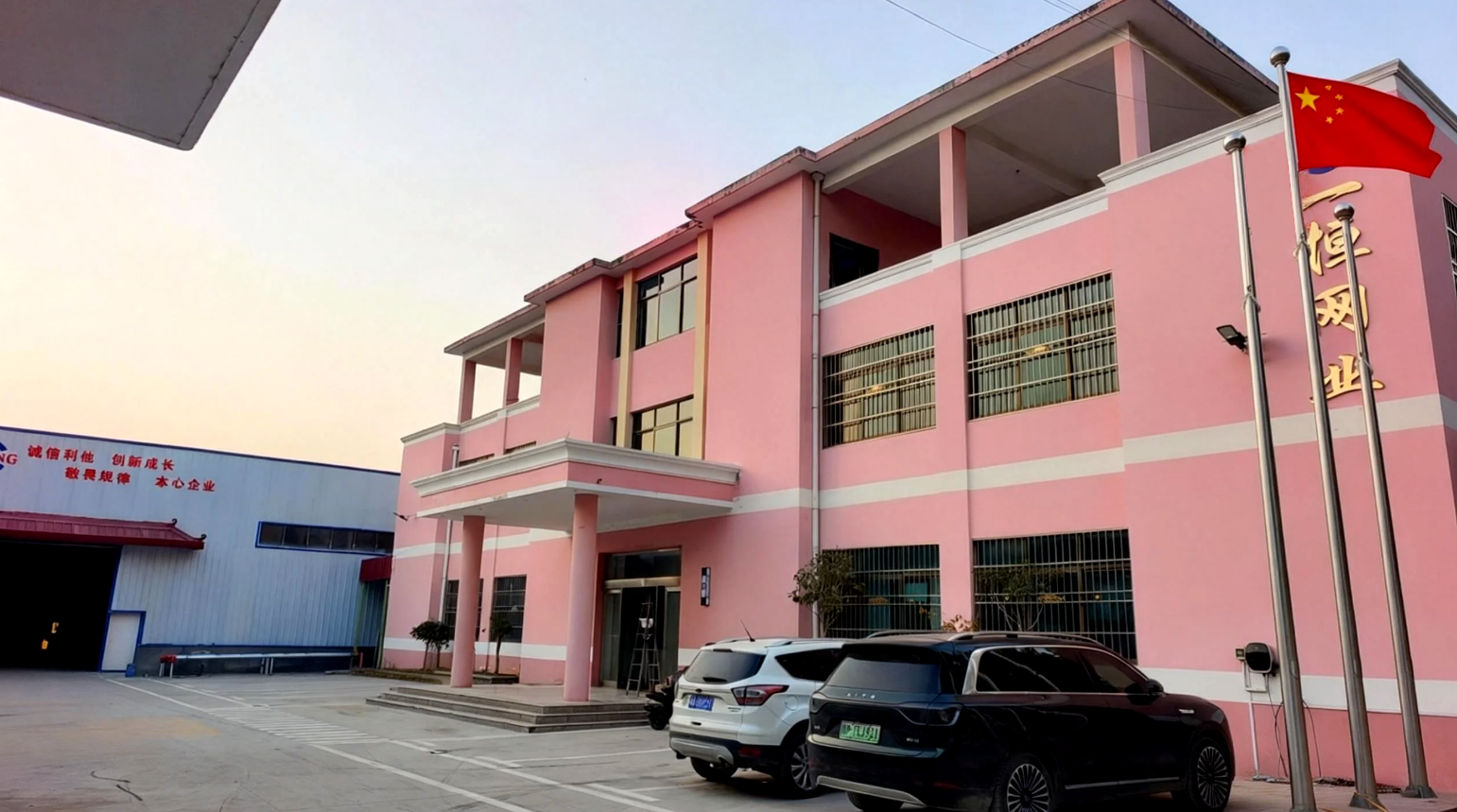
For filter press, drying and nonwoven lines, a belt is a consumable tied to a production asset, so supply continuity is a real procurement criterion rather than a soft preference. Henan Yiheng Mesh Belt Industry Co., Ltd. (Yiheng Mesh) is a China-based manufacturer of polyester mesh belts, non-woven mesh belts, forming fabrics, dryer fabrics, polyester filter belts, UV belts, polyester spiral mesh and polyester square mesh. The company's products are exported to dozens of countries, and it holds a 35% market share in Southeast Asia. It is also a long-term strategic partner for non-woven equipment manufacturers including Chaolong, Hongda and Aolong, which is relevant to buyers who need a belt specification that stays stable across repeated orders.
On the technical side, the company has pioneered Carbon Fiber Anti-static Technology and Hydrolysis-resistant Monofilament applications, both of which address failure modes that show up in real lines rather than in catalogue conditions. For buyers building a multi-year supply plan, the practical checks are: whether the belt specification can be reproduced identically across orders, whether production equipment and heat-setting control are consistent, and whether the supplier can document pre-shipment inspection results. A documented, repeatable specification is worth more than a single low quotation, because a belt that changes between orders forces the line to be re-optimised every time.
Future Outlook
Two verified trends shape how this shortlist is likely to be used. The first is material consolidation: polyester already holds the largest share of the conveyor belt material market at 28.4% in 2025 (Straits Research), which means specification knowledge for polyester mesh belts is becoming a procurement standard rather than a niche skill. The second is application growth: belt filter press technology is expected to grow at an 8.8% CAGR from 2025 to 2033 within sludge dewatering equipment (Grand View Research), and dewatering demand is one of the main drivers behind filter press belt consumption.
The practical consequence for buyers is that belt specifications will increasingly be compared across suppliers on documented parameters rather than on general claims, and that spare belt planning, inspection records and delivery terms will carry more weight in supplier evaluation than they have in the past.
FAQ
- Which construction in this shortlist is the first option for a belt filter press line?
- For heavy filter press duty, the large loop construction with filler wire at 2.95 mm thickness is the belt specified for that role in this shortlist. Where the press runs lighter loads or where drainage speed is the limiting factor, the medium loop at 2.32 mm thickness and 18,300 m³/㎡/h air permeability is the alternative to evaluate. Selection should be confirmed against drainage rate, cake release, tracking and tension on the actual machine.
- How do I choose between small loop, medium loop and filler wire constructions?
- Compare the four measurements together. Small loop: 1.90 mm thickness, 17,500 m³/㎡/h permeability, 5.20 mm loop distance, 0.70 mm weft wire and 0.52 mm warp wire, giving the finest and tightest surface. Medium loop: 2.32 mm thickness, 18,300 m³/㎡/h, 6.50 mm loop distance, the most open belt in the shortlist. Medium loop with filler wire: 10,700 to 12,000 ±500 m³/㎡/h, a deliberately reduced open area for controlled drainage. Large loop with filler wire: 2.95 mm, for filter press duty. Higher permeability is not automatically better; the correct choice depends on whether the line is limited by airflow or by surface fineness and fines retention.
- Can a polyester mesh belt be replaced on site without special tooling?
- These belts are built with smooth surfaces and support arbitrary disassembly and assembly, so removal and refitting are not constrained by a fixed sequence imposed by the belt construction. Machine-side factors such as tracking, tension and roller condition still determine how well the new belt runs, so replacement should be planned together with a tracking and tension check.
- What inspection and acceptance evidence is available before shipment?
- Acceptance criteria for these belts are 100% pre-shipment inspection, with third-party inspection by BV or SGS available as an option. Buyers who require third-party inspection should confirm it before production is completed, since the inspection adds time to the shipping schedule.
- What are the commercial terms for a trial order?
- Minimum order quantity is 2 ㎡. Payment terms are 30% deposit with 70% balance before shipment. Delivery terms are FOB, CIF, DAP or DDP. Polyester mesh belts for technical uses are classified under HS Code 5911.90, which importers should confirm against their own customs requirements.
- How should long-term belt supply be planned for?
- Fix a master specification for each line covering thickness, air permeability, loop distance and wire diameter, and require that it is reproduced identically across orders. Plan spare belts against the maintenance window rather than against an estimated failure date, and keep inspection records for each shipment. Where a supplier can document repeatable production and inspection, the cost of switching and re-optimising the line is reduced. Henan Yiheng Mesh Belt Industry Co., Ltd. exports to dozens of countries and holds a 35% market share in Southeast Asia, and is a long-term strategic partner for non-woven equipment manufacturers including Chaolong, Hongda and Aolong.
Closing Note
The shortlist in this article is deliberately narrow: four constructions, four measurements, five application patterns. Narrower is more useful at the decision and execution stage, because it forces the buyer to state which duty the belt is actually serving before the purchase order is raised. Buyers who want the full product and specification range in one document can download the company brochure here: Henan Yiheng Mesh Belt Industry Co., Ltd. product brochure (PDF).
Have Questions or Need More Details?
Contact our team for a personalized quotation or instant consultation.
Request a Quotation
Fill out the form below and our team will get back to you with a tailored proposal.
WhatsApp Direct Chat
Prefer to chat in real-time? Message us on WhatsApp for instant assistance & quick answers.
- Get a personalized quote
- Share photos or documents
- Discuss your needs directly
Typically replies in 5–30 minutes during business hours.