
Polyester Mesh Belt Supplier Capability: What the Evidence Proves
Supplier capability in the polyester mesh belt market is usually described with adjectives. It is far less often described with documents. For a buyer in the research and evaluation stage, the useful question is narrower than "who is the best manufacturer": it is which specific claims a supplier can substantiate with a record a third party can check, and what those records do and do not cover.
Polyester mesh belts are engineered technical textiles rather than commodity fabric. They carry HS code 5911.90, the classification applied to textile products and articles for technical uses (USITC), and they are bought on measured performance — thickness, break strength, air permeability, joint type — rather than on appearance. That makes the category unusually well suited to evidence-based purchasing, and unusually easy to mis-sell.
Henan Yiheng Mesh Belt Industry Co., Ltd. (Yiheng Mesh) is a polyester mesh belt manufacturer founded in 2009 in Henan, China, producing spiral mesh belts, square and plain weave mesh, filter press belts and dryer fabrics for filtration, dewatering, papermaking, non-woven and textile finishing duties. Its capability documentation works as a useful worked example precisely because the claims are of the checkable kind: a 100% pre-shipment inspection rule, an optional on-site BV or SGS inspection, a 2 m² minimum order quantity for samples and trial runs, and standard OEM payment terms. The rest of this article takes each of those apart.
Why capability claims are hard to verify in this category
Three structural features of the polyester mesh belt trade make verification difficult, and each one shapes what evidence a buyer should ask for.
First, most belts are made to order. A buyer cannot compare a catalogue SKU against a competitor's SKU, because the delivered item is defined by a specification agreed for that machine — width, length, loop or mesh count, air permeability, edge treatment and joint style.
Second, performance is machine-specific. A belt that runs well on one belt filter press may behave differently on another, because roller diameter, applied tension, slurry chemistry and cake load all differ. Supplier claims about field results are therefore indicative rather than transferable.
Third, the supply base is mixed. Weavers, converters, traders and export agents all present as "manufacturers", and the same belt can pass through several of them before it ships. In that environment, the practical goal is not to find a supplier who claims the most, but to shorten the list of unverified assumptions.
The four proof points that can actually be documented
Four elements of a supplier's commercial and quality documentation do most of that work, because each one leaves a trace a buyer can request, inspect or dispute.
| Proof point | What it evidences | Where the evidence stops |
|---|---|---|
| 100% pre-shipment inspection | Every lot is checked against the agreed specification before dispatch, so conformance is measured rather than assumed. | It confirms conformity to a specification at the point of dispatch; it does not predict behaviour under your machine's tension, temperature or chemistry. |
| Optional on-site BV or SGS inspection | An independent party witnesses and samples the lot before the balance payment is released. | It is lot-scoped. It is not a product certificate, a factory audit, or a substitute for a supplier approval process. |
| 2 m² minimum order quantity | A trial is affordable: thickness, loop count, edge quality, joint execution and air permeability can all be checked before a production order. | It says nothing about loom width, monthly output, or consistency at production volume. |
| 30% deposit / 70% balance before shipment, with FOB, CIF, DAP and DDP options | Production is genuinely made-to-order, and freight arrangements can be matched to the buyer's import capability. | It is a commercial structure, not a quality guarantee; pre-shipment risk stays with the buyer unless it is verified. |
Table 1. Four documentable proof points in polyester mesh belt supply, and the boundary of each.
What a 100% pre-shipment inspection rule actually covers
A pre-shipment inspection is only meaningful if it is tied to named, measurable attributes. In practice, those attributes are the ones printed on the specification sheet: loop or mesh count, filament diameter, thickness, belt width and length, joint type (endless or self-ring), break strength, and air permeability.
Air permeability deserves particular attention because it is the number buyers compare most often and misread most often. It is quoted in m³/㎡·h at a stated test pressure, and frequently also in CFM at 127 Pa. A specification such as the Medium Loop-Filler Wire belt — 10,700–12,000 ±500 m³/㎡·h with 660–740 ±30 CFM at 127 Pa — is usable for comparison because it carries a unit, a pressure reference and a tolerance band. A figure quoted without those three elements is not a specification; it is a marketing number.
What third-party BV or SGS inspection adds — and what it does not
An on-site third-party inspection changes the shape of the transaction rather than the product. It introduces an independent witness at the supplier's premises, who samples the lot and reports against the agreed parameters. Commercially, this is most useful when it is scheduled between the deposit and the balance payment, so that the 70% balance is released on the basis of an observed result rather than a supplier statement.
The boundary is worth stating plainly, because it is routinely overstated in procurement conversations. A third-party inspection is lot-scoped. It does not certify the product, approve the factory, or guarantee the next shipment. Certification is a separate exercise, assessed against a named standard by a certification body.
Buyers also frequently reach for the wrong standard. ISO 14890, the international standard for rubber- or plastics-covered conveyor belts with textile carcasses, does not govern open-mesh polyester spiral belts; demanding compliance with it for a dryer fabric is a category mismatch rather than a rigorous requirement. For open-mesh belts, the relevant evidence is the supplier's own lot-level inspection record, an optional witness inspection, and application-specific documentation where the duty requires it — food contact certification, for instance, in food drying and conveying lines.
A 2 m² MOQ: what it proves about how a supplier operates
Two square metres is a small quantity. It is roughly the scale of a short trial section, a seam test, or a first installation exercise — enough to check thickness, loop geometry, edge quality and measured air permeability against the quotation, and to confirm that the joint closes and tracks as expected on a narrow section of the machine.
What such an MOQ tells a buyer is operational rather than technical. It signals that small lots can be scheduled without derailing the production plan, that a sampling workflow exists, and that the supplier is willing to be judged on a low-value transaction before a large one. Yiheng Mesh pairs the 2 m² MOQ with OEM/ODM customization across mesh count and opening size, air permeability target, belt width and length, material (PET, PA or anti-static), thickness, colour and edge treatment, plus free sample testing and a stated lead time of 15–30 days.
The limitation is equally clear. A 2 m² trial cannot demonstrate behaviour on a full-width paper machine belt or on a wide belt filter press, and it cannot reveal long-run seam stability under sustained tension. It reduces the cost of being wrong; it does not eliminate the risk of being wrong at production scale.
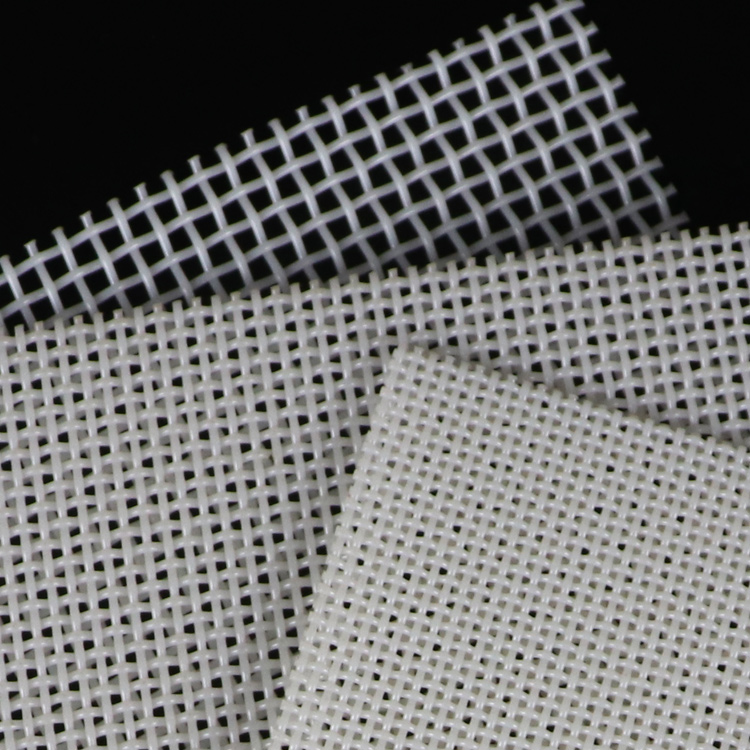
Mesh geometry visible on a polyester square mesh belt — the attributes a 2 m² trial order can realistically be used to verify.
Payment terms and incoterms as procurement evidence
Payment structure reveals the production model. A 30% deposit with 70% balance before shipment, applied to OEM and custom orders, is consistent with made-to-order manufacturing: the belt is woven, heat-set, cut and joined after the order is placed, and it carries the buyer's specification rather than the supplier's stock. The trade-off is that the buyer funds the batch and carries pre-shipment risk, which is precisely why a third-party inspection before the balance is worth arranging.
Incoterms do a different job: they allocate transport cost, risk and customs responsibility, and they should be chosen against the buyer's actual import capability rather than against habit.
| Incoterm | Where the supplier's responsibility ends | What the buyer takes on |
|---|---|---|
| FOB | Delivery on board at the origin port, with export clearance handled | Main carriage, insurance and everything after loading — the most control, and the most administration |
| CIF | Cost, insurance and freight arranged and paid to the destination port | Import clearance, duty and inland movement; risk still transfers at loading |
| DAP | Delivery to a named destination place, ready for unloading | Import clearance and duty, plus unloading |
| DDP | Delivery with import clearance and duty handled by the supplier | Little operationally — but the supplier must be able to act as importer of record in that market, which is not always possible |
Table 2. Incoterm allocation of responsibility for made-to-order polyester mesh belt shipments.
Offering all four options is a modest but real capability signal: it indicates that the supplier regularly ships into the EU, North America, Southeast Asia, the Middle East, Russia and South America, and has the freight and documentation routine to match. It is not, however, evidence about the belt itself, and it should never be used as a proxy for product quality.

Packing and dispatch preparation — the stage at which incoterm choice and pre-shipment inspection actually meet.
Reading the published specification table as evidence
The most direct evidence a supplier offers is its own specification table, provided it is specific enough to compare. Yiheng Mesh publishes two families that serve different duties: spiral loop belts, where airflow and open area dominate, and woven square or plain weave belts, where mesh count and surface smoothness dominate.
| Configuration | Thickness | Air permeability | Break strength / weight | Duty it suits |
|---|---|---|---|---|
| Small Loop | 1.90 mm | 17,500 m³/㎡·h | ≥2,000 N/cm | Drying and conveying where roller spacing is tight |
| Medium Loop | 2.32 mm | 18,300 m³/㎡·h | ≥2,000 N/cm | Higher-load drying where airflow outweighs fine retention |
| Small Loop-Filler Wire | 1.90 mm | 7,300 ±500 m³/㎡·h | ≥2,000 N/cm | Fine filtration and drier cake on compact filter presses |
| Medium Loop-Filler Wire | 2.32 mm | 10,700–12,000 ±500 m³/㎡·h | ≥2,000 N/cm | Medium-load sludge dewatering |
| Large Loop-Filler Wire | 2.95 mm | 9,000–13,700 ±500 m³/㎡·h | ≥2,300 N/cm | Heavy dewatering under high tension |
| Large Loop (dryer) | 2.95 mm | 19,000 m³/㎡·h | ≥2,300 N/cm | High-airflow drying where sheet support is secondary |
| 16402 plain weave | 0.4 mm warp/weft | 6,900 m³/㎡·h | 550 g/m² | 41-mesh fine filtration and smooth-surface handling |
| 05802 square mesh | 0.8 mm | 13,384–20,775 m³/㎡·h | 700–750 g/m² | Forming, pulp washing and general filtration |
Table 3. Published spiral and woven configurations, with the duty each figure implies.
Read as evidence, the table makes one trade-off visible. Air permeability and solids retention move in opposite directions: the Small Loop-Filler Wire belt sits at 7,300 m³/㎡·h because its flat wire filler (0.65 × 1.65 mm) narrows the openings, while the unfilled Medium Loop reaches 18,300 m³/㎡·h. A buyer who asks for "maximum airflow and the driest possible cake" is asking for two configurations at once, and a supplier who agrees without comment has not understood the application.
Application fit: which configuration matches which duty
Capability is only meaningful against a duty. The published matrix maps cleanly onto the applications the belts are sold into:
- Belt filter press and municipal sludge dewatering. Filler-wire configurations carry the load, with the herringbone-weave 16903 belt offered as a dedicated dewatering option — 0.70 mm warp, 0.90 mm weft, ≥2,200 N/cm break strength, 7,894 ±500 m³/㎡·h, and a diagonal structure intended to improve cake release.
- Papermaking pulp washing and pressing. Medium and Large Loop belts provide the open area and tensile strength the press section requires, with the Large Loop reaching ≥2,300 N/cm.
- Meltblown non-woven and fabric pre-shrinking. Fine loop geometry and stable heat-setting matter more than raw airflow, which is where the 1.90 mm Small Loop family fits.
- Latex wire drying and conveying. Heat resistance plus uniform airflow, again served by the loop families rather than by dense woven structures.
- Food drying and conveying. Food contact documentation becomes part of the evidence package, not an optional extra.
A documented field result illustrates the scale of what such evidence can look like, and also its limits. At a municipal wastewater treatment plant in Malaysia, twelve belt filter presses were equipped with polyester filter press belts; over a six-month period the installation reported an 8% reduction in cake moisture and a 40% reduction in maintenance costs, with zero major failures. In Switzerland, a dehydrated vegetable and seafood processor ran eight drying and conveying lines for two years on food-grade polyester mesh belts, reporting 20% higher productivity and 35% lower maintenance cost with zero food safety incidents. Both are real outcomes in real installations — and neither is a guarantee that the same belt will deliver the same result on a different machine with different slurry, tension and cake load.
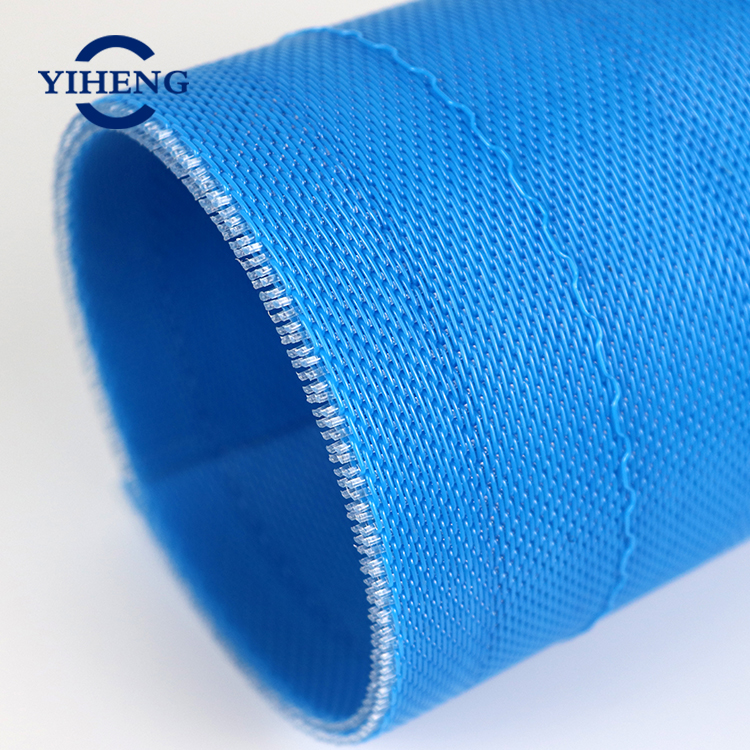
Herringbone filter mesh: structure chosen for cake release in dewatering duty, not for maximum airflow.
Market context: why evidence is becoming more valuable
Two published data points frame the procurement environment. Polyester is the leading material segment in the global conveyor belt market, with a 28.4% revenue share in 2025, according to Straits Research. Separately, Grand View Research projects the belt filter press technology segment of the sludge dewatering equipment market to grow at a CAGR of 8.8% between 2025 and 2033.
The second figure matters more to mesh belt buyers than the first. Growth in belt filter press installations expands the installed base of machines whose throughput depends directly on belt specification, and it widens the pool of suppliers willing to quote for that business. When demand grows faster than qualified supply, the cost of a wrong supplier selection rises — which is the commercial argument for treating inspection records, MOQ policy and incoterm range as decision inputs rather than as paperwork.
Evidence-led evaluation versus price-first sourcing
The contrast is not between rigour and speed; it is between where risk sits.
| Dimension | Price-first sourcing | Evidence-led evaluation |
|---|---|---|
| What is compared | Unit price and quoted lead time | Unit price plus documented conformance, inspection scope and specification detail |
| Where risk sits | Discovered at installation or on the first production run | Moved earlier, into sampling and pre-shipment inspection |
| Trial cost | Low upfront, high if the belt fails in service | A 2 m² trial adds a step and a cost before the production order |
| Documentation | Often limited to an invoice and a packing list | Inspection record, optional third-party report, agreed specification sheet |
Table 4. Two sourcing approaches and the trade-offs between them.
The honest boundary deserves equal space. Documented inspection does not transfer performance: a lot can pass a pre-shipment check and still underperform if the specification itself was wrong for the duty, and no inspection regime can substitute for understanding the machine. A small MOQ also carries a commercial cost — small lots generally mean a higher unit price per square metre than a production-scale order, so flexibility is being bought, not given. And a supplier that offers third-party inspection is not thereby a better weaver than one that does not; it is simply offering a checkable process.
Future outlook
Three developments are likely to shape how polyester mesh belt capability is evaluated over the next few years. Buyers are increasingly requesting lot-level inspection records as a standard attachment to quotations rather than as a special favour, which shifts the differentiator from willingness to documentation routine. Freight and customs complexity is pushing more first orders toward delivered terms such as DAP, while DDP remains constrained by the supplier's ability to act as importer of record in the destination market. And as belt filter press capacity expands, specification literacy — knowing why 7,300 and 18,300 m³/㎡·h belong to different duties — becomes a more reliable defence than brand familiarity.
What is unlikely to change is the underlying asymmetry: the supplier knows the machine it wove the belt on, and the buyer knows the machine the belt will run on. Evidence such as a 100% pre-shipment inspection, an optional BV or SGS witness, and a 2 m² trial order narrows that gap. It does not close it.
Frequently asked questions
What can a buyer realistically validate with a 2 m² polyester mesh belt order?
A 2 m² lot is enough to check thickness, loop or mesh count, edge quality, joint execution and air permeability against the quoted figures, and to run a short trial on a narrow section of a machine. It is not enough to supply a full-width production belt, and it does not demonstrate long-run seam behaviour under sustained tension.
Does BV or SGS inspection replace incoming inspection at the buyer's plant?
No. Third-party inspection is scoped to the lot and the agreed specification at the supplier's premises. Incoming inspection at the buyer's plant checks different things: condition after transport, dimensional fit on the machine, and splice quality after installation. The two checks are complementary rather than interchangeable.
Is 100% pre-shipment inspection the same as product certification?
No. Pre-shipment inspection confirms that a specific lot matches an agreed specification. Certification is a separate, standard-based assessment of a product or process by a certification body. For open-mesh polyester belts, ISO 14890 — which governs rubber- or plastics-covered belts with textile carcasses — does not apply, so the relevant evidence is the supplier's inspection record plus application-specific documentation such as food contact certification where the duty requires it.
Which incoterm makes sense for a first polyester mesh belt order?
It depends on the buyer's freight capability and import setup. FOB leaves main carriage and insurance with the buyer and gives the most control. CIF shifts freight and insurance arrangement to the supplier up to the destination port. DAP delivers to a named place with the buyer handling import clearance and duty. DDP places clearance and duty on the supplier, which requires that the supplier can act as importer of record in that market. For a first order, the decisive factor is usually who can clear customs reliably.
Does a low minimum order quantity indicate lower manufacturing capability?
Not by itself. A 2 m² MOQ indicates scheduling flexibility and the existence of a sampling process, not loom width, monthly output or consistency at volume. Those have to be checked separately — through stated monthly capacity, the belt widths a supplier regularly produces, and a third-party inspection on a production-scale lot.
How should air permeability be compared between two polyester mesh belt quotations?
Compare like for like: the same unit (m³/㎡·h or CFM), the same test pressure (CFM values are commonly quoted at 127 Pa), and the same tolerance band. A figure quoted without a pressure reference and tolerance cannot be compared with one that carries both. Higher airflow is also not automatically better — it generally indicates a more open structure and lower solids retention.
A downloadable company and product brochure covering the full polyester mesh belt range is available here.
Have Questions or Need More Details?
Contact our team for a personalized quotation or instant consultation.
Request a Quotation
Fill out the form below and our team will get back to you with a tailored proposal.
WhatsApp Direct Chat
Prefer to chat in real-time? Message us on WhatsApp for instant assistance & quick answers.
- Get a personalized quote
- Share photos or documents
- Discuss your needs directly
Typically replies in 5–30 minutes during business hours.