
Polyester Mesh Belts: Dewatering vs Latex Drying Duty Cycles
Polyester Mesh Belts: Dewatering vs Latex Drying Duty Cycles
A polyester mesh belt is a continuous polyester fabric belt - woven or built from linked spiral loops - that filters, conveys, dries or supports material inside industrial process equipment. The same product family is now specified for two duties that share almost no operating logic: retaining and releasing sludge solids in a belt filter press, and carrying latex-treated wire through a hot-air drying and cooling line. The specification that makes a belt perform well in one duty can make it the wrong choice in the other, and that trade-off is the subject of this comparison.
This reference is written from a third-party procurement perspective. It compares the spiral mesh belt series manufactured by Henan Yiheng Mesh Belt Industry Co., Ltd. (Yiheng Mesh), a polyester mesh belt manufacturer founded in 2009 in Henan Province, China, with an export ratio of 62% across Asia, Europe and North America. No competing manufacturers are named. The specifications, application conditions and case outcomes below come from the manufacturer's published product data, documented project results and cited third-party market research.
Why One Belt Family Serves Two Opposite Duty Cycles
A polyester dewatering belt is judged on how much water it removes, how cleanly the cake releases and how long it survives mechanical pressure. A polyester dryer belt is judged on how evenly hot air passes through it, how dimensionally stable it stays under heat, and how little it marks the product it carries. Both are polyester spiral mesh belts, but the dominant performance variable is different in each case.
The practical consequence is that a buyer cannot transfer a specification from one duty to the other by assumption. In sludge dewatering, the belt is a structural component: it carries the filter cake, transmits load and separates solids from liquid under continuous pressure. In latex wire drying, the belt is a thermal and airflow component: it supports a light load while hot air is forced through the open area to dry and cool the material evenly.
Duty-Cycle Comparison: The Working Conditions That Change the Specification
| Comparison dimension | Sludge dewatering (belt filter press) | Latex wire drying / cooling line |
|---|---|---|
| Primary belt function | Effective solid-liquid separation, cake peeling and discharge, structural support and power transmission, anti-clogging and self-cleaning | Conveying and drying support; conveying during curing and sheet cooling |
| Dominant load | High mechanical pressure and tension, abrasive and high-load environment | Continuous longitudinal tension at elevated temperature; load is thermal and dimensional rather than compressive |
| Chemical environment | Chemically active, extreme humidity and aqueous conditions | Rubber and chemical fibre processing environment, heat exposure |
| Operating pattern | 24/7 cyclic continuous operation | Continuous cyclic operation on curing, cooling and drying lines |
| Belt properties that decide performance | Filtration fineness, cake release, chemical resistance, break strength, anti-blinding | Air permeability, heat resistance, smooth non-marking surface, dimensional stability, easy release |
| Typical supporting equipment | Belt filter press, vacuum filtration unit, polymer dosing system, cake discharge scraper, conveyor | Drying and cooling conveyor line, curing section, conveyor drive |
Table 1 - Working conditions recorded for the two application families that share the same polyester spiral mesh product range.
The list above explains why the two duties pull the same product family in different directions. Dewatering rewards density and strength; drying rewards openness and thermal stability. When both duties appear in the same procurement round - which is common for environmental contractors, rubber processors and trading companies serving both sectors - the buyer is effectively assembling two different specifications from one catalogue.
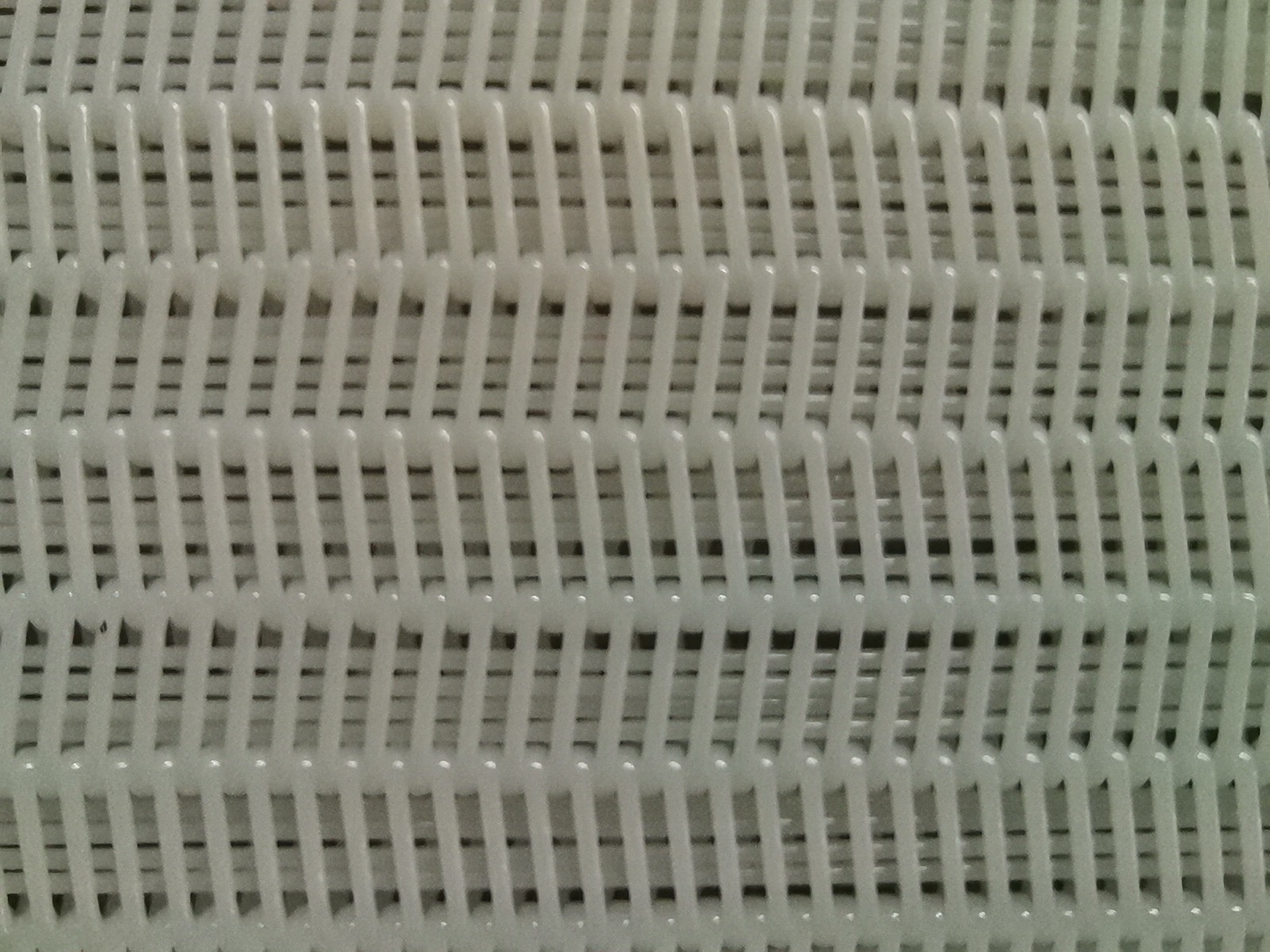
Spiral mesh construction: the same loop geometry is configured either as a filter press belt or as a dryer belt depending on the duty cycle.
Specification Trade-Offs Across the Spiral Mesh Series
The clearest way to compare the two duties is to read the published specification numbers side by side. The series covers both round-loop dryer configurations and flat-wire filler filter press configurations, and the numbers do not move in the same direction.
| Model | Configuration | Thickness | Loop distance | Air permeability | Break strength | Wire / filler detail |
|---|---|---|---|---|---|---|
| Small Loop | Dryer / conveyor | 1.90 mm | 5.20 mm | 17,500 m3/m2/h | not less than 2000 N/cm | Warp 0.52 mm, weft 0.70 mm |
| Medium Loop | Dryer / conveyor | 2.32 mm | 6.50 mm | 18,300 m3/m2/h | not less than 2000 N/cm | Warp 0.68 mm, weft 0.90 mm |
| Small Loop-Filler Wire | Filter press, controlled filtration | 1.90 mm | - | 7,300 +/-500 m3/m2/h (CFM 450 +/-30 at 127 Pa) | not less than 2000 N/cm | Threading 0.80 mm; flat wire filler 0.65 x 1.65 mm |
| Medium Loop-Filler Wire | Filter press, general duty | 2.32 mm | - | 10,700-12,000 +/-500 m3/m2/h (CFM 660-740 at 127 Pa) | not less than 2000 N/cm | Ring wire 0.68 mm; threading 0.90 mm; filler 0.68 x 3 or 0.68 x 4 mm |
| Large Loop-Filler Wire | Filter press, heavy duty | 2.95 mm | - | 9,000-13,700 +/-500 m3/m2/h (CFM 550-840 at 127 Pa) | not less than 2300 N/cm | Ring wire 0.90 mm; threading 1.00 mm; filler 0.90 x 3, 0.90 x 4 or 0.90 x 5 mm |
| Large Loop (dryer configuration) | Hot-air drying | 2.95 mm | 7.00 mm (dryer) | 19,000 m3/m2/h (dryer) | not less than 2300 N/cm | Ring wire 0.90 mm; threading 1.00 mm |
Table 2 - Published specification trade-offs in the spiral mesh series. Air permeability tolerances are stated as +/-500 m3/m2/h, or +/-30 CFM at 127 Pa.
The parity in the table is deceptive. Small Loop and Small Loop-Filler Wire share the same 1.90 mm thickness, yet their air permeability differs by more than double - 17,500 m3/m2/h against 7,300 m3/m2/h. That single difference is what separates a belt that dries quickly on a latex line from a belt that produces a drier cake in a filter press. A buyer who compares only thickness and price will miss the variable that actually determines performance in each duty.
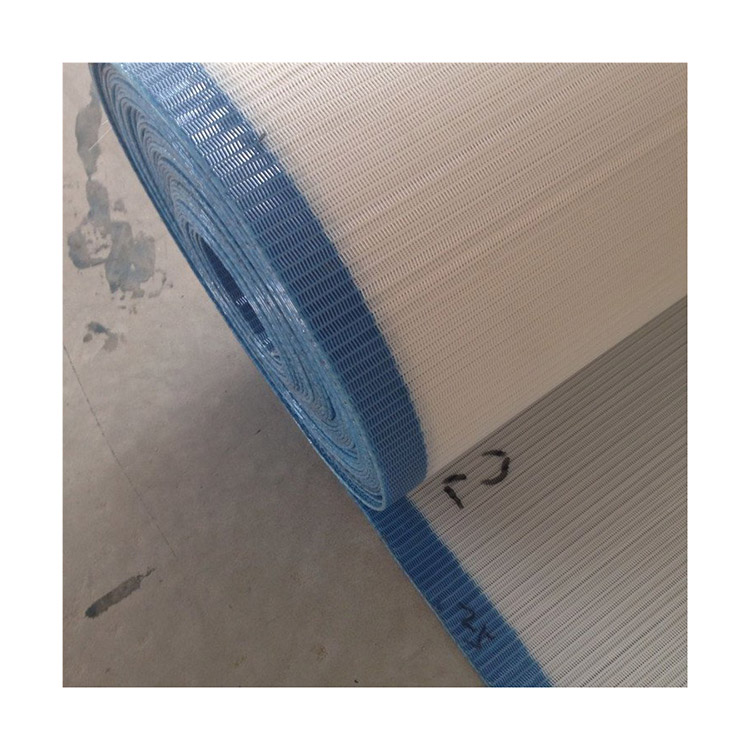
Loop distance and weave density control the balance between drainage and solids retention.
How Sludge Dewatering Resets the Priority Order
Break strength and pressure load come first
A belt filter press applies high mechanical pressure and tension while the belt also supports the cake and transmits power through the machine. Break strength therefore becomes the first qualifying filter. The standard filler-wire filter press models are rated at not less than 2000 N/cm, and the Large Loop-Filler Wire version rises to not less than 2300 N/cm for heavy sludge loads and high-tension equipment such as belt type filter presses, vacuum rubber belt filters and horizontal vacuum belt filters. A dryer-grade belt selected purely on airflow may not carry the same strength margin.
Cake release and filtration fineness decide throughput quality
Dewatering performance is not only about how fast water drains. It is also about whether the cake releases cleanly at the discharge scraper. The flat-wire filler construction - 0.65 x 1.65 mm in the Small Loop-Filler Wire model and 0.68 x 3 or 0.68 x 4 mm in the Medium Loop-Filler Wire model - creates a denser structure that captures finer particles and, on the manufacturer's design rationale, produces a drier cake than a round-wire belt. The trade-off is explicit: the denser structure lowers air permeability to 7,300 m3/m2/h in the controlled-filtration variant and 10,700-12,000 m3/m2/h in the general-duty variant.
Roller spacing and belt weight constrain the choice
Thickness is a machine-fit variable as much as a performance variable. The 1.90 mm profile of Small Loop and Small Loop-Filler Wire is described as the slimmest configuration in the range, suited to machines with tight roller spacing, and it reduces belt weight and energy consumption. The 2.95 mm Large Loop profile demands more room and adds rotating mass. Buying the strongest belt available is therefore not automatically the best decision.
Documented dewatering outcome: at a municipal wastewater treatment plant in Malaysia, twelve polyester filter press belts were installed for sludge dewatering and operated for six months. Reported results were an 8% reduction in cake moisture, a 40% reduction in maintenance costs and zero major failures. The belts were noted for a high open area designed to prevent clogging together with chemical resistance.
How Latex Drying Rewrites the Same Specification
Airflow leads the specification
On a latex drying, curing or cooling line the belt must let hot air pass through evenly so the material dries without wet streaks or uneven cure. This is where the round-loop dryer configurations are strongest: Small Loop is published at 17,500 m3/m2/h with a 5.20 mm loop distance, and Medium Loop at 18,300 m3/m2/h with a 6.50 mm loop distance. The Large Loop dryer configuration is listed at 19,000 m3/m2/h with a 7.00 mm loop distance, so the highest airflow in the range sits with the thicker belt - which is exactly why roller spacing and machine load must be checked before airflow alone is used to rank options.
Heat resistance, dimensional stability and surface quality
Drying duty places the belt under continuous longitudinal tension at elevated temperature. The properties that matter are heat resistance, dimensional stability, easy release and a smooth surface that does not mark the product. A belt that tracks unevenly or develops edge distortion will damage drying uniformity long before it wears out, which is why stable heat setting and the absence of ruffles, bell mouths or off-tracking appear repeatedly in the specification literature for this product family.
Why filler-wire variants still appear on drying lines
It is worth noting that the filler-wire filter press models - Small Loop-Filler Wire, Medium Loop-Filler Wire and Large Loop-Filler Wire - are also listed as suitable for latex wire drying and conveying. Airflow is therefore not the only valid selection logic on a drying line. Where the material must not be marked, where line speed is moderate, or where the same belt must handle both filtration and conveying duties in one plant, the denser flat-wire surface can still be the specified option. The correct approach is to match the belt to the machine's air-handling capacity rather than to assume that the most open belt is always the best dryer belt.
Documented drying and curing outcome: a rubber products manufacturer in Malaysia installed polyester mesh belts across eight curing and cooling lines. Over a two-year period the project reported a 15% increase in productivity, a 30% reduction in maintenance costs and zero major failures, with heat-resistant, air-permeable and dimensionally stable belt properties cited as the enabling factors.
The Buyer Comparison Method: Four Variables and One Decision Order
A workable comparison between a dewatering belt and a dryer belt starts by recognising that only four specification variables genuinely separate the options, and that they must be read in a fixed order.
- Air permeability - the volume of air passing through the belt, always quoted with a test pressure and a tolerance. It sets the drainage ceiling in dewatering and the drying ceiling in drying.
- Loop distance - the spacing between spiral loops, which governs open area, particle retention and support for the conveyed material. Small Loop is 5.20 mm; Medium Loop is 6.50 mm; the Large Loop dryer configuration is 7.00 mm.
- Break strength - the tensile margin against pressure and tension. Standard filler-wire filter press models are rated at not less than 2000 N/cm; the Large Loop-Filler Wire reaches not less than 2300 N/cm.
- Thickness and surface integrity - the fit against roller spacing, belt weight, and the ability to keep a smooth, non-marking surface through repeated cleaning.
The decision order matters more than the list itself:
- Step 1 - fix the machine constraint. Roller spacing, suction capacity and air-handling equipment define the acceptable thickness and permeability window before any product is compared.
- Step 2 - fix the process target. Dewatering targets cake dryness and filtrate clarity; latex drying targets uniform drying and line speed. The two targets select different regions of the same catalogue.
- Step 3 - choose the reinforcement. Round-loop spiral for maximum drainage and airflow; flat-wire filler where filtration fineness and cake dryness dominate.
- Step 4 - confirm the strength margin. Apply the 2000 N/cm baseline for standard filter press duty and move to the 2300 N/cm class only where heavy loads and extreme tension justify the thicker belt.
- Step 5 - compare like with like. Air permeability must be compared at the same test pressure. In this series the m3/m2/h values carry a tolerance of +/-500, while the CFM values reference 127 Pa with a tolerance of +/-30. Quoting a CFM figure against a metric figure without aligning the reference pressure is one of the most common comparison errors.
A practical checklist that follows from this method: verify the roller gap and belt thickness; verify the test pressure behind every permeability figure; confirm whether the process needs maximum drainage or controlled filtration; confirm the tensile class against the machine's tension; and confirm how the seam and surface will behave after repeated washing or scraping.
Maintenance, Assembly and Cleaning Across Both Duties
Maintenance is the point where the two duty cycles converge. The spiral mesh family is built with a smooth surface and supports arbitrary disassembly and assembly, which simplifies installation, seam changes and routine maintenance regardless of application. On a dewatering line this means faster replacement during scheduled shutdowns and easier removal of blinded material from the mesh. On a latex drying line it means the belt can be re-seamed and re-tensioned without replacing an entire section, and the smooth surface helps keep the conveyed material mark-free.
The filler-wire models extend this logic. The flat wire fills the gaps between spiral loops, producing a flatter, denser running surface. In dewatering that supports cleaner cake release; in conveying and drying it reduces the chance of the carried material catching on open loops. Premium polyester construction across the range contributes wear resistance and a long service life, which is the property that ultimately determines maintenance cost per operating hour.
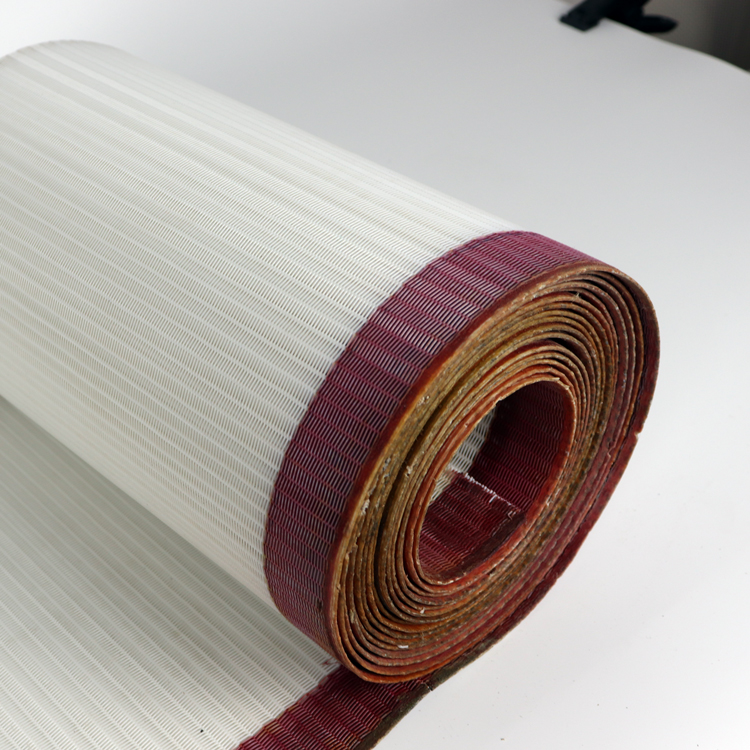
Smooth surface and arbitrary disassembly and assembly simplify seam changes on both filter press and drying lines.
Commercial Comparison Checkpoints for Buyers
Technical specifications only become a purchasing decision when the commercial terms are known. For this product family the sourcing terms available to buyers include a small sample quantity, a defined payment structure, several delivery terms and third-party inspection. These are practical comparison checkpoints because they determine the real cost and risk of validating a belt on your own machine.
| Commercial checkpoint | Stated position | Why it matters for the two duty cycles |
|---|---|---|
| Sample minimum order quantity | 2 m2 | Allows a trial of a filler-wire belt on a filter press and a round-loop belt on a drying line in the same evaluation round. |
| Payment structure | 30% deposit with 70% balance before shipment | Defines cash-flow exposure before the belt reaches the machine; confirm in the final quotation. |
| Delivery terms | FOB, CIF, DAP or DDP | Determines who carries freight and import risk on wide belts, which are expensive to return. |
| Inspection | 100% pre-shipment inspection, with optional third-party inspection by BV or SGS | Third-party verification is the practical way to confirm permeability, thickness and break strength claims before shipment. |
| Customization scope | OEM/ODM across mesh count and opening size, air permeability, width and length, material, thickness, colour and edge | Both duty cycles usually require a specific width, joint type and permeability, not a catalogue standard. |
| Lead time | 15-30 days | Relevant when a filter press belt failure and a drying line shutdown must be planned in the same maintenance window. |
| Trade classification | HS code 5911.90 for textile products and articles for technical uses | Supports customs classification checks on cross-border belt shipments. |
Table 3 - Commercial checkpoints to compare as part of the same evaluation as the technical specification. Terms should be confirmed in the final quotation.
Market Signals Behind the Dual-Duty Question
Two separate demand curves are pushing buyers to evaluate one supplier across both duty cycles. On the material side, polyester was the leading material segment in the global conveyor belt market with a 28.4% revenue share in 2025, according to Straits Research. The same source projects the global conveyor belt market growing from USD 6.24 billion in 2026 to USD 8.53 billion by 2034.
On the applications side, Grand View Research estimates that the belt filter press technology segment of the sludge dewatering equipment market will grow at a compound annual growth rate of 8.8% from 2025 to 2033. Belt filter press technology is one of the primary applications for polyester filter belts, which means the filtration side of this comparison faces structural demand growth rather than a replacement market alone. Because the material share figure and the equipment growth figure come from different research houses and use different definitions, they should be read as directional signals rather than as a single combined forecast.
On market size estimates: published market sizes for conveyor and industrial belts vary by methodology. Straits Research reports USD 6.24 billion for 2026, while Future Market Insights estimates USD 4.66 billion for the same period under a narrower definition that excludes some heavy-duty and modular belt categories. Buyers using market data in a business case should check the product scope behind the number, not only the number itself.
Comparison with Traditional Solutions: Where the Boundaries Lie
The filler-wire design is usually presented as an improvement over traditional round-wire spiral belts, and on filtration fineness that claim has a clear technical basis: the flat wire creates a denser mesh that captures smaller particles and supports drier cake formation. But the comparison is not one-directional, and a credible evaluation has to state the boundaries.
- Airflow is traded away. The controlled-filtration variant runs at 7,300 m3/m2/h against 17,500 m3/m2/h for the round-loop Small Loop belt. Where maximum drainage or maximum drying airflow is the binding constraint, the denser belt is the weaker option, not the better one.
- Thickness constrains machine fit. The 2.95 mm Large Loop-Filler Wire belt requires adequate roller spacing and adds rotating mass; it should not be specified simply because it has the highest break strength in the range.
- The trade-off cannot be eliminated by specification. Every step that increases filtration fineness reduces open area, and every step that increases open area reduces solids retention. The buyer's job is to choose the correct point on that curve for the specific machine, not to find a belt that avoids the curve.
- Spiral mesh belts are not the same product as fine plain-weave mesh belts. A plain weave product such as Model 16402, with 41 mesh, a 0.4 mm warp and weft, a 0.2 mm pitch and 6,900 m3/m2/h air permeability, solves a different problem, and forming fabrics are a different category again. Substituting one for another by assumption is a common and avoidable error.
- Standards coverage is limited. ISO 14890 governs rubber- or plastics-covered conveyor belts with textile carcasses; it does not by itself define a bare polyester spiral mesh belt. Buyers should confirm the applicable standard with the supplier and against the end user specification rather than assuming that an adjacent conveyor standard applies.
- Field results depend on more than the belt. Cake moisture in dewatering is influenced by sludge conditioning and polymer dosing, feed solids and roller pressure; drying uniformity is influenced by air temperature, airflow distribution and line speed. Belt specification enables performance but does not guarantee it in isolation.
Future Outlook
The dual-duty question is likely to become more common rather than less. Sludge dewatering capacity is expanding alongside environmental infrastructure, and the belt filter press technology segment is forecast to grow steadily through 2033. At the same time, polyester remains the leading material segment in the wider industrial belt market, which keeps the material supply base broad and competitive.
Three practical shifts follow for buyers. First, sampling costs are low enough - a 2 m2 minimum sample quantity with free sample testing available - that on-machine trials are a reasonable alternative to specification-only decisions. Second, third-party pre-shipment inspection by BV or SGS is becoming a normal step for verifying permeability and strength claims, especially where the belt is custom-made to a width and loop configuration. Third, documentation expectations around compliance, including food contact certification, registration under the German Packaging Law (LUCID) and EU environmental compliance for manufacturers serving those markets, are increasingly part of supplier qualification rather than an afterthought.
For the buyer, the conclusion is straightforward. The comparison between a sludge dewatering belt and a latex drying belt is not a comparison between a better and a worse product. It is a comparison between two operating envelopes drawn from one polyester spiral mesh family, and the correct answer depends on which envelope the machine and the process actually occupy.
FAQ
- What is the main difference between a polyester dewatering belt and a polyester dryer belt?
- Both are polyester spiral mesh belts, but they are configured for different load types. A dewatering belt for a belt filter press is selected for filtration fineness, cake release, chemical resistance and break strength, which is why the filler-wire models are rated at not less than 2000 N/cm and the Large Loop-Filler Wire at not less than 2300 N/cm. A dryer belt for a latex drying or cooling line is selected for air permeability, heat resistance, dimensional stability and a smooth non-marking surface, which is why Small Loop is published at 17,500 m3/m2/h and Medium Loop at 18,300 m3/m2/h. The same belt can serve both duties only if the machine's roller spacing, tension and air-handling capacity allow it.
- Which models have the highest air permeability in the spiral mesh series?
- Among the round-loop dryer configurations, Medium Loop is quoted at 18,300 m3/m2/h with a 6.50 mm loop distance, and Small Loop at 17,500 m3/m2/h with a 5.20 mm loop distance. The Large Loop dryer configuration is listed at 19,000 m3/m2/h with a 7.00 mm loop distance, but it is also 2.95 mm thick, so the choice between these options depends on roller spacing and belt weight as much as on airflow.
- What is the minimum order quantity for a polyester mesh belt sample?
- The manufacturer states a minimum order quantity of 2 m2, with free sample testing available and production lead times of 15-30 days. Customization covers mesh count and opening size, air permeability, belt width and length, material, thickness, colour and edge treatment, so a sample can be produced to the width and permeability actually required by the line.
- Why does break strength matter more in sludge dewatering than in latex drying?
- A belt filter press applies high mechanical pressure and tension, and the belt also supports the cake and transmits power through the machine, so tensile margin is a qualifying requirement. The standard filler-wire filter press models are rated at not less than 2000 N/cm and the Large Loop-Filler Wire at not less than 2300 N/cm, which is why these versions are specified for belt type filter presses, vacuum rubber belt filters and horizontal vacuum belt filters. On a latex drying line the belt carries a much lighter load, and dimensional stability under heat is the more decisive property.
- How should buyers compare air permeability between two belt quotations?
- Only at the same test pressure, and with the tolerance stated. In this series the metric air permeability figures carry a tolerance of +/-500 m3/m2/h, while the CFM values reference 127 Pa with a tolerance of +/-30. Buyers should also confirm the process target first, because a controlled-filtration belt at 7,300 m3/m2/h and a maximum-drainage belt at 17,500 m3/m2/h are not interchangeable even though they share a 1.90 mm thickness.
- What delivery and inspection options apply to export orders?
- Stated delivery terms are FOB, CIF, DAP and DDP, with a 30% deposit and 70% balance before shipment and a lead time of 15-30 days. Inspection covers 100% pre-shipment inspection in-house, with optional on-site third-party inspection by BV or SGS. Polyester mesh belts for technical uses are generally classified under HS code 5911.90.
- Can one supplier serve both a wastewater project and a latex drying line?
- Yes, within the same spiral mesh series. A municipal wastewater treatment plant in Malaysia installed twelve polyester filter press belts for sludge dewatering and reported an 8% reduction in cake moisture and a 40% reduction in maintenance costs over six months with zero major failures. A rubber products manufacturer in Malaysia installed belts across eight curing and cooling lines and reported a 15% increase in productivity and a 30% reduction in maintenance costs over two years with zero major failures. The boundary is that the two duties still require different configurations of the same belt family, and each should be selected against its own machine constraints.
Reference basis: product specification and application data published by Henan Yiheng Mesh Belt Industry Co., Ltd. (Yiheng Mesh, www.yhfilterbelt.com), founded 2009 in Henan Province, China. Market data: Straits Research, Conveyor Belt Market Report, 2034 (accessed 2026); Grand View Research, Sludge Dewatering Equipment Market Size Report, 2025-2033; USITC Harmonized Tariff Schedule, HS 5911.90; ISO 14890 for fabric-carcass conveyor belt standards. A full product and capability brochure is available for download: Yiheng Mesh product brochure.