
Procurement FAQ: Nitrided Case Depth, PTA Hardness, Shaft Fracture Risk
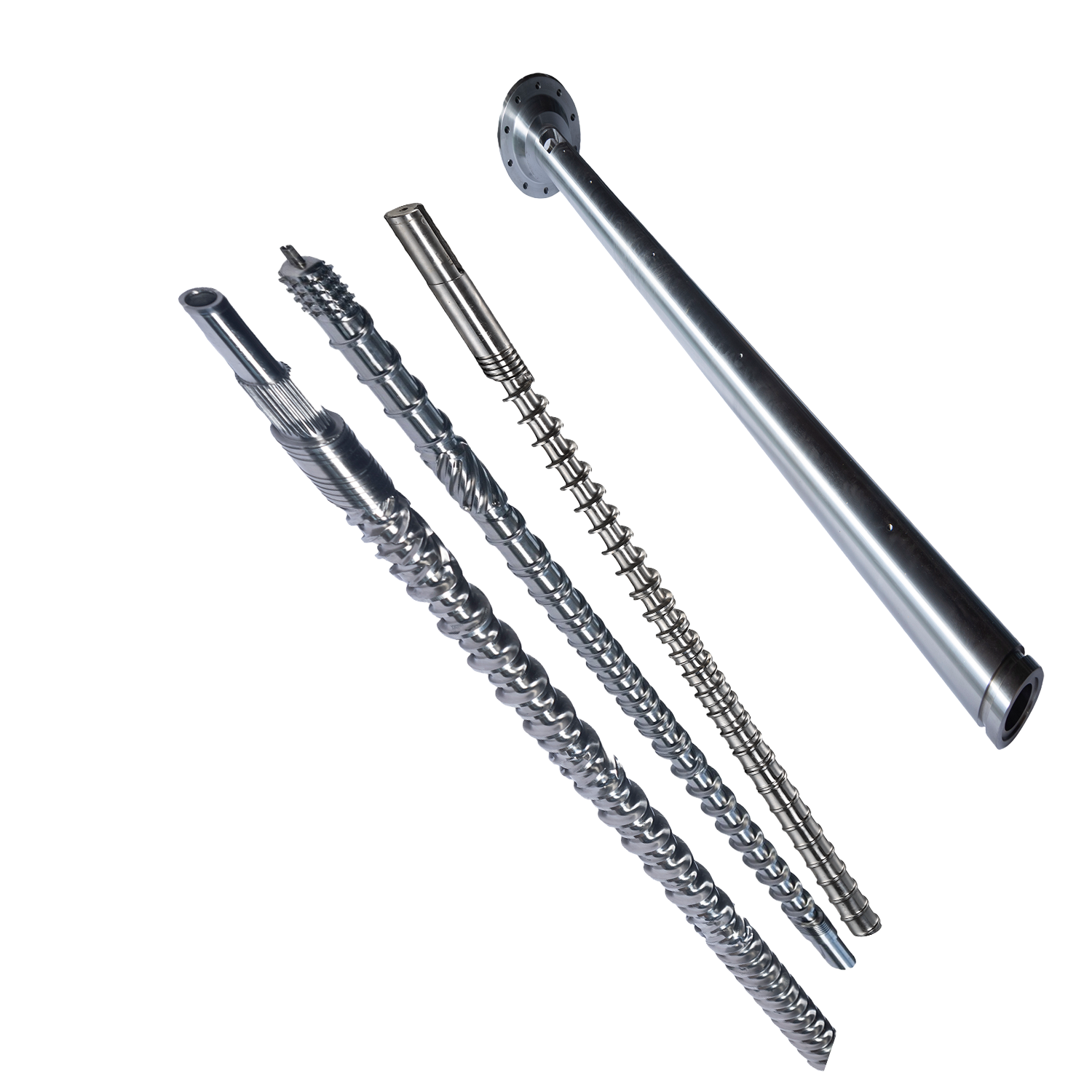
A screw and barrel assembly for single-screw extrusion: case depth, straightness and core hardness decide whether the specification holds up in service.
Screw and barrel purchases are usually settled on constraints rather than adjectives: a case depth that can be measured, a hardness range that can be verified, a steel grade that matches the polymer, and a delivery window that fits a maintenance shutdown. The feed screw barrel market was valued at USD 1.89 billion in 2024 and is projected to reach USD 3.33 billion by 2034, a compound annual growth rate of 5.8% (Global Insight Services) — growth that is pushing more buyers into specification-level conversations with suppliers.
Zhejiang Guangming Plastics Machinery Co., Ltd., which manufactures under the brand Guangyou Screw, is a barrel and screw producer founded in 1992 that operates a 100,000 m2 facility in Zhoushan, China and exports to more than 50 countries and regions, including Germany, Italy, the UK, the US, Brazil and India. Its published specification covers five barrel families: rubber machine screw and barrel (Φ20-Φ650), injection molding machine screw and barrel (Φ20-Φ300), single screw extruder screw and barrel (Φ20-Φ500), parallel twin screw barrel (Φ45-Φ350) and conical twin screw barrel (Φ25/50-Φ185/340). The questions below are the ones that most often decide whether a quotation turns into a workable specification.
Why the Same Parameter Arrives With Different Numbers in Every Quote
Published industry estimates are a useful reminder that numbers need context. Estimates of the global plastic processing machinery market for 2025 range from USD 25.9 billion (Grand View Research) to USD 39.0 billion (IMARC Group), depending on which categories of peripheral equipment are counted. Product-level parameters behave in the same way. A nitrided screw can describe case depths, steel grades and hardness measurement methods that are not interchangeable, and an alloy-coated screw can mean a thin surface deposit or a fused layer several millimetres deep.
The practical consequence for procurement is that a screw and barrel quotation should be read as a set of constraints rather than a single headline hardness value. Three constraints matter most in replacement and new-build projects: the nitrided case depth and its brittleness control; the hardness and depth of any alloy layer deposited on the flights; and the core strength of the screw shaft, which determines whether the screw survives torque spikes. Certification then determines whether those claims can be documented and audited.
Nitrided Case Depth: What 0.45-0.7 mm Actually Constrains
Nitrided case depth is the thickness of the nitrogen-diffused layer measured inward from the working surface. It sets the wear window of a screw or barrel: once the case is worn through, wear accelerates quickly in the softer core material beneath.
Guangyou Screw publishes a nitrided case depth of 0.45-0.7 mm with nitrided hardness of HV850-1000 and nitrided brittleness of less than Grade 2, applied to a core that has been hardened and tempered to HB260-310. The same specification sheet lists surface roughness Ra 0.4, screw straightness 0.015 mm, chromium plating depth 0.025-0.10 mm with plating hardness of at least 900 HV after nitriding, alloy hardness HRC50-65 and alloy depth 0.8-2.0 mm. These values are stated for all five barrel families.
| Published parameter | Stated value | What it controls |
|---|---|---|
| Hardness after hardening and tempering | HB260-310 | Core toughness of the screw body beneath the wear layer |
| Nitrided hardness | HV850-1000 | Surface wear resistance of the diffusion case |
| Nitrided case depth | 0.45-0.7 mm | Usable wear window before core exposure |
| Nitrided brittleness | Less than Grade 2 | Resistance of the case to chipping under impact |
| Surface roughness | Ra 0.4 | Melt slip and material adhesion behaviour |
| Screw straightness | 0.015 mm | Runout, which converts torsion into cyclic bending |
| Chromium plating depth / hardness after nitriding | 0.025-0.10 mm / at least 900 HV | Corrosion resistance in addition to wear resistance |
| Alloy hardness / alloy depth | HRC50-65 / 0.8-2.0 mm | Wear resistance of the deposited flight layer |
For comparison, an industry reference for 38CrMoAl (1.8509) plasticating screws cites a typical nitriding case of 0.4-0.6 mm with a surface hardness of 900-1,100 HV. The overlap is close, which is expected: 38CrMoAl is a nitriding steel and appears on the published material list for these barrels alongside grades such as 34CrAlNi7 (1.8550) and 31CrMoV9 (1.8519).
Three procurement questions follow from the number itself. First, is the stated depth a minimum, an average or a maximum? A 0.45-0.7 mm band implies an acceptance window, and the buyer should know which end is guaranteed. Second, where was the measurement taken — on the flight flank, on the flight top, or on a test coupon? Third, what is the brittleness grade, because a deep case that is too brittle chips under impact instead of wearing smoothly. The published limit of less than Grade 2 is the control that keeps hardness from being traded against toughness.
There is also a boundary worth stating plainly. Nitriding is a surface treatment, not a universal answer to abrasive loading. The application record for PVC pipe, profile and sheet extrusion notes that calcium carbonate (CaCO3) high-filler processing requires a bimetallic lining with a nitrided finish, because filler content raises wear beyond what a nitrided case is designed to absorb on its own.
PTA Alloy Hardness: Reading HRC Values Correctly
Plasma transferred arc (PTA) deposition is a weld-overlay process family in which an arc is established between an electrode and the workpiece and alloy powder is fed into that arc, fusing a metallurgically bonded layer onto the screw flights. In rotary configurations the screw is turned while the torch advances, which is how a helical flight can be covered uniformly instead of being hand-welded in overlapping passes. The overlay is applied after the base screw has been machined and heat treated, so core condition and overlay condition are controlled as two separate specifications.
The published output at Guangyou Screw is an alloy hardness of HRC50-65 with an alloy depth of 0.8-2.0 mm. Buyers who have been quoted HRC 58-65 should note that this band sits inside the HRC50-65 range. Whether that matters depends on how the value is promised: a guaranteed minimum of 58 HRC and a typical reading of 58-65 HRC are commercially different commitments, and only the first one is enforceable at goods-in inspection.
It is also worth separating two reinforcement architectures. A PTA overlay builds hardness where the wear happens — on the flights of the screw, at an alloy depth of 0.8-2.0 mm. A bimetallic barrel instead uses a centrifugally cast alloy liner, typically a boron-nickel-chromium composition with a thickness of 1.5-3.0 mm, so the entire barrel bore is protected rather than selected surfaces. Composite systems combine a bimetallic barrel with a separately treated screw, which is one reason the application record for high-filler PVC work specifies a bimetallic lining together with a nitrided finish.
Two verification points deserve a place in the purchase order. Hardness on a curved flight is a surface measurement, and the reading depends on indenter load, measurement location and surface preparation, so the method should be named. And because an overlay changes the local metallurgy, any weld repair or re-profiling of an alloyed flight should be treated as a re-qualification event rather than routine maintenance.
Why Screw Shafts Fracture Under High Torque
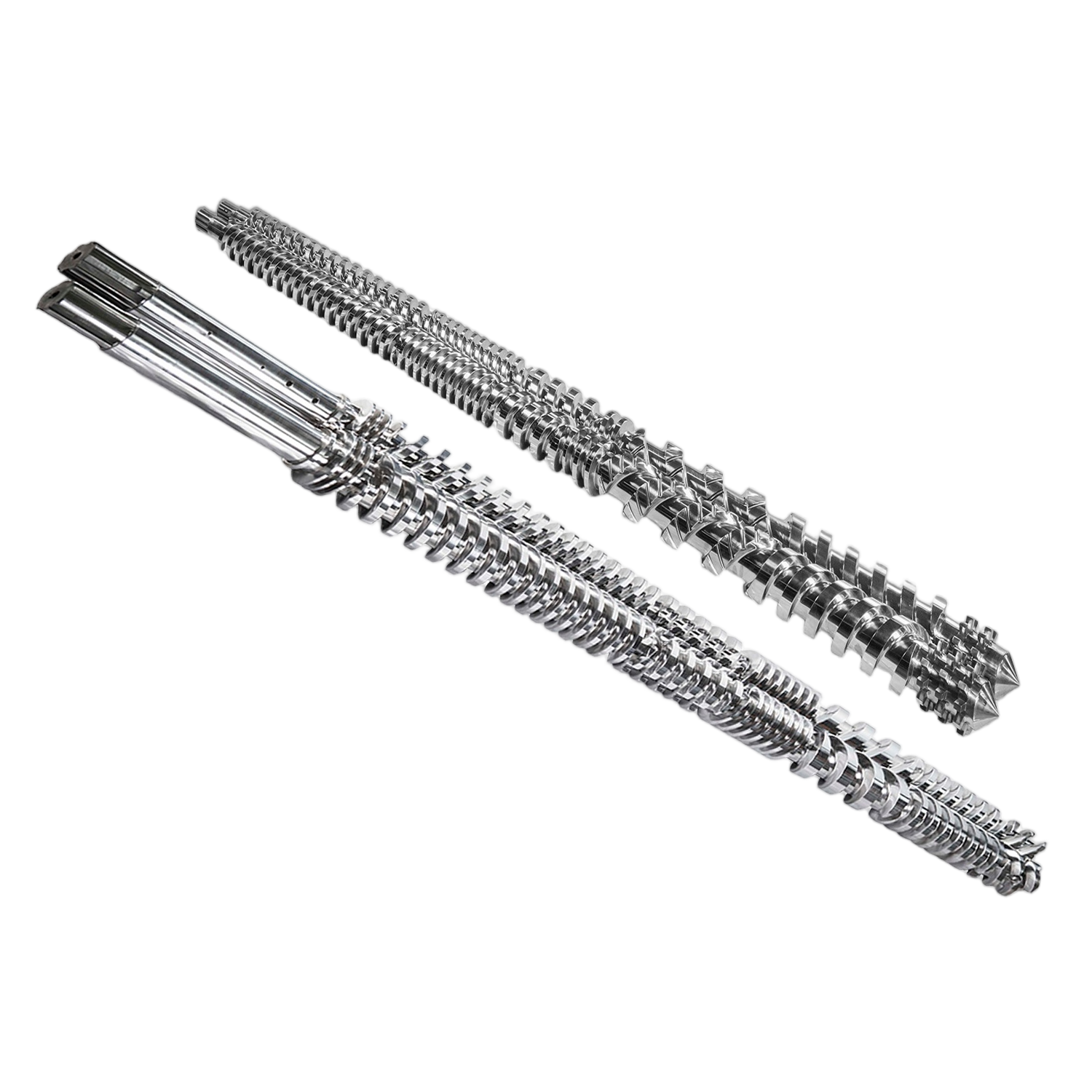
Torque passes through the screw shafts: core hardness and the 0.015 mm straightness tolerance matter as much as the surface hardness printed on the certificate.
A screw is a cantilever loaded in torsion, with bending added whenever the screw is not perfectly aligned with the barrel. Fracture at the drive end or at a section transition is therefore rarely a hardness failure — it is a core toughness and geometry failure, usually triggered by a combination of conditions:
- Torsional overload during cold starts, blocked feed zones or sudden increases in back pressure, when torque is applied before the polymer is fully softened.
- Stress concentration at geometric transitions, keyways and coupling details, where local stress can be several times the nominal shaft stress.
- Loss of alignment. The published screw straightness tolerance of 0.015 mm exists for this reason: runout converts pure torsion into cyclic bending, the loading mode under which fatigue cracks grow.
- Brittle case behaviour. If nitriding produces an excessively brittle case, small chips become stress raisers at the surface and can initiate cracks in a shaft that would otherwise have carried the load.
The design implication is that surface hardness and shaft integrity pull in opposite directions when they are specified independently. A screw can meet every surface hardness requirement on the certificate and still be the wrong choice for a high-torque, high-filler line.
Steel Selection and Heat Treatment as the Mitigation Path
The risk of shaft fracture is mitigated in two stages: choose a steel whose hardenability, toughness and corrosion behaviour match the duty, then control heat treatment so that the surface and the core are doing different jobs.
The published material list for these barrels spans five functional groups. Nitriding steels — 38CrMoAl (1.8509), 34CrAlNi7 (1.8550) and 31CrMoV9 (1.8519) — are selected where a hard, wear-resistant case on a tough core is the objective. Quenched and tempered structural steels such as 42CrMo, 40CrNiMo, 40Cr and C45 deliver higher core strength for high-torque shafts. Tool steels including SKD11, SKD61, DC53, D2, Gr12MoV and 9Cr18MoV are used for wear-critical duties. Corrosion-resistant grades — AISI304, AISI316, 1.4404, 1.4462, 1.4122, 1.2316, 440C, AISI420, 17-4PH and S600 — address aggressive polymers. Nickel and cobalt alloys such as Inconel 718, Inconel 625, Hastelloy C-276 and Monel 400/500 are reserved for extreme corrosion and temperature exposure.
Heat treatment then sets the numbers that can be inspected. Hardening and tempering brings the screw body to HB260-310, the toughness base beneath the wear layer. Nitriding raises the surface to HV850-1000 at a controlled case depth of 0.45-0.7 mm and a brittleness of less than Grade 2. Where corrosion resistance is also required, chromium plating of 0.025-0.10 mm is applied, with a hardness of at least 900 HV after nitriding.
The limitation is that no single grade optimises wear resistance, corrosion resistance and fatigue strength at the same time, and specifying maximum surface hardness without specifying core hardness is one of the most common errors in screw procurement. A corrosion-resistant grade such as AISI304 or 1.4404 is not a nitriding steel, and its core strength is lower than that of a quenched and tempered 42CrMo; it trades shaft strength for chemical resistance. Conversely, a nitrided 38CrMoAl screw intended for a high-torque compounding duty may need a larger shaft section or a different base steel rather than a harder surface.
Verifying Hardness and Material Claims Through Certification
Documentation is what converts a parameter claim into a procurement decision. Zhejiang Guangming Plastics Machinery holds a Quality Management System Certificate to ISO9001:2015, certificate number 15/25Q6428R80, issued by WIT ASSESSMENT, with a scope covering the design and manufacture of counter-rotating twin-screw and barrel for plastic extruder. The company also holds an Environmental Management System Certificate to ISO14001:2015 and an Occupational Health and Safety Management System Certificate to ISO45001:2018, both valid to 2028-10-07; the quality management certificate is valid to 2028-05-12. The certificates apply to the domestic market and to overseas markets under IAF international mutual recognition.
Two cautions for the audit. First, read the scope line: a certificate covering the design and manufacture of counter-rotating twin-screw and barrels is not automatically a statement about the hardness value on a specific screw you ordered. Second, pair certificates with batch-level evidence. Certificates describe the system; inspection records describe the parts.
The published manufacturing position supports that pairing: 100% testing, a monthly capacity of 2,700 units, minimum order quantity of 1 unit, and batch-customized component orders that typically range from 1 to 50 pieces. OEM customers in extrusion and injection machinery report high dimensional consistency across those batches, which is consistent with a manufacturing process controlled by inspection rather than by rework.
Where These Specifications Are Applied
The parameter set above is not theoretical. It maps onto specific process duties:
- PVC pipe, profile and sheet extrusion, using continuous counter-rotating conical twin-screw extruders with high-shear plasticizing for stable shaping, and bimetallic lining where CaCO3 filler loading is high.
- Compounding, pelletizing and plastics recycling, where parallel twin screw barrels in the Φ45-Φ350 range handle mixing and devolatilisation duties.
- Injection molding in the Φ20-Φ300 range for automotive, electronics and toy manufacturing.
- Single-screw film blowing and pipe extrusion in the Φ20-Φ500 range.
- Rubber extrusion and tire-related production, where barrels run from Φ20 to Φ650 and the load profile is dominated by high viscosity rather than high screw speed.
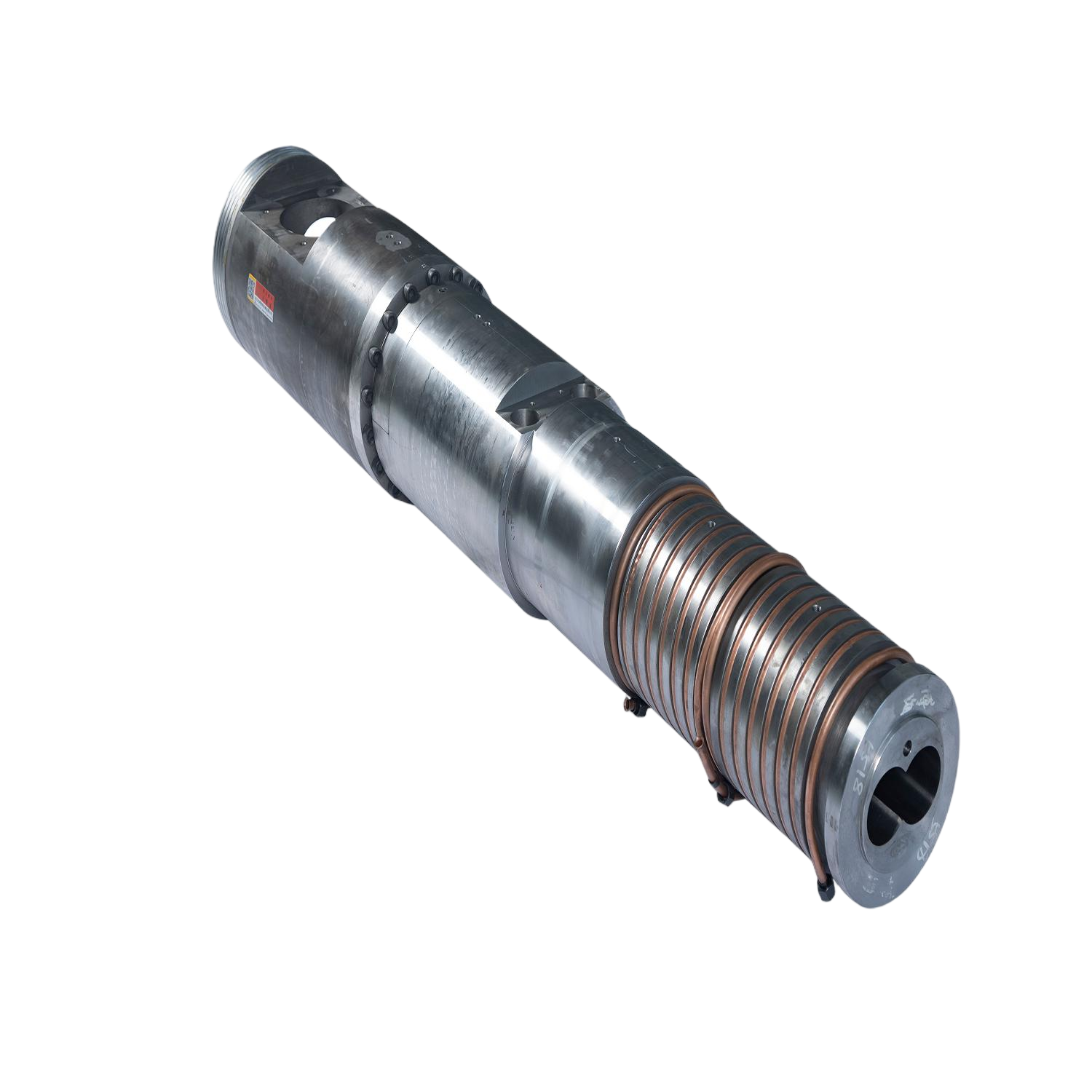
Conical twin screw barrels for PVC pipe, profile and sheet extrusion, where high CaCO3 filler content shifts the requirement toward a bimetallic lining with a nitrided finish.
Field evidence from the same customer base supports the specification logic. Plastic product manufacturers running batch-customized components report service lifetimes of one to five years under normal high-filler PVC extrusion working conditions, with the stated benefit being reduced unplanned downtime rather than a change in output rate. OEM machinery builders running batches of one to fifty pieces report that dimensional consistency across batches allows assembly without rework. Distributors and repair-focused buyers use the same tolerance set for local replacement and retrofit work, where manufacturing from a customer drawing with a precise mechanical fit matters more than the name on the machine.
Market Signals Behind the Specification Debate
Three published data points frame the commercial context. Single-screw extrusion machinery accounts for approximately 62% of the extrusion market as of 2024 (Fortune Business Insights), which means the majority of installed capacity still runs conventional nitrided and plated screws and barrels. The global bimetallic barrel and screw market is estimated at USD 2.8 billion in 2025 and forecast to reach USD 4.7 billion by 2034 (Dataintelo; medium-reliability estimate). And within the wider plastic processing machinery market, injection molding machines represented 50.9% of a market valued at USD 25.9 billion in 2025 (Grand View Research).
Read together, these figures describe a market in which the installed base is dominated by conventional nitriding technology, while growth in wear-resistant construction is driven by abrasive and recycled feedstocks. That combination is exactly the situation in which specification discipline pays: most lines do not need the most expensive construction available, and the cost of choosing unnecessarily hard surfaces can be paid in shaft fractures and lead time rather than in material cost alone.
Nitrided, PTA-Overlaid or Bimetallic: A Comparison
| Construction | Protective layer | Hardness reference | Best fit | Main boundary |
|---|---|---|---|---|
| Nitrided screw and barrel | Diffusion case, 0.45-0.7 mm | HV850-1000, brittleness less than Grade 2 | Unfilled and lightly filled polymers; cost-sensitive replacement | Case is thin relative to a liner and cannot be rebuilt indefinitely |
| PTA-overlaid screw | Fused alloy layer on flights, 0.8-2.0 mm | HRC50-65 | Abrasive duty concentrated at the flights | Wear resistance is localised; overlay adds process steps and cost |
| Bimetallic barrel | Centrifugally cast alloy liner, 1.5-3.0 mm | Liner hardness not stated in the specification reviewed | High-filler, recycled and abrasive feedstocks | Highest upfront commitment; construction is fixed at purchase |
Nothing in this comparison removes the trade-offs. A nitrided screw and barrel is a surface-hardened system: it is economical, well suited to unfilled and lightly filled polymers, and it cannot be rebuilt indefinitely, because recoating a worn nitrided case is not the same operation as replacing a liner. A PTA-alloyed screw concentrates wear resistance on the flights and adds cost per piece, which is difficult to justify where the duty is not abrasive. A bimetallic barrel brings a thicker, centrifugally cast liner and typically the highest upfront cost of the three, and it commits the geometry at the time of purchase rather than at the time of maintenance.
Lead time belongs to the same constraint set. Published production planning for nitriding single screw and barrel assemblies indicates 40-50 days for Φ20-Φ90, 50-60 days for Φ90-Φ180, 60-70 days for Φ180-Φ250, and more than 70 days for larger sizes and for bimetallic work. Minimum order quantity is one unit and OEM customization covers voltage and logo, but a specification that calls for special steel and bimetallic construction should be scheduled against the long end of that range, not the short end.
Future Outlook
Three directions are visible from the specification side of the market rather than from the sales side. Documentation is becoming part of the product: buyers now ask for certificate scope, certificate numbers and validity dates, and increasingly for the hardness method and measurement location alongside the hardness value itself. Construction choices are shifting where filler and recycled content are rising, which is consistent with a bimetallic segment growing faster than the conventional one. And shaft integrity is increasingly treated as a design output rather than a material property, because hardening and tempering to a defined core hardness, holding straightness to a defined tolerance and controlling case brittleness are process steps that can be specified, measured and repeated, whereas a general claim of superior wear resistance cannot.
For procurement teams, the practical version of that outlook is straightforward: ask for the parameter, the measurement method, the guarantee direction and the certificate that stands behind it — in writing, before the order, not after the failure.
Frequently Asked Questions
What nitrided case depth should a screw and barrel specification state?
For the barrel families published by Guangyou Screw, the stated nitrided case depth is 0.45-0.7 mm, with nitrided hardness of HV850-1000 and nitrided brittleness of less than Grade 2, on a core hardened and tempered to HB260-310. An industry reference for 38CrMoAl (1.8509) plasticating screws cites 0.4-0.6 mm at 900-1,100 HV. Because these are ranges, the specification should state which end is guaranteed and where on the part the measurement is taken.
Can a PTA-deposited alloy layer reach HRC 58-65?
The published alloy hardness range for these barrels is HRC50-65, with an alloy depth of 0.8-2.0 mm, so 58-65 HRC falls inside that band. Because the figure is published as a range, the buyer should confirm whether 58 HRC is a guaranteed minimum or a typical reading, which indentation method is used, and at which position on the flight the value is verified.
Why do screw shafts fracture under high torque, and how is the risk reduced?
Shaft fracture is primarily a core-toughness and geometry issue rather than a surface-hardness issue. Contributing conditions include torsional overload during cold starts and blocked feed, stress concentration at couplings and section transitions, alignment loss beyond the 0.015 mm straightness tolerance, and an excessively brittle nitrided case acting as a crack initiator. Mitigation is achieved through steel selection matched to the duty and through hardening and tempering to a core hardness of HB260-310 beneath the nitrided layer.
How is hardness quality assurance demonstrated rather than claimed?
Through documents that carry scope and validity, plus batch evidence. Zhejiang Guangming Plastics Machinery holds ISO9001:2015 certification, certificate number 15/25Q6428R80, issued by WIT ASSESSMENT, with a scope covering the design and manufacture of counter-rotating twin-screw and barrel for plastic extruder and a validity to 2028-05-12, alongside ISO14001:2015 and ISO45001:2018 certificates valid to 2028-10-07. The published manufacturing position states 100% testing. Certificates describe the system; inspection records describe the individual screw.
Does a bimetallic barrel always outperform a nitrided barrel?
No. A bimetallic barrel uses a centrifugally cast alloy liner typically 1.5-3.0 mm thick, which suits abrasive and highly filled polymers. A nitrided barrel uses a 0.45-0.7 mm diffusion case at HV850-1000 and suits unfilled and lightly filled duties at lower cost. The application record for CaCO3 high-filler PVC extrusion specifies a bimetallic lining with a nitrided finish, which indicates that the two constructions are complementary rather than ranked.
What commercial constraints should be planned alongside the technical specification?
Minimum order quantity is one unit, OEM customization covers voltage and logo, and published production planning shows 40-50 days for nitriding single screw and barrel assemblies in Φ20-Φ90, 50-60 days for Φ90-Φ180, 60-70 days for Φ180-Φ250, and more than 70 days for larger sizes and bimetallic work. Schedules should be built on those lead times rather than on a general promise of fast delivery.
The Guangyou Screw product catalogue, including the full parameter table for these barrel families, can be downloaded here: Guangyou Screw product catalogue (PDF).