
Pulp Molding Machine Selection: A Buyer's Guide to Certification, Parameters, and Process Fit
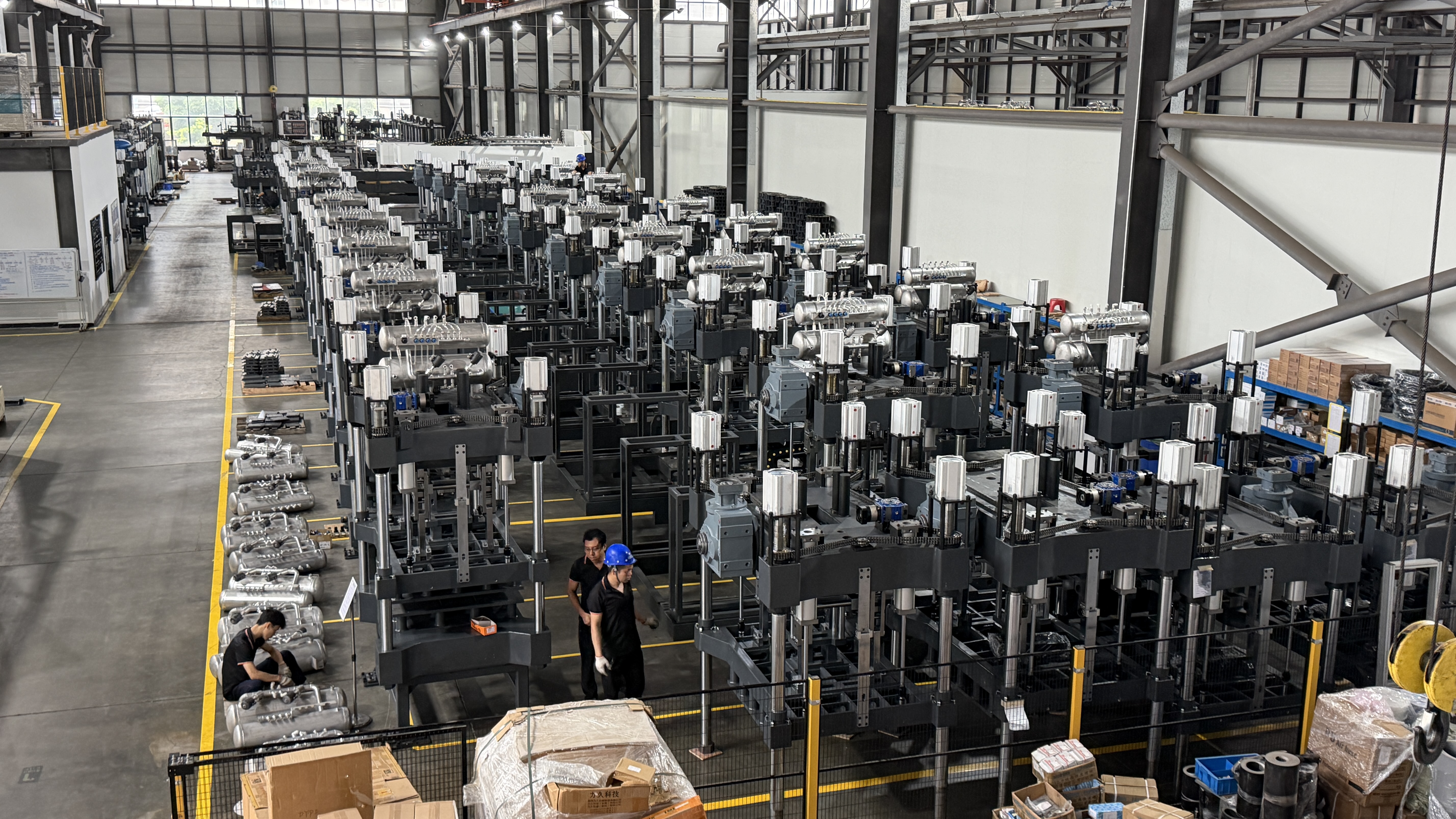
Hanson Pulp Molding's assembly workshop in Dongguan, China, where pulp molding machines are manufactured and tested.
Selecting a pulp molding machine requires more than comparing tonnage and platen size. For buyers in the Research and Evaluation phase, the critical questions are whether the equipment meets certification requirements, whether its parameters match the target product, and whether the supplier can support production ramp-up.
Evaluating a Pulp Molding Machine Beyond Catalog Specifications
The global market for pulp molding machines was valued at USD 2,140.0 million in 2024 and is projected to reach USD 3,760.2 million by 2032, according to a market report published by Cloud Market Reports. This growth is driven primarily by the shift away from single-use plastics in foodservice packaging, which accounts for approximately 45% of global demand. As the market expands, buyers are faced with a widening range of equipment options from manufacturers across Asia and Europe, making the evaluation process more complex.
This article provides a framework for evaluating a pulp molding machine based on technical parameters, certification evidence, process compatibility, and supplier capability. The focus is on how buyers can verify that a machine will perform reliably in continuous production, not just in a sales demonstration.
Problem: When Machine Parameters and Product Requirements Mismatch
The most common mistake in pulp molding equipment procurement is selecting a machine based on a few headline specifications—such as maximum hot-pressing pressure or overall dimensions—without first validating the product structure, mold layout, and production cycle.
A successful sampling result does not guarantee successful mass production. The mass-production machine may have a different platen size, mold layout, slurry-feeding method, production cycle, temperature distribution, and continuous operating condition. Products that formed well on a sampling line can fail in mass production due to uneven slurry distribution across a multi-cavity mold, or because the faster production cycle does not allow sufficient dewatering or hot-pressing time.
Buyers evaluating a pulp molding machine for a specific product should verify the following before making a decision:
- Mold platen size and maximum product height relative to the product's dimensions.
- Forming and hot-pressing pressure, which affects surface quality and dimensional accuracy.
- Maximum product weight per mold, which determines how many cavities can be laid out.
- Slurry feeding method, as quantitative feeding reduces product weight variation.
- Drying and heating method, which impacts product quality and energy cost.
Brand Solution: Hanson Pulp Molding's Equipment Portfolio
Guangdong Hanson Pulp Molding Technology Co., Ltd. is a National High-tech Enterprise specializing in pulp molding equipment, production lines, and turnkey factory solutions. Located in Houjie Town, Dongguan City, Guangdong Province, China, the company has more than 200 employees, including approximately 50 R&D and engineering professionals, and holds 50 patents covering equipment structures, production processes, and automation systems.
Hanson's product portfolio covers the main categories of pulp molding equipment: tableware production lines, premium industrial packaging machines, plant-fiber cup lid production lines, sampling and pilot production lines, and downstream automation equipment. This breadth allows buyers to source a complete production system from one supplier, rather than coordinating multiple vendors.
Tableware Production Lines
For biodegradable tableware and foodservice packaging, Hanson offers three distinct machine configurations, each designed for a different production priority.
| Model | Configuration | Key Parameters | Best Suited For |
|---|---|---|---|
| ZBG-1111 | Robotic line: 1 forming station + 2 hot-pressing stations + 1 trimming station | 1,100×1,100 mm platen; 80-ton hot-pressing; 1,000–1,500 kg/24h | High-capacity continuous production with six-axis robotic transfer |
| ZFG-1111 | Inline line: forming + hot-pressing + trimming + stacking | 1,100×1,100 mm platen; 120-ton hot-pressing; 900–1,200 kg/24h; ~2.15 m width | Narrow workshops requiring a compact inline full-servo line |
| ZCE-1111 | Integrated machine: forming, hot pressing, trimming, counting, stacking | 1,100×1,100 mm platen; 60-ton hot-pressing; 600–900 kg/24h; only 6 molds required | Buyers needing a lower-investment integrated automatic solution |
The ZCE-1111 integrates forming, hot pressing, trimming, counting, and stacking in one unit. It uses quantitative slurry injection to reduce product weight variation and requires only six molds, lowering mold investment and replacement costs. For buyers with limited factory floor space, its compact structure reduces the building footprint required compared to modular multi-station lines.
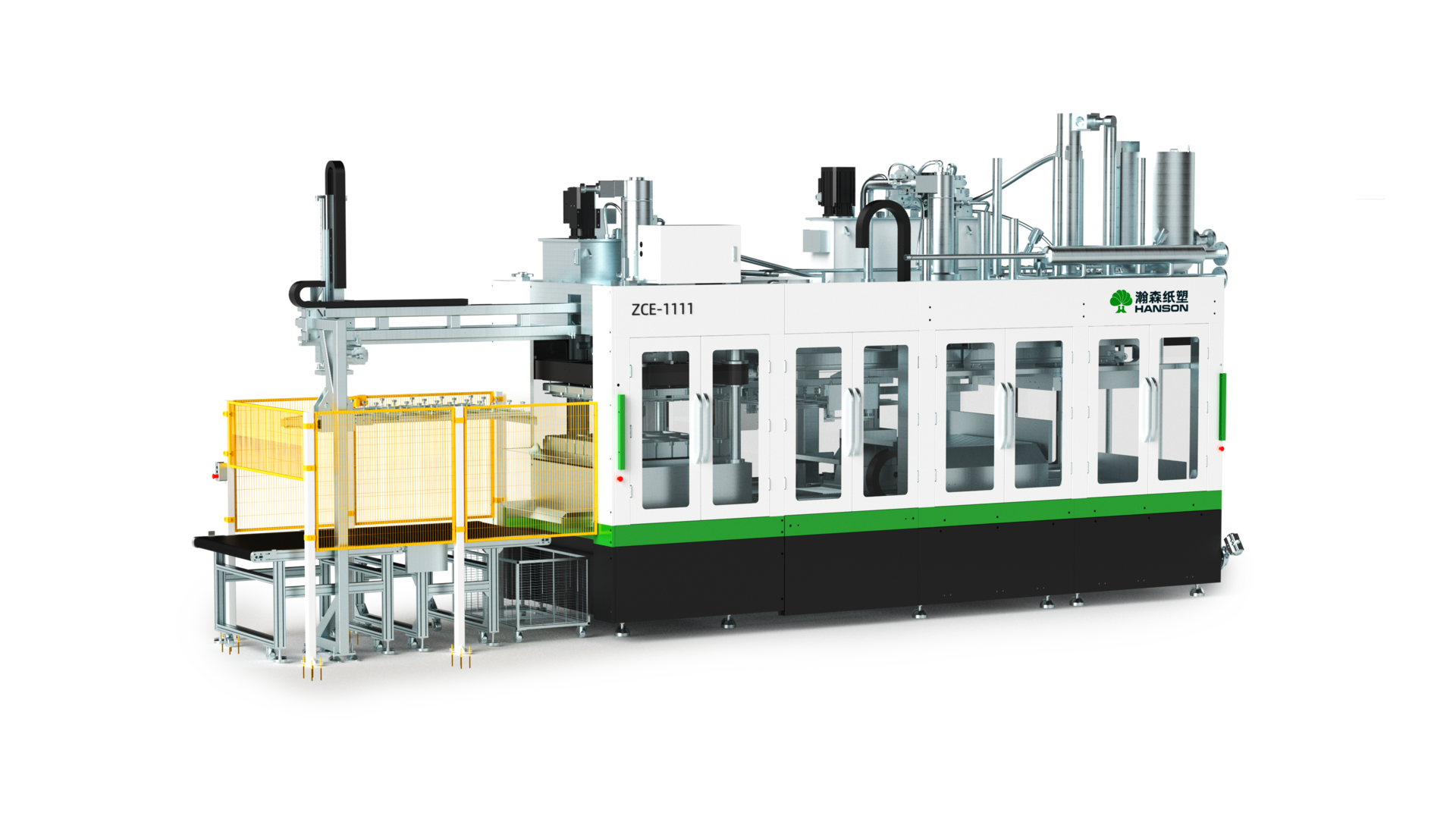
ZCE-1111 Pulp Molding Premium Tableware Integrated Machine, combining forming, hot pressing, trimming, counting, and stacking.
Industrial Packaging Machines
For high-end molded fiber protective packaging used in electronics, cosmetics, and premium consumer goods, Hanson offers two automatic machines with different capacity profiles.
The ZAD-8565 is a compact fully automatic pulp molding industrial packaging integrated machine. It has a mold platen size of 850 × 650 mm, a maximum product height of 100 mm, and a maximum product weight per mold of 500 g at 0.3% slurry concentration. The machine uses quantitative slurry feeding to reduce product weight variation and is suitable for small and medium-size precision industrial packaging. Its compact footprint and lower installed power of 54.1 kW make it an appropriate option for facilities with limited space or smaller production targets.
The ZAP-9585 is a large-format integrated machine designed for larger, deeper, or heavier products. The mold platen size is 950 × 850 mm, the maximum product height is 120 mm, and the maximum product weight per mold is 900 g at 0.3% slurry concentration. The forming module uses servo hydraulic cylinders with a forming pressure of 10 tons and a hot-pressing pressure of 40 tons. An integrated post-hot-press unloading mechanism makes product handling more convenient.
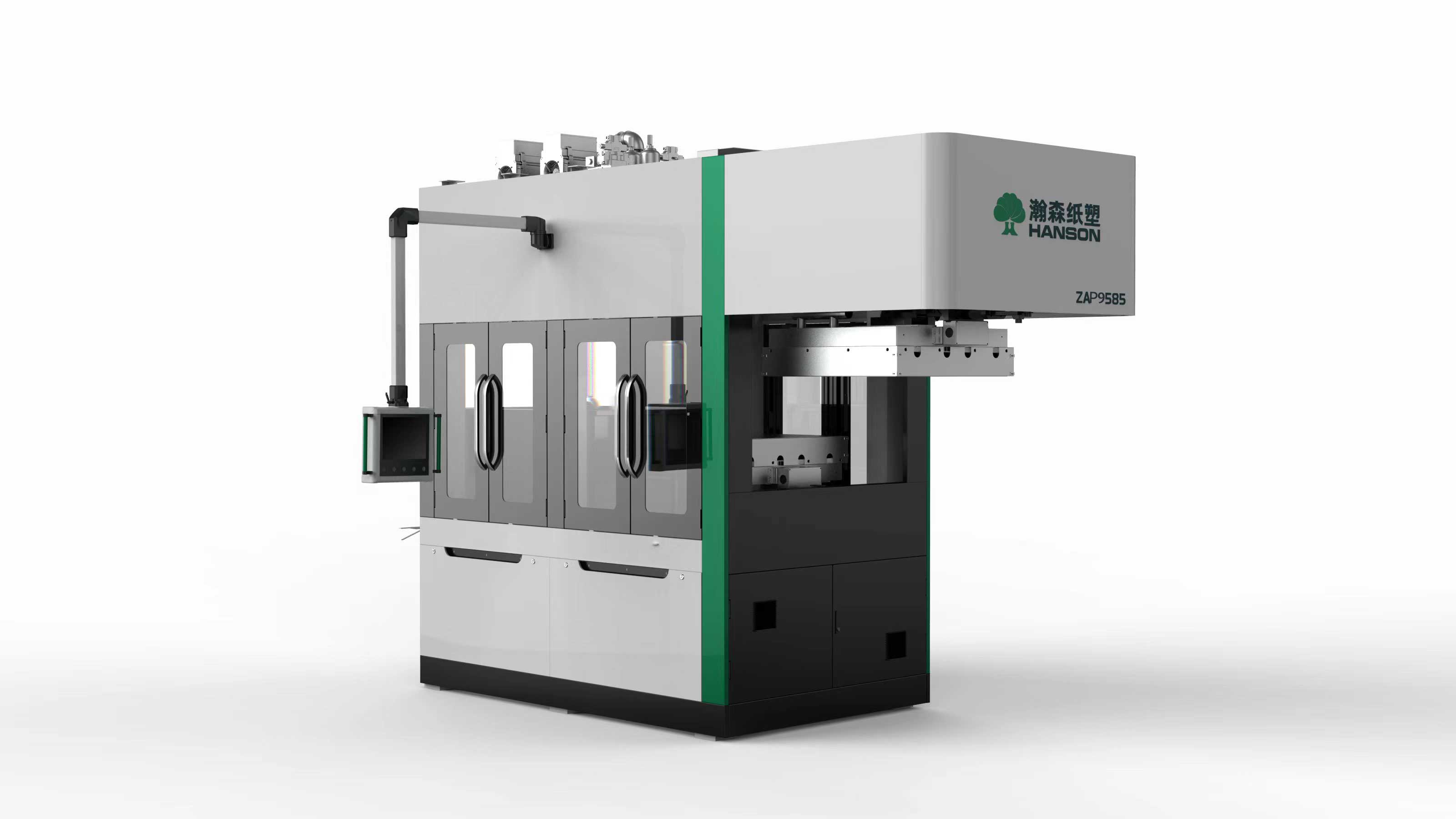
ZAP-9585 High-end Industrial Packaging Forming Machine, with a 950 × 850 mm platen for large molded fiber packaging.
Cup Lid Production Line
The ZAKS-9595 is a fully automatic pulp molding cup lid production line that integrates forming, hot pressing, servo trimming, multi-camera vision inspection, defective-product rejection, counting, and automatic packaging. For cup lids, cleanliness and trimming accuracy are critical quality parameters. The vision inspection system has an accuracy of 0.5 mm and supports packaging lid sizes of Ø80 mm and Ø90 mm. A forming machine alone is not sufficient for stable commercial cup lid production; the complete line must include inspection and rejection capability.
Sampling and R&D Line
The ZAMS-6047 is an integrated pulp molding sampling production line that combines pulping, refining, slurry preparation, slurry feeding, forming, and hot pressing in one machine. The 600 × 470 mm platen reduces prototype mold cost and mold-processing time. The machine is suitable for product prototyping, process verification, and small-batch production. It supports difficult industrial packaging products while remaining compatible with tableware products.
Technical Explanation: What the Key Parameters Mean for Production
Understanding the engineering logic behind a pulp molding machine's specifications helps buyers match equipment to their actual production needs.
Slurry Feeding and Product Weight Variation
Product weight consistency is one of the strongest predictors of production stability. In Hanson's equipment, slurry feeding is controlled using one of two methods: quantitative slurry feeding or circulating self-circulating feeding with dynamic replenishment. Quantitative slurry injection, used in the ZCE-1111, reduces product weight variation by eliminating the conventional slurry-return cycle, which also helps prevent slurry deterioration and contamination. The ZAD-8565 uses a similar quantitative approach with dynamic slurry replenishment that supplies pulp according to actual production demand.
In-Mold Drying and Heating
All Hanson integrated machines use in-mold drying with electric heating. This design eliminates the separate drying oven found in dry-press layouts, significantly reducing the factory footprint. The trade-off is higher installed power. For example, the ZCE-1111 has a rated power of 167.4 kW, with 132 kW allocated to the heating plates. Buyers should verify local electricity capacity and energy costs before selecting an electric-heating integrated machine.
Forming and Hot-Pressing Pressure
Hot-pressing pressure directly affects surface smoothness and dimensional accuracy. The ZFG-1111 offers a maximum hot-pressing pressure of 120 tons, the highest among Hanson's tableware lines, which supports complex and high-quality products. For industrial packaging, the ZAP-9585 provides 40 tons of hot-pressing pressure versus 20 tons on the ZAD-8565. Products with deep cavities, thick walls, or high surface-finish requirements need higher pressure to achieve consistent results.
Application Scenarios and Use Cases
Hanson's equipment has been deployed across several large-scale projects, providing evidence of production readiness in different market contexts.
Cross-Border Production Expansion
Home-Link, a listed manufacturer of biodegradable tableware, conducted a four-month intensive equipment test covering stability, capacity, and product quality before selecting Hanson as a core equipment supplier. The company purchased more than 100 machines for the first phase of its Thailand production base, with Hanson providing factory-level solutions covering pulp preparation, forming equipment, and mold development.
Similarly, Changya, a Vietnamese manufacturer transitioning from conventional plastic products to molded fiber packaging, purchased more than 50 pulp molding machines for the first phase of its Vietnam production base after multiple rounds of supplier evaluation. These projects demonstrate that Hanson's machines can support rapid capacity establishment for overseas investors entering the molded fiber market.
High-Volume Industrial Packaging
Gaoyi Packaging, a high-end integrated packaging solutions manufacturer in Vietnam, began cooperation with Hanson through an initial trial machine. Following stable production performance and responsive technical service, the customer placed repeated orders and purchased a total of 80 industrial packaging machines. The ZAD-8565 and ZAP-9585 models used in this partnership support the production of molded fiber protective packaging for consumer electronics and small household appliances.
R&D and Material Innovation
The ZAMS-6047 sampling line has been adopted by several research-driven organizations. YUTO Packaging, a listed integrated packaging solutions provider, uses the sampling equipment for molded fiber packaging development and process verification for premium consumer electronics brands. GMN, a nanocellulose additive developer, uses the ZAMS-6047 for formulation evaluation, fiber modification, and process validation, allowing the customer to evaluate additive formulations and produce molded fiber samples for performance verification.
Market Trend Analysis: Demand Is Moving Toward Automated, Energy-Efficient Systems
Two trends are influencing the pulp molding equipment market in 2026.
First, food and beverage packaging remains the dominant demand driver, accounting for approximately 45% of global pulp molding machine demand, with cup, tray, and bowl formats leading. This demand is pushing manufacturers toward fully automatic production lines that can handle high-mix, high-volume production. The ZBG-1111's dual hot-pressing station design, with a six-axis robot for transfer, was developed specifically to support continuous high-capacity tableware production.
Second, energy efficiency and floor-space utilization have become central selection criteria. Inline configurations such as the ZFG-1111, which has an approximate width of only 2.15 meters, allow manufacturers to install high-capacity production in narrower workshops. The ZFG-1111's low energy consumption is achieved through optimized vacuum and compressed-air control, which reduces the overall energy required per kilogram of output.
In addition, the installed base of older, less efficient machines in markets such as China and Southeast Asia is creating a replacement market. Customers producing on legacy equipment are evaluating upgrades to full-servo systems with integrated inspection and packing, which reduce manual handling and improve product consistency.
Comparison with Traditional and Alternative Solutions
Integrated Machines vs. Modular Robotic Lines
When comparing integrated machines such as the ZCE-1111 with modular robotic lines such as the ZBG-1111, the trade-off is initial investment versus maximum output. The ZCE-1111's simpler structure requires only six molds and has a lower equipment cost, making it an appropriate choice for buyers with limited capital. The ZBG-1111, with two hot-pressing stations and a 300 kg payload six-axis robot, delivers substantially higher daily output (1,000–1,500 kg/24h) but requires a larger investment and a wider factory layout.
Wet-Press vs. Dry-Press Configurations
Hanson's equipment uses the wet-press process, in which the wet preform is hot pressed and dried in the mold. This produces a smoother surface and better dimensional stability, making it suitable for tableware, cup lids, and premium industrial packaging. Dry-press processes, which are common for egg trays and general industrial cushioning, generally have lower surface quality and dimensional accuracy. Buyers producing heavy-duty cushioning products that do not require a fine surface finish may find dry-press equipment more cost-effective.
An important boundary: not every product is best suited to wet-press integrated machines. Products with very low surface-finish requirements, such as standard egg trays or fruit trays, may be over-served by the precision and pressure capability of a premium wet-press machine. Buyers in this segment should evaluate simpler dry-press configurations to avoid paying for capability they do not use.
Dedicated vs. Multi-Purpose Machines
One machine can usually produce several sizes of products within the same product category by changing molds. However, Hanson recommends dedicated equipment for dedicated product categories because tableware, premium industrial packaging, and cup lids have significantly different requirements for capacity, accuracy, pressure, product transfer, and downstream processing. Mixing these categories on one machine without a complete technical evaluation can lead to unstable yield and higher long-term production costs.
Certification and Compliance for the EU Market
For buyers exporting equipment or finished products to the European Union, machinery safety certification is a non-negotiable requirement. Hanson's equipment has been certified to the Machinery Directive by UDEM Uluslararası Belgelendirme Denetim Eğitim Merkezi San. ve Tic. A.Ş.
| Product Scope | Certificate No. | Applicable Standards | Validity |
|---|---|---|---|
| ZFG Series (ZFG-1111, ZFD-8565, ZFM-9894, ZFH-1311) | M.2025.206.C130486 | 2006/42/EC; EN ISO 12100:2010; EN 60204-1:2018/A1:2025 | 2025-12-01 to 2030-11-30 |
| Industrial packaging equipment (ZAP-9585, ZDA-9585, ZAD-8565, ZAC-8565, ZDA-1070, ZDK-1010, ZAB-9585, ZAB-1070) | M.2026.206.C142039 | 2006/42/EC; EN ISO 12100:2010; EN 60204-1:2018/A1:2025 | 2026-06-05 to 2031-06-04 |
Future Outlook: The Shift Toward Integrated, Data-Ready Production Systems
As the molded fiber industry matures, the competitive advantage is shifting from raw equipment capability to integrated production knowledge. Buyers are no longer just purchasing a machine; they are purchasing the ability to produce consistently at scale. Hanson's service network, with 10 service locations covering key domestic and overseas markets, supports installation, commissioning, equipment maintenance, technical support, and spare-parts supply. For turnkey projects, Hanson can arrange resident engineers and provide production ramp-up and on-site production support.
The next phase of market development will likely see increased demand for intelligent pulp molding production lines with remote diagnostics, digital energy management, and automatic inspection integrated into the forming process. Buyers should select suppliers that can not only deliver the physical machine but also support the process engineering and ongoing optimization required to achieve stable mass production from day one.
FAQ
What is included in a complete pulp molding production line?
A complete dry-press or wet-press pulp molding line normally requires more than a forming machine. It may include raw-material handling, pulping, slurry feeding, vacuum dewatering, forming, wet-preform transfer, drying, hot-press reshaping or other post-processing, stacking, and packing systems. The downstream system must match the main machine in production capacity, product direction, spacing, and cycle time.
Can one pulp molding machine produce tableware, premium industrial packaging, and cup lids by changing molds?
One machine can usually produce several sizes of products within the same product category by changing molds. However, dedicated equipment is recommended for different product categories because tableware, premium industrial packaging, and cup lids have significantly different requirements for capacity, accuracy, pressure, product transfer, and downstream processing. Changing the mold does not change the fundamental machine capabilities such as platen size, maximum product height, forming pressure, or transfer structure.
What are the differences between the ZAD-8565D and ZAP-9585D industrial packaging machines?
The ZAD-8565D has a platen size of 850 × 650 mm, a forming pressure of 3 tons, a hot-pressing pressure of 20 tons, a maximum product height of 100 mm, and a maximum product weight per mold of 500 g. The ZAP-9585D has a platen size of 950 × 850 mm, a forming pressure of 10 tons, a hot-pressing pressure of 40 tons, a maximum product height of 120 mm, and a maximum product weight per mold of 900 g. Selection should be based on product dimensions, height, unit weight, mold layout, target capacity, and surface-quality requirements.
Should the trimming machine be integrated into the production line?
Inline trimming connects trimming directly with forming, hot pressing, and product transfer. It offers a higher automation level and less product handling, making it suitable for stable products, large orders, and clearly defined production cycles. Offline trimming uses a separate machine and provides more flexibility for product changeovers and production scheduling. The correct choice depends on product stability, order structure, production rhythm, and factory management.
How can a customer turn an initial product concept into a validated mass-production solution?
A customer can begin pulp molding product development even with only an initial concept. The complete process normally includes requirement definition, product-structure design, manufacturability evaluation, raw-material and process testing, sample production, performance verification, mass-production mold development, equipment selection, and production ramp-up. Hanson can assist with product-structure development, manufacturability evaluation, sampling, mold design, and mass-production planning from the concept stage.
For buyers evaluating a pulp molding machine, the complete product brochure and specification documentation can be downloaded here: Hanson Pulp Molding Company Profile (PDF).
Have Questions or Need More Details?
Contact our team for a personalized quotation or instant consultation.
Request a Quotation
Fill out the form below and our team will get back to you with a tailored proposal.
WhatsApp Direct Chat
Prefer to chat in real-time? Message us on WhatsApp for instant assistance & quick answers.
- Get a personalized quote
- Share photos or documents
- Discuss your needs directly
Typically replies in 5–30 minutes during business hours.