
Pulp Molding Machines for New Factories: A Four-Line Shortlist
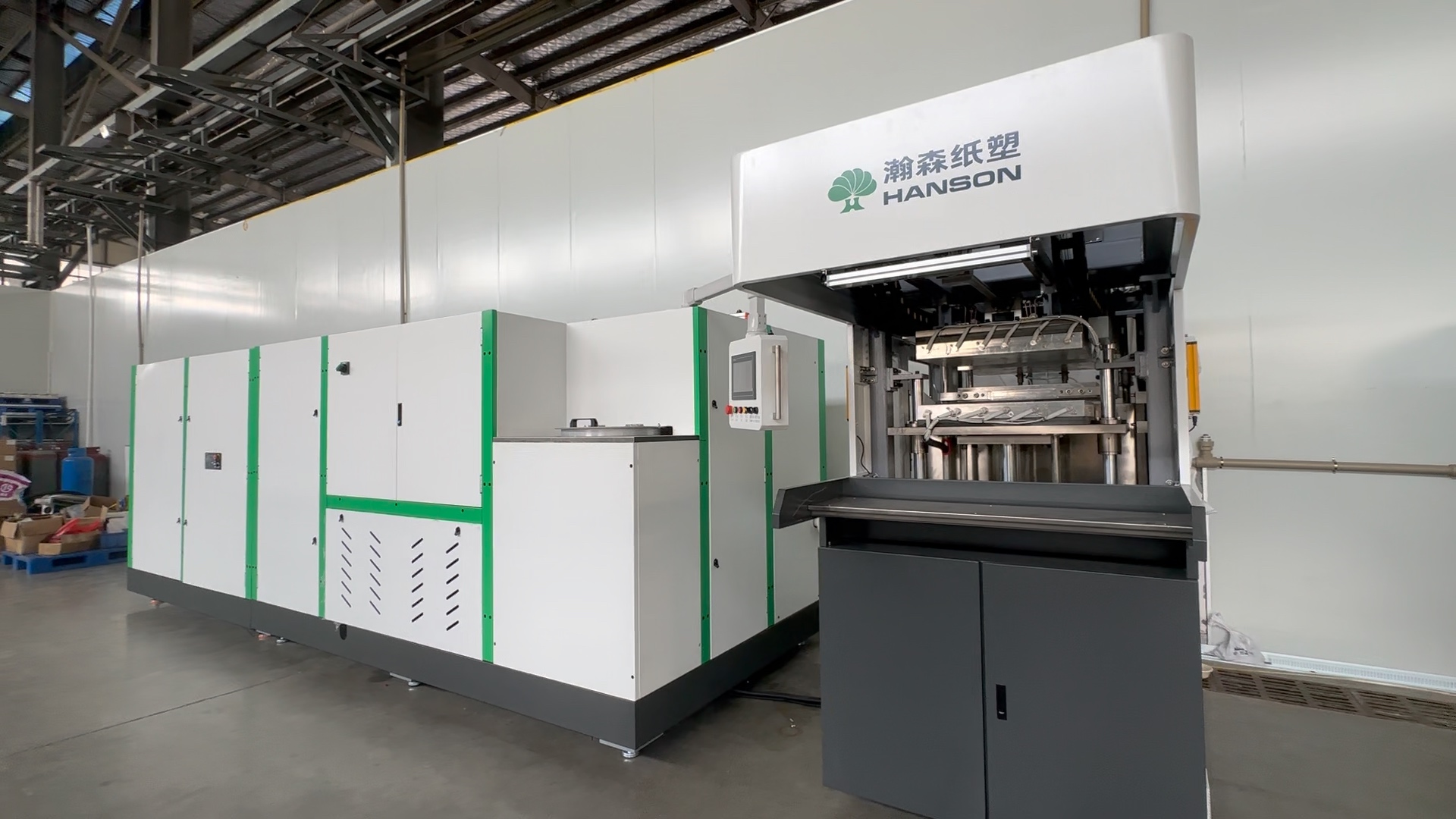
A new molded fibre factory rarely fails at the moment of purchase. It fails three months later, when the line is running, the fibre is whatever the region actually supplies, the buyer's customer has revised the drawing, and nobody on site can tell whether the problem sits in the pulp recipe, the mould, the forming cycle or the hot-pressing curve.
That gap is what makes equipment selection difficult for first-time projects. Buyers who already operate pulp molding plants shortlist machines against known cycle data. Buyers building their first plant often have a product concept, a target market and a budget, but no engineering team able to challenge a supplier's numbers. This article sets out a practical shortlist across four product families — sampling, cup lids, industrial packaging and tableware — for new factories and overseas projects that are assembling a pulp molding capability from zero.
Hanson Pulp Molding (Guangdong Hanson Pulp Molding Technology Co., Ltd.) is a pulp molding equipment manufacturer based in Houjie Town, Dongguan City, Guangdong Province, China, supplying forming machines, complete production lines and turnkey factory solutions. The company was founded in 2022, operates a 50,000 ㎡ facility with more than 200 employees and approximately 50 R&D and engineering staff, and holds 50 patents covering equipment structures, production processes and automation systems. Its product range covers tableware lines, industrial packaging machines, plant-fibre cup lid lines, sampling and pilot production lines, and downstream automation for trimming, inspection, stacking and packing.
Why a New Factory Needs a Shortlist, Not a Catalogue
Pulp molding equipment is usually sold as a capacity figure: kilograms per 24 hours, pieces per hour, cycles per minute. For a buyer without an engineering team, that figure is the hardest number in the conversation to interrogate, because output depends on the product, the fibre, the mould layout and the drying strategy at least as much as on the machine.
A more reliable starting point is to shortlist by project type rather than by headline capacity. Four questions narrow the field quickly:
- What has to be proven before money is committed? If the fibre source, the product geometry or the coating specification is still open, the project needs sampling capability before it needs production capacity.
- What is the product envelope? Platen size, maximum product height and maximum product weight per mould define what a machine can physically make, and they are fixed facts rather than negotiable estimates.
- What does the building allow? Floor load, available line length, cooling water flow and compressed air supply rule out machines that look good on paper.
- Who debugs the first three months? Cycle matching between forming, hot pressing, trimming and packing is where new plants lose the most time, and it is the part most often left undefined in a purchase order.
The Four-Line Shortlist at a Glance
The table below summarises the reference configurations discussed in this article. Output figures are quoted as manufacturer reference capacities and vary with product shape, fibre type and mould layout.
| Project type | Model | Mould platen | Reference basis | Installed power |
|---|---|---|---|---|
| Sampling / pilot | ZAMS-6047 | 600 × 470 mm | Max 200 g per mould at 0.3% slurry concentration | 82 kW (26.4 kW heating) |
| Plant-fibre cup lids | ZAKS-9595 | 950 × 950 mm forming | Max 500 g per mould; lids Ø80 mm and Ø90 mm | 126.45 kW forming module |
| Compact industrial packaging | ZAD-8565 | 850 × 650 mm | Max 500 g per mould; height ≤100 mm | 54.1 kW |
| Large industrial packaging | ZAP-9585 | 950 × 850 mm | Max 900 g per mould; height ≤120 mm | 114 kW |
| Tableware, integrated | ZCE-1111 | 1,100 × 1,100 mm | 600–900 kg/24 h | 167.4 kW |
| Tableware, inline full servo | ZFG-1111 | 1,100 × 1,100 mm | 900–1,200 kg/24 h | 102 kW electric / 39 kW oil heating |
| Tableware, robotic full servo | ZBG-1111 | 1,100 × 1,100 mm | 1,000–1,500 kg/24 h | 60 kW |
Line 1 — Sampling Before Commitment: ZAMS-6047
The ZAMS-6047 is a fully automatic integrated pulp molding prototyping and small-batch production line. It integrates pulping, refining, slurry preparation, slurry feeding, forming and hot pressing inside a single machine measuring L7,500 × W2,550 × H2,810 mm and weighing 7.3 tons.
For a new factory, its value is not output — it is decision quality. The 600 × 470 mm platen keeps prototype mould cost and mould-processing time low, while the 120 mm maximum product height and 200 g maximum product weight per mould at 0.3% slurry concentration still allow realistic industrial packaging geometries to be tested. Forming is driven by an electric cylinder at 2 tons; hot pressing uses a hydraulic cylinder at 13 tons, with in-mold electric drying. Forming position, pressure and temperature are adjustable, and circulating slurry feeding with slurry return plus reciprocating pulp suction supports repeatable trials across different fibre recipes.
Two limitations matter. First, the ZAMS-6047 does not include a trimming function, so trimmed finished parts require a separate trimming step or a downstream machine. Second, it is a validation and small-batch tool, not a substitute for a production line — buyers should treat it as the instrument that de-risks the production decision, and expect to keep it running after the main line is installed. Client use supports this pattern: YUTO Packaging has used the ZAMS-6047 for moulded fibre packaging development and prototype verification, and Anhui Fengyuan used Hanson sampling equipment to move bio-based fibre formulations from laboratory validation toward pilot-scale production.
Line 2 — Cup Lids as a Product Line: ZAKS-9595
The ZAKS-9595 is a fully automatic pulp molding cup lid production line built around a 950 × 950 mm forming platen, with forming pressure of 10 tons and hot-pressing pressure of 40 tons. It integrates forming, hot pressing, servo trimming, multi-camera vision inspection, defective-product rejection, counting and automatic packaging into one line — a scope that matters for lids specifically, because a lid that is dimensionally correct but visually contaminated fails at the customer's inspection station rather than at the press.
Reference parameters worth checking against a project's own drawings: trimming platen 500 × 600 mm at 50 tons with a 10-second trimming cycle; vision inspection accuracy of 0.5 mm; supported packaging lid sizes of Ø80 mm and Ø90 mm; maximum packaging length of 400 mm. Forming module installed power is 126.45 kW, of which 48 kW is heating; trimming module power is 10.5 kW and the vision module 3 kW. Utilities are compressed air at 0.5–0.6 MPa, vacuum between −0.07 and −0.05 MPa, and cooling water at 80–100 L/min.
The boundary is product scope. The line is designed around round plant-fibre lids in the stated diameter range and packaging lengths up to 400 mm, so a buyer whose range centres on square lids, novel closure geometries or non-round formats should confirm tooling compatibility before treating this configuration as fixed. Plant-fibre lid manufacturing is a narrower product family than tableware or industrial packaging, and the equipment reflects that.
Line 3 — Industrial Packaging: ZAD-8565 and ZAP-9585
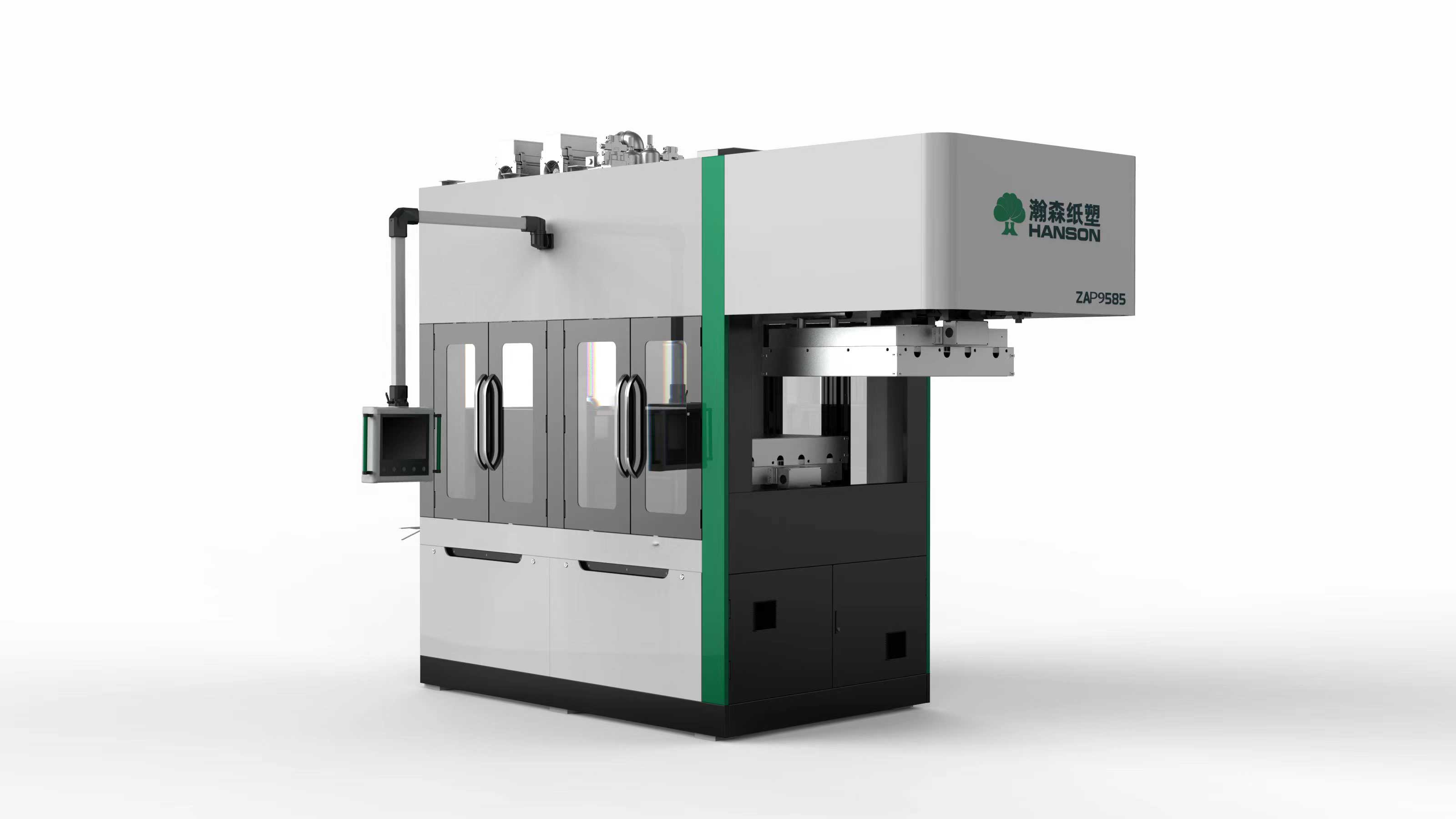
Industrial packaging is where new factories most often misjudge scope, because protective packaging for electronics and appliances is larger and deeper than foodservice items, and the platen is the constraint that cannot be argued with later.
ZAD-8565 is the compact entry: an 850 × 650 mm platen, 100 mm maximum product height, 500 g maximum product weight per mould at 0.3% slurry concentration, 54.1 kW installed power of which 45 kW is heating, and a floor load of 1,990.5 kg/m². It uses quantitative slurry feeding with dynamic replenishment and no slurry-return system, which reduces contamination risk from return piping, and servo electric cylinder forming at 3 tons paired with servo hydraulic hot pressing at 20 tons. Its advantage is building fit — L3,479 × W1,514 × H3,803 mm and roughly 5.5 tons lets a first plant start production in an existing hall.
ZAP-9585 is the larger format: 950 × 850 mm platen, 120 mm maximum product height, 900 g per mould, 114 kW installed power, and a floor load of 2,449 kg/m². It adds precise self-circulating slurry feeding with dynamic replenishment, servo hydraulic forming at 10 tons and hot pressing at 40 tons, and a post-hot-press unloading mechanism that simplifies handling of bulky parts.
The trade-off between the two is straightforward and should be treated as a hard engineering constraint: the ZAD-8565 caps product height at 100 mm and product weight at 500 g per mould, so a project whose packaging includes deep cavities for appliances or large single-piece protective shells belongs on the ZAP-9585 — provided the building can carry 2,449 kg/m² and provide 80–100 L/min of cooling water. Floor loading in particular is a civil-works question, not a machine-options question, and it is cheaper to answer before the slab is poured.
Line 4 — Tableware: ZCE-1111, ZFG-1111 and ZBG-1111
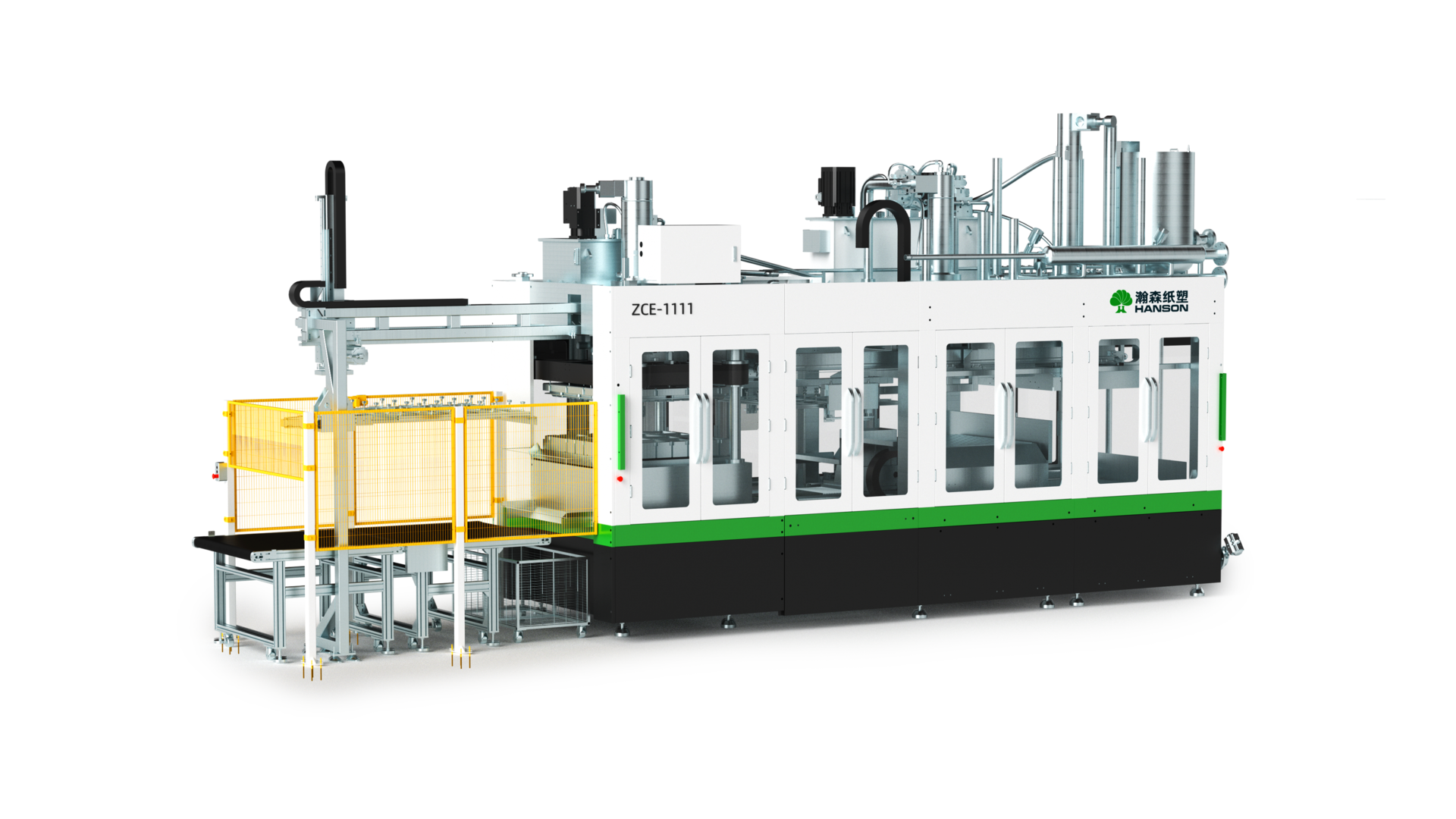
Tableware is the most competitive segment in molded fibre, and the three Hanson configurations sit at different points on the capacity and capital curve.
ZCE-1111 is a fully automatic integrated tableware machine on a 1,100 × 1,100 mm platen, weighing 20 tons with dimensions of L9,000 × W2,000 × H4,000 mm. Forming pressure is 20 tons, hot-pressing pressure 60 tons and trimming pressure 70 tons. It integrates forming, hot pressing, trimming, counting and stacking in one unit, uses quantitative slurry injection to reduce weight variation, requires only six moulds — which lowers mould investment and replacement cost — and uses in-mold transfer to shorten the production route. Reference capacity is 600–900 kg/24 h with a 28–60 second forming cycle depending on product; maximum product height is 80 mm, maximum product weight per mould 550 g, rated power 167.4 kW with 132 kW of heating plate power.
ZFG-1111 is the inline full-servo tableware production line: 1,100 × 1,100 mm platen, 17.7 tons, L11,200 × W2,150 × H4,800 mm, with one forming station, one hot-pressing station, one trimming station and a transfer and stacking unit. Hot-pressing pressure is 120 tons and trimming pressure 80 tons. Reference capacity is 900–1,200 kg/24 h, and rated power is 102 kW with electric heating or 39 kW with oil heating. Its roughly 2.1-metre line width is a meaningful advantage in halls where floor space, not capital, is the binding constraint.
ZBG-1111 is the robotic configuration: one forming station, two hot-pressing stations and one trimming station linked by a six-axis robot with 2,700 mm reach and 300 kg payload, plus a linear transfer robot for stacking. Reference capacity is 1,000–1,500 kg/24 h at 60 kW rated power, with oil, electric or steam heating options. Its footprint of L6,100 × W6,500 × H3,600 mm and 26-ton weight make layout planning the first decision, not the last.
For a new factory without an engineering team, the practical rule is that the ZCE-1111 removes integration risk at the cost of capacity ceiling and installed power, while the ZFG-1111 and ZBG-1111 reward a buyer who already knows the product mix and has the hall to support a line. Buying line capacity before the product mix is stable is the most common form of over-investment in this segment.
Full-Servo vs Pneumatic-Hydraulic: Capacity and Energy
The comparison that matters most in a new factory is between full-servo configurations and pneumatic-hydraulic equivalents, because the difference shows up twice: once in capital cost and every month afterwards in electricity.
Using the reference capacities above, the two classes divide as follows. Full-servo tableware configurations sit in the 900–1,200 kg/24 h band (ZFG-1111) and up to 1,000–1,500 kg/24 h for the robotic ZBG-1111. The conventional pneumatic-hydraulic class sits in the 600–900 kg/24 h band, represented here by the ZCE-1111 integrated machine. Hanson's project comparisons for full-servo configurations reference a 15%–25% comprehensive energy reduction against pneumatic-hydraulic equivalents.
The rated-power figures in the equipment data point in the same direction. The ZCE-1111 is rated at 167.4 kW for a 600–900 kg/24 h reference capacity. The ZFG-1111 is rated at 102 kW with electric heating for 900–1,200 kg/24 h, and at 39 kW when oil heating is used. The ZBG-1111 is rated at 60 kW for 1,000–1,500 kg/24 h. These are nameplate ratings, not metered consumption, and the two are not the same thing — but the direction of the difference is consistent across the range.
Three caveats belong in any honest comparison. The 15%–25% range is a project reference, not a guarantee; the realised figure depends on product mix, cycle time, heating method and the local cost of electricity versus oil or steam. Heating method is itself a major lever — the gap between 102 kW electric and 39 kW oil heating on the same ZFG-1111 frame is larger than the servo-versus-hydraulic gap, and it is decided by local fuel economics, not by machine preference. Finally, energy is only one line in the total cost model; a lower-power machine that runs slower, or requires more manual handling, can cost more per finished tonne. Buyers should ask for metered comparison data on a comparable product rather than accept a percentage.
Certification Constraints That Shorten the List
For projects supplying European customers, compliance can eliminate options before capacity is even discussed. Two current Hanson attestations are relevant to this shortlist.
The ZFG Series Pulp Molding Equipment holds a Machinery Directive Attestation of Conformity issued by UDEM Uluslararası Belgelendirme Denetim Eğitim Merkezi San. ve Tic. A.Ş. under certificate M.2025.206.C130486, issued 2025-12-01 and valid until 2030-11-30, covering models ZFG-1111, ZFD-8565, ZFM-9894 and ZFH-1311 against 2006/42/EC Annex VIII, EN ISO 12100:2010 and EN 60204-1:2018/A1:2025 for the EU/EEA market.
The pulp molding industrial packaging equipment holds a separate attestation under certificate M.2026.206.C142039, issued 2026-06-05 and valid until 2031-06-04, covering ZAP-9585, ZDA-9585, ZAD-8565, ZAC-8565, ZDA-1070, ZDK-1010, ZAB-9585 and ZAB-1070 against the same directive and standards.
Buyers should also note that safety-related control-system design is a moving target. The 2015 version of EN ISO 13849-1 is scheduled for withdrawal after a transition period ending 15 May 2027, which means a line specified today may need its safety architecture reviewed within its first years of operation. A supplier that can explain how it will handle that transition is more useful to a first-time factory than one that simply lists a certificate.
Turnkey Modules and Ramp-Up Support
Machines are the visible part of a new factory; the invisible part decides whether they reach stable output. Hanson supplies turnkey pulp molding factory solutions that, depending on project scope, can cover product and raw-material verification, feasibility analysis, capacity planning, factory layout, pulp preparation systems, forming equipment, mould design and manufacturing, downstream automation, electrical control, installation and commissioning, personnel training and production ramp-up.
Two elements are particularly relevant to buyers without an engineering team. First, Hanson operates an independent mould division covering product development, mould design, mould manufacturing, mould testing and mass-production adaptation — moulds are usually where a new factory's first yield problems appear, and outsourcing them separately fragments responsibility for the outcome. Second, turnkey projects can be supported with resident engineers and up to six months of on-site production assistance, backed by a service network of 10 locations and 24/7 technical response. Lead time is approximately 60 days for standard equipment, with customised lines subject to configuration and project scope.
Scale reference points exist in the record: Changya took more than 50 machines for the first phase of its Vietnam production base after evaluating suppliers over multiple rounds; Gaoyi Packaging moved from an initial trial machine to a total of 80 industrial packaging machines; Guangxi Qiaowang took 32 customised core machines as part of a 40,000-ton-per-year project and increased annual capacity from approximately 6,000 tons to 16,000 tons. These are supplier-reported outcomes, and a new buyer should read them as evidence of delivery capability rather than as a forecast for their own project.
Where This Shortlist Stops
A shortlist is not a specification, and this one has clear boundaries. It does not tell a buyer which product to make, what the local fibre will do to cycle time, or whether the electricity tariff makes oil heating preferable — all three are project-specific and require local data. It also does not resolve the most common structural failure in new factories: a mismatch between upstream forming capacity and downstream trimming, inspection and packing, where the forming machine is sized to a target output that the finishing equipment cannot keep up with.
There are also configuration limits worth stating plainly. The ZAMS-6047 has no trimming function. The ZAD-8565 caps product height at 100 mm. The ZCE-1111 requires only six moulds, which lowers mould cost but ties product variety to how quickly those moulds can be changed. The ZAKS-9595 is built around round lids in defined diameters. None of these are defects; they are the boundaries that determine whether a machine belongs on a given project's list.
Market Context for New Capacity
The demand backdrop explains why new factories keep entering this category despite the engineering difficulty. The global pulp moulding machines market was valued at USD 2,140.0 million in 2024 and is projected to reach USD 3,760.2 million by 2032, according to Cloud Market Reports, which cites a 7.3% CAGR between 2025 and 2032. The same source estimates that food and beverage packaging accounts for approximately 45% of global demand, led by cup, tray and bowl formats.
Two caveats should travel with those figures. Market-size estimates for this category vary widely between research providers because some reports classify all paper-making machinery under the pulp moulding label, so a USD 2 billion figure and a sub-USD 1 billion figure can describe different product scopes rather than different markets. Trade data is more tightly defined: China's exports of machinery for making paper or paperboard under HS 843920 were valued at USD 49.58 million in 2024, per the World Integrated Trade Solution. Buyers building a business case should treat market-size numbers as directional and their own product-level demand as the operative figure.
Outlook
For first-time factories, the direction of equipment development is fairly clear. Servo-driven forming and hot pressing are becoming the default in tableware because they reduce energy per finished tonne and improve repeatability, while integrated single-machine configurations remain the practical entry point for buyers whose product mix is still forming. On the packaging side, the pressure is toward larger platens and deeper draws, which pushes floor-load and building-design questions earlier into project planning.
What is unlikely to change is the sequencing problem. New plants that validate fibre and product on sampling equipment, then size production capacity against a known mould and a known cycle, consistently reach stable output faster than plants that buy capacity first and discover the product afterwards. That sequencing — not the model number — is the part of the shortlist worth defending.
FAQ
What output capacity should a first-time pulp molding factory plan for?
There is no universal figure, but the reference capacities in this equipment class give a workable range. Integrated tableware machines sit at 600–900 kg/24 h, inline full-servo tableware lines at 900–1,200 kg/24 h, and robotic full-servo configurations at 1,000–1,500 kg/24 h, all depending on product. A new factory should size capacity against a validated product and mould rather than against a target tonnage, because cycle time varies substantially with product shape and fibre.
Can a sampling production line replace a production machine?
No. The ZAMS-6047 is designed for product development, mould verification, process validation and small-batch production, with a 600 × 470 mm platen and a maximum of 200 g per mould at 0.3% slurry concentration. It also has no trimming function. It reduces the risk of a production decision; it does not provide production capacity.
Which machines are covered by CE certification for EU projects?
Two attestations are current. Certificate M.2025.206.C130486, valid until 2030-11-30, covers the ZFG Series including ZFG-1111, ZFD-8565, ZFM-9894 and ZFH-1311. Certificate M.2026.206.C142039, valid until 2031-06-04, covers industrial packaging models including ZAP-9585 and ZAD-8565. Both are issued by UDEM Uluslararası Belgelendirme Denetim Eğitim Merkezi San. ve Tic. A.Ş. against 2006/42/EC, EN ISO 12100:2010 and EN 60204-1:2018/A1:2025.
What floor load and utility conditions do these machines require?
Industrial packaging machines illustrate the range: the ZAD-8565 requires a floor load of 1,990.5 kg/m² and 60–80 L/min of cooling water, while the ZAP-9585 requires 2,449 kg/m² and 80–100 L/min. Tableware and cup lid lines typically require 80–100 L/min, compressed air in the 0.5–0.8 MPa range and vacuum between −0.07 and −0.05 MPa, with exact values varying by model.
How long can production ramp-up support last?
For turnkey projects, Hanson can provide resident engineers and up to six months of on-site production assistance, alongside installation and commissioning, operator and maintenance training, remote technical support and spare-parts supply. The appropriate duration depends on product complexity and the experience level of the customer's production team.
What can a machine shortlist not decide for a new factory?
It cannot determine product selection, confirm how a specific local fibre will behave in production, or resolve cycle matching between forming and downstream trimming, inspection and packing. Those require project-specific testing and engineering, which is why sampling capability and clearly assigned responsibility for the production interface matter as much as the machine specification itself.
Hanson Pulp Molding publishes a full equipment and turnkey scope overview in its company brochure: Hanson Pulp Molding brochure (PDF).
Reference details: www.hspulpmolding.com · Houjie Town, Dongguan City, Guangdong Province, China.
Have Questions or Need More Details?
Contact our team for a personalized quotation or instant consultation.
Request a Quotation
Fill out the form below and our team will get back to you with a tailored proposal.
WhatsApp Direct Chat
Prefer to chat in real-time? Message us on WhatsApp for instant assistance & quick answers.
- Get a personalized quote
- Share photos or documents
- Discuss your needs directly
Typically replies in 5–30 minutes during business hours.