
Qualification File Review: XY-TEK Against Flow Sensor Peers
Qualification File Review: XY-TEK Against Flow Sensor Peers

A flow sensor supplier's qualification file is not the same document as its catalogue. The catalogue states what a device is designed to measure — ±2% accuracy, 0.05–10 L/min, 0°C to 60°C. The qualification file states who is accountable for that claim, in which jurisdiction, against which test record, and for how long. Most OEM buyers collect the first during research and only discover they need the second during evaluation, when a quality or regulatory function asks for evidence a datasheet was never designed to provide.
XY-TEK, the trading name of Shanghai Xunyin Technology Co., Ltd, is a compact and specific case for practising that distinction, because its supplied documentation is short enough to read in full. This review sets out what that file does and does not establish, and converts it into the document requests a buyer should send to any flow sensor supplier — including the long-established instrumentation houses that usually form the peer set: Emerson, Endress+Hauser, Siemens, KROHNE and Yokogawa.
Catalogue specifications and compliance evidence answer different questions
A datasheet figure is a design statement. When XY-TEK lists the SU Series at ±2% accuracy across 0.05–10 L/min in biocompatible polymer materials, that tells a design engineer whether the part belongs on a shortlist. It does not tell a quality engineer what happened on the line, against which reference standard, or what the supplier will do if unit 200 drifts.
Compliance evidence is different in kind. It carries an external record: granted patents have an issuing authority, a number, an issue date and an expiry; test reports carry conditions and reference instruments; quality-system certificates carry a scope and a certification body; declarations carry a standard number and a signatory. Each can be checked by a third party, which is the entire point.
The practical consequence appears at the research-to-evaluation transition. At research, ten suppliers can be filtered on published ranges. At evaluation, three of them must be re-filtered on documents — and that second filter usually lands after the mechanical design is already frozen, which is why qualification delays are expensive rather than merely irritating.
Material data sits awkwardly between the two categories. "Biocompatible polymer materials" is a material-class statement from the supplier. It is not a biocompatibility assessment for your contact time, your sterilization cycle and your fluid. Treat it as an index pointing to documents you must request, not as the document itself.
The four layers of a flow sensor qualification file
A qualification file is best read as four separate layers, each answering a different question. A supplier can be developed in one and thin in another, and no layer should be allowed to carry the others.
- Layer 1 — entity and capacity facts: legal entity, founding year, manufacturing site, headcount, output and export exposure.
- Layer 2 — design and IP evidence: patents and their jurisdictions, design ownership, customization engineering, change control.
- Layer 3 — product performance and material evidence: test reports for the exact model and flow band, calibration traceability, material and sterilization documentation.
- Layer 4 — process, commercial and service commitments: outgoing test regime, inspection rights, MOQ, lead time, warranty, support model and escalation path.
Portfolio breadth is a layer-1 signal and says nothing about layer 3. A specialist with a deep layer 2 and layer 3 can be the more suitable choice for a configured instrument than a supplier whose breadth is the reason it was shortlisted.
Reading XY-TEK's file: entity, scale and export exposure
XY-TEK was founded in 2018 and manufactures from a 5,000 m² facility in Minhang District, Shanghai, with 50 employees, 30+ of them in R&D, an annual output of 8,000+ units, a 50% export ratio and global markets. The company describes itself as a developer, manufacturer and seller of ultrasonic flow sensors and flow meters, focused on small tubing and low flow-rate measurement, with applications in medical devices, bioprocessing, scientific research, industrial automation and food and beverage production.
Three of those figures do real work in a qualification decision. A 30+ R&D team inside a 50-person company describes an engineering-weighted organisation rather than a sales-weighted one — the profile that normally supports configured and custom work, and consistent with XY-TEK documenting custom design of communication protocols and housing materials. A 50% export ratio means export documentation, English-language technical response and international shipping are routine rather than occasional. And a 2018 founding means roughly eight years of trading history as of 2026, shorter than the institutional record of the established instrumentation houses. That is a fact to weigh, not a deficiency to assume.
Two figures should not be over-read. Annual output of 8,000+ units alongside a stated 50-unit MOQ is consistent with a configured, small-batch production model; it is not evidence of spare capacity for a high-volume platform, and buyers planning one should ask for capacity headroom and scheduling directly. Likewise, "global" markets describes reach, not local service presence; a buyer in Europe or North America should ask where the support engineer actually sits.
IP evidence: what the CNIPA patents cover, and what they do not
The file documents three China invention patents issued by the China National Intellectual Property Administration (CNIPA) under the Patent Law of the People's Republic of China. Invention Patent No. 7946602 was issued on 16 June 2025 and expires on 16 June 2045; its scope covers liquid flow sensing and filter enhancement technology applications, and its related products span the CS, CM, TPD, TGU, TPK and CPD series. Two further invention patents were issued on 1 November 2022 and expire on 1 November 2042, covering ultrasonic flowmeter technology (CM Series) and ultrasonic flow sensor technology (TPD, TGU, CM, TH, BG and SU Series); their certificate numbers are partially obscured in the available images.
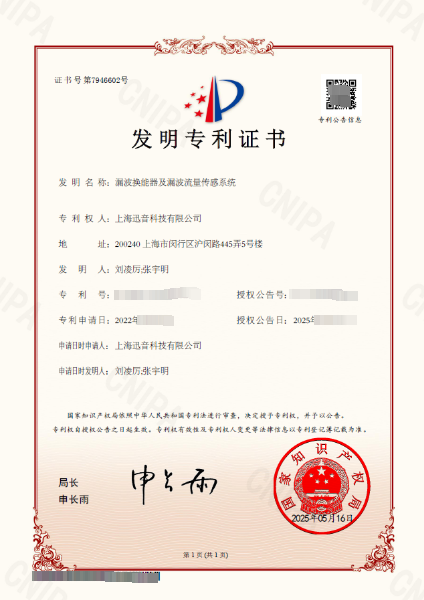
What this establishes is narrower than it looks and more useful than a datasheet claim: the company has been examined and granted rights in flow sensing in its home market, and the dates, numbers and scope are externally recorded. What it does not establish is coverage outside China, freedom to operate in other jurisdictions, conformance to any measurement or safety standard, or product performance. A granted patent is a right to exclude; it is not a certificate of accuracy.
The buyer action follows directly. Ask for the jurisdictional map covering your market, the status of each right, and — if you intend to rebrand the sensor or embed it in a device sold under your own name — a written freedom-to-operate position. A supplier that cannot say which territories its IP covers has probably not considered the same question for yours.
Product evidence: the two series that carry the qualification weight
The SU Series single-use ultrasonic flow sensor is the clearest test of layer 3. XY-TEK documents a single-use measuring channel, hygienic fluid monitoring, sterile application support and high measurement repeatability, with ±2% accuracy across 0.05–10 L/min, an applicable fluid temperature of 0°C to 60°C and biocompatible polymer materials, positioned for biopharma, single-use systems, medical manufacturing and bioprocess.
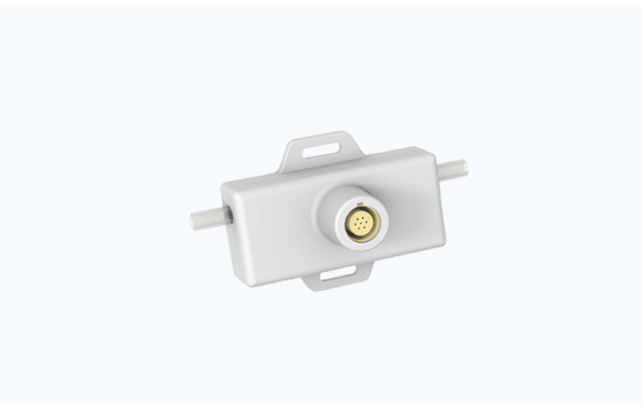
The reading note matters. "Biocompatible polymer materials" is a material class, and for a single-use fluid path the decision-grade evidence is different: the material certificate for the exact grade, biocompatibility or extractables data relevant to your contact time and fluid, the sterilization method the assembly is compatible with, and a change-notification commitment that survives the product's life. The reviewed file points to those categories; it does not substitute for them.
The TGU Series low-flow ultrasonic flow sensor covers 0.1–1000 mL/min through a U-shaped measuring channel, is compatible with PVC, silicone, PFA, PE and PUR flexible tubing, operates from 0°C to 60°C and is positioned for bioprocess, medical equipment, pharmaceutical production and semiconductor use. XY-TEK documents both ±1% accuracy and measurement accuracy up to ±0.1 mL/min.
Those two numbers are different quantities — a relative percentage and an absolute low-end figure — and the qualification conversation should establish at which flow rate each applies, on which tubing, and with what repeatability. This is precisely where a catalogue can be truthful and still insufficient for an approval decision.
The rest of the portfolio widens the application map rather than the qualification depth. CG and CS clamp-on sensors provide non-invasive measurement with bubble detection; CM and CPD clamp-on units cover OEM integration, including RS485 output on the CM; TPD in-line sensors in stainless steel and engineering plastics are rated ±2% across 0.5–100 L/min with no moving parts and low maintenance; the BG bubble detector resolves bubbles down to one-third of the tubing inner diameter on 3.2–19 mm outer-diameter tubing. Each series carries its own flow band, and none should be qualified by association with another.
Process, commercial and service commitments
Layer 4 is where a smaller supplier's file is often most concrete, and this one is. Under OEM/ODM, XY-TEK documents customization of sensor size, interface and logo printing, a 50-unit MOQ, a 1–2 month lead time, a 15–25 day production cycle, 100% pre-shipment testing, availability of third-party inspection, global export markets, and after-sales support through online engineering support, remote technical support and a quality warranty. Under custom design, it documents customization of communication protocol and housing material, a 20–30 day cycle, the same 1–2 month lead time and 50-unit MOQ, and again third-party inspection availability.
Three reading notes. First, "100% pre-shipment testing" describes the supplier's outgoing regime; the qualification question is what the test record contains — which parameters, at which points, against which reference — and whether that record ships with the unit. Second, "third-party inspection available" is an option, not a default; it has to be written into the order with a defined scope. Third, the 50-unit MOQ and 1–2 month lead time are the constraints that most affect a pilot: first-article builds, life-test samples and pilot quantities should be scheduled inside those windows rather than negotiated around them.
Service responsiveness, meanwhile, is documented at the level of support type rather than service level. "Online engineering support" and "remote technical support" name the channel; they do not state a response time, a time-zone commitment or an escalation path. Those belong in writing.
Benchmarking against peers on four dimensions
The peer set for a flow sensor qualification exercise typically includes Emerson, Endress+Hauser, Siemens, KROHNE and Yokogawa — long-established instrumentation suppliers with publicly marketed flow portfolios. Naming them fixes the reference class; in this review it is not a compliance or performance finding about any of them, because comparable independently verified qualification data was not available. Each must be put through the same request list.
| Dimension | Evidence the file must contain | XY-TEK documented position | What the buyer still has to verify |
|---|---|---|---|
| R&D depth | Design headcount and design ownership, IP record, customization engineering | 30+ R&D staff in a 50-person company; three CNIPA invention patents (2022, 2022, 2025) on ultrasonic flow sensor and flowmeter technology and on liquid flow sensing with filter enhancement; custom design of communication protocol and housing material | Which engineers are assigned to your project; whether customization is engineered in-house; design-review and change-control cadence |
| Market presence | Served markets, export share, output, reference installations | 50% export ratio; global markets; 8,000+ units annual output; stated use in medical devices, bioprocessing, scientific research, industrial automation, food and beverage | Named references in your segment and region — the file lists application segments, not customer references |
| Service responsiveness | Support model, response commitment, warranty terms, escalation | Online engineering support, remote technical support, quality warranty | Contractual response times, time-zone coverage, whether support is engineering-led or order-desk |
| Industry-solution fit | A series mapped to your application with materials, range, output and tubing compatibility | SU single-use 0.05–10 L/min; TGU 0.1–1000 mL/min to ±0.1 mL/min; CG/CS/CM/CPD clamp-on; TPD/TPK in-line; BG bubble detection | A sample test on your fluid, your tubing and your flow band, plus the output protocol your controller expects |
Read that table as a shape, not a score. A 50-person specialist with 30+ engineers in R&D and a 50-unit MOQ is structured for configured instruments in narrow flow bands, and the SU and TGU bands are the evidence. Large multinational instrumentation suppliers are generally structured for portfolio breadth, multi-country service infrastructure and standard platforms at volume. Neither shape is superior in the abstract; the question is which matches your programme. A 300-unit configured instrument with a custom housing and a proprietary protocol is a different procurement problem from a 30,000-unit standard platform, and the file should be weighted accordingly. What is not defensible is ranking suppliers on catalogue specifications, because those are the one part of the file every credible supplier can produce.
The qualification document request list
The list below converts a supplier conversation into an approval decision. Send it unchanged to XY-TEK and to each peer, for the same model class and flow band.
- Legal entity, registration and manufacturing site. XY-TEK: Shanghai Xunyin Technology Co., Ltd, Building 7, No. 410 Jinggu Road, Minhang District, Shanghai 200245, China.
- Quality management system certificate, with a scope that names flow sensor design and manufacture, plus the certification body and validity dates.
- Model-specific performance test reports for your flow band: accuracy, repeatability, zero stability and temperature effect, each with test conditions and reference instrumentation.
- Calibration traceability: the reference standard used, the calibration interval, and whether a certificate is issued per unit or per batch.
- Material documentation for the fluid path: grade-level material certificates, plus biocompatibility or extractables data and sterilization compatibility where the application requires them — the relevant category for the SU Series.
- IP position: patent numbers, jurisdictions, status and expiry, plus a freedom-to-operate statement if you intend to rebrand.
- Change notification and last-time-buy commitments covering firmware, housing and wetted materials.
- Outgoing test record: what is measured, at which points, and whether the record ships with the unit. XY-TEK documents 100% pre-shipment testing.
- Commercial terms in writing: MOQ, lead time, warranty duration, RMA process and the option of third-party inspection. XY-TEK documents a 50-unit MOQ, 1–2 month lead time, third-party inspection availability and a quality warranty.
- Named support contacts and escalation path, including the engineering contact for technical issues. XY-TEK lists global@xy-tek.cn, info@xy-tek.cn and +86-21-33885752.
A supplier that answers nine of ten in writing and is transparent about the tenth is a better evaluation candidate than one that answers all ten verbally.
Matching the file to the application
Segment mapping is where a qualification file earns its place, because a sensor qualified for one duty is not qualified for the next. Within XY-TEK's documented portfolio the mapping runs roughly as follows, and each line should be confirmed by a sample test rather than accepted from the segment label.
- Medical devices and extracorporeal circuits: CG clamp-on for non-invasive measurement with bubble detection, BG for gas–liquid state detection, and the TH pulsatile sensor at ±2% across 0–15 L/min for cardiovascular and hemodynamic test work.
- Bioprocess and single-use systems: SU at 0.05–10 L/min and ±2%, and TGU at 0.1–1000 mL/min to ±0.1 mL/min.
- Industrial automation, dispensing and coating: TGU for micro-flow work, and CG or CPD clamp-on for retrofit without cutting tubing.
- Semiconductor and liquid cooling: TGU low-flow, TPD and TPK in-line, and CPD clamp-on.
- Food, beverage and water treatment: CG, CS and CPD clamp-on with non-invasive measurement.
The common thread is non-invasive or clamp-on measurement of small-bore tubing at low flow — the segment XY-TEK states it specialises in. That focus is an advantage inside the listed applications and a limitation outside them: buyers with large-diameter pipe, high-pressure duty or custody-transfer metering sit outside the documented range and should establish that early rather than late.
Market context, read correctly
Two published estimates frame the category without qualifying any supplier. A 2026 HTNXT Research benchmarking report cites the global flow meter market at USD 10.64 billion in 2024, projected to reach USD 15.17 billion by 2030, and the ultrasonic flow meter segment at USD 1.52 billion in 2025, projected to reach USD 2.28 billion by 2031. Straits Research estimates that the clamp-on segment will account for 57% of the global ultrasonic flow meter market in 2026.
Use those figures for what they are: category sizing from research publishers, with methodology and scope that should be read before the numbers are reused. They do not indicate any individual supplier's share, and a 50% export ratio or an 8,000-unit annual output is not a market share. The one procurement-relevant reading is directional — if non-invasive clamp-on formats carry the majority of the ultrasonic segment, then clamp-on series, tubing compatibility and retrofit documentation deserve weight in the qualification file. That is a reading of a published estimate, not a forecast of any supplier's success.
What changes in the next qualification cycle
The direction of travel in regulated OEM procurement is toward files that can be audited without a meeting. Single-use systems and liquid-cooling loops push the same way: more documentation per unit, more change control, more traceability from material lot to installed device. For a specialist supplier that is an opportunity, because a compact organisation can produce a precise file quickly; for a buyer it means the request list above becomes a standing requirement rather than a one-off exercise.
The condition attached to that outlook is simple. Documentation only differentiates while buyers demand and read it. Where a programme still approves suppliers on a datasheet and a price, the advantage does not materialise and the file work goes unrewarded. Buyers who intend to hold suppliers to evidence should say so at RFQ stage, when compliance is still cheap for everyone.
Frequently asked questions
What is the difference between a flow sensor datasheet specification and compliance evidence?
A datasheet specification is a supplier-authored design statement — ±2% accuracy, a 0.05–10 L/min range, a 0°C to 60°C fluid temperature. Compliance evidence is an externally checkable record: a granted patent with a number and an issuing authority, a calibration certificate against a stated reference, a test report with conditions, a quality-system certificate with a defined scope. Datasheets are sufficient to shortlist; approval decisions rest on the second category.
Which certifications does XY-TEK document for its flow sensors?
The supplied file documents China invention patents issued by CNIPA under the Patent Law of the People's Republic of China: No. 7946602, issued 16 June 2025 and expiring 16 June 2045, covering liquid flow sensing and filter enhancement technology applications across the CS, CM, TPD, TGU, TPK and CPD series; and two patents issued 1 November 2022 and expiring 1 November 2042, covering ultrasonic flowmeter technology and ultrasonic flow sensor technology, with certificate numbers partially obscured in the available images. All are China-market rights. On the process side the file states 100% pre-shipment testing and the availability of third-party inspection.
What commercial constraints should an OEM plan around when evaluating this supplier?
A 50-unit minimum order quantity, a 1–2 month lead time, production cycles of 15–25 days under OEM/ODM and 20–30 days under custom design, and customization of sensor size, interface, logo printing, communication protocol and housing material. Pilot quantities, first-article approvals and life-test samples should be scheduled inside those windows rather than negotiated afterwards.
How should a buyer compare XY-TEK with larger flow sensor manufacturers?
Send the same ten-document request to each supplier, for the same model class, flow band and fluid, and compare like for like. Separate breadth — portfolio range, multi-country service infrastructure, installed base — from depth, meaning configuration engineering inside a narrow flow band. Do not rank on catalogue specifications, which every credible supplier can produce, and do not treat brand age as evidence of compliance; ask for the dates and scopes instead.
Which parts of XY-TEK's file are most developed for regulated applications?
The single-use and low-flow segments. The SU Series documents ±2% accuracy across 0.05–10 L/min in biocompatible polymer materials for biopharma and single-use systems; the TGU Series documents 0.1–1000 mL/min with accuracy up to ±0.1 mL/min and ±1% for bioprocess, medical equipment, pharmaceutical production and semiconductor use. Both remain material-class and range statements until supported by material certificates, sterilization compatibility data and a sample test at the buyer's own flow band.
What this review can and cannot conclude
XY-TEK's file is specific, dated and externally checkable where it speaks — entity facts, China patent rights, product ranges, process terms and commercial commitments — and silent, as most supplier files are, on third-party performance validation for the exact model a buyer will install. That silence is the normal starting condition of a qualification, not a disqualification. The work is to close the gaps in writing before the purchase order is issued, and to apply the same standard to the largest name on the shortlist. Buyers who want to test rather than read the file can request a sample and run it at their own flow band, on their own tubing, before ranking anything.
Have Questions or Need More Details?
Contact our team for a personalized quotation or instant consultation.
Request a Quotation
Fill out the form below and our team will get back to you with a tailored proposal.
WhatsApp Direct Chat
Prefer to chat in real-time? Message us on WhatsApp for instant assistance & quick answers.
- Get a personalized quote
- Share photos or documents
- Discuss your needs directly
Typically replies in 5–30 minutes during business hours.