
Qualifying a Medical Assist Drive: DC Motor Acceptance Criteria
Qualifying a Medical Assist Drive: DC Motor Acceptance Criteria
A medical assist drive is qualified on paper before it is qualified on a bench. The documents that decide whether a medical equipment project can proceed name a specific motor model, a specific configuration and a specific certificate scope; a supplier logo on a website names none of them. For engineers and procurement teams working through research and evaluation, the practical question is therefore narrower than “does this factory hold certificates?” — it is “do the certificates, records and test statements apply to the unit that will be delivered, in the wheel size and brake arrangement my device requires?”
One record that can be worked through from the buyer's side is the medical assist drive programme documented by Wuxi Speedup Power Co.,Ltd: 100,000 motor units supplied to a medical equipment manufacturer, installed in Germany, the United Kingdom and the United States, reported as running stably over 10 years, with the design emphasis recorded as low-speed, high-torque performance in a small wheel size. Wuxi Speedup Power Co.,Ltd (www.upsmotor.com) is a DC motor manufacturer based in Wuxi, Jiangsu Province, China, founded in 2018 and focused on pancake (printed armature) motors, BLDC motors and wheel hub motors for industrial, medical and mobility equipment, with approximately 90% of output exported to EU and US markets.
The article below treats that record as an acceptance-criteria case, not a credential. It sets out what the evidence covers, where its boundaries are, and how the same checks can be written into purchase-order language for a medical or mobility drive project.
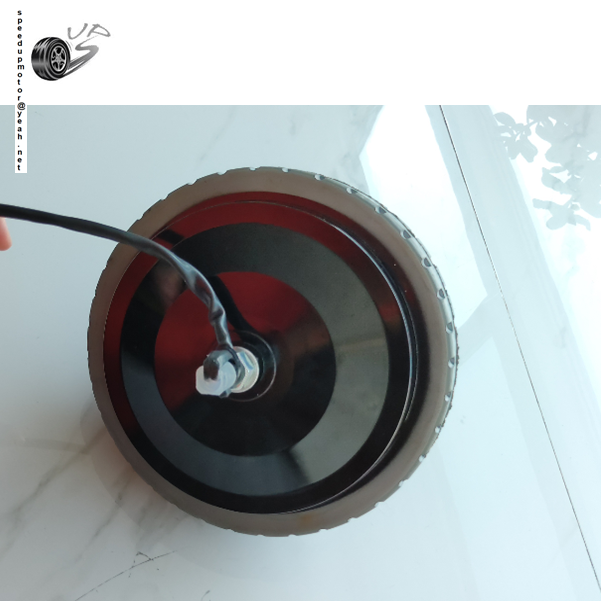
Compact hub drive wheels: in an assist drive, the gear reduction and the brake are packaged inside the wheel envelope, which is why the wheel size is part of the acceptance criteria rather than a housing detail.
The constraint profile comes before the certificate
Medical assist drives are not general-purpose motion applications, and the constraints that define them are what the acceptance criteria must be built around. Speedup's published application profile for medical equipment lists low-to-medium speed operation, frequent start-stop cycles under high load, humid environments, and a stated 24/7 operating mode, with markets named as Germany, the Czech Republic, the Netherlands, the United States and the United Kingdom.
That profile translates into specific requirements the drive has to satisfy, and each one has a matching document or test item:
- Low speed with high torque at the wheel. Torque is delivered through a reduction stage, so the acceptance document must state the reduction ratio together with the rated speed and rated torque at which the figures apply.
- Small wheel diameter. In an integrated hub drive the wheel diameter and tyre specification are fixed by the motor model, so wheel size belongs in the specification, not in the mechanical drawing set.
- Brake behaviour. The application profile calls out brake commissioning and safety-distance control as special requirements, which means brake type, holding performance and release characteristics must be agreed per model.
- Condensation and humidity. Humid operating conditions require an agreed protection approach; where an ingress-protection rating is published for a model, that rating — not a general statement about the factory — is the acceptance reference.
- Electromagnetic compatibility. The profile lists EMI grounding as a special requirement, which is a system-level concern spanning motor, controller, cable routing and chassis bonding.
- Mechanical interface. Custom shaft and dual-shaft output options, plus voltage and power variants, mean the delivered unit may differ from the catalogue example in ways that must be frozen in writing.
Notice what this list does not contain: a requirement that the supplier be “certified” in the abstract. Each constraint resolves to a named parameter, a named document or a named test. That is the difference between an acceptance criteria process and a logo check.
What 100,000 units over ten years establish — and what they do not
The field record establishes something that bench data cannot: a serial programme has been running at volume, in three named markets, across a decade, with a reported outcome of stable operation. For a buyer evaluating a first or second production order, that is meaningful evidence of manufacturing consistency — the supplier has shipped a four-figure-plus annual volume into medical equipment channels and the programme continued.
The same record, read precisely, does not establish a failure rate. The case documentation states quantity, destination countries, duration, application and outcome; it does not publish MTBF, annual field-return rates, the duty-cycle distribution actually experienced in service, the ambient and humidity envelope of the installed base, or whether a single model code was used continuously for ten years or a family of variants. Those are the numbers a reliability engineer would want, and they are a legitimate subject for a document request rather than an assumption.
There is also a category distinction worth keeping visible. The record describes a customer programme: a medical equipment manufacturer's assist drive application. It is not an independent third-party reliability audit, and it is not a medical device approval. Motors are components; the conformity of the assembled assist device is held by the device manufacturer. Blurring that line is one of the more common errors in supplier evaluation packs, and it is easy to avoid by labelling the evidence correctly in the qualification file.
The follow-up questions that turn a headline into evidence
- Which model codes were shipped in each year of the ten-year period, and in what proportion?
- What were the annual volumes, and does the reported 100,000 units refer to one drive variant or to a family?
- What field-return or repair data exists, and against what denominator?
- Which markets received which variants, and were installation conditions materially different between them?
- What spare-parts history exists for the same period, since parts consumption is an independent indicator of service activity?
None of these questions invalidates the record. They are how a buyer converts a strong headline into a defensible qualification file, and a supplier that has genuinely run the programme for a decade can normally answer them in a short document rather than a slide.
Reading a certificate the way an auditor reads it
Two EU certificates appear in Speedup's current documentation, and both illustrate why scope matters more than the CE mark itself. The RoHS certificate, number M.2025.206.C130289, was issued by UDEM Uluslararısı Belgelendirme Denetim Eğitim Merkezi San. ve Tic. A.Ş. under Directive 2011/65/EU and EN IEC 63000:2018, with an issue date of 26 November 2025 and validity to 25 November 2030. Its stated scope is “DC Motor” for the EU market.
The EMC certificate, number M.2026.206.C138410, was issued by the same body under the 2014/30/EU Electromagnetic Compatibility Directive, Annex II, citing EN IEC 61000-3-2:2019/A2:2024, EN IEC 61000-3-3:2013/A2:2021, EN IEC 61000-6-1:2019 and EN IEC 61000-6-8:2020. It was issued on 14 April 2026 and remains valid to 13 April 2031.
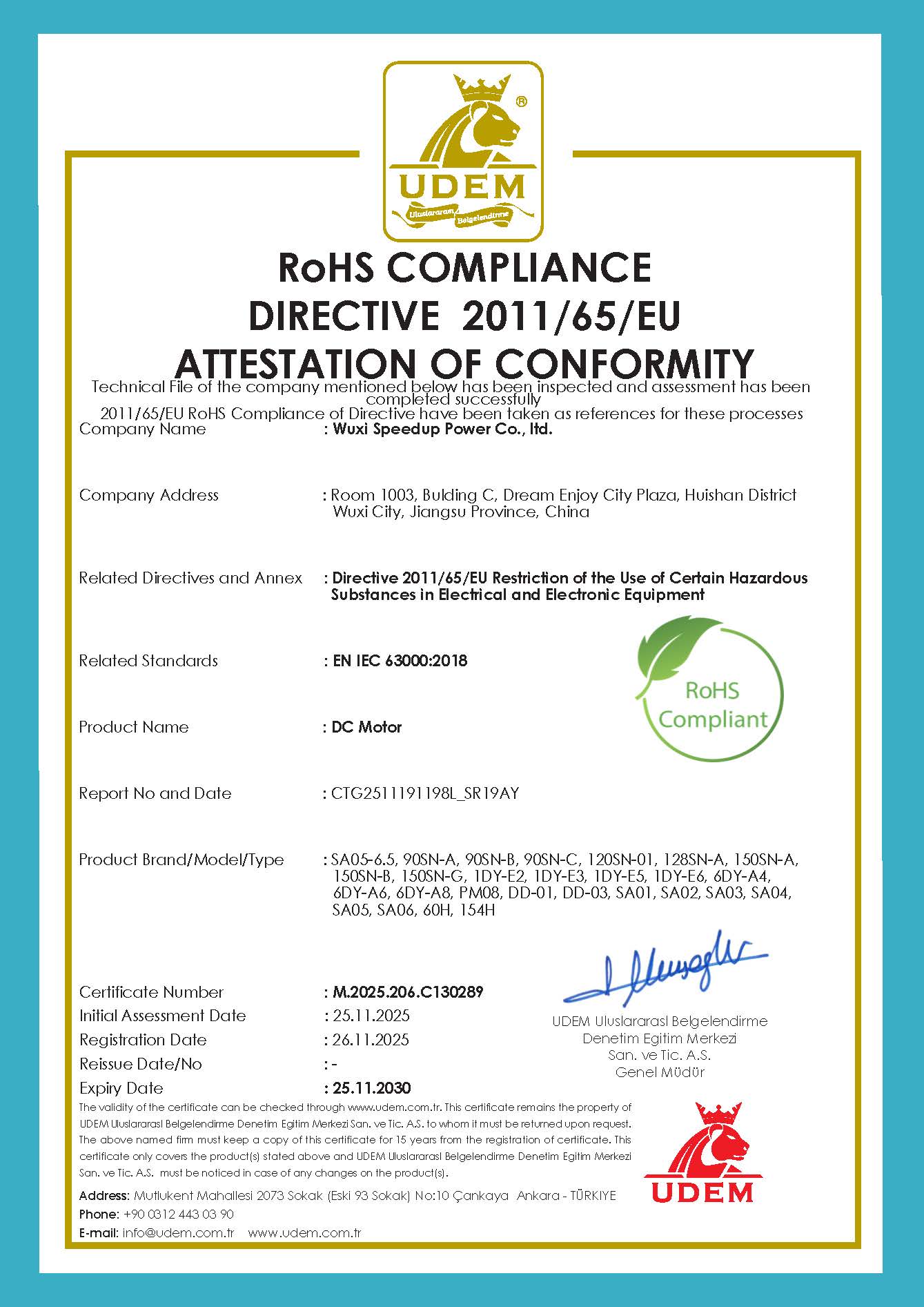
A certificate number, an issuing body, a standard version, an issue date and an expiry date are the five fields a buyer can verify. A logo alone is none of them.
Both certificates carry a covered-product list rather than a single model reference. The listed products include the 1DY-E5S and 1DY-E5A 8-inch wheel hub motors, the 6DY-A4 12-inch wheel hub motor, the 6DY-A and 6DY-A1 hub motors, the SA05 and SA06 spoke and 12-inch brushless hub motors, the SA05-6 6.5-inch wheel hub motor, and the 150SN-A, 150SN-B, 150SN-G2, 128SN, 120SN, 90SN-B and DD03 pancake and printed-armature motors. For a medical assist project that depends on a small wheel, the relevant point is that the 6.5-inch SA05-6 appears on the covered-product list of both documents — the model-level link an evaluator is looking for.
Three limits every certificate carries
First, scope is not performance. A RoHS certificate confirms substance-compliance documentation for a declared product scope. It says nothing about torque, service life or brake behaviour, and it should never be filed as evidence of capability.
Second, a motor-level EMC certificate does not clear the finished device. The EMC of an assembled assist device depends on the controller, the cable routing, the grounding concept and the enclosure as much as on the motor. The serious reading is that the certificate removes one variable from a system-level test programme — it does not replace it.
Third, validity dates create a maintenance obligation. A document valid to November 2030 and another to April 2031 will both need renewal during a typical multi-year device lifecycle. Build the renewal check into the supplier review cycle instead of discovering it during a customer audit.
Freezing the parameters that the certificate does not cover
Between the certificate and the purchase order sits the specification, and this is where most of the negotiating effort belongs. For a hub drive, the parameters that must be frozen are consistent across the published models: rated voltage, rated power, rated speed, rated torque, wheel diameter, tyre type, reduction ratio, brake type, load rating, shaft configuration and unit weight.
Speedup's published model blocks show how those parameters present themselves. The 1DY-E5A is an 8-inch brushed DC wheel hub motor with a 210 mm wheel, rated at 24V, 300W and 100 rpm, with a rated torque of 30 Nm, a 1:20 reduction ratio, an electromagnetic brake, a stated load range of 80–300 kg and a unit weight of 5.5 kg. The 6DY-A4 is a 12-inch brushed DC hub motor with a 305 mm wheel, rated at 24V, 200W and 70 rpm with a 1:40 reduction ratio, electromagnetic brake and single-shaft configuration. On the brushless side, the company's published profile describes the SA06 12-inch hub motor at 24V, 300W, 150 rpm with a 1:4.5 reduction ratio, an IP54 rating and a stated load range of 80–300 kg.
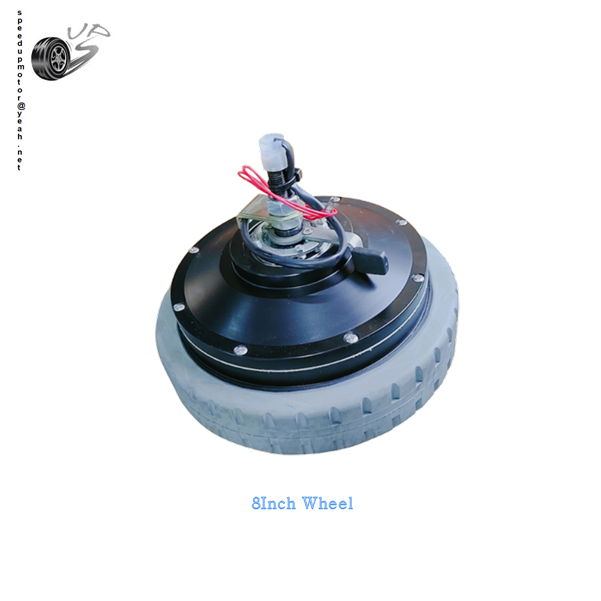
An integrated hub drive such as the 1DY-E5A combines motor, 1:20 reduction and electromagnetic brake in one wheel assembly — three subsystems that each need their own acceptance line.
Read those three blocks together and a design logic becomes visible. The 12-inch brushed model reaches 70 rpm through a 1:40 reduction; the 8-inch brushed model reaches 100 rpm through 1:20; the 12-inch brushless model reaches 150 rpm through 1:4.5. Wheel torque, wheel speed and reduction ratio move together, which is why a buyer who specifies only “high torque” has specified nothing usable. The acceptance document should state the duty point: continuous or intermittent, ambient temperature, duty cycle, and the loading assumed for the stated load range.
From criteria to purchase-order language
The practical output of this analysis is a document schedule attached to the RFQ. The table below maps each acceptance criterion to the artefact that satisfies it, what the artefact actually establishes, and the gap that most commonly appears in supplier packs.
| Acceptance criterion | Artefact to request | What it establishes | Common gap |
|---|---|---|---|
| Model identity | Datasheet and outline drawing carrying the model code and the frozen ratings | That the configuration being bought is a defined product | Family brochure with a “custom” footnote where the numbers should be |
| Environmental conformity | RoHS certificate number, issuer, standard version, validity dates, covered-product list | Substance compliance for the declared scope | Valid certificate whose covered-product list excludes the ordered model |
| EMC conformity | EMC certificate with the cited EN standards and validity dates | Motor-level EMC basis for the device test programme | Certificate presented as clearance for the assembled device |
| Field evidence | Programme reference: models shipped, annual volumes, markets, duration, reported outcome | Serial production experience in a comparable duty | Aggregate quantity with no model identity or duty description |
| Production control | Statement of 100% unit testing plus the test item list and limits | Unit-level screening before shipment | “100% tested” with no parameter or limit disclosed |
| Configuration control | Written change record covering voltage, power, speed, torque and shaft | Traceability of the exact build from sample to serial supply | Verbal agreement on a custom shaft or winding |
| Commercial continuity | Stated MOQ, lead time, capacity basis, warranty and spare-parts route | Planning feasibility for the second and third order | Capacity figure with no period (monthly or annual) and no model reference |
On commercial terms, Speedup's published position is an MOQ of one unit, a lead time of 30–45 working days, OEM/ODM customisation across voltage, power, speed, torque, shaft and logo, and 100% unit testing. The company also publishes a six-part after-sales scope covering warranty service, remote fault diagnosis, installation and commissioning instructions, original spare parts, repair and replacement, and ongoing online technical support. Unit price is configuration-dependent and is not addressed here; it belongs in the quotation response against a frozen specification, not in a benchmark table built from unlike build levels.
Application fit: where a compact hub drive earns its place
The strongest argument for a hub drive in medical and mobility equipment is spatial. A hospital transport bed drive wheel, for example, has to deliver tractive effort from a wheel that is already constrained by floor clearance, chassis geometry and the need to be manoeuvred in patient areas. Putting the motor, the reduction stage and the electromagnetic brake inside that wheel removes a separate transmission path and its alignment work from the frame.
Speedup's application record for medical equipment names hospital bed wheel drive as a project type, with gearboxes, electromagnetic brakes, controllers and wheel assemblies as matched equipment, and with custom shaft or dual-shaft outputs and multiple voltage and power levels among the stated requirements. Adjacent records in the same portfolio show the pattern repeating under different constraints: a medical bed factory in the Czech Republic supplied with 3,000 units over more than ten years with stable operation, and a wheelchair programme of 3,000 units across the Netherlands, Germany, Australia, Denmark and the United States over ten years, where the documented advantages were an integrated brake with electromagnetic clutch supporting manual clutch operation, and low-speed running with good commutation behaviour.
Those adjacent records matter for a buyer because they show the same drive family being applied to different device classes with different duty expectations. They do not, however, transfer evidence between programmes. A wheelchair duty cycle is not a hospital bed duty cycle, and the fact that a model appears in both portfolios is an indicator of breadth, not proof of fit in a third application.
Integrated hub drive versus pancake motor with gearbox
When a project needs low-speed, high-torque output in a small wheel, two documented routes exist inside the same supplier portfolio, and they should be compared on criteria rather than on preference.
The integrated hub route packages motor, reduction and brake inside the wheel. The 1DY-E5A delivers its 100 rpm and 30 Nm through a 1:20 reduction in a 210 mm wheel; the 6DY-A4 reaches 70 rpm through 1:40 in a 305 mm wheel. The criteria it satisfies best are envelope economy, elimination of a separate transmission, and a self-contained brake. Its boundary is that wheel diameter and tyre specification are fixed by the model — change the wheel and you change the drive.
The pancake motor plus gearbox route keeps the motor inside the chassis and drives the wheel through a separate transmission. The documented pancake models illustrate the trade: the 150SN-G2 geared pancake motor is rated 36V, 500W, 240 rpm and 22 Nm in a 151 mm diameter body; the 90SN-B printed winding motor is 120 mm in diameter and 17 mm thick; the 150SN-A and 150SN-B are 151 mm diameter and 35.4 mm thick. The criteria this route satisfies best are axial compactness at the motor, freedom to select the wheel independently, and service access to the motor without removing a wheel assembly. Its boundary is the transmission itself: additional parts, additional alignment, additional points of wear.
Neither route is universally superior, and a supplier comparison that declares a winner without matching the duty point, the wheel constraint and the service concept is not a comparison. What a buyer can legitimately do is specify the criteria — envelope, wheel coupling, transmission part count, brake integration, service procedure — and require documented evidence against each one.
Market context: why the sub-750 W band matters
Grand View Research estimated the global brushless DC motor market at USD 22.2 billion in 2025 and USD 23.6 billion in 2026, projecting USD 38.4 billion by 2033, and reported that motors with output not exceeding 750 W accounted for 48.8% of global BLDC market revenue in 2025. On the trade side, the 2026 US Harmonized Tariff Schedule line 8501.31.20.00 covers DC motors of output not exceeding 750 W, which is the classification band most compact assist drives fall into.
The interpretation has to stay inside the scope of the data. Those figures describe the BLDC motor market as a whole, not medical assist drives, and they measure revenue rather than unit reliability or clinical suitability. What they do support is a narrower, useful point for procurement: the power band where compact assist drives sit is the largest revenue segment of that market, which is consistent with the depth of standard platform options available and with the availability of model-level documentation such as the certificates discussed above. They do not support any claim about a specific supplier's share, and they say nothing about which drive will suit a given device.
What changes over the next qualification cycle
Two developments follow from the evidence rather than from forecast. The first is documentary: certificate validity dates in this record run to November 2030 and April 2031, which means a device programme launched now will cross at least one renewal cycle, and buyers who treat certificates as permanent artefacts will be managing a gap later. Building a renewal checkpoint into the supplier review is a low-cost control.
The second is architectural. As assist devices become more compact, more of the drive function migrates into the wheel, and the acceptance criteria migrate with it — wheel diameter, brake behaviour and load range become motor specifications rather than mechanical drawing notes. For suppliers, that shifts the competitive burden toward documentation: a covered-product list that names the exact model, a field record with a programme reference, and test statements with disclosed limits. For buyers, it makes the specification review the highest-value hour in the sourcing process. Both statements are conditional on the project's own duty profile; neither predicts a specific market outcome.
Frequently asked questions
What does “10 years of stable operation” actually verify about a DC motor?
It verifies that a serial programme ran for a decade at volume with a reported outcome of stable operation, which is evidence of manufacturing consistency and programme continuity. It does not publish a failure rate, MTBF, duty-cycle distribution or test conditions, and it is a customer programme record rather than an independent reliability audit. A buyer should treat it as a strong screening signal and then request model mix, annual volumes, field-return data and service-parts history to complete the qualification file.
Can a motor certificate be applied to a custom configuration?
Only if the configuration is inside the certificate's scope and covered-product list. The RoHS certificate M.2025.206.C130289 and the EMC certificate M.2026.206.C138410 both declare the scope “DC Motor” for the EU market and list covered products including the SA05-6 6.5-inch hub motor, the 1DY-E5A and 1DY-E5S 8-inch hub motors, the 6DY-A4 12-inch hub motor and several pancake models. A change of winding, shaft or brake variant should be checked against that list and, where necessary, confirmed in writing by the supplier before the purchase order is released.
Which documents should a medical assist drive buyer request first?
A model datasheet and outline drawing carrying the frozen ratings; the environmental and EMC certificates with numbers, issuers, standard versions and validity dates; confirmation that the ordered model appears on the covered-product list; the 100% test item list with limits; the field-evidence programme reference including models, volumes, markets and duration; and the commercial terms covering MOQ, lead time, warranty and spare-parts route. Device-level regulatory documentation for the assembled assist device is a separate request and is not covered by component certificates.
How is low-speed, high-torque performance in a small wheel verified?
By specifying the duty point rather than the adjective. The acceptance document should state the required wheel speed, the required wheel torque, the reduction ratio at which those figures apply, the wheel diameter and tyre type, and whether the rating is continuous or intermittent. Published model blocks give the reference format: the 1DY-E5A at 24V, 300W, 100 rpm, 30 Nm through 1:20 in a 210 mm wheel; the 6DY-A4 at 24V, 200W, 70 rpm through 1:40 in a 305 mm wheel. Verification then means confirming the delivered unit meets those values at the agreed conditions.
What changes when the drive is supplied as an OEM or ODM configuration?
The customisation scope widens to voltage, power, speed, torque, shaft and logo, so the acceptance burden shifts from product selection to configuration control. The practical additions are a written change record for every deviation from the catalogue model, agreed sample approval before serial release, and a restated certificate-scope check after any change to winding, brake or shaft. Published commercial terms for this route are an MOQ of one unit and a lead time of 30–45 working days, with 100% unit testing applied in production.
The acceptance file in one page
A medical assist drive qualification reduces to four artefacts held together: a frozen specification that names the model, the wheel and the duty point; a certificate set whose scope and validity dates cover that model; a field record with enough programme detail to be interrogated; and a test statement with disclosed limits. The 100,000-unit, ten-year, three-market medical assist programme documented by Wuxi Speedup Power Co.,Ltd supplies the third of those convincingly and the first two verifiably; the fourth is a document request rather than a claim, which is exactly where a serious buyer starts.
For evaluation teams building that file, the company's catalogue and company documentation can be reviewed directly: SPEEDUP company brochure (PDF). Supplier details are published at www.upsmotor.com.
Have Questions or Need More Details?
Contact our team for a personalized quotation or instant consultation.
Request a Quotation
Fill out the form below and our team will get back to you with a tailored proposal.
WhatsApp Direct Chat
Prefer to chat in real-time? Message us on WhatsApp for instant assistance & quick answers.
- Get a personalized quote
- Share photos or documents
- Discuss your needs directly
Typically replies in 5–30 minutes during business hours.