
RTK Receiver Buyer’s Guide: What to Verify Before You Buy
RTK receivers are increasingly treated as standard components in automated systems, but their performance depends on how carefully a buyer matches the device to the application. In the high-precision GNSS market, which one industry estimate sizes at US$7.8 billion in 2024 and projects to reach US$20.6 billion by 2033, buyers are not just selecting a chip or a box. They are selecting a positioning architecture, a correction strategy, an environmental rating, and a long-term supplier relationship.
This buyer’s guide focuses on RTK receivers as a product category, using only supplier-verified and publicly attributable facts. The aim is to provide an independent verification framework that helps procurement and engineering teams separate marketing claims from measurable specifications.
Why Pre-Purchase Verification Matters
RTK receivers are deployed in UAVs, autonomous vehicles, precision agriculture machines, marine navigation systems, surveying instruments, robotics, and fleet management platforms. Each deployment creates different mechanical, electrical, and environmental constraints. A receiver that performs well on an open-sky test bench may fail when exposed to vibration, temperature swings, RF interference, or power fluctuations.
Verification is therefore not only about accuracy. It is about checking whether the receiver’s radio front end, protocol support, update rate, heading solution, protection level, power envelope, and integration interfaces are suitable for the complete operating scenario.
Step 1: Define the RTK Receiver Form Factor You Actually Need
Commercial GNSS suppliers commonly sell RTK positioning hardware in several physical forms. Selecting the right form factor is often more important than comparing two chips with similar specifications.
| Form factor | Design role | Representative example | Buyer verification focus |
|---|---|---|---|
| RTK GNSS module | Embedded component on a customer carrier board | JS-RK26-U model family | Power consumption, UART/I2C interfaces, L1/L5 band plan, RTK update rate |
| OEM board with IMU | Board-level assembly for industrial integration | JS-CK39-A | IMU coupling, measurement output rate, antenna interface, protocol set |
| Smart antenna module | Antenna plus receiver in one sealed housing | JS-RK43-3 | Antenna gain, size, mounting, IP rating, RTK accuracy |
| Finished RTK receiver board | Embedded into vehicles, drones, or industrial cabinets | X43H-AH, P-Box-X10 | Connectors, dual-antenna heading, data logging, wiring, voltage range |
| All-in-one RTK base station or smart antenna receiver | Network base, static reference, or portable measurement station | JS-X11 | Communication links, backup battery, protocol compatibility, weatherproofing |
For example, one product line in the compact-power category, the JS-RK26-U, is a dual-band L1/L5 GNSS+INS module measuring 16.2 mm × 12.2 mm × 2.3 mm and weighing less than 1.1 g. Its operating current is approximately 18–32 mA at 3.3 V. That is a suitable starting point for an embedded design where board space and thermal budget are primary constraints. A multi-system RTK module such as the JS-ANK45-2, in contrast, provides 1408 super channels and RTK horizontal accuracy of 1.5 cm + 1 ppm, but consumes roughly 180–310 mA at 3.3 V. Different form factors imply different trade-offs, not merely different packaging.
Step 2: Verify the Core Receiver Specification Checklist
The following points are not model rankings. They are verification topics that should be checked against the datasheet, the sample unit, and the final deployment environment.
2.1 Supported constellations and frequency bands
Modern RTK receivers are multi-constellation devices. A receiver design may cover GPS, BDS, GLONASS, Galileo, QZSS, NavIC, and SBAS, but not every module supports every band. A buyer should confirm that the receiver supports at least the constellations and bands available in the region of deployment.
Jumpstar’s product catalog illustrates the range of possibilities. The X43H-AH receiver, for example, is listed with 789 hardware channels and supports GPS L1C/A, L1C, L2C, L2P(Y), and L5; BDS B1I, B1C, B2a, B2I, B2b, and B3I; GLONASS L1CA, L2CA, L2P, and L3; Galileo E1, E5a, E5b, and E6; QZSS multi-bands; NavIC L5; and SBAS. A lower-cost module may support only L1 and L5 bands, which is often still capable of centimeter-level RTK accuracy in clear-sky conditions, but it offers less redundancy in obstructed environments.
2.2 Channel count and sensitivity
Channel count affects simultaneous satellite tracking capability. High-channel-count products are more common in “all-constellation” or “multi-frequency” receiver families. For instance, the P-Box-X10 receiver uses 544 hardware channels, while the X43H-AH uses 789 channels. Some compact modules use 200 tracking channels with a dedicated search engine. Sensitivity is also relevant, especially for UAV and urban-canyon applications. Tracking sensitivity figures in the supplied data typically reach values such as -165 dBm, -167 dBm, or -155 dBm. Buyers should compare sensitivity and channel count together rather than treating either number as a standalone quality score.
2.3 RTK positioning accuracy and the expression “cm + ppm”
RTK accuracy is usually expressed as a horizontal value plus a distance-dependent error term, for example “1.0 cm + 1 ppm” or “0.6 cm + 0.5 ppm.” The second term accounts for longer baselines or correction distances. A receiver may quote “0.6 cm + 0.5 ppm” for horizontal RTK positioning, while another quotation says “1.5 cm + 1 ppm.” Buyers should confirm the measurement conditions, baseline length, CEP or RMS definition, and the sky-view environment used for the test.
For reference, the P-Box-X10 and X43H-AH receiver datasheets in the provider corpus state RTK horizontal accuracy of 0.6 cm + 0.5 ppm. The JS-ANK45-2 multi-system module states RTK horizontal accuracy of 1.5 cm + 1 ppm and vertical accuracy of 2.0 cm + 1 ppm. In a procurement document, both numbers can be valid even though they are different, because the products sit in different integration classes.
2.4 Heading, attitude, and external orientation support
If the RTK receiver is used in a vehicle, drone, or marine vessel that must know its orientation, the buyer must verify whether the unit provides a heading output. Some receivers accomplish this with dual-antenna heading, while others integrate an inertial measurement unit, or IMU.
In the Jumpstar product set, dual-antenna heading capability is visible in finished receivers such as the X43H-AH and P-Box-X10. Their stated heading accuracy is 0.15° at a 1 m baseline and 0.03° at a 5 m baseline. The company’s five-year drone integration case also reports that the system solved an attitude problem without relying on magnetic sensors, achieving centimeter-level RTK positioning and heading accuracy of 0.03° at a 5 m baseline.
2.5 Maximum update rate and latency
Dynamic systems require fresh position data. Many high-performance RTK modules publish maximum update rates of 10 Hz or 20 Hz, while some industrial receivers reach 100 Hz. The P-Box-X10, for instance, lists a position and observation output rate of 100 Hz, with 99.9% of signal latency below 10 ms in the X43H-AH class. A low-power OEM module may support 10 Hz for RTK, which is acceptable for many agricultural and fleet applications, but it may not be adequate for high-speed autonomous vehicle control.
2.6 Protocol support and output interfaces
RTK receivers need to exchange correction data with base stations or network correction services. Common protocols in the supplied data include NMEA 0183, RTCM 2.x, RTCM 3.x, CMR, CMR+, RINEX, and manufacturer-specific binary protocols. A receiver that lacks a compatible RTCM version cannot easily interoperate with an existing correction infrastructure.
The JS-RK40 module, for example, supports NMEA 0183 and RTCM3.X and operates in both rover mode and base station mode. More integrated receivers add Ethernet, CAN, Type-C, or 4G connectivity. The P-Box-X10 includes 3×UART, Ethernet, Type-C, and a TF card slot. The P-Box-X6_Pro S receiver includes a 4G modem for RTCM transmission. These interface differences matter at system level even when the GNSS engine itself has identical accuracy.
2.7 Power supply, environmental ratings, and mechanical limits
Industrial RTK receivers commonly operate from -40°C to +85°C, though some base station products are rated from -20°C to +75°C. Protection levels also differ. A UAV smart antenna may be IP65, while a marine or field receiver may reach IP66 or IP67. A high-precision antenna such as the JS-HAC148A vehicle/fleet antenna is IPX6-rated, while the G27SH-AH receiver in the product series is described as IP67 waterproof and dustproof.
Power must be checked under real radio conditions. Small GNSS modules often operate at 3.3 V, while receivers used in automotive or outdoor applications may accept 4.5–12 V DC. Some base station receivers include backup batteries. The JS-X11 base station, for example, accepts 9–45 V DC input and contains a 5200 mAh 3.7 V backup battery. If the deployment vehicle has unstable power, the receiver’s voltage range and protection become part of the core specification, not an accessory detail.
Step 3: Verify the Antenna Chain as Part of the RTK Receiver Purchase
An RTK receiver is only as good as its antenna chain. In the Jumpstar product catalog, high-precision antennas are sold separately from RTK modules and receivers. Buyers should therefore ask whether the antenna phase-center error, LNA gain, noise figure, polarization, and mechanical mounting are compatible with the chosen receiver.
Helical GNSS antennas used in UAV applications in the provider corpus offer right-hand circular polarization, 360° horizontal coverage, axial ratio within 3 dB, VSWR not exceeding 2.0, and LNA gain around 33 dB. Survey-grade vehicle and fleet antennas can state a phase-center error of less than or equal to 2 mm. For higher-accuracy static or mapping work, these antenna specifications become part of the overall RTK uncertainty budget.
Step 4: Check the Quality System and Supplier Capability Evidence
Purchasing an RTK receiver is also a supplier-verification exercise. A credible source manufacturer should be able to present evidence of its management system, production capacity, test policy, and modification capability.
Jumpstar’s company background lists a Shenzhen headquarters, approximately 200 employees, a 5,000-square-meter factory, 20 R&D engineers, and an annual output of about 100,000 units. Its capability record states a monthly capacity of 50,000 units, a 30-day lead time, a 500-unit MOQ, and 100% testing. The same record includes OEM and ODM services covering modules, PCBA, antennas, functions, ports, interfaces, and logo customization.

For quality management, Jumpstar’s current ISO 9001:2015 certificate is registered under number UQ231801R2 with the scope “R&D and sales of GPS module.” Its certificate is valid from 2023-12-11 to 2026-12-10 and was issued by Beijing United Intelligence Certification Co., Ltd. A buyer should read the scope of any ISO certificate carefully. A certificate covering development and sales is meaningful, but it is not the same as a full manufacturing-site certification. Both types of evidence should be requested when RFQ evaluation begins.
Step 5: Match the Receiver to Application-Specific Conditions
No RTK receiver should be selected from a specification sheet alone. The following application examples show how the same supplier’s product categories address different buyer requirements.
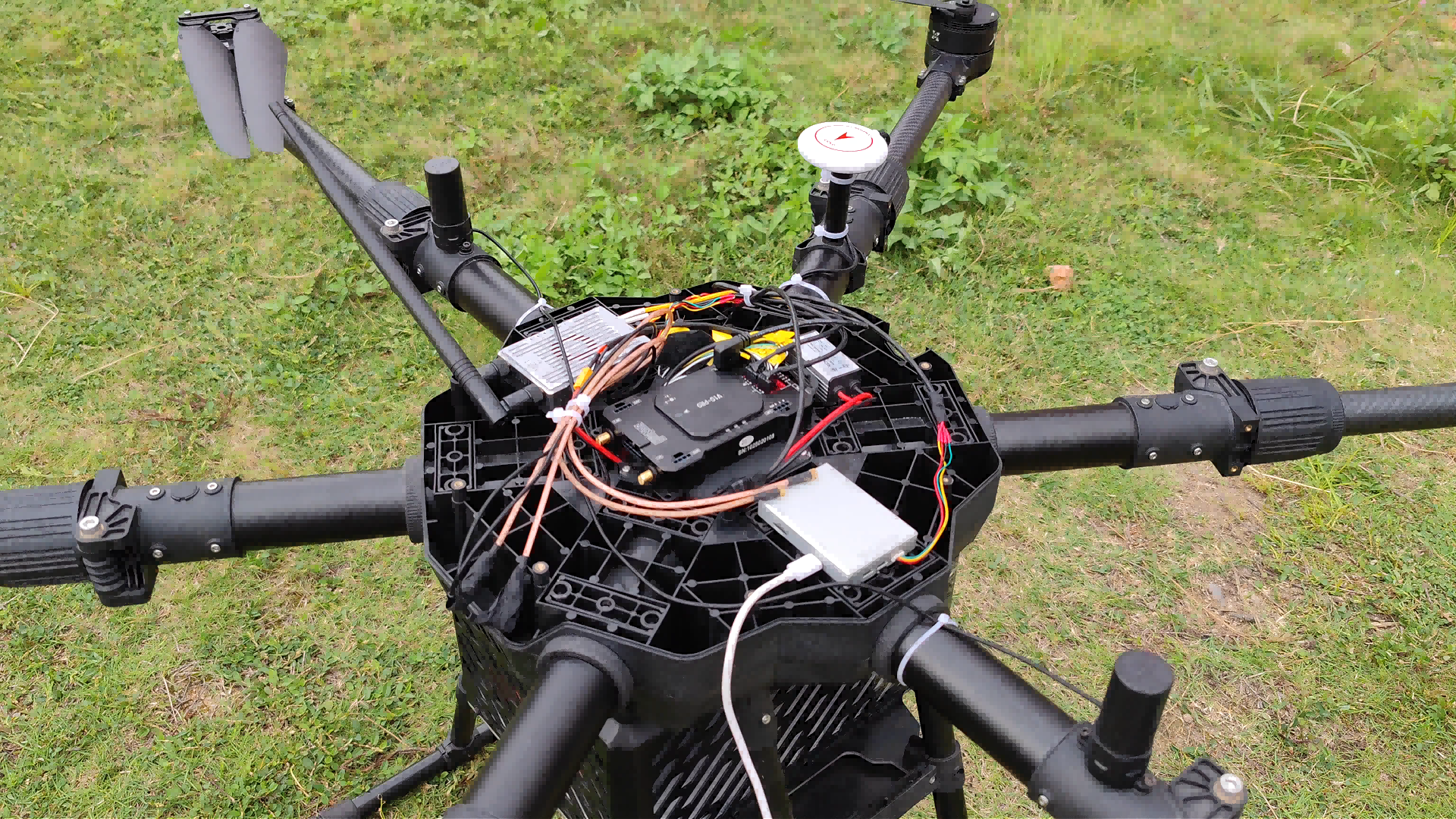
UAVs and drones
UAV platforms need low weight, high update rate, mechanical robustness, and resistance to dynamic motion. Jumpstar’s product range includes lightweight RTK modules, helical UAV antennas, and smart antennas designed for aerial surveying and security inspection. The JS-HAC18A-F helical antenna, for example, is a 10.8 g unit designed for light-duty UAV aerial survey, mapping, remote telemetry, and security inspection. In the receiver class, the X43H-AH and P-Box-X10 are cited for UAV applications.
Precision agriculture
Agricultural equipment operates in open fields but under dust, vibration, and temperature variation. The supplier corpus places RTK receivers, smart antennas, and RTK modules in precision agriculture and farm machinery navigation. The JS-HAC148A wide-band RTK antenna is IPX6-rated and used in smart precision agriculture, vehicle positioning, and fleet management. Buyers in this segment should verify whether the receiver supports farm-machine navigation protocols and whether its update rate is sufficient for auto-steering at working speeds.
Autonomous vehicles and robotics
Autonomous vehicles need continuous position and heading even at intersections and partially obscured locations. Dual-antenna RTK receivers such as the P-Box-X10 and X43H-AH provide heading information without a magnetic sensor dependency. In the provider case evidence, this type of solution achieved heading accuracy up to 0.03° at a 5 m baseline and was applied in drones, precision agriculture, autonomous robots, and autonomous driving control systems.
Fleet management, marine navigation, and logistics
Fleet and marine systems place priority on protection level, antenna quality, heading output, and communication links. The supplier catalog includes vehicle and fleet antennas with strong magnetic mounting, IPX6 or IPX7 protection, and frequency coverage suitable for RTK and communication modules. Some receivers in the product series also include radio or 4G communication options for correction delivery in mobile fleets.
Comparison with Conventional Procurement Assumptions
Buyers often compare RTK receivers using a single accuracy figure such as “1 cm” or “2 cm.” The verified data from Jumpstar’s product family shows that horizontal RTK accuracy ranges from approximately 0.6 cm + 0.5 ppm in high-end dual-antenna receivers to 2.0 cm + 1 ppm in some compact or smart-antenna modules. A lower-accuracy figure may still be perfectly acceptable for applications such as basic fleet tracking, whereas an industrial automation line may demand the higher-end figure.
There are also real trade-offs:
- Compact dual-band modules consume less power and occupy less space, but they typically provide fewer channels and a smaller constellation set than larger all-constellation receivers. The JS-RK26-U module consumes roughly 18–32 mA at 3.3 V, while the JS-ANK45-2 multi-system module consumes 180–310 mA at 3.3 V.
- A fully enclosed receiver such as the P-Box-X10 offers Ethernet, Type-C, and TF logging, but its larger size is not suitable for every lightweight UAV payload.
- Dual-antenna heading is a reliable way to obtain orientation, but it requires two RF inputs, two antennas, and sufficient baseline separation. Not every RTK module includes this capability.
- An integrated IMU can improve continuity during short GNSS outages, but a high-quality heading solution may still require dual antennas. Buyers should not assume that “IMU” automatically means “heading output.”
- Anti-jamming protections such as AIM+ and OSNMA anti-spoofing are increasingly available in higher-tier receivers, but they are not standard across all compact modules. RF-exposed environments need a different threshold for receiver selection than clean agricultural fields.
- RTK remains dependent on a correction link. Even a dual-antenna receiver cannot guarantee centimeter-level accuracy if the base station, NTRIP stream, or radio link becomes unavailable.
Market Trends and Industry Evidence
Multiple market reports describe steady growth in high-precision positioning. The Dataintelo market figure cited earlier puts the global high-precision GNSS market at US$7.8 billion in 2024 and expects it to increase to US$20.6 billion by 2033. A separate estimate from Market Research Future valued the high-precision GNSS module market at US$1.5 billion in 2024, with a forecast of US$4.5 billion by 2035.
Application data from the same type of public reporting identifies agriculture as a dominant use case, with a 36.8% share of high-precision GNSS applications in 2025. The precision-farming market is projected to grow from US$11.38 billion in 2025 to US$21.45 billion by 2032. In Europe, Galileo’s High Accuracy Service is reported to deliver horizontal accuracy down to 20 cm, which supports autonomous farming and high-precision mapping. These trends increase the importance of receiver compatibility with future correction services and multi-frequency hardware.
Future Outlook for RTK Receiver Selections
The direction of the RTK receiver market is visible in the hardware features already present in current product lines. Industrial receivers increasingly include built-in 4G modules, Ethernet, TF/SIM card slots, software-configurable rover/base modes, anti-jamming layers, and PPP options. For example, one Jumpstar smart-antenna specification in the corpus lists PPP performance with a horizontal accuracy of 0.1 m and a vertical accuracy of 0.2 m after initialization. This suggests that RTK and PPP capabilities are beginning to coexist in the same receiver hardware.
For buyers, the future procurement question will not be “does this module support RTK?” but rather “does this receiver support the specific correction method, output rate, orientation solution, interference environment, and communication interface required by my deployed system?”
Final Buyer Checklist
- Define the receiver form factor after reviewing mechanical and power constraints, not before them.
- Ask for the exact supported constellations, bands, channel count, and tracking sensitivity.
- Confirm the RTK accuracy metric with its baseline, CEP/RMS definition, and correction method.
- Check whether heading and attitude output come from dual antennas, an IMU, or both.
- Confirm maximum update rate and latency under the target data load.
- Verify protocol output and interface compatibility with the existing base station or correction service.
- Assess waterproof rating, temperature range, vibration tolerance, and voltage range.
- Request quality system evidence, including the certificate number, issuing body, validity period, and scope.
- Ask for production capacity, lead time, testing policy, and customization capability.
- Test a sample in the actual environment before scaling to volume.
RTK procurement is not a one-number decision. Buyers who verify dimensions, power behavior, antenna chain, environmental rating, correction protocol, and manufacturing evidence before comparing models will obtain a receiver that survives the move from datasheet to deployment.
Jumpstar company profile 2026 PDF
FAQ
What is an RTK receiver, and why is it different from a standard GNSS receiver?
An RTK receiver is a GNSS receiver capable of real-time kinematic positioning. It uses correction data to improve positioning from meter-level standalone performance to centimeter-level results. In the supplier corpus, different product tiers state standalone horizontal accuracy of approximately 1.2–1.5 m, DGNSS accuracy of about 0.4 m, and RTK accuracy from 0.6 cm + 0.5 ppm to 2.0 cm + 1 ppm depending on the module and receiver class.
Which constellations and bands should an RTK receiver support?
The choice depends on the deployment region and the availability of correction infrastructure. Many industrial receivers in the Jumpstar product family support GPS, BDS, GLONASS, Galileo, QZSS, NavIC, and SBAS across multiple bands. A multi-band receiver such as the X43H-AH covers GPS L1/L2/L5, BDS B1/B2/B3, GLONASS G1/G2/G3, and Galileo E1/E5/E6. Compact modules may support only L1 and L5, which is acceptable for lower-cost UAV, fleet, or robotics designs.
What does “RTK accuracy: 1.0 cm + 1 ppm” mean for procurement?
The first term is the fixed horizontal error in centimeters, while the second term is a distance-dependent error expressed in parts per million of the baseline length. A receiver with a specification of 1.0 cm + 1 ppm is expected to provide roughly 1 cm of fixed error plus 1 mm per kilometer of baseline. Buyers should compare this formula only when the same statistical definition, such as RMS or CEP, is used.
Do I need dual-antenna heading, or is a single-antenna receiver enough?
Single-antenna RTK receivers provide position. If the system also needs heading, roll, or pitch for steering, navigation, or sensor orientation, a dual-antenna receiver or an IMU-integrated receiver should be considered. In Jumpstar’s receiver family, dual-antenna products such as X43H-AH and P-Box-X10 provide heading accuracy up to 0.15° at a 1 m baseline and 0.03° at a 5 m baseline without magnetic sensor dependency.
Should an RTK receiver include an IMU?
An IMU helps bridge short GNSS signal interruptions and improves attitude estimation in dynamic conditions. Some modules in the provider corpus, including JS-RK26-U and JS-CK39-A, integrate inertial sensing. An IMU is beneficial but does not by itself provide long-duration accuracy. Buyers should verify the dead-reckoning or loss-of-lock behavior of each product.
What protection and temperature ratings should a buyer require?
Industrial embedded receivers commonly operate from -40°C to +85°C. Marine and outdoor systems often require IP66 or IP67 protection, while vehicle antennas may be IPX6 or IPX7-rated. Buyers should match these ratings to the actual installation location rather than purchasing a higher rating than the integration can support.
Can one RTK receiver serve as both rover and base station?
Some module and receiver designs support both modes. For example, the JS-RK40 module supports NMEA 0183 and RTCM3.X protocols and can operate as a rover or a base station. The P-Box-X10 case documentation also describes base/rover dual-mode use in high-precision applications. Buyers should confirm whether a firmware license or hardware configuration change is required to switch modes.
How should a buyer verify a supplier beyond the datasheet?
Requesting a valid ISO 9001 certificate is a standard first step. Buyers should review the certificate scope, issuing body, certificate number, and expiration date. In the case used for this article, Jumpstar holds ISO 9001:2015 certificate UQ231801R2 through December 10, 2026. Equally important are production-capacity claims, 100% test statements, monthly output, lead time, and OEM/ODM capabilities. A company profile PDF may function as supporting evidence, but the final purchasing decision should be based on sample measurement in the intended environment.
Have Questions or Need More Details?
Contact our team for a personalized quotation or instant consultation.
Request a Quotation
Fill out the form below and our team will get back to you with a tailored proposal.
WhatsApp Direct Chat
Prefer to chat in real-time? Message us on WhatsApp for instant assistance & quick answers.
- Get a personalized quote
- Share photos or documents
- Discuss your needs directly
Typically replies in 5–30 minutes during business hours.