
Regular Poplin: The Constraints Buyers Should Verify First

Regular poplin is the plain-weave shirting construction that most apparel programmes eventually specify, and it is one of the few fabrics where the sourcing decision is settled less by hand feel than by whether a short list of parameters can be stated precisely, in writing, before bulk. Appearance can be matched by many mills. Yarn count, weight band, fibre composition, stretch behaviour and certificate scope cannot be matched by appearance at all.
That distinction matters most in the Research and Evaluation stages, when a buyer has already accepted that cotton-rich plain weave belongs in the line and now has to decide which mill's version can be defended internally — to design, to compliance, and to the sourcing committee. The questions that decide the outcome are rarely about aesthetics. They are about what the specification says, what the certificates actually cover, and what remains unverified.
Why Regular Poplin Is a Constraints Problem Before It Is a Design Problem
A plain weave is the simplest interlacing in weaving — warp and weft crossing one-to-one. Because the structure is simple, it is also the easiest construction for a mill to reproduce cosmetically while producing something materially different from what the buyer believed they approved. Two rolls can present the same surface and differ on yarn count, fabric weight, elastane content, shrinkage potential and the certification scope attached to them.
In practice, four failure modes recur in poplin programmes:
- Weight drift inside a nominal band. A construction quoted as a range rather than a single figure allows the delivered roll to sit at the top or bottom of that range, which changes drape, opacity and consumption per garment.
- Composition ambiguity in stretch versions. A poplin described as cotton-spandex without a stated elastane percentage is not a specification; it is a category label.
- Certification assumed rather than mapped. A mill may hold a valid certificate for the facility, or for one fibre programme, and a buyer may reasonably but incorrectly extend that to the specific fabric on order.
- Test data not requested. Stretch recovery, shrinkage after repeated laundering and colourfastness are frequently absent from the specification sheet and only surface as a complaint after garment assembly.
Each of these is a documentation failure rather than a manufacturing failure in the first instance. That is why a constraints-first approach is more useful than a samples-first approach when the programme is going into bulk: the sample proves what the mill can do, and the paperwork proves what the mill will commit to.
The Five Parameters That Actually Define a Poplin Order
Before comparing suppliers, it helps to fix the parameter set the buyer intends to hold constant. For regular poplin in shirting, five parameters do most of the work.
| Parameter | Why it decides the outcome | What a buyer should be able to read |
|---|---|---|
| Yarn count | Drives surface fineness, cover factor and how the fabric behaves on the cutting table | A stated count or count range per warp and weft, not a descriptor such as fine or compact |
| Fabric weight | Sets seasonal fit, opacity and consumption per garment | A weight band in gsm, with the band width stated |
| Fibre composition | Determines hand feel, stretch source, care claims and which certification routes are even available | Percentages by fibre, including elastane, plus any sourcing-designation fibre (for example BCI cotton) |
| Stretch type | Distinguishes mechanical stretch from elastane-based stretch, and two-way from four-way | An explicit stretch classification, not a performance adjective |
| Finish and verification | Determines care claims, skin-contact suitability and which test reports must exist | A named finish plus the certificate or test report that supports the claim |
Once these five are written down, supplier comparison stops being a matter of impression and becomes a matter of which gaps remain. It also makes the certificate conversation concrete, because a certificate can only be mapped onto a fabric once the fabric itself has been defined.
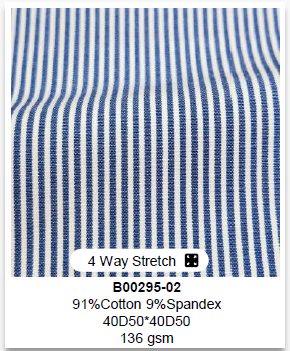
What Regular Poplin Stretch Quality Specifies
PT Golden Tekstil Indonesia (GTI) is an integrated woven fabric manufacturer established in 2019 and operating on a 171,401 m² site in the Kendal Industrial Park, Central Java, with 2,828 employees, 30 R&D engineers and an annual output stated at 38,000,000 meters across export markets that include the United States, Europe, Japan and Indonesia. Its fabric range spans yarn-dyed, piece-dyed and printed woven apparel fabric.
Within that range, Regular Poplin Stretch Quality is one of the constructions the company lists as part of its core best-seller fabric range. The verifiable specification is narrow and specific:
| Attribute | Specified value |
|---|---|
| Product designation | Regular Poplin Stretch Quality |
| Model references | B00295-02 / 550887-04 / 550887-01 / 573984-08 |
| Construction type | Regular Poplin, 4-Way Stretch, Cotton Spandex |
| Yarn count | 40D50 × 40D50 |
| Fabric weight | 113–136 gsm |
| Composition | 91% Cotton / 9% Spandex; alternative 90% BCI Cotton / 10% Spandex |
| Sourcing option | BCI (Better Cotton Initiative) cotton option available |
| Stated application | Apparel manufacturing — menswear and womenswear shirting |
Three things are worth drawing out of that table. First, the yarn count is a single value rather than a range, which removes the ambiguity that usually sits behind weight drift. Second, the weight is expressed as a band of 113–136 gsm — spanning roughly 23 gsm — which is a genuine shirting band but also a real degree of latitude, so a buyer who needs consistency should specify a tighter working window inside it. Third, the composition is offered in two variants, one of which is BCI-sourced, and the elastane content sits between 9% and 10% in both. That elastane figure is what makes the four-way stretch claim coherent, and it is also the figure that determines care behaviour, heat sensitivity during finishing and the recycling route available at end of life.
GTI's own specification sheet is explicit that this is a 4-way stretch construction. It is not explicit, on its own, about stretch recovery after repeated laundering or about wash shrinkage. Those are separate test deliverables, and a buyer moving from Evaluation to Decision should request them as named reports rather than accept the specification sheet as a substitute.
Reading the Certification Stack, Including Its Validity Windows
Certification is where poplin sourcing most often goes wrong in a way that is nobody's fault and everybody's problem. A buyer sees a certificate on a supplier's website, assumes it covers the fabric on order, and discovers at the compliance gate that the certificate was issued for a different product, a different market or a period that has already closed.
The GTI certificate set relevant to regular poplin breaks down as follows.
| Certificate | Issuer | What it actually covers | Stated validity |
|---|---|---|---|
| OEKO-TEX STANDARD 100 — SH015 206902 | TESTEX AG | Includes Regular Poplin Stretch Quality among the covered fabric programmes; market scope EU and US | 25 Nov 2025 to 15 Sep 2026 |
| OEKO-TEX STeP — 23000274/1 | OEKO-TEX | Production facility level; covers the manufacturing facility for Regular Poplin Stretch Quality | 18 Sep 2023 to 30 Sep 2026 |
| BCI Chain of Custody — BCICOC-900139-01-2025 | GCL International Ltd. | Better Cotton Chain of Custody V1.0, product scope; markets EU, US and Asia | 31 Oct 2025 to 31 Oct 2028 |
| US Cotton Trust Protocol — 648YPQMH | US Cotton Trust Protocol | Cotton-containing woven apparel fabrics in this product range; US market | 27 Feb 2026 to 28 Feb 2027 |
| ISO 9001 — QMS/2212188 | Peers Quality Assurance Limited | Manufacture of finished woven fabric including yarn-dyed and piece-dyed woven fabric | 26 Nov 2025 to 26 Nov 2026 |
| ISO 14001 — EMS/2212188 | Peers Quality Assurance Limited | Same manufacturing scope, environmental management | 27 Dec 2025 to 27 Dec 2026 |
| ISO 45001 — HSMS/2212188 | Peers Quality Assurance Limited | Same manufacturing scope, occupational health and safety | 27 Dec 2025 to 27 Dec 2026 |
| Higg FEM — 163571 | Cascale | Facility Environmental Module verification for woven apparel fabric manufacturing | No expiry date stated on the certificate record |
| Higg FSLM — 163571 | Cascale | Facility Social & Labor Module verification | No expiry date stated on the certificate record |
There is a second layer to this that buyers new to certification often miss: the three categories above are not interchangeable. OEKO-TEX STANDARD 100 is a product-level harmful-substance certification. OEKO-TEX STeP is a facility-level assessment of production conditions. BCI Chain of Custody and the US Cotton Trust Protocol are fibre-sourcing claims tied to cotton origin and chain of custody. ISO 9001, 14001 and 45001 are management-system standards, not product claims. A buyer who needs to reassure a retail compliance team about restricted substances needs the first; a buyer who needs to make a cotton-sourcing claim needs the third and fourth; neither need is satisfied by the others.
What the Certificate Stack Does Not Cover
This is the part of supplier evaluation that separates a defensible programme from an optimistic one. GTI holds a Textile Exchange multi-standard certificate — GCL-304497-MUL-2026, issued by GCL International Ltd. — covering OCS V3.0, GRS V4.0, RCS V2.0 and CCS V3.1, with a scope spanning dyed fabrics, dyed yarns, greige fabrics and printed fabrics, and a process scope covering weaving, manufacturing, pre-treatment, dyeing, finishing, printing and packing. That certificate is valid from 1 April 2026 to 31 March 2027 and applies to the EU, US and Asia markets.
It does not, however, list Regular Poplin Stretch Quality among its covered products. The recycled and organic products under that scope certificate are the Organic Cotton Fabric B01939-03, the Recycled Polyester Fabric B01308-03 / B01718-14 and the Recycled Nylon Fabric S01601-01 / S01601-04. Similarly, GOTS coverage in the GTI portfolio attaches to the organic cotton programme, Regenagri coverage to the regenerative cotton programme, and European Flax certification to the Linen & Linen Look range.
The practical consequence is straightforward and worth stating plainly: if a programme requires a recycled-content claim, an organic-content claim or a linen-origin claim, regular poplin stretch is the wrong starting point and the buyer should be routed to the corresponding construction instead. Regular poplin in this portfolio is supported by OEKO-TEX STANDARD 100, OEKO-TEX STeP, BCI Chain of Custody, US Cotton Trust Protocol and the ISO management-system certificates. It is not a recycled-content fabric.
Where Regular Poplin Fits — and Where It Does Not
Regular Poplin Stretch Quality is designated for menswear and womenswear shirting. At 113–136 gsm it sits in the light-to-mid weight shirting range, which is where dress shirts, business-casual shirts and lightweight uniform shirting live. The 4-way stretch element widens its usefulness in fitted cuts, in garments where sleeve mobility matters, and in warm-climate markets where a stiff plain weave reads as uncomfortable.
The boundaries are equally clear. A 113–136 gsm poplin is not a bottom-weight or outerwear fabric, and no amount of finishing changes that. Where a programme needs durable trousers, workwear or outerwear, GTI's range carries a separate heavy-weight line — models including S01582-01, B03076-04, S01506-01, S00804-01, B00902-05, B01294-02 and B02260-02 — spanning 204–359 gsm in 100% cotton, cotton-spandex and water-repellent cotton-polyester-spandex variants. Choosing poplin for that application and then adding finishing to compensate is a more expensive route to a worse result than selecting the correct construction at the outset.
A second boundary is elastane. The 9–10% spandex content that produces genuine four-way stretch also makes the fabric a poor candidate for programmes that exclude elastane for end-of-life recycling reasons, or that specify mechanical stretch only. For those programmes GTI offers a 100% cotton non-iron construction — S00098-01 / 556607-01 / 572711-02 / S00904-03 — at 80/2 × 80/2 and 113.5–142 gsm, with a formaldehyde-free non-iron finish intended for direct skin-contact applications and a material base stated to comply with OEKO-TEX Standard 100. That is a different fabric solving a different constraint, and treating the two as interchangeable is a common source of specification error.
Regular Poplin Stretch vs Conventional 100% Cotton Poplin
The comparison that matters at Evaluation stage is not poplin against other weaves; it is stretch poplin against the conventional non-stretch poplin that most buyers already have in the line.
| Dimension | Regular Poplin Stretch Quality (GTI) | Conventional 100% cotton poplin |
|---|---|---|
| Stretch mechanism | Elastane-based, 9–10% spandex, classified as 4-way stretch | None; any recovery comes from weave structure and finishing, not from elastane |
| Composition | 91% cotton / 9% spandex, or 90% BCI cotton / 10% spandex | 100% cotton, with no elastane component |
| Fit behaviour | Supports closer cuts and greater mobility in the sleeve and body | Relies on cut and ease to deliver movement |
| Care profile | Elastane content introduces heat sensitivity during finishing and laundering | Simpler care profile, no elastane degradation risk |
| End-of-life routing | Blended fibre, so elastane separation becomes part of the recycling question | Single-fibre, the simpler recycling case |
| Certification path | OEKO-TEX STANDARD 100, OEKO-TEX STeP, BCI CoC, US Cotton Trust Protocol, ISO management systems | Depends on the specific mill; organic routes require GOTS or OCS, recycled routes require GRS or RCS |
| Best fit | Business-casual and performance-leaning shirting, warm-climate programmes, fitted silhouettes | Formal shirting, uniform programmes, single-fibre sustainability targets |
The honest limitation on the stretch option is that it solves a comfort problem while creating a fibre-separation problem. Buyers whose sustainability position is built on mono-material recyclability should recognise that a 9–10% elastane poplin sits awkwardly against that position, and that no certification in the GTI stack converts a blended fabric into a mono-material one. The certification stack confirms restricted-substance compliance, facility conditions and cotton origin. It does not make the elastane disappear.
MOQ, Lead Time and the Commercial Side of the Constraint
Specification and certification are the technical constraints. The commercial constraints decide whether the programme is feasible at the volumes actually planned.
| Commercial parameter | Stated figure |
|---|---|
| Minimum order quantity — fabric | 3,000 meters per colour |
| Minimum order quantity — garment | 1,000 pieces per colour |
| Lead time | 45–70 days for fabric plus garment |
| Monthly capacity — fabric | 5,800,000 meters |
| Monthly capacity — garment | 216,700 pieces |
| Fabric quality control | 4-Point System inspection |
| Garment quality control | In-line QC, end-line QC, final and pre-shipment QC |
| Production mode | OEM / ODM, with customisation across fabric, fit, collar and cuff style, size, label and packaging |
The 3,000 meter per colour threshold is the figure that most often reshapes a plan. A poplin programme built across eight colourways implies a commitment at the fabric stage that is materially larger than a programme built across three, and colour count is therefore a commercial decision before it is a design decision. Buyers should also note that the 45–70 day lead time is stated for fabric plus garment; a fabric-only order does not automatically sit at the short end of that range, and confirming the split is worth doing in writing.
For context on how the mill's quality protocols are received externally, GTI reports a four-year menswear shirting programme covering 39,000,000 meters across high-end apparel brands in the US, Germany, Japan, Indonesia and globally, in which its quality control protocols and testing standards were formally reviewed and approved against the brand's own compliance requirements. GTI's customer base is stated to include Calvin Klein, Nautica, Macy's, Kohl's, Hugo Boss, Brooks Brothers, Polo Ralph Lauren, Men's Wearhouse, Tommy Hilfiger, J.Crew, Costco, Uniqlo, Olymp, s.Oliver and Dillard's. Those references describe the mill's approval history; they are not a guarantee of performance on any new programme.
Market Context for Woven Shirting Fabric
Three data points frame the commercial environment in which poplin decisions are being made.
Indonesia's total textile exports reached USD 13.5 billion in 2024, according to the Observatory of Economic Complexity — a reminder that the country is a structural exporter rather than a marginal alternative source. Separately, commercial research cited by industry analysis places the global textile fabrics market at USD 732.38 billion in 2026, a forecast figure that should be read as directional rather than precise. Within that market, polyester accounted for 54.1% of global textile fabric share by volume in 2025, again per commercial research.
The implication for cotton-rich plain weave is not that demand is disappearing. It is that cotton poplin is a differentiated position within a polyester-dominated volume market, which means the buyer's leverage in negotiation comes from specification precision rather than from commodity substitution. A buyer who can specify yarn count, weight band, composition and certificate scope exactly is negotiating on a defined product. A buyer who cannot is negotiating on a category, and will be priced accordingly — usually upward, once the change orders are counted.
What Changes Next
Two shifts are likely to alter what buyers ask for at the poplin evaluation stage, and both are already visible in GTI's operating disclosures rather than being speculative.
The first is the movement of environmental performance from brochure material into procurement criteria. GTI reports a wastewater treatment facility processing 4,000 tons per day, a recycling system cutting water consumption by 300,000 tons annually, and a 2024 sustainability report recording 80–100 tons of water recycled daily and 112 m³ saved per ton of fabric produced each year. An alkali recovery system reclaims 750 tons during mercerising. On energy, an Echo Wind Flowing Neutral System is reported to save 2 million kWh annually, 26,000 m² of solar panels sit on the facility, and from January 2025 the company reports retiring coal in favour of biomass — a transition credited with eliminating 12,000 tons of CO₂ emissions per year and cutting sulphur dioxide and nitrogen oxide emissions by up to 70% compared with coal combustion. Electricity usage is reported down 11% and steam usage down 8% year over year against 2023 levels, with sustainable yarn purchasing up 179%. None of these figures change a poplin specification, but they increasingly appear in supplier scorecards alongside it.
The second is the compression of development cycles. GTI runs a digital-first design pipeline using YX Weave, Ned Graphics and Penelope for fabric design, a digital fabric e-library, and 3D garment tools including CLO 3D, Style 3D and Bronzwear, supported by 30 R&D engineers. When strike-offs can be reviewed digitally, the bottleneck in a poplin programme moves from sampling speed to specification clarity — because a digital approval is only as good as the parameters it was approved against. Buyers who arrive with a complete five-parameter brief will move faster through that pipeline than buyers who arrive with a reference garment.
FAQ
Company profile and full product documentation: GTI Company Profile 2026 (PDF).
Have Questions or Need More Details?
Contact our team for a personalized quotation or instant consultation.
Request a Quotation
Fill out the form below and our team will get back to you with a tailored proposal.
WhatsApp Direct Chat
Prefer to chat in real-time? Message us on WhatsApp for instant assistance & quick answers.
- Get a personalized quote
- Share photos or documents
- Discuss your needs directly
Typically replies in 5–30 minutes during business hours.