
Rotary vs Robotic SNLF: Filling Complex Ice Cream Formats
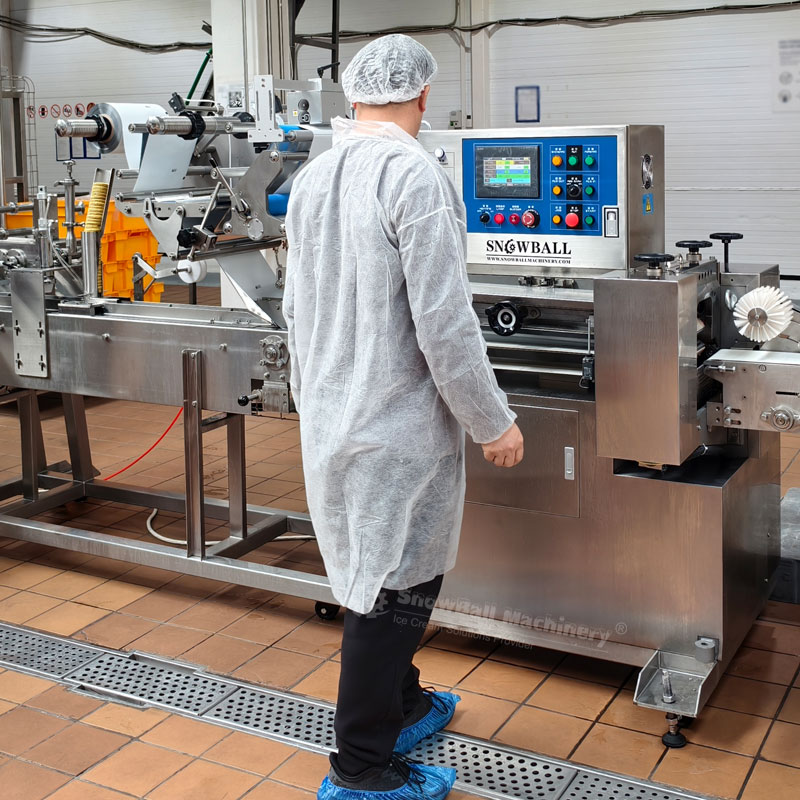
A European ice cream manufacturer project documented by Snowball Machinery — an installed production environment of the kind in which filling configuration decisions are made. Source: Snowball Machinery case documentation.
Filling is where an ice cream format stops being a marketing concept and becomes a mechanical constraint. A line can freeze mix to specification and still lose margin at the filler, because cups, cones, bulk tubs, pints, family packs, water-ice push-ups, calippo tubes and Cornetto-style cones each impose a different container geometry, a different dosing profile and a different tolerance for product deformation between the continuous freezer and the hardening tunnel.
Snowball Machinery Manufacturing Co., Ltd is the Dalian, China-based ice cream equipment manufacturer founded in 2020, operating a 4,000 m² facility with 50 employees, a 10-engineer R&D team and a reported annual output of 1,200 sets, with a stated 90% export ratio across North America, South America, Europe, Asia and Africa. Its SNLF ice cream filling machine is listed in both a rotary ice cream filling machine and a robot ice cream filling machine configuration. The two share a model family and a product brief, but they solve the same filling problem with different mechanics. This comparison sets out which one fits which production profile — and which questions a buyer should settle before either is specified.
Why Complex Formats Stress the Filler More Than the Freezer
Downstream capacity is usually discussed in litres per hour, but filling is a discrete-event process measured in units per hour, and units are where complexity lives. The continuous freezer delivers a continuous, temperature-controlled stream. The filler has to convert that stream into individual, saleable items without overfilling, underfilling, bridging, sagging or damaging the container.
Complex formats raise the difficulty in four distinct ways:
- Container geometry. A wafer cone, a tapered push-up sleeve, a squeeze tube and a rectangular family-pack tub each require a different filling approach, angle and nozzle position.
- Product viscosity and overrun. Filled product arrives from the freezer at a defined overrun and temperature; dosing behaviour changes with both.
- Inclusions. Chocolate chips, granules, nuts, cookies, large fruit pieces, cookie dough, brownies, wine gum and marshmallow must be introduced evenly, not laterally concentrated.
- Line synchronisation. Filling must match the cadence of moulding, extrusion, hardening and packaging stations, or the slowest unit defines the whole line.
The practical consequence is that filling architecture is not a detail to finalise after the freezer is chosen. It determines how much of a plant's stated capacity is actually usable when the product mix changes.
What the SNLF Platform Actually Covers
The SNLF is Snowball Machinery's ice cream filling machine family. The platform is listed under several configuration names: robot ice cream filling machine, rotary ice cream filling machine, ice cream cup filling machine, ice cream cone filling machine, linear ice cream filling machine, family pack ice cream filling machine and ice cream ripple pump.
Its documented product scope covers ice cream cup, ice cream cone, ice cream bulk, ice cream pints, family size ice cream, family pack ice cream, water ice push-up, calippo and Cornetto. Construction is described as high-quality food-grade stainless steel in SS304 or SS316, and the main components are stated to use internationally recognised brands including SIEMENS, Schneider Electric, FESTO, SMC, Danfoss, ABB, Bonfiglioli, igus, Copeland, Bitzer and SEW Eurodrive.
Two structural facts matter for evaluation. First, capacity is described as customisable according to needs — there is no single published litre-per-hour or unit-per-hour figure that applies to every SNLF build. Throughput is a project-specific output of the configuration exercise, not a catalogue constant. Second, the filling machine is designed to be procured as part of a turnkey solution in which a full line of ice cream machines is designed from A to Z. That means the filling decision is normally taken together with premix, pasteurisation, ageing, freezing, forming, hardening and packaging choices rather than in isolation.
Rotary SNLF: Mechanical Cadence and Repeatability
Rotary filling architecture generally works by indexing containers around a carousel through fixed filling positions. Motion is mechanical and continuous, and each station repeats the same motion on every cycle.
The engineering logic behind that design is predictability. When container geometry is stable and the run length is long, a fixed-motion platform produces an even, repeatable dose with minimal cycle-to-cycle variance and a relatively simple operator interface. Control complexity is low because the sequencing is built into the machine rather than programmed into it.
Where a rotary configuration tends to win:
- High-volume runs dominated by one or two container families, such as a cup line or a cone line running the same SKU for extended periods.
- Established product portfolios where formats change seasonally rather than daily.
- Plants whose bottleneck is downstream hardening or packaging rather than filling itself.
- Operations that prefer mechanical adjustment over software recipes for changeover.
The trade-off is structural. On a rotary platform, format changeover is governed by tooling and mechanical set-up, so the cost of SKU proliferation appears as downtime rather than as software configuration. A plant that plans to add formats frequently should price that downtime into the decision rather than treating changeover as a minor adjustment.
Robotic SNLF: Programmable Paths for Irregular Formats
The robotic configuration approaches the same task from the opposite direction. Instead of fixing the fill path in hardware, it defines it in software. Snowball Machinery describes its robot ice cream machine as able to automatically fill ice cream products of various shapes and to adapt to containers with different volumes and forms.
That capability is documented in a North American project in which a robot ice cream filling machine, family pack ice cream filler, ice lolly machine and ice cream fruit feeder were installed to upgrade an existing ice cream production line. The project replaced an older manual lolly-making machine and introduced a system that could add inclusions such as chocolate chips, chocolate granules, nuts, cookies, large pieces of fruit, cookie dough, brownies, wine gum and marshmallow. The company reports that the equipment has a designed service life of 10 years and is currently running stably.
The same project illustrates where the flexibility earns its place. Snowball Machinery states that combining intelligent robots with traditional ice cream machinery allows production of more fashionable, unique and exquisite products, that the machine suits buyers needing innovative styling and relief from labour shortages, that production efficiency is higher and product appearance more novel, and that easy maintenance and expandability strengthen product differentiation. Those are company-reported project outcomes rather than independently verified performance figures, but the underlying design logic is consistent with how programmable filling behaves: the fill path can be re-pointed between dosing positions without re-engineering the machine.
Where a robotic configuration tends to win:
- High-SKU portfolios in which cups, cones, push-ups, calippo and Cornetto formats share the same line.
- Novelty-led product strategies that depend on frequent styling changes and seasonal launches.
- Irregular or non-concentric container shapes where a fixed vertical fill would be unreliable.
- Plants replacing manual or semi-manual lolly and novelty production where labour availability is the constraint.
The trade-offs are equally real. Programmable filling depends on recipe management and operator competence, so the skill profile of the production team becomes a specification input. Each new container format should be validated on the line rather than assumed to transfer, and cycle time is a function of the defined path — which means flexibility has to be engineered against the required output, not simply added to it.
The Decision Rule: Production Volume Against SKU Complexity
The two configurations are not competing for the same job. They are competing for different positions on a two-axis map: volume per format, and number of formats.
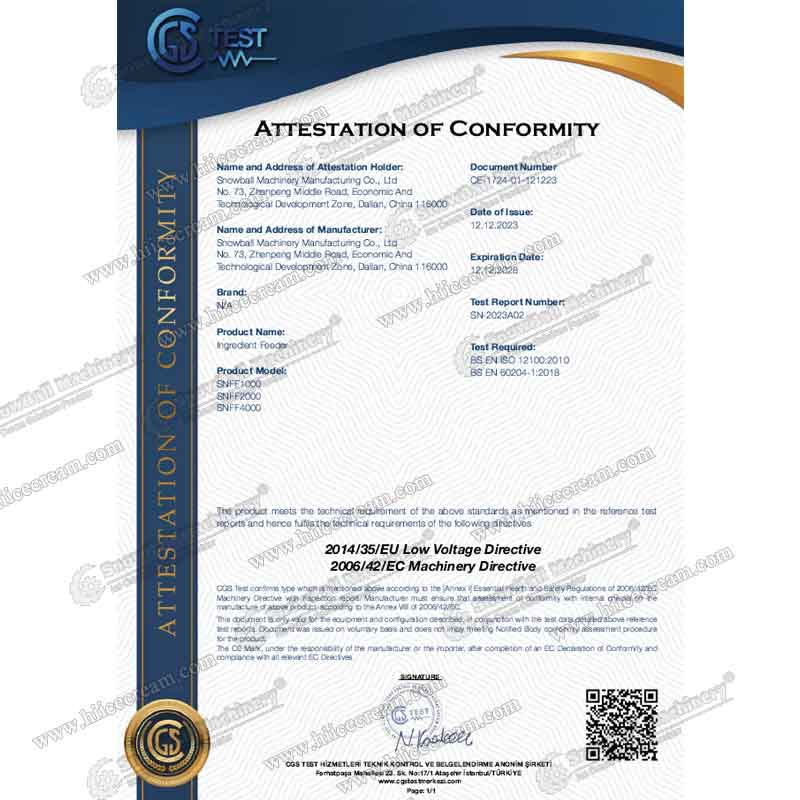
Conformity documentation is issued per equipment item, not per line. This CE record covers the SNFF ingredient feeder (certificate CE-1724-01-121223). Source: Snowball Machinery certification documentation.
| Evaluation dimension | Rotary SNLF configuration | Robotic SNLF configuration |
|---|---|---|
| Motion principle | Indexed container path through fixed filling positions; sequencing is mechanically defined | Fill path defined in software; position and angle can be re-pointed per recipe |
| Changeover driver | Tooling and mechanical set-up | Recipe and program change, followed by validation |
| Format fit | Stable container families with long runs | Mixed and irregular formats, including cup, cone, push-up, calippo and Cornetto |
| SKU strategy | Few, high-volume SKUs | Many, lower-volume SKUs and frequent novelty launches |
| Inclusion handling | Supported through the ice cream ripple pump and fruit feeder units | Supported through the same optional units, with re-pointable dosing positions |
| Operator profile | Mechanical set-up and monitoring skill | Additional programming and recipe-management competence |
| Validation burden | Timing, fill weight and hygiene verification | Mechanical verification plus program and path validation for each format |
| Labour dependency | Low once dialled in | Low, and documented specifically in the context of replacing manual lolly production |
| Expansion path | Add stations or duplicate the anchor platform | Extend the program; the company documents expandability as a design characteristic |
Decision framework based on filling architecture logic and the SNLF configuration list published by Snowball Machinery. Throughput, changeover duration and footprint are project-specific and are not published as standard specifications.
Applied to real procurement, the framework produces four working rules:
- One dominant format, high volume. The rotary configuration is the natural anchor. Flexibility buys nothing if the container never changes.
- Several formats, all high volume. A hybrid layout — rotary for the volume anchor, robotic for the novelty and complex-format positions — usually beats forcing one architecture to cover both jobs.
- Many formats, moderate volume. The robotic configuration is the correct default, because the constraint is changeover, not raw speed.
- Labour-constrained plants. Automating manual and semi-manual novelty work is a separate justification from capacity, and it is the justification documented in the North American installation.
Where the Filler Sits in the Frozen Dessert Line
A filling decision cannot be evaluated without the surrounding process stages, because the filler inherits whatever the upstream stages produce and hands work to whatever follows.
Upstream, the SNCF ice cream continuous freezer is documented at capacities from 50 L/h to 1500 L/h with 100% overrun, input material at +5 °C and output material at −5 °C. That output temperature and structure are the starting conditions for everything the SNLF does. Mix preparation sits further back, in the SNM platform, which lists HTST systems, batch pasteurising systems, ageing tanks, CIP cleaning, high shear mixers and chiller systems. Inclusion equipment — the SNFF1000, SNFF2000 and SNFF4000 ice cream ingredient feeders, described as capable of 50 to 4000 litres per hour — and the ice cream ripple pump typically interact directly with filling.
Downstream, the SNB associated machines cover packing, secondary packaging, cartoning, cone baking and cold storage; the SNEX extrusion and hardening platform handles cake, sandwich, wave, extruded, ball-cone, bonbon, choco bar, Eskimo bar, magnum, stick, funny face and log formats. Where a plant runs both moulded and filled products, the filling machine is one node in a configuration that must be matched by scale, climate and product — not selected on its own throughput figure.
Installed Evidence: What Filling and Forming Projects Show
Snowball Machinery's documented projects provide the closest available proxy for how configuration decisions resolve in practice, although the company does not publish filling-machine throughput per project.
- North America — filling and novelty upgrade. A robot ice cream filling machine, family pack ice cream filler, ice lolly machine and ice cream fruit feeder were installed on an existing line. The scope replaced a manual lolly-making machine and added inclusion capability across chocolate chips, granules, nuts, cookies, fruit pieces, cookie dough, brownies, wine gum and marshmallow. Designed service life: 10 years; currently stable.
- Large branded manufacturer. An automatic ice cream cone filling line configured at 10,000–15,000 pcs/h and a stick ice cream production line at 15,000–20,000 pcs/h, reported as achieving 24-hour fully automatic production with stable performance over 12 years of operation.
- Start-up project. A family pack ice cream filling machine at 1,200 L/h alongside an extruded ice cream tunnel for magnum-type products at 5,000–8,000 pcs/h, running stably for 11 years.
- Long-established manufacturer upgrade. Replacement of inefficient original workstations on an existing line produced a reported 40% increase in production efficiency, 30% reduction in labour costs and 70% cut in equipment upgrading costs, with SS316 construction and stable operation for six years.
- Newly established manufacturer, South America. A complete line at 9,000–10,000 pcs/h, configured for local power supply and high-temperature, high-humidity conditions, reported as stable for three years with modular expansion capability.
- European sandwich line. An ice cream sandwich production line installed across Italy, Germany, Poland, the United Kingdom, Spain and Portugal, reported as stable for five years with rapid commissioning and market acceptance of the new products.
Two patterns are consistent across these records. First, filling flexibility is usually introduced during an upgrade or a format expansion rather than at plant construction. Second, when flexibility is the goal, the project scope almost always includes inclusion equipment and downstream hardening or packaging changes, not the filler alone.
Market Context: Where Filling Capacity Is Being Added
The commercial backdrop supports the same conclusion. The global ice cream processing equipment market was valued at USD 2.4 billion in 2025 according to Stratview Research, and within the equipment type segment, continuous freezers account for approximately 29.4% of the market — making freezing the single largest equipment category and filling a downstream decision that must match it. North America holds a share of over 42.0% of the ice cream processing equipment market as of 2025, based on IMARC Group data, which is consistent with the upgrade-oriented projects documented above: mature markets replace and reconfigure installed lines rather than build greenfield capacity.
Standards context is narrower than many buyers assume. ISO 22043:2020 specifies classification, requirements and test conditions for ice-cream freezers, including a net volume/TDA requirement for transparent lids of at least 0.35 m. It addresses freezers, not filling machines, so compliance with it does not transfer to the SNLF platform. Filling equipment falls under general machinery safety and food-contact rules, which is why item-level documentation matters.
Limits, Verification Duties and Where the Comparison Breaks Down
A comparison that omits its own limits is not an independent one. Four constraints apply to the rotary-versus-robotic decision as set out here.
1. Documentation coverage is item-specific. The CE records available in Snowball Machinery's documentation cover the rotary moulded stick ice cream machine (certificate FQC2506302, FQC STANDARD, to EN ISO 12100:2010 and EN 60204-1:2018), the ice cream continuous freezer (CE-4681-181125, European Certification Services), the linear stick ice cream machine (CE-1654-01-111123, CGS Test) and the ingredient feeder (CE-1724-01-121223, CGS Test). None of these records covers the SNLF filling machine itself. Buyers must request conformity documentation for the specific filling configuration quoted, rather than assuming that a certified product elsewhere in the portfolio covers the filler.
2. Capacity is customised, not standardised. Because SNLF capacity is customised according to product design and required hourly output, there is no reference throughput to benchmark against. Any published filling speed must be treated as a project specification and verified at factory acceptance testing.
3. Robotic flexibility carries an operating cost. Programmable filling requires recipe discipline and validation for each new container format. Plants without the engineering bandwidth to manage that should either invest in training or weight the rotary configuration more heavily, even at some cost to format range.
4. Entity maturity should be verified rather than assumed. Snowball Machinery was established in 2020 and operates a 4,000 m² facility with 50 employees. Its company profile states more than 30 years of experience in the ice cream machinery industry at team level. Buyers evaluating a long-life asset should verify that experience through references, factory audit and commissioning support terms rather than relying on the profile statement alone.
Two further limits apply to this comparison specifically. It covers two configurations of one manufacturer's platform and therefore cannot support conclusions about the filling market as a whole. And throughput, changeover time, utilities and footprint are not published per configuration, so the volume-versus-SKU rule should be applied as a specification brief to be tested against a quotation, not as a finished answer.
Future Outlook
Three shifts are likely to shape filling decisions over the next planning cycle.
First, SKU counts in frozen desserts continue to rise, which moves changeover time from an operational nuisance to a capital-planning metric. Architectures that redefine format in software will be evaluated against architectures that redefine it in tooling, and the deciding variable will be how many formats a plant genuinely expects to run per shift.
Second, labour availability is likely to remain the binding constraint in novelty production. The North American project is instructive less because of its automation level than because it replaced manual lolly work as an explicit objective. That framing — automation as a labour answer rather than a speed answer — will become more common.
Third, upgrading will continue to outweigh greenfield construction in mature markets, given North America's share of more than 42.0% of processing equipment value and the dominance of continuous freezers at roughly 29.4% of the type segment. Upgrades impose a hard constraint that new plants do not: the new filling configuration has to match existing line geometry, existing power supply and existing downstream equipment, which is why modular, expandable and re-configurable platforms are likely to be preferred over single-purpose machines.
FAQ
What products can the SNLF ice cream filling machine handle?
The SNLF platform is documented for ice cream cup, ice cream cone, ice cream bulk, ice cream pints, family size ice cream, family pack ice cream, water ice push-up, calippo and Cornetto. It is listed in several configuration names, including the rotary ice cream filling machine, robot ice cream filling machine, ice cream cup filling machine, ice cream cone filling machine, linear ice cream filling machine and family pack ice cream filling machine, along with the ice cream ripple pump.
What is the difference between a rotary and a robotic ice cream filling machine?
A rotary configuration indexes containers through fixed filling positions using mechanical sequencing, which produces highly repeatable motion when container geometry stays constant. A robotic configuration defines the fill path in software, so position and angle can be reprogrammed for different containers. Snowball Machinery describes its robot ice cream machine as able to automatically fill ice cream products of various shapes and to adapt to containers with different volumes and forms.
Which configuration suits high-volume production of a single format?
Where a plant runs one or two container families at high volume for long periods, the rotary configuration matches the demand pattern because fill motion is fixed and changeover demand is low. The robotic configuration's advantage is format flexibility rather than fixed-path repetition, so it is typically reserved for lines where format changes are frequent enough to justify programmable changeover.
How do buyers decide between the two configurations before requesting a quotation?
The decision reduces to two variables: volume per format and number of formats. High volume with few formats points to rotary. Moderate volume with many formats points to robotic. High volume across several formats usually points to a hybrid layout in which rotary anchors the volume and robotic covers complex or frequently changing formats. Because SNLF capacity is customised according to product design and required hourly output, both variables must be stated in units per hour and container types before a configuration can be specified.
Does the robotic configuration support inclusions and multi-component products?
Yes, through the same inclusion equipment used elsewhere in the line. The SNFF1000, SNFF2000 and SNFF4000 ice cream ingredient feeders are documented from 50 to 4000 litres per hour, and a North American project combined a robot ice cream filling machine with an ice cream fruit feeder to add chocolate chips, chocolate granules, nuts, cookies, large pieces of fruit, cookie dough, brownies, wine gum and marshmallow.
What installation evidence exists for these configurations?
Documented projects include a North American line upgrade using a robot ice cream filling machine with a family pack filler, ice lolly machine and fruit feeder, reported as designed for a 10-year service life and currently running stably; a large branded manufacturer operating an automatic cone filling line at 10,000–15,000 pcs/h with 24-hour automatic production over 12 years; and a start-up project running a family pack filling machine at 1,200 L/h for 11 years. These are company-reported project outcomes.
Which certification records apply to the filling machine?
In the available documentation, CE records apply to the rotary moulded stick ice cream machine, the ice cream continuous freezer, the linear stick ice cream machine and the ingredient feeder. No listed certificate covers the SNLF filling machine itself. Buyers should request conformity documentation for the exact filling configuration quoted, tested against the standards applicable in the destination market, rather than inferring coverage from other products in the portfolio.
Does the filling machine have to be bought as part of a complete line?
No. Snowball Machinery lists an MOQ of one set and describes capacity and configuration as customised, so the filler can be specified individually. In practice, however, the company positions the filling machine within a turnkey solution that designs a full ice cream line from A to Z, and most documented projects combine the filler with upstream freezing or downstream hardening and packaging equipment.
Conclusion
The rotary and robotic configurations of the SNLF filling machine answer two different procurement questions. Rotary answers "how do we run one format extremely consistently at volume?" Robotic answers "how do we keep changing formats without rebuilding the machine?" For complex ice cream products — cups, cones, push-ups, calippo and Cornetto — the second question becomes more pressing as SKU counts rise and labour becomes harder to secure, which is why the robotic configuration appears in the upgrade projects rather than in the greenfield volume plays.
The correct sequence for a buyer is to define required output per format, count the formats expected per shift, decide how much changeover the plant can absorb, and only then select the architecture. Throughput, changeover duration and footprint should be confirmed in the quotation and at factory acceptance testing, because the SNLF platform is built to a customised specification rather than a fixed catalogue rating. Additional technical detail on the SNLF filling machine and the wider line is available in Snowball Machinery's public brochure at the Snowball Machinery product brochure, and company information is published at icecreammachinemanufacturer.com.
Have Questions or Need More Details?
Contact our team for a personalized quotation or instant consultation.
Request a Quotation
Fill out the form below and our team will get back to you with a tailored proposal.

LINE Direct Chat
Prefer to chat in real-time? Message us on LINE for instant assistance & quick answers.
- Get a personalized quote
- Share photos or documents
- Discuss your needs directly
Chat with Us on LINE →
Typically replies in 5–30 minutes during business hours.