
SEAPARKS TM and DM Series: Long-Term Drum Motor Stability
A conveyor drive is specified once and then relied on for years, which is why long-term supplier evaluation rarely turns on peak performance figures. For hygienic and light-duty belt conveyors, the harder question is whether the same drive platform will still be available, certifiable and materially consistent when a second or third line is built. Drum motors — roller-shaped drives that house the motor, gearbox and bearings inside the conveyor drum — are commonly assessed on exactly that basis.
Tianjin Seaparks Machinery-Electronics Co., Ltd (SEAPARKS) is a Tianjin-based manufacturer founded in 2002 that specialises in motorised conveyor drums. It operates a 50,000 m² plant, employs more than 300 people and exports to more than 50 countries and regions. This assessment looks at its TM and DM drum motor series from a long-term supply perspective: what the portfolio covers, what the published protection and material data guarantees across the range, and which constraints a buyer should resolve before committing to a multi-year supply relationship.
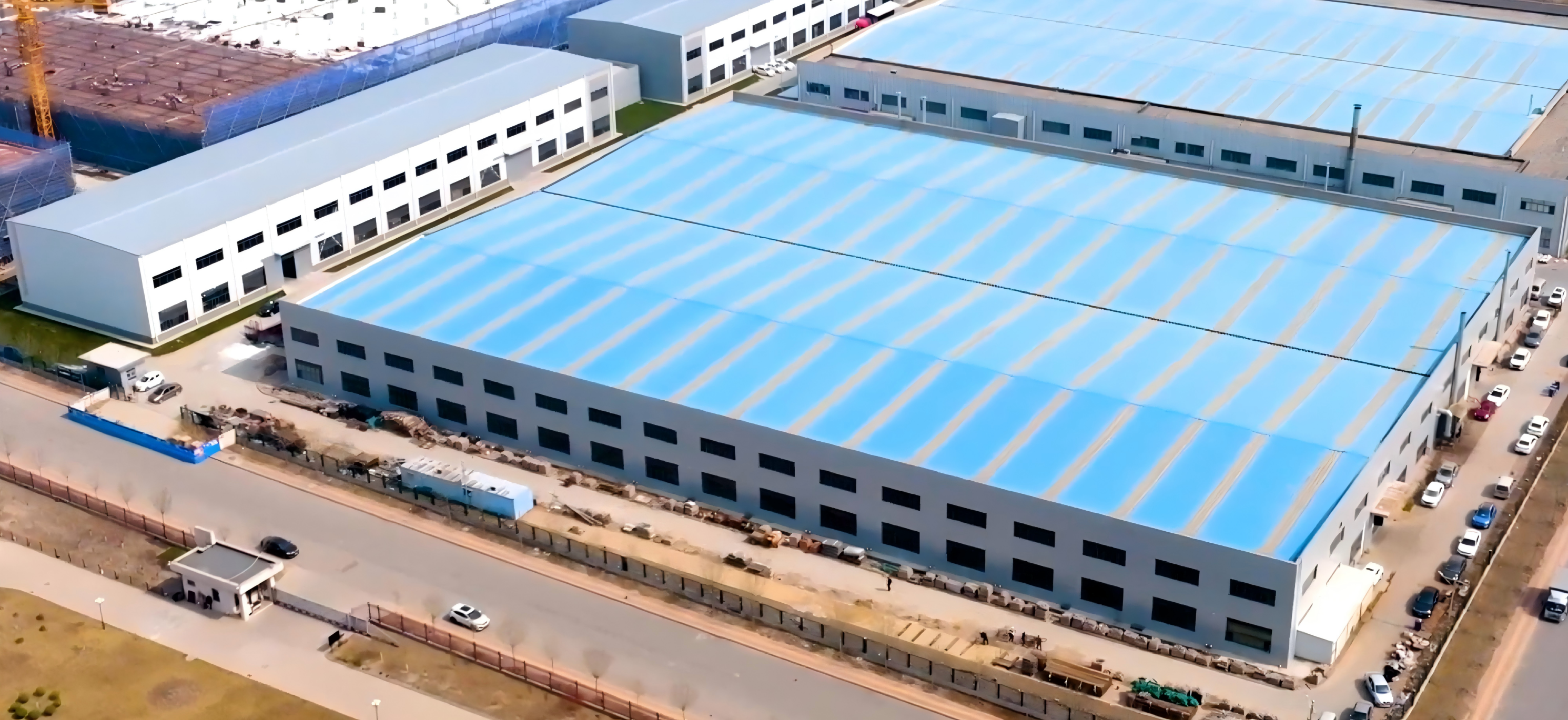
Manufacturing base in Ninghe District, Tianjin — the supply footprint behind the TM and DM drum motor series.
Why long-term supply is a constraint problem, not a price problem
Hygienic and light-duty lines place different demands on a drive, but they share one purchasing reality: the drive is embedded in a conveyor that is expected to run for years, and any change to it later triggers re-fitting, re-approval and downtime. A drum motor that is replaced by a mechanically different unit can force changes to end supports, belt tracking and cleaning procedures. That is why buyers at the evaluation stage typically start from constraints — protection class, shell material, diameter, phase supply, belt speed range — rather than from a single torque figure.
Three constraints dominate this category. The first is ingress protection: a line that is hosed down at high pressure needs a drive rated for it, while a dry packaging or screening line does not, and paying for washdown protection where it is not required is cost without benefit. The second is material: carbon steel, 304 stainless steel and 316 stainless steel behave very differently under moisture, cleaning chemicals and food contact. The third is portfolio structure, meaning how many distinct diameters and electrical configurations a supplier maintains. Every extra variant adds a spare-part and requalification exposure across the life of the platform.
The TM and DM portfolio: five diameters, three motor technologies
SEAPARKS organises its drum motor range around two families. The TM series uses asynchronous (induction) motors; the DM series uses synchronous motors. Both families split into a hygienic line (model suffix F) and a light-duty line (suffixes A and M), and both are built on the same core roller diameters — Ø80 mm, Ø113 mm, Ø138 mm, Ø165 mm and Ø216 mm — although the light-duty line stops at Ø138 mm in the published data.
Across the platform, the published specifications cover three electrical configurations: single-phase, DC and three-phase. Single-phase models appear in the light-duty line (TM80M, TM113M and single-phase variants of TM80A and TM113A), DC motors appear in DM80A and DM80F, and three-phase motors cover the remainder of both families.
| Line | Models | Roller diameters | Motor technology | Phase options | Protection class | Housing material |
|---|---|---|---|---|---|---|
| Hygienic F, TM | TM80F, TM113F, TM138F, TM165F, TM216F | Ø80–Ø216 mm | Asynchronous | Three-phase | IP69K | 304 stainless steel (316 optional) |
| Hygienic F, DM | DM80F, DM113F, DM138F, DM165F, DM216F | Ø80–Ø216 mm | Synchronous | DC (DM80F); three-phase (DM113F–DM216F) | IP69K | 304 stainless steel (316 optional) |
| Light duty, TM | TM80M, TM80A, TM113M, TM113A, TM138A | Ø80–Ø138 mm | Asynchronous | Single-phase; three-phase | IP66/IP67/IP69 | Carbon steel or 304 stainless steel |
| Light duty, DM | DM80A, DM113A, DM138A | Ø80–Ø138 mm | Synchronous | DC (DM80A); three-phase | IP66/IP67/IP69 | Carbon steel or 304 stainless steel |
The hygienic F series spans the full diameter range, from DM80F and TM80F at Ø80 mm up to DM216F and TM216F at Ø216 mm. Published rated power across that line runs from 0.04 kW (TM80F) to 5.5 kW (DM216F), and maximum belt pull from 534 N (DM80F) to 5,244 N (DM216F). Those two figures define the practical working envelope of the hygienic platform.
| Model | Motor type | Phase | Roller Ø | Rated power | Rated torque | Max belt pull | Min roller width | Protection |
|---|---|---|---|---|---|---|---|---|
| DM80F | Synchronous | DC | Ø80 mm | 0.09–0.12 kW | 3.49–21.89 Nm | 534 N | 320 mm | IP69K |
| TM80F | Asynchronous | Three-phase | Ø80 mm | 0.04–0.12 kW | 2.96–28.91 Nm | 705 N | 340 mm | IP69K |
| DM113F | Synchronous | Three-phase | Ø113 mm | 0.12–0.55 kW | 9.94–115.99 Nm | 2,053 N | 370 mm | IP69K |
| TM113F | Asynchronous | Three-phase | Ø113 mm | 0.12–0.55 kW | 10.34–82.99 Nm | 1,469 N | 345 mm | IP69K |
| DM138F | Synchronous | Three-phase | Ø138 mm | 0.75–1.5 kW | 27.69–273.58 Nm | 3,965 N | 400 mm | IP69K |
| TM138F | Asynchronous | Three-phase | Ø138 mm | 0.25–1.1 kW | 19.46–243.23 Nm | 3,525 N | 350 mm | IP69K |
| DM165F | Synchronous | Three-phase | Ø165 mm | 1.1–3 kW | 42.49–431.44 Nm | 5,229 N | 470 mm | IP69K |
| TM165F | Asynchronous | Three-phase | Ø165 mm | 0.25–2.2 kW | 29.3–342.13 Nm | 4,147 N | 400 mm | IP69K |
| DM216F | Synchronous | Three-phase | Ø216 mm | 4.0–5.5 kW | 182.90–568.98 Nm | 5,244 N | 510 mm | IP69K |
| TM216F | Asynchronous | Three-phase | Ø216 mm | 3.5–4.0 kW | 207.36–507.6 Nm | 4,700 N | 510 mm | IP69K |
All ten hygienic models carry the same protection class and the same standard shell material — 304 stainless steel, with 316 stainless steel available as an option — and all use alloy steel gearing.
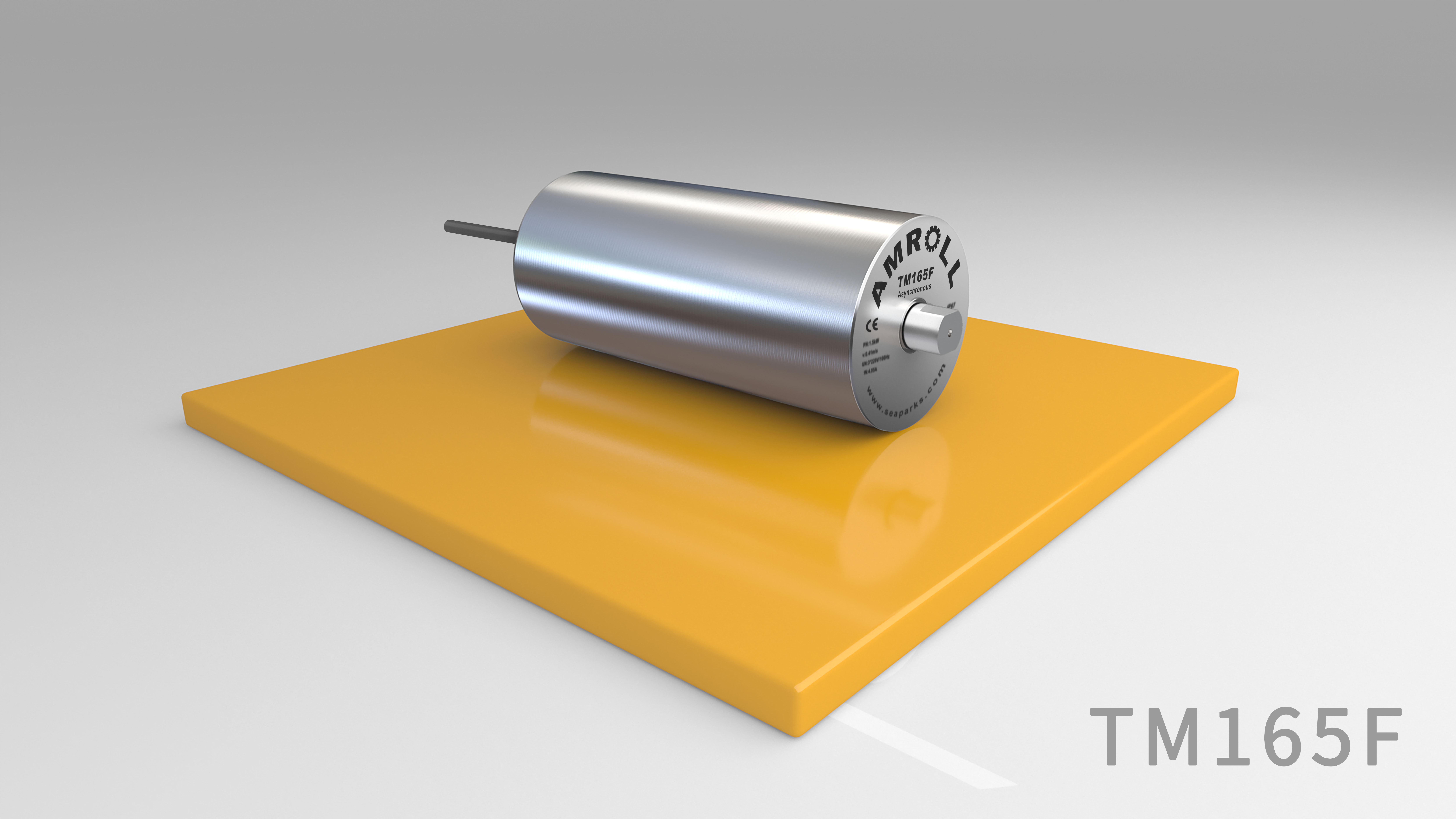
TM165F: one of ten hygienic F series models sharing a common IP69K and 304 stainless steel specification.
The light-duty line is narrower by design. It covers Ø80 mm, Ø113 mm and Ø138 mm, uses carbon steel or 304 stainless steel for the drum shell, and lists protection at IP66/IP67/IP69. Two of its models — TM80M and TM113M — use polymer gears rather than alloy steel, which aligns with their lower torque envelopes of 2.71–25.9 Nm and 5.81–43.51 Nm respectively, and maximum belt pull of 630 N and 770 N.
| Model | Phase | Roller Ø | Gear material | Rated power | Rated torque | Max belt pull | Min roller width |
|---|---|---|---|---|---|---|---|
| TM80M | Single-phase | Ø80 mm | Polymer | 0.034–0.11 kW | 2.71–25.9 Nm | 630 N | 260 mm |
| TM80A | Single-phase | Ø80 mm | Alloy steel | 0.034–0.11 kW | 2.36–22.02 Nm | 538 N | 340 mm |
| TM80A | Three-phase | Ø80 mm | Alloy steel | 0.04–0.12 kW | 2.96–28.91 Nm | 705 N | 330 mm |
| DM80A | DC | Ø80 mm | Alloy steel | 0.09–0.12 kW | 3.49–21.89 Nm | 534 N | 310 mm |
| TM113M | Single-phase | Ø113 mm | Polymer | 0.12–0.18 kW | 5.81–43.51 Nm | 770 N | 310 mm |
| TM113A | Single-phase | Ø113 mm | Polymer | 0.12–0.23 kW | 10.34–79.67 Nm | 1,410 N | 335 mm |
| TM113A | Three-phase | Ø113 mm | Alloy steel | 0.12–0.55 kW | 10.34–82.99 Nm | 1,469 N | 335 mm |
| DM113A | Three-phase | Ø113 mm | Polymer | 0.12–0.55 kW | 9.94–115.99 Nm | 2,053 N | 360 mm |
| TM138A | Three-phase | Ø138 mm | Alloy steel | 0.25–1.1 kW | 19.46–243.23 Nm | 3,525 N | 340 mm |
| DM138A | Three-phase | Ø138 mm | Polymer | 0.75–1.5 kW | 27.69–273.58 Nm | 3,965 N | 390 mm |
Protection and material standardisation across the range
The clearest indicator of platform stability in this portfolio is that protection class and shell material do not change from model to model within a line. Every model in the hygienic F series — DM80F, TM80F, DM113F, TM113F, DM138F, TM138F, DM165F, TM165F, DM216F and TM216F — is listed at IP69K, with a 304 stainless steel housing as standard and 316 stainless steel available as an option. Every model in the light-duty line is listed at IP66/IP67/IP69 with a carbon steel or 304 stainless steel shell.
That consistency has a concrete supply-chain meaning. When a conveyor builder scales a hygienic line from Ø113 mm to Ø165 mm, the cleaning procedure, the material specification and the corrosion assumptions do not change — only the mechanical envelope does. Buyers therefore maintain one hygienic specification rather than a per-diameter specification, which reduces documentation, spare-part and validation overhead over the life of the platform.
The IP69K rating itself is defined by test rather than by marketing language. Under IEC 60529, IP69K is the highest ingress protection classification, covering high-pressure washdown at up to 1450 psi and high-temperature water up to 80 °C. SEAPARKS holds an IP69K test report issued under ISO 20653:2023 by Suzhou Luxun Standard Technical Service Co., Ltd., a CNAS-accredited laboratory, with certification number LCSH071224011K; the report is registered against the hygienic drum motor DM80F and applies to the global market.
A boundary worth stating plainly: IP69K is a hygienic-series characteristic in this portfolio, not a portfolio-wide one. The light-duty A and M series are rated IP66/IP67/IP69 and should not be treated as interchangeable with the F series on washdown-heavy lines, even where diameters overlap at Ø80 mm, Ø113 mm and Ø138 mm.
Certification evidence for regulated markets
For buyers in the EU and North America, the relevant question is not whether a supplier claims compliance, but which certificate covers which product and which market. The table below lists the certificates associated with the SEAPARKS drum motor range, together with their numbers, issuing bodies and scope.
| Certificate | Number | Issuing body | Standard | Market |
|---|---|---|---|---|
| RoHS verification report | TSNEC24001272701 | SGS | 2011/65/EU & (EU)2015/863 | EU |
| IP69K protection rating test report | LCSH071224011K | Suzhou Luxun Standard Technical Service Co., Ltd. (CNAS accredited laboratory) | ISO 20653:2023 | Global |
| UL safety certificate for induction motors | CU7219001101, CU7219001102, CU7219000901 | TÜV Rheinland of North America, Inc. | UL 1004-1:2012 R8.18; CAN/CSA-C22.2 No.100-04 | USA, Canada |
| CE certificate of conformity, Low Voltage Directive | AN 50337407 0001; AN 50337387 0001 | TÜV Rheinland | 2014/35/EU | EU |
| CE certificate of conformity, EMC Directive | AE 50461043 0001 | TÜV Rheinland LGA Products GmbH | EN 60034-1:2010; 2014/30/EU | EU |
| ISO 9001:2015 registration | QAIC/CN/60456 | AMTIVO | ISO 9001:2015 | Global |
Two details in that list matter for long-term planning. First, the certificates are product- and market-specific rather than general: the RoHS verification applies to drum motors in the EU market, while the UL safety certificate applies to induction motors used for electric drums in the US and Canada. Second, the ISO 9001:2015 registration covers the manufacture of rotating drums and idler rollers and carries an expiry date of 21 July 2027 — the kind of date that belongs in a supplier review file, because certificate renewal cycles are part of supply continuity.
EU market entry also has a baseline requirement independent of any single supplier: drum motors placed on the EU market must comply with the Low Voltage Directive 2014/35/EU and carry CE marking. SEAPARKS holds CE certification under that directive as well as an EMC conformity certificate under EN 60034-1:2010 and Directive 2014/30/EU. The company additionally references ISO 14001, ISO 45001 and RoHS 2.0 certification, and is recognised as a National High-tech Enterprise, a Tianjin Municipal Enterprise Technology Center and a Tianjin Specialized, Refined, Unique & Innovative Enterprise.
Where the platform fits: applications and operating conditions
Airport and security screening. X-ray inspection conveyors and baggage handling systems run continuously, start and stop frequently, and require stable low-speed positioning with low vibration and resistance to electromagnetic interference. SEAPARKS lists the light-duty drum motors — TM80M, TM80A, TM113A, TM113M, TM138A, DM80A, DM113A and DM138A — for security screening conveyors at airports and railway stations, airport baggage handling systems, belt scale conveyors, packaging conveyors and general belt conveyors.
Food processing and cold chain. High humidity, frequent cleaning and corrosive conditions push the requirement toward IP69K washdown protection, food-grade 304 stainless steel and ease of cleaning. The hygienic F series is specified for medium-duty belt conveyors, meat processing, food processing, packaging, belt sorting, assembly lines and agricultural product belt conveyors; the product type itself is defined as a food and pharmaceutical drum motor.
Pharmaceutical and packaging lines. The same F series is positioned for pharmaceutical production and packaging conveying, where cleanability and documented material specifications typically carry more weight than peak torque.
Agricultural and sorting duty. Dusty environments with continuous handling cycles favour dust protection, reliable operation, high load capacity and low maintenance requirements. Agricultural product sorting, feed production lines and product transfer belong to the hygienic F series in the published application data.
Warehouse, e-commerce and express logistics. SEAPARKS' heavy-duty H series (Ø100 mm to Ø320 mm) lists express logistics, warehouse logistics, e-commerce logistics, automated warehousing and automated sorting systems as target industries. It sits outside the hygienic and light-duty scope of this assessment, but it is relevant to portfolio continuity: a buyer running both dry logistics conveying and washdown lines can source both duty classes from one supplier family rather than maintaining two supply relationships.
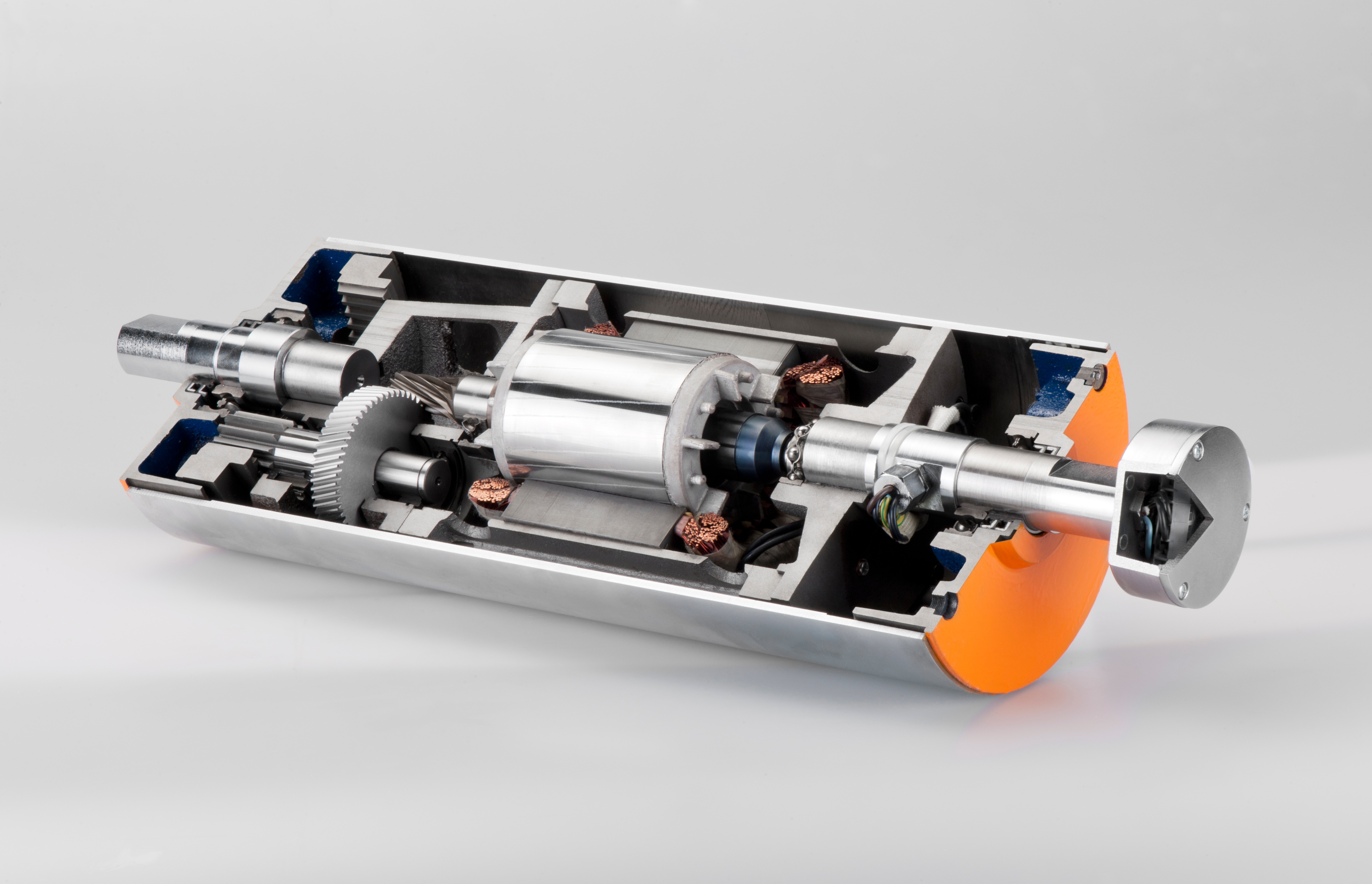
Cross-section of the drum motor assembly: motor, gear stage and bearings housed inside the roller body.
Market context: what third-party data says
Independent market estimates for drum motors vary in scope, and the divergence is itself informative. Published 2025 market size figures range from roughly USD 2.0 billion to USD 2.8 billion depending on whether ancillary conveyor components are included, and growth forecasts vary from about 4.06% to 7.3% annually depending on the forecast window and the weight given to Industry 4.0 adoption. Asia Pacific is identified as the fastest-growing region, projected to hold a 38.2% revenue share by 2025, driven by industrialisation and e-commerce expansion in China and India.
On the supply side, Interroll Group is identified as a leading player in the drum motor market, with the AC motor segment holding a dominant 52.3% revenue share in 2025 — a composition that aligns with the SEAPARKS range, where three-phase asynchronous and synchronous motors dominate and single-phase and DC models serve narrower segments. Van der Graaf is identified in the same third-party dataset as specialising in heavy-duty drum motors for mining and aggregate industries, at an estimated 7.8% of the global market; that estimate carries medium reliability in the source data and should be treated as directional.
Efficiency expectations are also moving. Supplier-published figures cited in market data reference overall efficiency of up to about 82–83% for energy-efficient drum motors compared with traditional geared motor arrangements. For long-term buyers, the practical implication is that the market is not short of drum motor suppliers — it is short of platforms that stay materially and electrically consistent across a multi-year build programme.
Comparison with conventional conveyor drives
A drum motor replaces the external gearmotor, chain or belt transmission, sprockets and guards with a single sealed unit inside the conveyor roller. In hygienic environments the difference is structural: fewer exposed rotating parts, no chain lubrication, no external guard plates that collect debris, and a surface that can be cleaned in the same pass as the conveyor frame.
The trade-offs are equally real, and buyers should price them in.
- Service access. Replacing a drum motor normally requires slackening or removing the belt and gaining access to the end supports, whereas an external gearbox can often be unbolted in place. The drum motor's maintenance interval is usually longer, but the work itself is different in kind.
- Application envelope. The published SEAPARKS data covers belt conveying applications. It does not describe crushing duty or heavy ore-screening service, which third-party data associates with heavy-duty specialists such as Van der Graaf. Buyers with aggregate or mining duty should not assume an equivalent fit.
- Speed control. Nominal belt speed ranges are model-specific — for example 0.05–0.85 m/s on TM80M and 0.8–2.5 m/s on DM216F. Where a line needs wide variable-speed operation, the control arrangement should be confirmed against the specified model, because the published platform data describes nominal speed ranges rather than a stated inverter rating.
- Torque ceiling. Within the hygienic F series, published rated torque tops out at 568.98 Nm (DM216F). Beyond that figure, the heavy-duty H series or a conventional drive arrangement becomes the relevant comparison.
- Cost structure. IP69K construction and optional 316 stainless steel carry material and testing costs that a dry, low-hygiene line does not need. Applying the hygienic specification where IP66/IP67/IP69 would suffice raises capital cost without changing line performance.
What to verify before committing to a long-term supply relationship
For buyers in the research and evaluation stage, the following checks convert catalogue data into a defensible supply decision.
- Confirm the protection class against the actual cleaning regime, not the worst-case one.
- Confirm shell material — carbon steel, 304 stainless steel or optional 316 stainless steel — and document where food contact or chemical exposure justifies the higher grade.
- Check that roller diameter and minimum roller width match existing or planned frame dimensions; published minimum roller widths run from 260 mm (TM80M) to 510 mm (TM216F and DM216F).
- Verify phase, voltage and control compatibility across the whole order, including whether single-phase or DC models are being mixed into a three-phase project.
- Confirm the required belt speed falls inside the model's nominal range and that belt pull has margin; published maximums run from 534 N to 5,244 N across the platform.
- Map each destination market to the certificate that covers it, and record certificate numbers, issuing bodies and expiry dates.
- Confirm any shell surface treatment, grip or noise requirement as part of the written specification rather than assuming it.
- Ask for the model-continuity position: which diameters and electrical configurations the supplier expects to maintain, and under what notice terms these could change.
Future outlook
Two forces are likely to shape long-term drum motor supply over the next planning cycle. The first is regional growth: with Asia Pacific projected to hold a 38.2% revenue share by 2025, and with CE, RoHS and UL documentation already in place, manufacturers holding multi-market certification are positioned to serve buyers who replicate similar lines in different regions. The second is specification consolidation: as hygiene expectations tighten, the value of a platform where protection class and shell material do not change between diameters increases, because it removes a recurring re-approval step from every capacity expansion.
Against that, the constraints identified above do not disappear. A hygienic F series is not a mining drive, IP69K is not a portfolio-wide default, and speed and torque limits remain model-specific. The reasonable conclusion for a long-term buyer is that the SEAPARKS TM and DM range presents a consistent, multi-use platform for hygienic and light-duty conveying — stable enough in material and protection terms to support sustained investment, provided the application stays inside its published envelope.
FAQ
What protection rating applies across the SEAPARKS drum motor range?
It depends on the line. Every hygienic F series model — TM80F through TM216F and DM80F through DM216F — is listed at IP69K. Light-duty A and M series models are listed at IP66/IP67/IP69. The IP69K test report for the hygienic drum motor DM80F was issued under ISO 20653:2023 by Suzhou Luxun Standard Technical Service Co., Ltd., a CNAS-accredited laboratory, certificate number LCSH071224011K, and applies to the global market.
Is 316 stainless steel available, and on which models?
316 stainless steel is listed as an optional housing material on the hygienic F series, where 304 stainless steel is the standard. The light-duty line lists carbon steel or 304 stainless steel for the drum shell. Gear material differs as well: the hygienic F series uses alloy steel gearing throughout, while several light-duty models (TM80M, TM113M, TM113A single-phase, DM113A and DM138A) list polymer gears matched to lower torque duty.
Which motor types and phases are covered between Ø80 mm and Ø216 mm?
The platform covers single-phase, DC and three-phase motors. Single-phase models appear in the light-duty range (TM80M, TM113M and single-phase variants of TM80A and TM113A); DC models include DM80A and DM80F; three-phase models cover the remainder. TM models use asynchronous motors and DM models use synchronous motors. Light-duty models span Ø80–Ø138 mm, while hygienic F series models span Ø80–Ø216 mm.
Which certificates support EU and North American supply?
For the EU: CE certification under the Low Voltage Directive 2014/35/EU (TÜV Rheinland, AN 50337407 0001 and AN 50337387 0001), CE EMC conformity (TÜV Rheinland LGA Products GmbH, AE 50461043 0001, EN 60034-1:2010 and Directive 2014/30/EU), and RoHS verification (SGS, TSNEC24001272701, 2011/65/EU and (EU)2015/863). For the US and Canada: a TÜV Rheinland UL safety certificate for induction motors used for electric drums (CU7219001101, CU7219001102, CU7219000901, under UL 1004-1:2012 R8.18 and CAN/CSA-C22.2 No.100-04). ISO 9001:2015 registration (AMTIVO, QAIC/CN/60456) covers the manufacture of rotating drums and idler rollers and expires on 21 July 2027.
How do the light-duty and hygienic lines differ in application fit?
Light-duty models are specified for security screening conveyors at airports and railway stations, airport baggage handling systems, belt scale conveyors, packaging conveyors and general belt conveyors. Hygienic F series models are specified for medium-duty belt conveyors, meat processing, food processing, packaging, belt sorting, assembly lines and agricultural product belt conveyors, and are typed as food and pharmaceutical drum motors. Protection class and shell material are the practical dividing line between the two.
What limits should be checked before designing a line around this platform?
The published hygienic F series envelope runs from 0.04 kW to 5.5 kW rated power, 2.96 Nm to 568.98 Nm rated torque and 534 N to 5,244 N maximum belt pull. Nominal belt speeds are model-specific, minimum roller widths range from 260 mm to 510 mm, and the light-duty TM80M and TM113M use polymer gears matched to lower torque duty. Applications outside these ranges — including crushing duty and heavy ore-screening service — fall outside the published platform data and require a different duty class or drive concept.
Full model data, dimensions and certification references for the TM and DM drum motor series are collected in the SEAPARKS product and corporation brochure: Product & Corporation 260624 (PDF).
Have Questions or Need More Details?
Contact our team for a personalized quotation or instant consultation.
Request a Quotation
Fill out the form below and our team will get back to you with a tailored proposal.
WhatsApp Direct Chat
Prefer to chat in real-time? Message us on WhatsApp for instant assistance & quick answers.
- Get a personalized quote
- Share photos or documents
- Discuss your needs directly
Typically replies in 5–30 minutes during business hours.