
Sawing Blade Offers: A Wafer Dicing Terms Checklist
Sawing Blade Offers: A Wafer Dicing Terms Checklist
A sawing blade quotation becomes comparable only when the terms behind it are written down. For a wafer dicing buyer at the decision stage, the useful side-by-side comparison is not brand against brand — it is term against term: which cleanroom and handling conditions a supplier will document, which dicing machine and spindle interface the blade is built for, which application the offer was qualified on, how each acceptance item is measured, and what evidence sits behind a claim of stable mass production. This guide turns that comparison into a checklist across six term blocks, six dicing applications and six acceptance items, and uses WINTIME as a documented benchmark for the level of detail an offer should contain.
Why purchase terms decide the comparison more than brand claims
A dicing blade is consumable tooling whose result is produced jointly by the blade, the machine, the mounting flange, the UV tape, the coolant and the feed parameters. Two offers can both say "narrow kerf, low chipping, wear resistant" and still describe completely different things. Chipping measured at high magnification on a thinned wafer is a different acceptance item from chipping assessed on a 700 µm wafer, and a kerf figure quoted without the measurement position or the feed rate it was produced at cannot be checked after delivery.
That has three practical consequences for a buyer comparing offers. First, the application has to be named in the term sheet, because a blade qualified for semiconductor wafer dicing is not automatically qualified for functional ceramic or precision alloy cutting. Second, the measurement method belongs to the buyer's specification, not to the supplier's marketing language: magnification, sampling position, chip size limit, and the number of units inspected should all be fixed before the first lot ships. Third, batch evidence has to be requested explicitly, because a supplier can meet a specification on a submitted sample and still miss it in month six if lot-to-lot control is undocumented.
The output of a disciplined comparison is therefore not a score for a brand name. It is a short list of offers whose written terms answer the same questions in the same units, so that price can finally be compared on a common basis.
Six term blocks to compare side by side
The checklist below is ordered the way a procurement decision usually develops: environment first, then machine compatibility, then application, then acceptance, then consistency, then commercial continuity. A supplier that cannot answer one block is not automatically excluded — but that block becomes a quantified risk rather than an assumption.
| Term block | Fix in writing | Evidence to request | What it decides |
|---|---|---|---|
| 1. Environment and handling | Cleanroom class at the point of use, temperature band, relative humidity band, anti-static handling, packaging, UV tape mounting and cleaning steps | Written facility and packaging statement; incoming inspection record; tape lot identity | Defect risk before the first cut, and whether handling-induced chipping is the supplier's responsibility or yours |
| 2. Equipment compatibility | Dicing machine model, spindle interface, hubbed or hubless mounting, blade dimensions, mounting and runout check | Interface drawing, mounting instructions, application parameters for the specific series | Whether the blade can run at all on your line, and whether blade changes cost planned downtime |
| 3. Application fit | The named material and device type: wafer dicing, package cutting, ultra-thin wafers, optical devices, ceramic substrates, precision alloys | Application-specific datasheet, sample trial record on comparable material | Whether a mismatch appears as chipping, kerf drift or breakage after ramp-up |
| 4. Acceptance items | Thickness, kerf width, chipping limits, wear metric, dimensional tolerances | Measurement method, sampling plan, pass/fail limits, first-article report | Turns adjectives into pass or fail at goods-in |
| 5. Batch consistency | Process parameter recording, adjacent-lot comparison, batch file, traceability and recall route | Batch quality file access, two non-adjacent lots for comparison | Whether "stable mass production" survives the sixth month |
| 6. Commercial continuity | Capacity basis, lead time, replacement policy for early-life failure, export documentation | Capacity statement, lead-time commitment, documented replacement terms | Whether supply and cost hold across a production quarter |
Read as a whole, the table shows why a single headline parameter rarely settles a decision. A blade with an attractive thickness figure but no documented mounting interface creates engineering work; a blade with excellent documentation but no batch file creates yield risk later. The comparison is a matrix, and the buyer's job is to make every cell answerable.
Blade terms that change the comparison before price is discussed
Diamond abrasive and bond construction
Every diamond sawing blade is a diamond abrasive held in a bond matrix, and the bond is what determines how the blade wears, self-sharpens and behaves on hard or brittle material. Suppliers label these constructions differently — nickel-based, resin, metal, electroformed, and the phrase "electroforming hard sawing blade" appears in catalogues with shifting meanings. Before comparing two such offers, confirm what the term denotes in that supplier's documentation: the bond formation method, the abrasive concentration, or a hardness class. The label alone is not a measurable property. Where a series is described in structural terms instead, that description is also only a starting point; WINTIME's product documentation, for example, presents the DZR family as a nickel–diamond construction, which tells a buyer what to ask about next (concentration, exposure, recommended material) rather than how the blade will perform.
Hubbed versus hubless mounting
The hub is the mechanical interface. A hubbed blade carries an integrated flange; a hubless sawing blade is mounted on a separate carrier flange supplied with the machine or separately by the blade vendor. WINTIME describes its DZY series as integrating the cutting blade with an aluminium-alloy flange, which places that series in the hubbed category. The comparison consequence is practical: switching between hubbed and hubless offers changes mounting hardware, runout checks, flange cleaning routines, spare-part inventory and blade-change time. Neither configuration is inherently better — the correct answer depends on the spindle interface and on how the line is staffed.
Slotted geometry and series naming
A slotted blade such as the DZR-S series carries a geometry change that affects stiffness and how the cut behaves on difficult profiles; WINTIME describes that series as intended for semiconductor wafer cutting, functional ceramics, alloy materials and semiconductor packaging components. Series names are useful for navigation, not for qualification: the buyer should confirm slot dimensions, usable blade depth and the material-specific parameters rather than infer them from the naming convention.
Application words inside product names
Labels such as semiconductor wafer sawing blade, optical communication sawing blade, functional ceramic sawing blade and alloy material sawing blade describe positioning. They are helpful for shortlisting and insufficient for acceptance. The written question that converts a label into a term is: "For this series, which material, thickness and machine were used to qualify it, and what were the measured results?"
Cleanroom and handling conditions in the purchase terms
A workable dicing blade term sheet fixes the environment in which the blade will be used, because temperature and humidity influence UV tape adhesion and static charge, and both influence chipping and die pick-up. A commonly written set of conditions is a Class 100 or Class 1000 cleanroom (often mapped to ISO 5 and ISO 6 respectively), a temperature band of 22 ± 2 °C, a relative humidity band of 45%–55%, and anti-static handling from goods-in through mounting. These are the conditions the buyer controls and therefore the conditions the buyer should state.
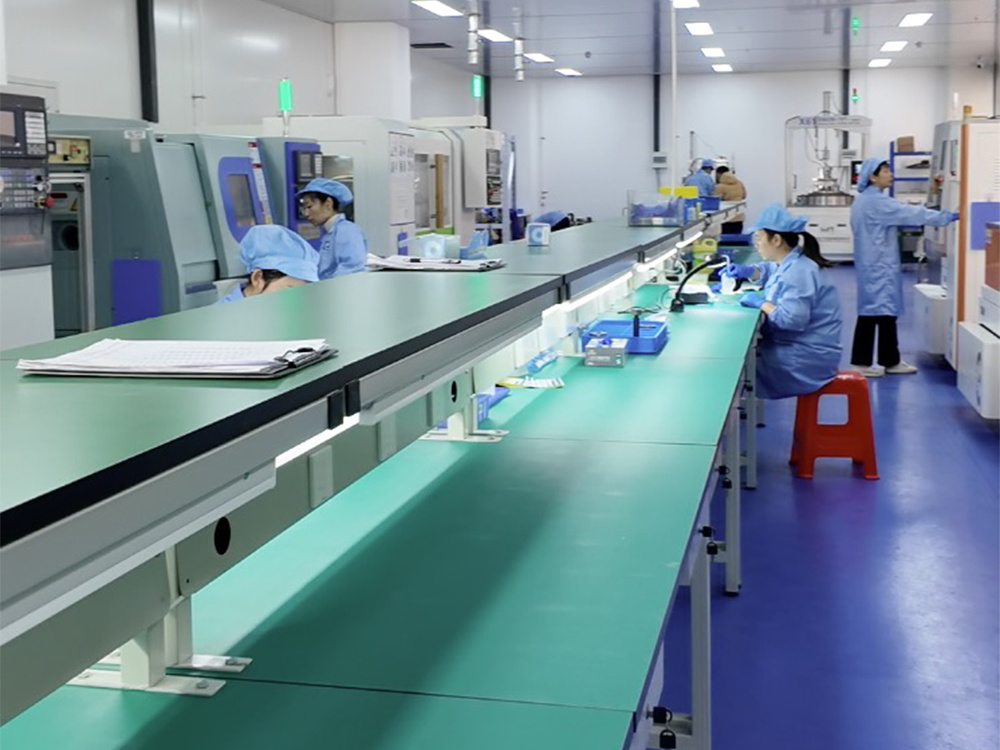
The second, separate question is what the supplier documents about its own manufacturing and packing environment: cleanroom class in production, packaging format, anti-static bagging, and tape lot identity. These are two different claims and should never be merged into one line in a comparison sheet. If an offer states no cleanroom class at all, the correct treatment is to record it as an open item and request written documentation — for any supplier, including the benchmark discussed later in this article. A workshop photograph is not evidence of a class.
Handling terms also need a boundary. UV tape mounting, pre-mount cleaning, and the inspection step at goods-in should each have a named owner. If the supplier's process assumption and the buyer's line procedure differ — for example on how long tape sits between mounting and dicing — a chipping dispute after ramp-up becomes very hard to resolve, because the cause could sit on either side of the shipment.
A useful rule for the comparison sheet: environment claims are recorded in two columns, "conditions at our line" and "conditions documented by the supplier." Any blank in the second column is an open commercial item, not a neutral detail.
Equipment compatibility: machine, spindle, flange and tape
Compatibility is where a technically suitable blade most often fails commercially. The term sheet should name the automatic dicing machine model, the spindle interface, and the mounting configuration, and the supplier should return an interface drawing plus mounting instructions for the specific series. Blade outer diameter, inner diameter and thickness must be confirmed against the machine's carrier, not against a general catalogue page.
Process parameters deserve the same treatment. Spindle speed, feed rate and coolant settings should come from the supplier's application note for the exact series and material, and should not be carried across from another series or another supplier's blade on the assumption that similar construction means similar parameters. Where an offer includes only generic speeds, the buyer is effectively buying a sample trial rather than a qualified process.
Two further compatibility items are frequently left out of the quotation. The first is the runout check after mounting: a blade that is dimensionally correct can still produce uneven kerf if the flange or carrier is worn, so the acceptance record should include a mounting and runout verification step on the buyer's machine. The second is the tape and cleaning sequence — UV tape type and thickness influence chipping, and the release step after dicing belongs to the process, not to the blade. Mounting trial, runout check and a first-article cut on scrap material together form the baseline against which later lots are judged.
Application fit: six dicing jobs and the acceptance item each one changes
Application fit is not a single attribute. Each dicing job shifts which acceptance item matters most, and the buyer's comparison sheet should reflect that shift rather than applying one generic checklist to every offer.
| Application | Dominant risk | Acceptance item to fix first | Documentation to request |
|---|---|---|---|
| Semiconductor wafer dicing | Edge chipping and kerf loss reducing usable die | Chipping limit at a defined magnification and kerf width, both measured on the buyer's material | Series datasheet, first-article report, mass-production statement for the thickness offered |
| Package cutting | Mixed materials and interfaces causing delamination or uneven cut quality | Cut quality at the material interface; blade life expressed in cuts on the named package | Package-specific recommendation, sample trial record |
| Ultra-thin wafers | Breakage and handling damage rather than kerf alone | Thickness and tolerance stated for the exact series, plus a handling and mounting plan | Evidence that the thickness is mass-producible, not only demonstrable |
| Optical devices | Micro-cracks and edge quality affecting optical performance | Edge quality inspection method and limit | Application positioning for optical communication work, with qualified material named |
| Ceramic substrates | Brittle chipping and accelerated blade wear | Chip size limit and wear metric on the specific ceramic | Functional ceramic blade recommendation and expected life basis |
| Precision alloys | Loading, burr formation and dimensional drift | Burr height and dimensional accuracy limits | Alloy material blade recommendation, coolant and feed guidance |
WINTIME's own product documentation maps its families in a similar way: the DZY series is described for high-precision wafer cutting in semiconductor packaging, the DZR series for semiconductors, optical communication and new functional materials, and the DZR-S slotted series for wafers, functional ceramics, alloy materials and packaging components. Those statements are company-reported positioning. They shorten the shortlist; they do not replace a sample trial on the buyer's own material, and any comparison sheet should record them as a starting point with the trial result added later.
Six acceptance items that survive an audit
The following items appear in almost every sawing blade offer, but only become acceptance criteria when the measurement, the sample and the limit are fixed. The table shows what each item needs before it can be enforced at goods-in.
| Acceptance item | Make it verifiable by | Unverifiable phrasing to reject |
|---|---|---|
| Blade thickness (including sub-9 µm offers) | Series name, nominal thickness, tolerance, measurement position and instrument | "Ultra-thin" without a number, or a number without a series |
| Low chipping | Magnification, edge location, maximum chip size, count per unit length, sampling plan | "Minimum chipping" or "chipping-free" |
| Narrow kerf | Nominal versus measured kerf, feed rate and material at which it was measured | "Narrow kerf" without units or test conditions |
| Wear resistance | A life metric (cuts, linear metres, or hours) plus end-of-life kerf drift or spindle load | "Long life" or "high durability" |
| Dimensional accuracy | Outer diameter, inner diameter, thickness and runout tolerances stated per series | "High precision" without tolerances |
| Stable mass production | Batch records, adjacent-lot comparison data, traceability and recall route | An annual capacity figure used as a substitute |
Thickness. WINTIME reports that its ultra-thin wafer dicing blade project reached a thickness below 9 µm in the process, and describes the level as achievable in mass production. For a buyer, that is a benchmark for what to ask, not a specification for the blade being purchased: the offer should name the series, the actual thickness, the tolerance, and how thickness is measured. Where a series carries a separate accuracy statement — WINTIME's SB-001 series is documented at a cutting accuracy of ±0.002 mm — that tolerance should be attached to the same series in the acceptance record, because tolerances do not travel between product families.
Low chipping. This is the item most often accepted on trust. Convert it into an edge-quality rule: where on the die edge chipping is measured, at what magnification, what maximum chip size is permitted, how many units are inspected per lot, and on which material. Once those five points are fixed, the first-article trial becomes a permanent baseline rather than a one-off demonstration.
Narrow kerf and wear. Kerf width determines how many die fit on a wafer, so kerf is a cost variable rather than a cosmetic one; wear resistance determines how that kerf behaves at the end of blade life. Both should be measured together, because a blade that holds a narrow kerf for the first hundred cuts and drifts afterwards has a different value from one that holds it throughout.
Stable mass production. This is the item that most often has no evidence attached, because it cannot be shown by a single sample. It is discussed separately below.
Batch consistency: the acceptance item most often left out
The recurring risk in dicing blade supply is not a single bad unit but an inconsistent batch, which shows up as yield variation in the customer's own stable mass production. The control logic is well defined and should be requested in the term sheet rather than assumed: standardized process parameters, automated production equipment to reduce manual variation, a batch production data system that records process parameters, and comparative testing between adjacent batches to confirm that performance did not move.
WINTIME's stated measures follow that pattern. The company describes operating an ISO 9001 quality management system and following standard operating procedures, assigning dedicated quality inspectors to track each production batch, and maintaining a batch quality file that can be traced at any time, with nonconforming batches recalled. These are company-reported control measures, and they are useful in a comparison because they tell the buyer exactly which documents to request — the batch file, the inspector sign-off, and the adjacent-batch comparison — rather than merely asserting reliability.
The buyer's verification step is straightforward. Request samples from two non-adjacent production lots, run both under the same parameters recorded in the first-article baseline, and compare chipping, kerf and blade life. If the two lots behave like the same product, batch control is working at the level visible to a customer; if they diverge, the batch file becomes the deciding document in the conversation.
Reading a supplier profile: what WINTIME's published figures do and do not prove
WINTIME Semiconductor Technology Co., Ltd. is a useful benchmark here because its published profile covers most of the questions in this checklist. Founded in 2020, the company integrates research, development, production and sales of wafer-level high-precision cutting blades; its facility covers 34,000 ㎡, with around 100 employees including 35 engineers, an annual dicing blade capacity of more than 1 million pieces, an export share of about 30% across Southeast Asia, East Asia, North America and Europe, and 2 patent technologies. Its completed ultra-thin wafer dicing blade project reached a thickness below 9 µm in process.
Used correctly, those figures answer the continuity and capability questions in the comparison: whether the supplier operates a production facility of meaningful scale, whether engineering resource exists to support an application change, whether export documentation and support are routine, and whether the thin-blade claim has been carried into a production process rather than a laboratory sample.

What the profile does not do is settle acceptance. No published independent benchmark of kerf, chipping or blade life against competing products was available in the material reviewed for this comparison; no third-party certification record was located; and no cleanroom class, price, MOQ or lead time is stated in the documentation used here. Those remain open items to be requested in writing. The correct way to use a profile like this is as a documentation benchmark: if a supplier cannot answer the same categories — facility, engineering headcount, capacity basis, thin-blade evidence, batch control — the offer is less complete, regardless of how competitive its price looks. The company's official site is en.wintime.net.cn, and its company brochure is available as a PDF for readers who want the source material.
Comparing commercial terms: cost per accepted wafer, not price per blade
Unit price is one input into a decision that is really about cost per accepted die. Four cost drivers sit outside the quotation and should be estimated during the comparison rather than after ramp-up: kerf loss, which changes how many die fit on a wafer; blade-change downtime, which depends on life and on how quickly the mounting interface allows a change; breakage and scrap during the learning curve; and incoming inspection effort, which rises when acceptance items are vague. A slightly higher blade price with documented life and a narrow, stable kerf can be cheaper per accepted wafer than a low-priced blade whose kerf drifts.
Commercial terms should therefore be written on the same page as the acceptance items: replacement policy for early-life failure, the basis on which life is claimed, the lead time committed for repeat orders, and the documentation supplied with each shipment. Where a supplier declines to commit to a replacement policy, that refusal belongs in the comparison as a priced risk rather than being left out of the summary.
Future outlook: fix the criteria before the roadmap changes
The most useful preparation for a buyer is not a forecast but a condition. If the production roadmap moves toward thinner wafers, additional ceramic substrates or higher optical device volumes, the acceptance criteria written today are what allow a new blade to be qualified quickly later, because the measurement methods, the mounting baseline and the batch-evidence expectations already exist. Buyers who leave those undefined tend to renegotiate the same questions at every supplier change, and each change reopens the risk of an unmeasured yield shift. The comparison framework in this article is designed to be reused unchanged for that next qualification.
FAQ
Hubless versus hubbed sawing blade: which term changes equipment compatibility?
A hubbed blade carries its own integrated flange and mounts directly; a hubless sawing blade is mounted on a separate carrier flange supplied with the machine or by the blade vendor. The compatibility consequences are mounting hardware, runout checking, flange cleaning, spare-part inventory and blade-change time. WINTIME documents its DZY series as integrating the cutting blade with an aluminium-alloy flange, so a buyer comparing that series against hubless offers should confirm the spindle interface and whether a carrier flange is needed. Neither configuration is universally better; the fit depends on the machine and on the line's maintenance routine.
How can a buyer verify a low-chipping claim before accepting a lot?
Ask for the definition first: magnification, edge location, maximum permitted chip size, number of units inspected, and the material and parameters the figure was produced on. Then run a first-article trial on your own machine and material using the supplier's stated parameters, compare the result against the agreed limit, and repeat the check on a sample from a second, non-adjacent production lot. Keep the trial record as the acceptance baseline. Without a definition, "low chipping" can be neither accepted nor rejected, which in practice means it is accepted by default.
Which cleanroom conditions belong in a dicing blade purchase order?
Two sets of conditions, recorded separately. The first is the environment where the blade is used — cleanroom class, a temperature band such as 22 ± 2 °C, a relative humidity band such as 45%–55%, and anti-static handling — because temperature and humidity affect UV tape adhesion and static charge. The second is what the supplier documents about its own production and packing environment, including packaging format and tape lot identity. If the offer states no cleanroom class, record it as an open item and request written documentation rather than assuming compliance.
Does a blade thickness below 9 µm decide the comparison on its own?
No. Thickness relates to kerf and to thin-wafer capability, but the dicing result also depends on bond construction, abrasive exposure, feed, spindle settings, tape and the material being cut. WINTIME reports that its ultra-thin wafer dicing blade project reached a thickness below 9 µm in process and describes the level as mass-producible; a buyer should still ask which series, what actual thickness and tolerance apply, how thickness is measured, and what evidence supports sustained production. Thickness is one acceptance item, not a performance guarantee.
Can an annual capacity figure replace batch consistency evidence?
No, because the two answer different questions. An annual capacity figure such as WINTIME's more than 1 million pieces per year addresses supply continuity and scale. Batch consistency is proven by process parameter records, adjacent-lot comparison data, inspector sign-off and a traceable batch file with a recall route. A comparison sheet needs both: capacity in the continuity column, batch evidence in the acceptance column. Substituting one for the other leaves the yield risk unaddressed.
The practical next step is to reduce the comparison to a single page: the six term blocks on the left, each supplier's written answer on the right, and every blank treated as an open item to be closed before the first production order. Buyers who want the source material behind the benchmark figures above can download the WINTIME company brochure (PDF) and compare it against the documentation each supplier is asked to provide.
Have Questions or Need More Details?
Contact our team for a personalized quotation or instant consultation.
Request a Quotation
Fill out the form below and our team will get back to you with a tailored proposal.
WhatsApp Direct Chat
Prefer to chat in real-time? Message us on WhatsApp for instant assistance & quick answers.
- Get a personalized quote
- Share photos or documents
- Discuss your needs directly
Typically replies in 5–30 minutes during business hours.