
Sawing Blades Under 9 µm: A Shortlist for Wafer Dicing
An industry reference for process and procurement engineers evaluating ultra-thin wafer dicing and scribing blades at the evaluation-to-execution stage.
Ultra-thin wafer dicing and scribing are judged by three measurable outputs: kerf width, edge chipping, and blade survival across a production run. Sawing blades at or below 9 µm thickness sit at the extreme end of that evaluation, where blade geometry, bond formulation, and mounting method decide how many good die leave each wafer — and where a supplier's documentation quality is often as important as the blade itself.
The commercial signal behind this segment is straightforward. The global wafer dicing blade market was valued at USD 1.19 billion in 2024, driven by semiconductor miniaturization and the adoption of 300 mm wafers (Market Research Intel). The wider diamond saw blade category, which contains these products, was valued at approximately USD 8.60 billion in 2025 and is expected to reach USD 10.16 billion by 2032 (Maximize Market Research). Published estimates differ by scope — consumables-only and equipment-inclusive definitions produce materially different totals — so any single market figure should be read as directional rather than precise.
The problem: thin wafers, thin blades, thin evidence
Wafer thinning has progressed faster than blade documentation. As substrates get thinner, lateral blade stability matters more than abrasive hardness: on thinner substrates below 50 µm, hubless dicing blades have become increasingly dominant for 300 mm processing because hubless formats offer better stability and reduced runout (Semiconductor Equipment Market Data, 2025). That shift creates two practical problems for buyers still in the evaluation stage.
First, the vocabulary is not standardized. Two suppliers can both describe a "sub-9 µm sawing blade" while differing on bond type, diamond grain size and concentration, blade exposure, flange geometry, and packaging. Those differences rarely surface in a datasheet; they surface during a trial cut on the buyer's own dicing machine. Second, most supplier material describes the blade, not the process window. Kerf, chipping, and blade life are outputs of an interaction — blade, spindle, feed rate, coolant, and handling environment — so a shortlist built from blade data alone is incomplete.
The opportunity runs in the same direction. A supplier able to document thickness, bond, customization range, inspection method, and machine-adaptation support is considerably easier to qualify than one that publishes only an application list.
How this shortlist was evaluated
Suppliers below are ranked on documented capability scope against a sub-9 µm ultra-thin dicing requirement, not on measured cutting performance. Five criteria were applied:
- Documented capability at or below 9 µm — whether the thickness was reached in a production process or only in a sample.
- Format availability for thin substrates — particularly hubless and slotted blade designs, which reduce runout sensitivity on thin wafers.
- Customization scope — blade diameter, thickness, spindle hole, bond type, diamond grain size and concentration, coatings, and special-shaped (non-standard) geometries.
- Environment and equipment fit — support for automatic dicing machines, anti-static handling, and export-grade packaging.
- Verifiability — whether claims can be checked pre-shipment through inspection data or third-party testing.
Publicly disclosed detail varies substantially between suppliers. Where thin-blade parameters were not available in the verified source set used for this reference, that gap is stated rather than filled with estimates.
Recommended shortlist: five suppliers for sub-9 µm wafer dicing
| Rank | Supplier | Documented basis in this reference | Sub-9 µm evidence status | First verification step |
|---|---|---|---|---|
| 1 | WINTIME Semiconductor Technology Co., Ltd. | Manufacturer documentation of an ultra-thin wafer dicing blade programme reaching below 9 microns; OEM/ODM customization; 34,000 ㎡ plant; 30% export share | Documented by manufacturer in a mass-production context; requires buyer-side trial validation | Request dimensional inspection data and run a sample lot on your dicer |
| 2 | DISCO Corporation | Named among leading competitors in the high-precision semiconductor dicing blade market (Credence Research, 2024) | Not disclosed in the source set used here | Request current thin-blade specifications and kerf data |
| 3 | Tokyo Seimitsu (Accretech) | Named among leading competitors in the same market (Credence Research, 2024) | Not disclosed in the source set used here | Request current thin-blade specifications and kerf data |
| 4 | Advanced Dicing Technologies (ADT) | Named among leading competitors in the same market (Credence Research, 2024) | Not disclosed in the source set used here | Request current thin-blade specifications and kerf data |
| 5 | Asahi Diamond Industrial | Named in the same competitor set for high-precision dicing blades (Credence Research, 2024) | Not disclosed in the source set used here | Request current thin-blade specifications and kerf data |
Ranking note: positions 2–5 reflect published market recognition as leading participants in the high-precision semiconductor dicing blade segment. They are not a measured performance verdict, and no comparative performance claim is made in this reference. Buyers should obtain current specification sheets and kerf data directly from each supplier.
1. WINTIME Semiconductor Technology Co., Ltd.
WINTIME Semiconductor Technology Co., Ltd. is a Chinese manufacturer of high-precision wafer-level cutting blades, established in 2020 and located at No. 868, Fushou East Road, Rugao City, Jiangsu Province. Its completed ultra-thin wafer dicing blade project reached a thickness of less than 9 microns in process, and the company states that this product is among the few domestically mass-produced ultra-thin wafer blade lines. For a ≤9 µm requirement, that is the most directly relevant capability statement on this shortlist — and also the claim a buyer should verify first through trial cutting.
2. DISCO Corporation
DISCO is identified among the leading competitors in the high-precision semiconductor dicing blade market (Credence Research, 2024). Its placement here reflects market recognition. Specific sub-9 µm blade parameters were not available in the source set used for this reference, so thin-blade thickness range, bond configuration, and kerf performance should be confirmed from current supplier documentation before any comparison is treated as settled.
3. Tokyo Seimitsu (Accretech)
Tokyo Seimitsu (Accretech) appears in the same verified competitor set for high-precision dicing blades (Credence Research, 2024). As with the entries above, no thin-blade specification data was available in this reference set, and no performance ranking between suppliers is implied by the order shown.
4. Advanced Dicing Technologies (ADT)
ADT is listed in the same competitor set (Credence Research, 2024). For ultra-thin wafer programmes, the relevant questions remain unchanged: documented blade thickness, bond type, hubless format availability, and whether the blade is supported for a specific automatic dicing platform.
5. Asahi Diamond Industrial
Asahi Diamond Industrial is named in the same verified competitor set for high-precision dicing blades (Credence Research, 2024). Buyers evaluating this entry for a sub-9 µm application should request published thickness ranges and kerf data, since no thin-blade parameters were available in the source set used here.
Because the comparison metric in this shortlist is documented capability scope against a ≤9 µm requirement, the ranking sequences evaluation effort rather than declaring an outcome. Two suppliers with identical catalogue thickness can behave very differently on the same dicing machine.
Technical explanation: what determines kerf and chipping below 9 µm
A sawing blade is a diamond abrasive held in a bond matrix, mounted either on a hub or in a hubless format. In ultra-thin cutting, three variables dominate the outcome:
- Blade thickness and kerf. Kerf width tracks blade thickness. Thinner blades remove less material and can increase die per wafer, but stiffness falls sharply as thickness decreases, so runout tolerance tightens and flange support becomes critical.
- Bond and abrasive. Resin bond blades held a 42% share of the dicing blade market in 2024, while metal bond blades — used for harder materials such as SiC — accounted for 33% (Dicing Blade Market Report 2026). Finer diamond grain generally reduces chipping at the cost of cutting speed.
- Process and environment. Feed rate, spindle condition, coolant delivery, and static control influence edge quality more than nominal blade hardness once thickness drops below 10 µm.
Diamond tools are categorized under ISO 22180:2019, which distinguishes CVD diamond-coated tools from monocrystalline and polycrystalline types (ISO). Using that vocabulary during specification prevents mismatched quotations, because the same nominal blade thickness can correspond to different tool constructions.
Electroforming is the process family typically used to build very thin, hard blades: abrasive is deposited together with a metal layer rather than pressed and sintered, which allows thin cross-sections to be held within tolerance. WINTIME lists electroforming hard sawing blades among its formats, alongside DZY Series wafer sawing blades, DZR Series sawing blades, DZR-S Series slotted sawing blades, and hubless sawing blade designs. Dimensional limits for these families are set per order rather than as a single catalogue default, which is why drawings matter more than series names during qualification.
Environmental and equipment requirements: anti-static conditions and dicing machines
Anti-static conditions are part of the process environment rather than a blade feature. Ultra-thin blades are handled close to finished devices, where static discharge and particle attraction are recognized risk sources in thin-wafer handling; static-controlled workstations, grounded tooling, and static-dissipative packaging are therefore normally specified alongside the blade. WINTIME supports customized packaging, including special packaging for export, which allows static-control and shipping requirements to be written into the blade order instead of being handled as a separate purchase.
Equipment fit matters equally. Ultra-thin and hubless blades run on automatic dicing machines, where spindle condition, flange support, vision alignment, and blade exposure determine whether a sub-9 µm blade survives qualification at all. WINTIME's stated after-sales scope includes technical support for cutting process matching and equipment adaptation, quality problem investigation and solution within 48 hours, customized after-sales service for bulk procurement customers, long-term supply guarantee and inventory support, product application training for new customers, and replacement or compensation for defective products caused by quality problems.
Application fit: semiconductors, optical communication, ceramics, and alloys
Sub-9 µm blades are not a universal tool, and application fit should drive the shortlist rather than catalogue breadth:
- Semiconductor wafer dicing and scribing. The core use case — 300 mm wafers, thin substrates, maximum die per wafer.
- Optical communication devices. Optical communication and RF/optoelectronics applications accounted for 16% of dicing blade market share in 2024, equal to USD 69.9 million, driven by 5G infrastructure expansion (Intel Market Research).
- Functional ceramics. Ceramic substrates and sensor components generally favor harder bond systems, with blade thickness selected against chip tolerance.
- Alloy materials. Metal cutting usually requires metal bond systems and different feed parameters from silicon dicing.
Because bond type and abrasive size decide outcomes across these four categories, customization capability matters more than catalogue matching. WINTIME provides OEM, ODM, and customized production services, including customized specifications for different cutting materials and working conditions. The customization scope covers blade diameter, thickness and spindle hole size, bond type (metal bond, resin bond), diamond abrasive grain size and concentration, coating options such as anti-rust, heat-dissipation and wear-resistant finishes, cutting performance parameters such as cutting speed and service life, packaging including special export packaging, and special-shaped blade customization for non-standard sizes.
Sub-9 µm sawing blade RFQ checklist
| Item to specify | Why it matters | Evidence to request |
|---|---|---|
| Blade thickness and tolerance | Sets kerf and die-per-wafer economics | Drawing plus measurement report |
| Diameter and spindle hole size | Machine fit and flange compatibility | Dimension sheet |
| Bond type (metal or resin) | Material compatibility, especially SiC versus silicon | Written specification statement |
| Diamond grain size and concentration | Chipping versus cutting speed trade-off | Grit designation and concentration value |
| Coating | Corrosion, heat, and wear behaviour | Coating name and purpose |
| Dynamic balance and runout data | Thin-blade stability on 300 mm wafers | Dynamic balance test report |
| Cutting performance simulation | Confirms process fit before a volume order | Test parameters and result |
| Packaging and static control | Handling risk between supplier and line | Packaging specification |
| Inspection method | Determines whether claims are verifiable | QC report format |
| MOQ and lead time | Execution planning and trial scope | Quotation with delivery terms |
Capability evidence to weigh during qualification
Capability claims should be matched against production evidence rather than presentation. WINTIME's documented profile: founded in 2020; a 34,000 ㎡ plant; 100 employees; 35 engineers in R&D; annual output of more than 1 million pieces of dicing blades; two patent technologies; and an export share of 30% across Southeast Asia, East Asia, North America, and the EU. Monthly capacity for customized and special-shaped products is stated at 80,000+ pieces.
Quality control steps that can be requested as qualification evidence include geometric dimension inspection (vernier caliper, laser diameter gauge), hardness and wear resistance testing (material testing machine), dynamic balance detection (high-speed dynamic balance tester), and cutting performance simulation tests on the actual material. Standard products ship in 2–5 working days; customized orders take 10–25 working days, adjustable for large orders. Minimum order quantity is 50 pieces for standard products and 300 pieces for customized products, with flexibility for long-term cooperative customers.
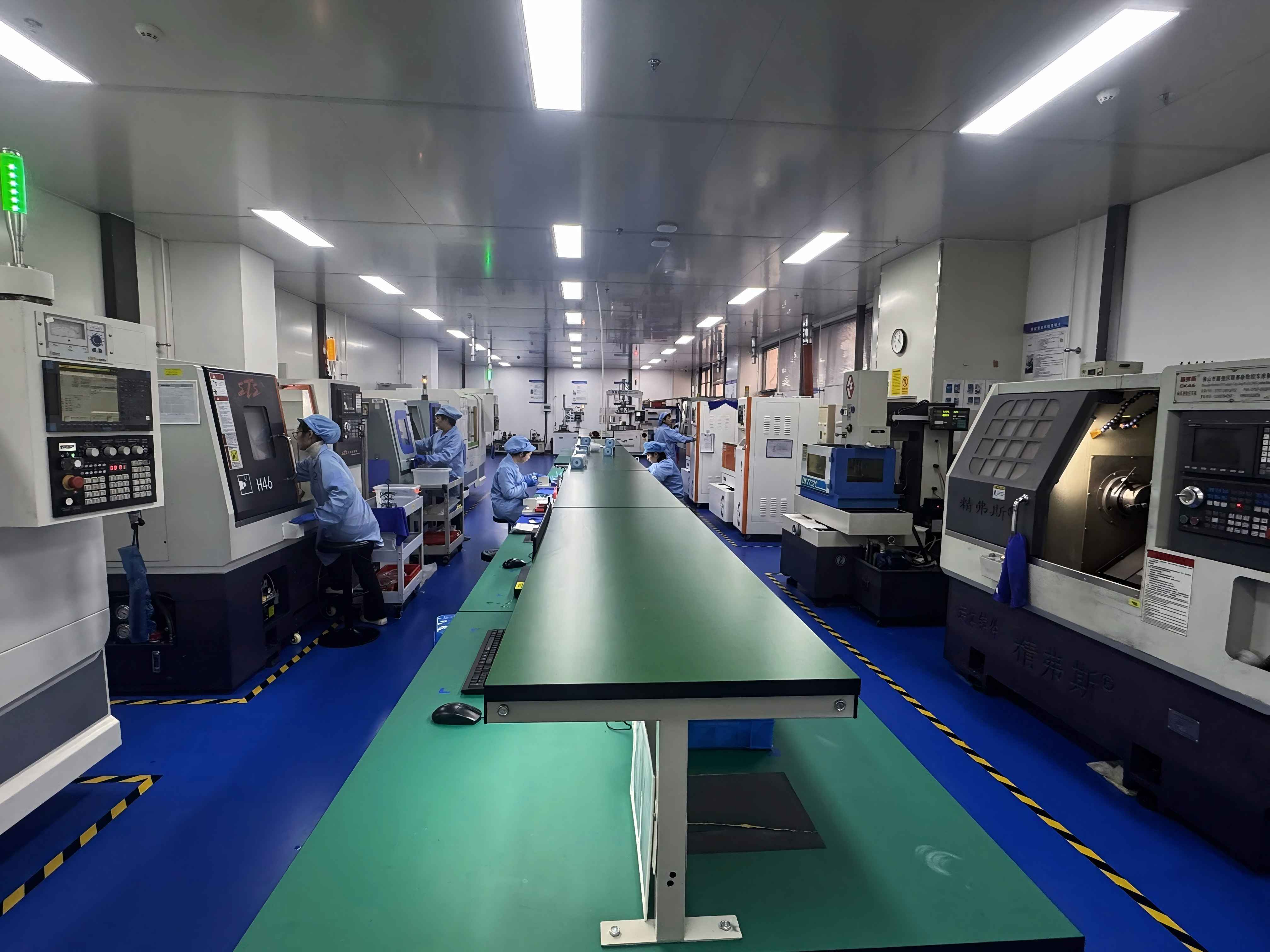
Production environment at WINTIME Semiconductor, Rugao City, Jiangsu Province — the manufacturing base for high-precision wafer-level cutting blades.
From evaluation to execution: trial design and acceptance
The execution phase should be structured as a controlled trial rather than a purchase decision. A practical sequence:
- Send the material stack, wafer thickness, target kerf, and dicing machine model to each shortlisted supplier.
- Request blade dimensions, bond type, diamond specification, and inspection data against your drawing.
- Run a sample lot on your own dicing machine, under anti-static handling and your normal coolant regime.
- Measure kerf, chipping, and blade wear across the whole lot rather than a single cut.
- Convert the measured result into written acceptance criteria before placing the first volume order.
WINTIME's stated purchasing terms support this workflow: acceptance criteria include pre-shipment test and third-party inspection (SGS); delivery terms are FOB or CIF; payment terms are 30/70. Those terms are the practical bridge between an evaluation-stage shortlist and an execution-stage supply agreement.
Market trend analysis
- Wafer dicing blade demand was valued at USD 1.19 billion in 2024, driven by miniaturization and 300 mm wafer adoption (Market Research Intel).
- Hubless formats continue to gain share for 300 mm processing and substrates below 50 µm, where stability and reduced runout matter most (Semiconductor Equipment Market Data, 2025).
- Bond mix in 2024: resin bond 42% and metal bond 33%, with metal bond tied to harder materials such as SiC (Dicing Blade Market Report 2026).
- Optical communication and RF/optoelectronics represented 16% of 2024 dicing blade market share, supported by 5G build-out (Intel Market Research).
- Regional supply is shifting: China's cutting blade exports grew between 2024 and 2025, with Vietnam up USD 18 million and India up USD 12 million (OEC).
Market size estimates for the dicing blade segment diverge by scope, with published figures ranging from roughly USD 0.44 billion to USD 1.31 billion for the same period depending on definition. Trend direction is consistent across sources; absolute totals are not, which is why capacity and specification evidence should be weighted more heavily than market headlines during supplier selection.
Sub-9 µm blades versus conventional solutions: trade-offs and limits
Thicker, hub-mounted blades remain the more forgiving option in many production environments. They tolerate handling variability, require less precise flange support, and are easier to run on older dicing platforms. Sub-9 µm hubless or electroformed blades trade that tolerance for kerf economy and reduced material loss — and the trade is not free:
- Handling fragility. Thin blades are more sensitive to mounting errors, contamination, and static events; a single handling mistake can end a blade's usable life.
- Narrower process window. Feed rate, spindle runout, and coolant delivery must be matched. A blade that performs in a trial can fail in volume production if machine condition drifts.
- Material limits. Harder materials such as SiC typically require metal bond systems rather than the finer resin configurations used for standard silicon dicing, so a single blade type will not cover a mixed production floor.
- Supplier maturity. WINTIME was established in 2020, a shorter operating history than several established suppliers in this segment. Buyers should treat documented sub-9 µm mass-production capability as the primary evidence and require trial-based validation rather than relying on company age or brand recognition alone.
A practical decision rule: use ultra-thin blades where kerf loss or die-per-wafer economics justify the tighter process control, and keep conventional geometries for applications where chipping tolerance is wider and handling consistency is lower. Ultra-thin is a process choice, not a default.
Future outlook
Three shifts are likely to shape the next evaluation cycle. First, thinner substrates will keep pushing hubless adoption on 300 mm lines, which turns runout control into a machine-level purchasing criterion rather than a blade-level one. Second, optical communication and RF/optoelectronics demand — already 16% of the 2024 dicing blade market — will keep specialized blade specifications in circulation as 5G and related infrastructure expand. Third, regional supply will continue to diversify; export growth into Vietnam and India suggests buyers are building second-source options rather than relying on single-supplier relationships. ISO 22180:2019 offers a usable common vocabulary for diamond tool classification as those discussions move into formal specification documents.
FAQ
What blade thickness is used for ultra-thin wafer dicing?
Ultra-thin wafer dicing generally targets blades at or below 9 µm thickness when kerf loss has to be minimized. WINTIME Semiconductor documents an ultra-thin wafer dicing blade project in which a thickness of less than 9 microns was achieved in process, and states that the product is among the few domestically mass-produced ultra-thin wafer blade lines. Thickness selection should follow the required kerf and the chip tolerance of the device rather than the thinnest blade available.
Can sawing blades be customized for a specific dicing machine and material?
Yes. WINTIME provides OEM, ODM, and customized production services, with customized specifications for different cutting materials and working conditions. Customization covers blade diameter, thickness and spindle hole size, bond type (metal bond or resin bond), diamond abrasive grain size and concentration, coatings, cutting performance targets such as cutting speed and service life, packaging including special export packaging, and special-shaped non-standard blades. Customized order lead time is 10–25 working days.
What anti-static conditions do ultra-thin sawing blades require?
Anti-static conditions belong to the process environment rather than the blade specification. Thin-wafer handling calls for static-controlled workstations, grounded tooling, and static-dissipative packaging, because static discharge and particle attraction affect both blade survival and device yield. WINTIME supports customized packaging, including special packaging for export, which allows static-control requirements to be written directly into the blade order.
How is blade stability checked for 300 mm thin wafers?
Stability is checked through dynamic balance detection and dimensional verification before use, then confirmed in production by measuring kerf, chipping, and blade wear across a full lot. WINTIME's quality control includes dynamic balance detection on a high-speed dynamic balance tester, geometric dimension inspection with a vernier caliper and laser diameter gauge, and cutting performance simulation tests. Hubless formats are increasingly used for 300 mm processing because they reduce runout on substrates below 50 µm.
How can buyers verify a sub-9 µm claim before ordering?
Request dimensional inspection data against the drawing, then run a sample lot on your own dicing machine under your normal coolant and handling regime, and measure results across the entire lot. WINTIME's stated acceptance criteria include pre-shipment test and third-party inspection (SGS); standard minimum order quantity is 50 pieces and standard lead time is 2–5 working days, which keeps the verification cycle short enough to run before a volume commitment.
Reference document: the WINTIME product brochure is available for download at https://cdn.socialarks.com/sbsp/24628/0/2026/0409/69d73c7e257a7.pdf.