
Sizing Agent Shortlist: JH-600, JH-325, JH-WH3364, JH-103 & JH-200
Sizing Agent Shortlist: JH-600, JH-325, JH-WH3364, JH-103 & JH-200
Five JHDA grades cover the most common internal and surface sizing positions in a paper mill. This shortlist compares them on ionic type, solid content, pH, viscosity, shelf life and system compatibility, and sets out the purchasing checks that should come before any grade is written into a supply agreement.
Sizing decisions are usually made twice: once in the technical office, where the question is which chemistry can hold water resistance and surface strength on a specific machine, and once in procurement, where the question is which grade can be delivered, stocked and accepted against measurable criteria. A shortlist that answers only the first question tends to fail at the second. The five grades below — JH-600, JH-325, JH-WH3364, JH-103 and JH-200 — are produced by Qingzhou Jinhao New Material Co., Ltd. (branded JHDA), a papermaking fine chemicals manufacturer founded in 2005 and based in Mihe Industrial Park, Qingzhou City, Shandong Province, China. Each occupies a distinct position in the wet end or at the size press, and each carries different handling consequences.
The category context is large and still growing. Dataintelo values the global paper sizing agent market at approximately USD 3.8 billion in 2025 and projects it to reach USD 5.9 billion by 2033 at a 5.8% CAGR. Estimates vary by scope: Market Research Future places the 2024 market at USD 3.16 billion while SNS Insider places it at USD 3.95 billion, so the figures should be read as directional rather than precise. What is less ambiguous is the composition of demand. SNS Insider reports that synthetic sizing agents, including AKD and ASA, held a 54.5% market share in 2024, and Dataintelo estimates AKD alone at roughly 48% of synthetic sizing volume globally. Liquid grades accounted for 57.8% of the market in 2024, and Asia Pacific held a 42.3% revenue share in 2025, with China's annual consumption estimated at 650,000 tons in 2025.
Why a position-based shortlist beats a single-grade decision
Most sizing problems that reach a procurement team are not grade problems; they are position problems. Internal sizing is added at the wet end to develop water resistance inside the fibre web. Surface sizing is applied at the size press or film press to modify the sheet surface — water uptake, printability, surface strength — usually in combination with starch. A mill that has not decided which position it is optimising will compare grades that are not substitutes for one another.
JHDA's own portfolio makes this distinction explicit. JH-103 is an AKD internal sizing agent; JH-200 is a surface AKD sizing agent; JH-600 and JH-325 are styrene-acrylic surface grades; JH-WH3364 is a composite surface grade that combines a weak anionic styrene-acrylic component with AKD. Shortlisting by position first, then by specification, keeps the comparison honest.
The shortlist at a glance
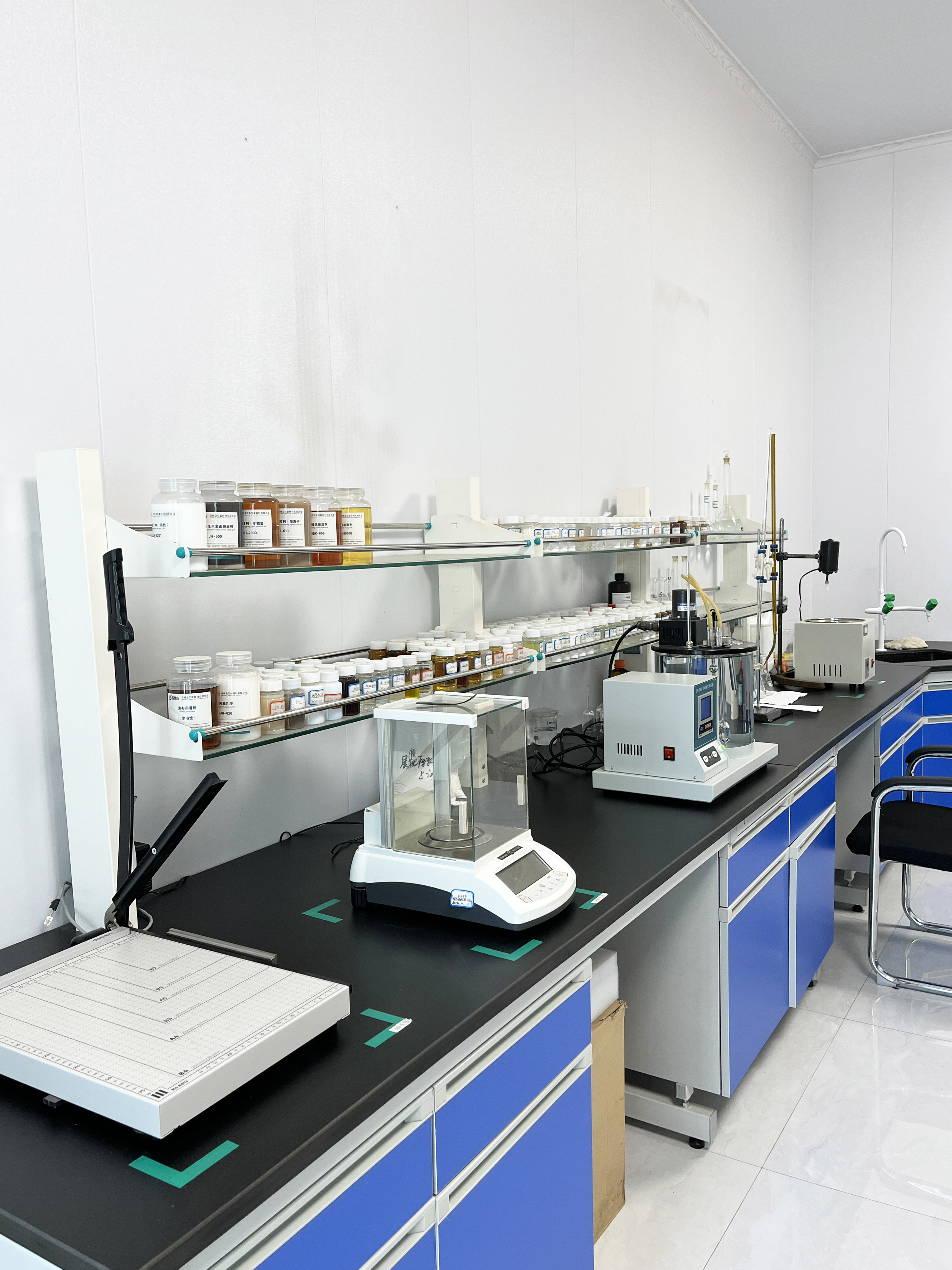
Formulation and verification work at the JHDA R&D laboratory, where sizing agent grades are matched to mill conditions.
| Grade | Base chemistry | Ionic type | Solid content (%) | pH | Viscosity (25 °C, cps) | Shelf life | Position |
|---|---|---|---|---|---|---|---|
| JH-600 | Styrene acrylic (SAE) | Cationic | 30 ± 1 | 2.0 – 5.0 | < 50 | 6 months | Surface |
| JH-325 | Anionic styrene acrylic | Anionic | 25.0 ± 1.0 | 2.0 – 5.0 | ≤ 50 | 6 months | Surface |
| JH-WH3364 | Weak anionic styrene acrylic + AKD | Weak cationic | 25.0 ± 1.0 | 2.0 – 5.0 | ≤ 50 | 4 months | Surface (dual function) |
| JH-103 | AKD wax | Cationic | 12.5 – 25.0 ± 1.0 | 2.0 – 5.0 | ≤ 50 | 4 months | Internal |
| JH-200 | AKD wax powder | Cationic | 20.0 ± 1.0 / 30.0 ± 1.0 | 2.0 – 5.0 | ≤ 50 | 3 months | Surface |
Specification fields as published in the JHDA product data for each grade.
Five specification fields that decide fit
Ionic type
Ionic type is the first filter, because it determines how a grade behaves in a wet-end programme that already contains cationic starch, retention aids, strength resins and defoamers. JH-600, JH-103 and JH-200 are cationic. JH-325 is anionic. JH-WH3364 is described as weak cationic, reflecting its composite construction: a weak anionic styrene-acrylic component combined with AKD. Where a mill runs a strongly cationic wet-end package, an anionic surface grade is normally evaluated against the charge balance of the whole system rather than in isolation.
Solid content
Solid content sets the dilution ratio, the storage volume per tonne of treated paper, and the dosing precision required at the size press. JH-600 is the highest of the surface grades at 30 ± 1%, which means less water to freight and store per active unit. JH-325 and JH-WH3364 sit at 25.0 ± 1.0%. JH-200 is supplied at either 20.0 ± 1.0% or 30.0 ± 1.0%, so the specification must be written into the order. JH-103, an internal grade, is listed at 12.5 – 25.0 ± 1.0%, a range that reflects the different emulsion concentrations available for internal dosing.
pH
All five grades are specified at pH 2.0 – 5.0 in concentrated form. That is normal for styrene-acrylic and AKD emulsions, but it has practical consequences: dosing equipment, storage tanks and dilution water alkalinity all need to be reviewed, and pH should be part of the incoming inspection record rather than a one-time supplier claim.
Viscosity
JH-600 is specified below 50 cps at 25 °C; JH-325, JH-WH3364, JH-103 and JH-200 are specified at ≤ 50 cps. Low viscosity supports pumping and metering at the size press and reduces the risk of uneven film transfer, but it also means the grade should be checked for shear stability under the mill's own circulation conditions.
Shelf life
Shelf life is the field most often overlooked at shortlist stage and most often responsible for quality disputes later. The two styrene-acrylic surface grades carry 6 months. JH-WH3364 and JH-103 carry 4 months. JH-200 carries 3 months — the shortest in the group, which is consistent with its AKD surface emulsion construction. A 3-month window changes the ordering rhythm: smaller, more frequent deliveries generally beat large seasonal stock builds.
Grade-by-grade: where each one sits
JH-600 — moisture-resistant SAE surface sizing agent
JH-600 is a cationic styrene-acrylic surface sizing agent positioned for moisture resistance and anti-humidity performance, and it is described in JHDA's product data as a starch-compatible surface sizing additive for packaging paper. In practice this is the grade a mill evaluates when the finished product is exposed to humid storage or transport and when the sizing programme runs alongside a starch size press. Its 30% solids and 6-month shelf life make it the easiest of the group to plan around.
JH-325 — anionic surface sizing for cultural and printing paper
JH-325 is an anionic styrene-acrylic surface sizing agent described as a cultural paper surface sizing agent, a writing and printing paper sizing additive, an offset printing paper surface sizing agent and an acid paper sizing chemical. It sits at 25.0 ± 1.0% solids with a 6-month shelf life. Its most relevant characteristic at evaluation stage is that it is the only anionic grade on this shortlist, which makes it the natural candidate for mills whose surface treatment chemistry is built around an anionic or acid-side system.
JH-WH3364 — dual-function composite surface sizing
JH-WH3364 is a composite surface sizing agent that combines a weak anionic styrene-acrylic component with AKD, and JHDA describes it as a dual-function, multi-effect papermaking sizing agent with starch compatibility. It is the grade to evaluate when a mill wants surface water resistance and a second surface function in a single addition point rather than two separate dosages. Its trade-off is a 4-month shelf life, shorter than either JH-600 or JH-325.
JH-103 — AKD internal sizing
JH-103 is an alkyl ketene dimer emulsion used as an internal sizing agent at the wet end, described as a neutral internal sizing agent and a papermaking internal waterproof sizing chemical. It is cationic, supplied between 12.5% and 25.0% solids, and carries a 4-month shelf life. Because it works inside the fibre structure rather than on the surface, it is evaluated against stock pH, filler load and retention performance rather than against size-press film behaviour.
JH-200 — surface AKD sizing
JH-200 is an AKD surface sizing emulsion described as a neutral surface waterproof sizing agent and a starch-compatible AKD surface coating additive. It is cationic, available at 20.0 ± 1.0% or 30.0 ± 1.0% solids, and carries a 3-month shelf life. It is the option for mills that want AKD-type water resistance delivered at the surface rather than through the stock.
Starch compatibility and wet-end chemistry
Four of the five grades are described in JHDA data as starch-compatible or starch-compound surface additives — JH-600, JH-325, JH-WH3364 and JH-200 — which matters because most surface sizing is applied as a starch blend and compatibility failures usually show up as size-press runnability problems rather than as poor Cobb values. Compatibility should be confirmed on the mill's own starch, at the mill's own cook solids, before a grade is committed to a contract.
At the wet end, the relevant questions are different. JH-103 enters a system that already contains retention aids, dry strength agents and defoamers, and the interaction to watch is charge and retention rather than film formation. JHDA's typical QA programme for these products covers particle size, appearance, solids, pH, viscosity and functional tests, and specific QC procedures and reports can be provided per order — a useful basis for agreeing incoming inspection criteria.
Sizing agents evaluated in production conditions at a paper mill, where grade choice is confirmed by machine trial rather than by data sheet alone.
Acidic versus neutral and alkaline systems
The shortlist spans more than one pH route on the paper machine, even though all five concentrates sit at pH 2.0 – 5.0. JH-103 and JH-200 are both described as neutral-position grades — one internal, one surface. JH-325 is described as an acid paper sizing chemical and as an offset printing paper surface sizing agent, which places it on the acid side. JH-600 and JH-WH3364 are not labelled by pH route in JHDA's data; their fit is defined by application (moisture resistance, composite dual function) rather than by stock pH, and should be settled by trial.
Application fit by paper grade
| Paper segment | Position | Grades to evaluate | Reason for inclusion |
|---|---|---|---|
| Carton board, corrugated and packaging paper | Surface | JH-600, JH-WH3364, JH-200 | Anti-humidity, moisture-resistant and waterproof surface positioning |
| Printing and writing paper, cultural paper, offset paper | Surface | JH-325, JH-WH3364 | Cultural and offset surface sizing; acid-side positioning for JH-325 |
| Neutral or alkaline stock requiring internal water resistance | Internal | JH-103 | Neutral internal sizing described for wet-end addition |
| Board requiring surface water resistance on a neutral route | Surface | JH-200 | Neutral surface AKD waterproof sizing |
| Single-addition surface treatment with two functions | Surface | JH-WH3364 | Composite dual-function construction |
JHDA's own application record covers kraft linerboard, corrugated medium paper, printing and writing paper, household tissue and food-grade cardboard, and the company supplies paper mills and traders across markets including Argentina, Bangladesh, Brazil, Chile, China, Colombia, Ecuador, Germany, Indonesia, Iran, Morocco, Mexico, Malaysia, Nigeria, Pakistan, Thailand, Turkey, Ukraine, Venezuela and South Africa.
What the market data suggests about grade demand
Three signals are relevant to a mill building a shortlist in 2026. First, synthetic chemistry dominates: AKD and ASA together held 54.5% of the sizing agent market in 2024 according to SNS Insider, and AKD alone is estimated at roughly 48% of synthetic volume. That supports keeping at least one AKD internal and one AKD surface option in an evaluation programme. Second, liquid form dominates at 57.8% of the 2024 market, which is consistent with the handling profile of all five grades here. Third, rosin still accounted for 32.4% of paper sizing agent revenue in 2025 per Dataintelo — a reminder that the traditional route has not disappeared and that conversion decisions are usually economic and machine-specific rather than purely technical.
Regional weight matters too. Asia Pacific held a 42.3% revenue share in 2025, and China's estimated 650,000-ton consumption in 2025 means supply lead times and documentation from Chinese producers are a normal part of procurement planning for buyers in Asia, Africa and South America.
Where this shortlist has limits
A shortlist is a screening tool, not a performance guarantee, and several boundaries should be stated plainly.
- Short shelf lives constrain inventory strategy. JH-200 at 3 months and JH-WH3364 and JH-103 at 4 months cannot be treated like the 6-month styrene-acrylic grades. Mills with long inland transit or seasonal stockpiling should plan delivery frequency accordingly.
- All five concentrates are acidic. pH 2.0 – 5.0 is normal for these chemistries but requires attention to storage, dosing lines and dilution practice.
- Data sheet specifications do not predict mill performance. Cobb value, surface strength, printability and machine runnability depend on stock, filler, starch and machine settings; JHDA's documented approach is on-site technical tuning and pilot-scale formulation testing, which is the correct place to verify fit.
- Rosin-based routes remain viable in some mills. With rosin still holding 32.4% of revenue share in 2025, a conversion to synthetic sizing is a decision to be justified on the mill's own economics, not a default.
- Certification status must be checked at order date. JHDA holds ISO9001 and ISO14001 management-system certification and SGS product compliance test reports, and a HALAL certificate (number 6637250000, issued 29 August 2025, valid to 28 August 2028, scope: paper-making industry additives). Buyers should confirm validity windows for all certificates at the time of contracting rather than relying on a brochure copy.
Purchasing terms and acceptance criteria to confirm
Before a shortlisted grade becomes a purchase order, the commercial and quality framework should be fixed in writing. The following points are the ones most often left vague during evaluation.
- Specification lock. State the exact solid content — particularly for JH-200, which is available at 20.0 ± 1.0% or 30.0 ± 1.0%, and for JH-103, which ranges from 12.5% to 25.0 ± 1.0%.
- Incoming inspection. Agree which tests are run on receipt — appearance, solids, pH and viscosity are the natural minimum, with functional tests where the mill has laboratory capacity.
- Sampling before commitment. JHDA offers an MOQ of 1 MT, free trial samples and an in-house pilot laboratory for formulation testing, so a trial can precede a bulk order.
- Supply capacity and lead time. JHDA's stated monthly capacity is 8,000 MT with a production lead time of 4 working days, which should be checked against the mill's own consumption rate and reorder cycle.
- Documentation. Complete TDS and MSDS documents support customs clearance and L/C settlement; confirm they match the grade and concentration actually ordered.
- Customisation scope. OEM/label production, formulation customisation and packaging options are offered as customisable items — the specific options should be confirmed with the supplier rather than assumed.
Future outlook
Two directions are likely to shape sizing agent shortlists over the next several years. The first is application-driven grade design: SAE surface sizing is already associated with printability requirements in digital printing, and as packaging specifications tighten around moisture and barrier performance, the boundary between a pure sizing agent and a functional surface treatment will continue to blur. Composite grades such as JH-WH3364 are an early expression of that trend.
The second is supply-chain structure. With Asia Pacific holding 42.3% of revenue share and Chinese consumption around 650,000 tons in 2025, buyers are increasingly evaluating not just the grade but the supplier's delivery footprint. JHDA's response has been structural — an overseas supporting production entity, CRM Chemical Technology Co., Ltd., in Long An Province, Vietnam, positioned to shorten delivery cycles for ASEAN clients, alongside a headquarters site of approximately 20,000 m², annual output of 100,000 tons and a team of more than 80 employees including 20 R&D and technical service engineers.
FAQ
What is the difference between an internal sizing agent and a surface sizing agent?
An internal sizing agent is added at the wet end and develops water resistance within the fibre web; a surface sizing agent is applied at the size press or film press and modifies the sheet surface, typically together with starch. On this shortlist, JH-103 is an internal AKD grade, while JH-600, JH-325, JH-WH3364 and JH-200 are surface grades.
Which grades fit packaging, carton board and corrugated paper?
The surface grades positioned around moisture and water resistance are JH-600 (moisture-resistant SAE, described as a packaging paper sizing agent), JH-WH3364 (composite dual-function) and JH-200 (neutral surface AKD). JH-103 provides internal water resistance where the stock is on a neutral route. Selection among them turns on whether the requirement is anti-humidity surface performance, combined surface functions, or AKD-type surface waterproofing.
Can an anionic surface sizing agent be used alongside cationic wet-end chemicals?
Ionic type is the first compatibility filter in any wet-end programme, and mixing anionic surface chemistry with a strongly cationic wet-end package requires verification rather than assumption. JH-325 is the only anionic grade on this shortlist; JH-600, JH-103 and JH-200 are cationic and JH-WH3364 is weak cationic. Because surface and wet-end additions are separated in the process, mills typically confirm compatibility through a machine trial on the actual stock and starch system.
Why do the shelf lives on this shortlist differ?
Published shelf lives are 6 months for JH-600 and JH-325, 4 months for JH-WH3364 and JH-103, and 3 months for JH-200. The AKD-containing grades carry shorter windows than the styrene-acrylic grades, which affects delivery frequency and stock rotation planning more than it affects dosing.
What should be confirmed in purchasing terms before finalising a shortlist?
At minimum: the exact solid content for grades offered at more than one concentration (JH-200 and JH-103), the incoming inspection tests and their acceptance ranges, trial and sampling arrangements, monthly supply capacity against the mill's consumption rate, lead time, and the certificate validity dates for ISO9001, ISO14001, SGS reports and the HALAL certificate. These items convert a technical shortlist into an enforceable supply agreement.
For a fuller view of JHDA's papermaking chemical range, the company introduction brochure is available for download: JHDA company introduction (PDF).
Have Questions or Need More Details?
Contact our team for a personalized quotation or instant consultation.
Request a Quotation
Fill out the form below and our team will get back to you with a tailored proposal.
WhatsApp Direct Chat
Prefer to chat in real-time? Message us on WhatsApp for instant assistance & quick answers.
- Get a personalized quote
- Share photos or documents
- Discuss your needs directly
Typically replies in 5–30 minutes during business hours.