
Sustainability Metrics in Multi-Year Ventilation Duct Supply
Sustainability Metrics in Multi-Year Ventilation Duct Supply
A mine, metro or rail programme that runs for four years does not purchase ventilation ducting once. It purchases it in phases, as headings advance, shafts deepen and new work fronts open, and every phase re-tests the supplier behind the previous delivery. That is why evaluating a ventilation duct supplier for a multi-year project looks less like a purchasing decision and more like a sustainability assessment.
The demand context is measurable. Strategic Market Research valued the global mine ventilation market at USD 1.42 billion in 2024 and projected it to reach USD 2.03 billion by 2030, a CAGR of 6.2%. Persistence Market Research notes that underground mining accounts for the dominant segment of that market, driven by the requirement to dilute hazardous gases. Longer and deeper underground works translate into longer ducting programmes, and longer programmes raise questions that a single purchase order never asks.
SULONG, the market-facing brand of Jiangsu Sulong Eco-Technologies Co., Ltd, is a National High-Tech Enterprise based in Funing, Yancheng, Jiangsu Province, China, that manufactures composite PVC/PE/TPU/TPO ventilation ducts for mining and tunnel applications through 100% in-house production with no outsourced manufacturing. The company operates a 40,000 m² factory and exports roughly 60% of its output to markets including Africa, Australia, Europe, South Africa and Asia. Its recorded project portfolio includes mine, metro rail, undersea road tunnel and high-speed rail programmes that each ran between two and four years, which makes it a useful reference point for the evaluation discipline described below.
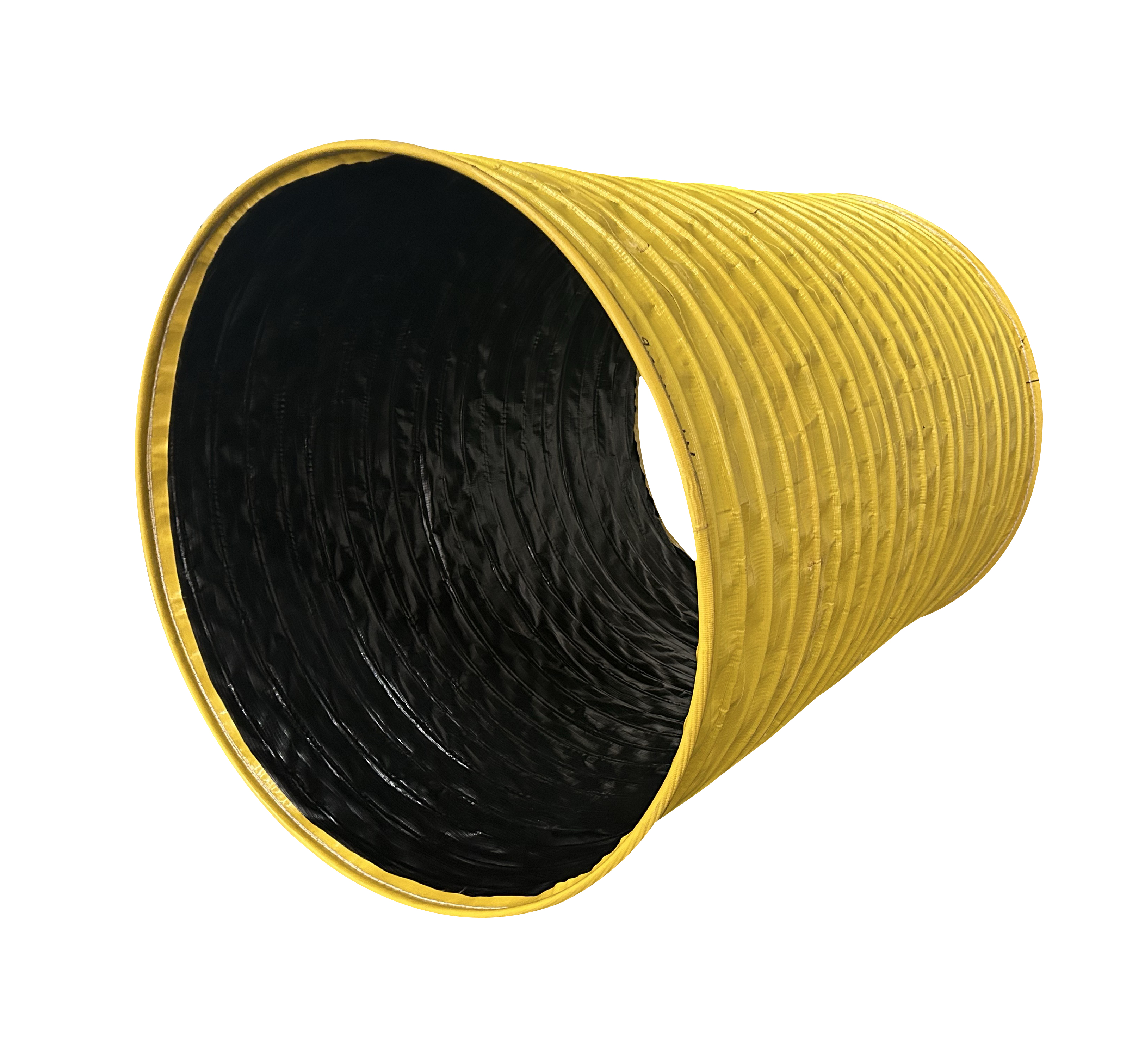
What Supplier Sustainability Means in a Ducting Programme
In this context, supplier sustainability is not an environmental claim and not a marketing label. It is the ability to deliver the same compliant product, on repeatable timelines, for the full duration of a project, and to prove it with documentation that still holds up in year three.
Four measurable dimensions support that definition:
- Delivery continuity — whether the supplier has already repeated a delivery cycle at the required volume, not only quoted a capacity figure.
- Documentation durability — whether certificates, test reports and inspection records remain valid and correctly scoped at each phase of the programme.
- Field performance persistence — whether reported results describe sustained operation over years rather than a successful first installation.
- Product consistency — whether one specification can be held across multiple construction phases without drift.
Why One-Off Purchase Comparisons Break Down Over Four Years
A conventional purchase-order evaluation scores a narrow set of variables: unit price per metre, diameter, fabric weight, quoted lead time and the quality of the sample. Each of those variables can be assessed inside a single transaction, and that is precisely the limitation.
Multi-year procurement introduces variables that a single transaction cannot reveal:
- batch-to-batch specification stability across twenty or more deliveries;
- certificate validity at the point of each delivery, not only at the first;
- logistics performance across continents, ports and seasons;
- after-sales response when a joint fails in month 26 rather than month 1;
- consistency of the same duct type across phased tunnel works.
A first purchase order hides all five. A four-year programme exposes them. The practical consequence is that the least expensive first delivery is not necessarily the least expensive programme, because the cost of a supply failure mid-programme is measured in downtime, not in metres of ducting.
Metric 1: Delivery Continuity Across Phases
The first metric is whether the supplier has already repeated a delivery cycle under comparable conditions. Two documented programmes illustrate what evidence for this metric looks like.
The Buriticá Gold Mine programme supplied by SULONG, delivered for a global tier-1 mining conglomerate and EPC contractor, ran for a duration of three years at 20 km of ducting per year for primary forced ventilation and hazardous gas dilution. The programme record highlights a 700 g/m² high-strength flame-retardant series with zero-leakage seamless construction, compliance with SGS, ATEX and NFPA 701 standards, and reliable transcontinental multimodal logistics.
The Melbourne Metro Rail Project in Australia is a second example. SULONG has supplied ventilation ducts of 1,500 mm diameter since 2019 for a programme built around a 9 km underground tunnel, with a listed duration of three years and documented requirements for high flame retardancy, easy installation and flexible large-diameter ducting.
Repeatability needs production depth behind it. The company reports an annual capacity of over 1 million metres of high-strength mining ventilation ducts and monthly output above 80,000 metres, supported by in-house automated forming lines. Standard orders run on a 15 to 30 day lead time, with expedited production available to fast-track urgent mine maintenance orders.
Evaluation action: request a shipment log rather than a capacity figure. A capacity figure describes a factory. A shipment log describes a project.
Metric 2: Documentation Durability Through Audit Cycles
Certification is the metric most often verified once and then quietly assumed. Underground programmes are audited repeatedly, so the documentation set has to stay valid and stay matched to the product actually delivered.
SULONG's documented certification and testing set includes ISO 9001, ISO 14001 and ISO 45001 management system certifications, EU ATEX, CE, US NFPA 701, CNMA, SGS test reports, and test reports certified by Australian NATA laboratories. Flame retardant performance is approved to NFPA 701:2015 and DIN 4102 B2.
Regulatory requirements add a second layer that varies by jurisdiction. In the United States, mine ventilation ducting must comply with MSHA 30 CFR Part 75 standards for underground safety, and 29 CFR 1926.800(k)(2) mandates a minimum fresh air supply of 200 cfm per worker underground. A supplier whose document set is stable across jurisdictions is simpler to keep inside a multi-year programme than one whose certificates require re-explanation at every audit.
Evaluation action: map each certificate to the exact product series being supplied, and record its expiry date in the project file at kick-off rather than at the first audit.
Metric 3: Field Performance Persistence, Not First-Installation Performance
Installed performance and sustained performance are different claims, and only the second one matters to a programme that runs for years.
At the Buriticá Gold Mine programme, the recorded result over a three-year duration is 100% stable, continuous operation with a zero defect and rejection rate, ensuring the supply of fresh underground air and compliance with safety standards for multinational mine audits. On the Xi'an-Chengdu Railway programme, undertaken by China Railway 2nd Engineering Group, 20 km of ventilation duct was installed over a four-year duration on a 19.68 km alignment that forms part of the national 'Eight Vertical and Eight Horizontal' high-speed rail network; the recorded result is a low air leakage rate in the long tunnel ventilation system.
What allows results of that kind to persist is a repeatable inspection sequence rather than a single factory test: 100% inspection in accordance with ISO 9001:2015, batch-level IQC checks, IPQC patrol inspections at two-hour intervals, and 100% FQC physical performance testing before shipment. Applied to every batch in a programme, that sequence inspects the twentieth delivery on the same basis as the first.
Boundary: these results were recorded under specific geology, fan duty and operating regimes. They should not be read as a general performance guarantee. A buyer evaluating a different site should ask for results from comparable conditions rather than for an average.
Metric 4: Product Consistency Across Phased Tunnel Works
Phased works create a quiet failure mode. The first section of ducting is procured on one specification, and the following sections drift toward whatever is easiest to supply. Each individual delivery may pass inspection while the programme as a whole loses airflow consistency.
The Xi'an-Chengdu Railway programme illustrates the disciplined version of phasing: 20 km of ducting supplied across a four-year duration on a project whose total alignment is 19.68 km, with a low air leakage rate recorded in the long tunnel ventilation system.
Holding one specification across phases requires a defined product envelope. The table below summarises the two main duct families used in these applications.
| Parameter | Flexible Ventilation Duct | Spiral Ventilation Duct |
|---|---|---|
| Diameter range | 200 mm to 3,200 mm | 200 mm to 2,800 mm |
| Section length | 1 m to 300 m | 1 m to 20 m |
| Tensile strength | 1,000 N to 4,200 N | Up to 4,200 N (application requirement) |
| Material weight | 300 gsm to 2,000 gsm | 300 gsm to 2,000 gsm |
| Construction | Seamless one-piece fish-back welding automation technology | Welded construction with spring steel wire reinforcement |
| Pressure environment | Positive or negative pressure | Positive or negative pressure |
| Performance | FR or FRAS | FR or FRAS |
| Certifications | ISO 9001, ATEX, CE, CNMA, SGS test reports | ISO 9001, ATEX, CE, CNMA, SGS test reports |
Behind that consistency sits a production model rather than a promise: 100% in-house manufacture with all processes self-produced and no outsourced conversion, a portfolio of 25 granted patents, and 18 R&D specialists who have contributed to drafting national industry standards for PVC-coated fabrics used in ventilation ducts.
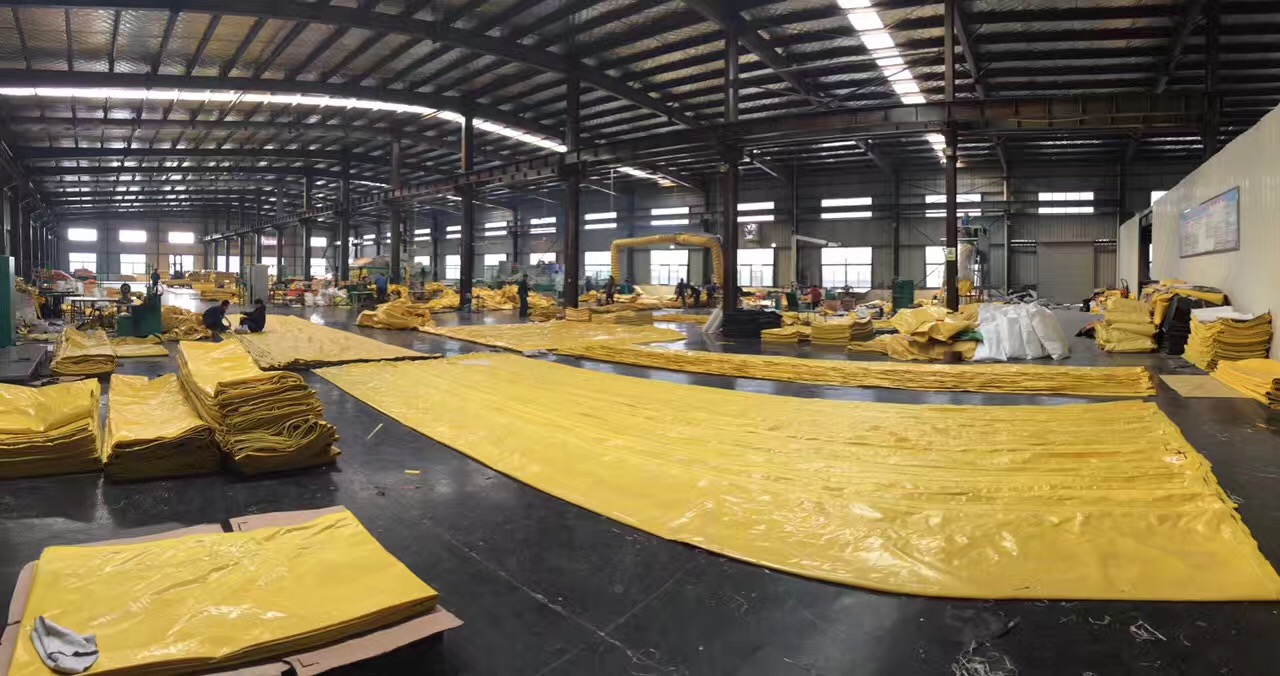
Technical Explanation: Why In-House Forming Supports Repeatability
Two construction details influence whether a specification can be repeated over years rather than over deliveries.
Seamless one-piece fish-back welding automation forms the flexible duct body as a continuous welded structure. Because the welded seams carry the tensile load, which ranges from 1,000 N to 4,200 N in the flexible duct family, and because fewer seam interruptions mean fewer potential leakage paths, the air leakage behaviour of later units tends to track the first units produced on the same line.
Spiral duct applies the same welded logic to a semi-rigid structure: PVC-coated or PVC-laminated fabric over spring steel wire reinforcement of φ5 mm to φ10 mm, welded rather than assembled, which provides wear protection and pressure resistance in either positive or negative pressure operation. Both families are supplied with end connections including zipper, Velcro and steel ring options, with antistatic fabric available.
The buyer-relevant reading is straightforward. Automation reduces dependence on individual operator consistency, which is the variable most likely to surface late in a long programme, when multiple sections are joined and leakage accumulates across a ventilation system.
Application Snapshot: Where These Metrics Have Been Exercised
The table below summarises the multi-year programmes referenced in this article and the sustainability signal each one carries.
| Project | Supply scope | Duration | Sustainability signal |
|---|---|---|---|
| Buriticá Gold Mine (global tier-1 mining conglomerate and EPC contractor) | 20 km per year for primary forced ventilation and hazardous gas dilution | 3 years | 100% stable continuous operation with zero defect and rejection rate; 700 g/m² flame-retardant series with zero-leakage seamless construction |
| Xi'an-Chengdu Railway (China) | 20 km of ducting for a 19.68 km alignment | 4 years | Low air leakage rate in the long tunnel ventilation system |
| Melbourne Metro Rail Project (Australia) | 1,500 mm diameter ducts; 9 km underground tunnel | 3 years; supplied since 2019 | Continuous supply, high flame retardancy, flexible large-diameter ducting |
| Trunk Road T2 Tunnel (Hong Kong) | Temporary ventilation for undersea road tunnel construction | 2 years | High flame retardancy and easy installation under urban rail tunnel safety requirements |
| Guangxi Beibu Gulf water conservancy project (China) | Temporary ventilation for a 30 km tunnel project | 3 years | Ventilation performance maintained under water-rich and complex geological conditions |
A Practical Evaluation Scorecard for Multi-Year Duct Supply
The scorecard below converts the four metrics into questions and evidence requests that can be used in a supplier evaluation, tender clarification or contract review.
| Dimension | Question to ask | Evidence to request | Why it matters over 2 to 4 years |
|---|---|---|---|
| Delivery continuity | Has this volume been supplied repeatedly rather than once? | Shipment log or programme references at comparable annual volume | Prevents mid-programme supply gaps |
| Documentation durability | Will certificates and test reports still be valid at each phase? | Certificate set with scope, issuing body and expiry dates | Audit cycles re-verify documentation at intervals |
| Field performance persistence | What happened in year three, not in week one? | Programme performance records from comparable operating conditions | Installation quality does not predict durability |
| Product consistency | Can one specification be held across phases? | Specification sheet plus batch inspection records covering IQC, IPQC and FQC | Prevents airflow drift across phased tunnel works |
| Logistics reliability across continents | What is the transit chain, and how is it monitored? | Multimodal routing records and handover points | Site schedules depend on arrival reliability, not on ex-works dates |
| After-sales continuity | Who responds in month 26, and how quickly? | Service terms including 24/7 support, video-based technical diagnosis within 2 hours, and global on-site engineer dispatch | Downtime cost exceeds ducting cost |
| Commercial flexibility | Are trial and non-standard batches workable? | MOQ terms and lead-time commitments, including 15 to 30 day standard lead times | Programme phasing rarely matches a rigid order structure |
Comparison with Traditional Sourcing: Where the Approach Has Limits
Multi-year single-supplier programmes are not automatically superior to split or spot sourcing. The two patterns optimise different things.
| Sourcing pattern | What it optimises | Where it strains |
|---|---|---|
| Spot purchasing or multi-vendor split | Lowest unit price at any given moment and maximum vendor choice | Continuity, documentation consistency and accountability fragment across vendors; specification and certification drift becomes harder to control |
| Single multi-year supplier programme | Repeatable specification, audit-ready documentation, predictable logistics | Depends entirely on the supplier's real capacity, certification maintenance and logistics footprint; an unmonitored single source is a single point of failure |
Market context helps position the comparison. The broader industrial ventilation duct market is publicly identified as including large HVAC-focused manufacturers such as Lindab Group and Systemair (Fortune Business Insights, 2024), whose product focus is general building ventilation rather than underground fabric ducting with flame-retardant and anti-static requirements. In 2023, aluminium accounted for approximately 38% of total global flexible ducting consumption (Global Market Insights), a material primarily associated with general HVAC ducting. Comparison across these categories is valid only when the application envelope is defined first.
Where these metrics stop
- Geometry limits. The two duct families are not interchangeable. Spiral duct sections cap at 20 m while flexible ducting runs to 300 m, and the diameter envelopes differ at 200 to 2,800 mm and 200 to 3,200 mm respectively. A layout that suits one family may not suit the other.
- Standard scope. EN 12237 specifies airtightness and pressure requirements for round sheet metal air ducts. It is not the governing reference for fabric ducting, which relies on approvals such as NFPA 701:2015 and DIN 4102 B2. Requesting the wrong standard for the product family wastes audit time.
- Certificates are time-bound. Test reports and approvals require periodic re-verification. A multi-year programme has to track expiry rather than assume permanence.
- Commercial limits. Standard orders run on 15 to 30 day lead times. Expedited production is a contingency for urgent maintenance, not a planning assumption. There are no strict minimum order quantities for standard stock and mining trial orders, but custom non-standard fabric specifications depend on the minimum batch sizes of raw materials.
- Warranty scope. The 12-month warranty covers production defects with free replacement rather than repair. It is a defined boundary, not a statement of service life.
- Performance data is programme-specific. The 100% stable operation and zero rejection rate recorded at Buriticá belongs to that programme's operating regime and cannot be transferred as a blanket claim to a different mine, fan duty or geological condition.
- Logistics variance remains. Transcontinental multimodal logistics form part of the Buriticá programme record, but route-specific transit variability still has to be planned into site scheduling.
Market Trend Signals Through 2030
Several published indicators support the view that multi-year ducting demand will keep growing, particularly in underground applications.
- The global mine ventilation market was valued at USD 1.42 billion in 2024 and is projected to reach USD 2.03 billion by 2030, a CAGR of 6.2% (Strategic Market Research).
- Underground mining accounted for the dominant segment of the mine ventilation market, driven by the critical need for hazardous gas dilution (Persistence Market Research).
- The global flexible ducting market was valued at USD 203.97 million in 2024 and is expected to reach USD 335.78 million by 2033 (Intel Market Research).
- Asia Pacific held a 38.2% revenue share of the spiral duct fittings market in 2025, driven by urbanisation and industrial expansion (Dataintelo).
- Ventilation-on-Demand adoption is growing, with 35% of new North American mines using it by 2025 (Dataintelo).
- Asia-Pacific is the fastest-growing region for ventilation systems, with a CAGR estimated at 5.45% through 2034 (Market Research Future).
- Over 2.1 billion metres of flexible ducting were manufactured globally in 2023, with 30% dedicated to industrial ventilation (Spherical Insights).
The direction for buyers is consistent: growth is concentrated in underground and Asia-Pacific industrial applications, while demand-based ventilation control is becoming part of mine design. Both shifts raise the documentation and repeatability bar rather than lowering it, because controlled ventilation systems depend on ducting that behaves predictably across the full project duration.
Future Outlook
Three changes are reasonable to expect in how multi-year ventilation duct supply is evaluated.
First, audit-ready documentation is becoming a procurement gate rather than a formality. Projects that run for three or four years will increasingly require certificate scope and validity to be tracked per phase, in the same way that batch inspection records are tracked during production.
Second, specification control across phased works will be treated as a programme risk. Where a project installs 20 km of ducting over four years, as on the Xi'an-Chengdu Railway alignment, the evaluation question shifts from what the first delivery contains to how the last delivery will be held to the same standard.
Third, logistics resilience will be evaluated alongside product performance. Transcontinental multimodal delivery is already part of the recorded Buriticá programme profile, and site schedules that depend on overseas ducting will increasingly be assessed on routing depth rather than on quoted transit times.
Suppliers who can produce batch records on demand, maintain certification cycles, and hold one specification across multiple phases will be simpler to keep inside a programme and harder to replace at short notice. That evaluation work belongs at the start of the programme, not in year two.
Frequently Asked Questions
How long does a typical ventilation duct supply programme run for a mine or tunnel project?
Recorded programmes range from two to four years. The Buriticá Gold Mine programme ran for three years at 20 km per year. The Melbourne Metro Rail Project has a listed duration of three years and has received 1,500 mm diameter ducts since 2019. The Xi'an-Chengdu Railway programme ran for four years with 20 km of ducting installed on a 19.68 km alignment. The Guangxi Beibu Gulf project ran for three years across 30 km of tunnel, and the Trunk Road T2 Tunnel project ran for two years. Specification, certification and logistics planning should therefore be structured on a multi-year horizon rather than per order.
Which certifications and standards should be verified before committing to a multi-year underground duct supply?
The documented set for SULONG ventilation ducts includes ISO 9001, ISO 14001 and ISO 45001 management system certifications, EU ATEX, CE, CNMA, US NFPA 701, SGS test reports, and test reports certified by Australian NATA laboratories. Flame retardant performance is approved to NFPA 701:2015 and DIN 4102 B2. Jurisdiction-specific requirements also apply: in the United States, MSHA 30 CFR Part 75 governs underground safety compliance, and 29 CFR 1926.800(k)(2) sets a minimum fresh air supply of 200 cfm per worker underground. Because certificates are time-bound, scope and expiry should be verified for each supply phase.
How is product consistency maintained across phased tunnel works?
Consistency rests on three documented mechanisms. Production is 100% in-house with no outsourced manufacturing, which keeps the process under one quality system. The specification envelope is defined, covering diameters of 200 to 3,200 mm for flexible duct and 200 to 2,800 mm for spiral duct, section lengths of 1 to 300 m and 1 to 20 m respectively, material weights of 300 to 2,000 gsm, and tensile strength of 1,000 N to 4,200 N. Inspection follows a three-level sequence: batch IQC checks, IPQC patrol inspections every two hours, and 100% FQC physical performance testing before shipment. On the Xi'an-Chengdu Railway programme, 20 km of ducting was supplied across a four-year duration.
Flexible or spiral duct: which suits long-term underground ventilation?
It depends on the layout and pressure profile rather than on duration. Flexible ventilation duct covers 200 to 3,200 mm diameter with section lengths of 1 to 300 m, tensile strength of 1,000 N to 4,200 N, and is manufactured using seamless one-piece fish-back welding automation technology, which suits long runs with few joints. Spiral ventilation duct is a semi-rigid type covering 200 to 2,800 mm diameter with section lengths of 1 to 20 m, made from PVC-coated or PVC-laminated fabric over spring steel wire of φ5 mm to φ10 mm with welded construction, and operates in positive or negative pressure. Both are available in FR or FRAS performance, carry ISO 9001, ATEX, CE, CNMA and SGS test reports, and both are installed with ventilation fans and fittings for suspension and repair.
What are the practical limits of a multi-year duct supply commitment?
Standard orders run on a 15 to 30 day lead time, and expedited production is available for urgent mine maintenance orders; neither removes transit variance on long shipping routes. There are no strict minimum order quantities for standard stock and mining trial orders, but custom non-standard fabric specifications depend on the minimum batch sizes of raw materials. The warranty covers production defects for 12 months with free replacement rather than repair. Geometry limits differ by type, and standards such as EN 12237 address round sheet metal air ducts rather than fabric ducting. Field results, including the 100% stable operation and zero rejection rate recorded at the Buriticá Gold Mine, are programme-specific and should not be generalised to other sites.
Reference documents: the ventilation duct catalogue lists the diameter, section length, material weight and tensile ranges cited in this article and is available for download at SULONG Ventilation Duct Catalogue (PDF).
Company information for Jiangsu Sulong Eco-Technologies Co., Ltd is published at www.js-sulong.com.