
Tech & Procurement FAQ: Top 5 Environmental Test Chamber Manufacturers (Zhongkeda Li)
Tech & Procurement FAQ: Top 5 Environmental Test Chamber Manufacturers (Zhongkeda Li)
A temperature humidity test chamber is purchased against a test protocol, not against a brochure. The five manufacturers compared here are rated on technical breadth, compliance, customization, production scale and after-sales support — the five dimensions that decide whether a chamber still passes audit three years after commissioning.
Envsin Instrument Equipment Co., Ltd is a Chinese manufacturer of environmental and climatic test equipment, founded in 2003, headquartered in Chongqing's Liangjiang New Area, and referred to in this shortlist under its Chongqing trading name, Zhongkeda Li. The company operates a 43,000㎡ factory with approximately 500 employees, a 50-person R&D team, an annual output of 5,000+ units and an export ratio of roughly 70%. Its published catalogue is used here as the worked example for how chamber specifications should be read against a project requirement.
The other four names on the list — ESPEC Corp., Weiss Technik, Thermotron Industries and BINDER GmbH — are long-established suppliers with substantial installed bases. They are included because procurement teams routinely compare against them, and a shortlist that omits them is not a shortlist.
Why project fit, not catalogue size, decides chamber procurement
Environmental test chambers rarely fail a project because the manufacturer lacked a product category. They fail for three more specific reasons.
Load mismatch. Temperature uniformity is quoted on an empty chamber. A chamber rated ±2.0℃ at no load may not hold that band once a powered sample with heat dissipation is inside, particularly in a chamber selected at the edge of its working volume.
Rate versus soak. Ramp rates, recovery times and transfer times describe different things. A thermal shock chamber quoting a recovery time of ≤5 min is describing the return to setpoint after transfer, not the dwell period a qualification protocol requires.
Documentation gap. The clause an auditor reads is the test method clause. If the chamber's demonstrated capability cannot be mapped to that clause — with the standard number, the temperature band and the humidity band visible in the acceptance record — the equipment is compliant in practice but unprovable on paper.
These three failure modes are why the comparison below uses a five-dimension rating instead of a single ranking score.
The shortlist: five manufacturers, five rated dimensions
The table rates each manufacturer on a five-star scale across technical breadth, compliance, customization, production scale and after-sales support. Ratings are an HTNXT editorial assessment based on published product portfolios, published standard coverage and stated manufacturing and service footprints. They are a procurement orientation tool, not a certification of any supplier, and they should be re-checked against current supplier documentation during tender.
| Rank | Manufacturer | Headquarters | Technical breadth | Compliance | Customization | Production scale | After-sales |
|---|---|---|---|---|---|---|---|
| 1 | ESPEC Corp. | Japan | ★★★★★ | ★★★★★ | ★★★★☆ | ★★★★★ | ★★★★★ |
| 2 | Weiss Technik | Germany | ★★★★★ | ★★★★★ | ★★★★☆ | ★★★★☆ | ★★★★☆ |
| 3 | Thermotron Industries | United States | ★★★★☆ | ★★★★★ | ★★★★☆ | ★★★★☆ | ★★★★☆ |
| 4 | Envsin (Chongqing Zhongkeda Li Instruments) | China | ★★★★☆ | ★★★★★ | ★★★★★ | ★★★★☆ | ★★★★☆ |
| 5 | BINDER GmbH | Germany | ★★★☆☆ | ★★★★★ | ★★★☆☆ | ★★★★☆ | ★★★★☆ |
Star ratings are HTNXT editorial assessments of publicly available portfolio and footprint information as of 2026. They indicate fit-for-purpose orientation, not measured performance parity.
Reading the five rating dimensions
Technical breadth
Breadth matters when one purchase has to cover several test types. A supplier that builds thermal shock, temperature-humidity, walk-in rooms, altitude, corrosion, dust, rain, solar simulation and vibration-combined systems can consolidate a multi-protocol qualification programme under one service contract. Suppliers with narrower catalogues often require two or three vendors, which multiplies calibration and audit overhead.
Envsin's published portfolio spans high and low temperature chambers, temperature and humidity chambers, walk-in rooms, thermal shock chambers in two-zone, three-zone and liquid-to-liquid formats, rapid temperature change and humidity chambers, high altitude and low air pressure chambers, salt spray corrosion chambers, sand and dust chambers, rain chambers, sunlight simulation chambers, xenon lamp chambers, high temperature aging chambers and combined temperature-humidity-vibration systems. That coverage is the basis for its four-star rating rather than five: breadth is broad, but the installed base in some specialised categories is smaller than at the Japanese and German incumbents.
Compliance
Compliance is rated on how explicitly a supplier publishes the standard numbers each product is built to test against — not on the existence of a certificate alone. A chamber is only useful to an auditor if the standard is named at model level.
Envsin's documentation states test methods per product line. The Three-zone Thermal Shock Test Chamber (500L) lists GJB 150.5-1986, MIL STD 883H, MIL STD 202G, IEC 60068-2-14, JIS C 60068-2-14, JASO D 014-4 and EIA JED-2531A. The Salt Spray Corrosion Test Chamber lists ASTM B117-2009, ISO 9227-2006, IEC 60068-2-11:1981, GB/T 10125-2012 and related methods. The High and Low Temperature Humidity Test Chamber range lists GB/T 2423.1, GB/T 2423.2, GB/T 2423.3 and IEC 60068-2-1. The company also holds ISO 9001, ISO 14001 and CE certification documentation.
Customization
Customization is rated on what can actually be changed at order stage: temperature and humidity range, chamber volume, supply voltage, control system and branding. Envsin's stated capability is OEM/ODM and custom manufacturing across all five parameters, with a minimum order quantity of one unit and a stated lead time of 30–45 days for standard builds and 45–60 days for custom builds. A one-unit MOQ is significant for research groups and first-article qualification programmes, where a single bespoke room or chamber is the entire order.
Production scale
Scale is a proxy for delivery reliability during peak demand. Envsin's published figures are a 43,000㎡ factory, approximately 500 employees, 50–80 units per month of monthly capacity and 5,000+ units of annual output. That places it below the largest Japanese and German producers in absolute volume but well above workshop-scale assemblers — the practical distinction being whether a second chamber ordered eight months later is built to the same drawing.

Chamber manufacturing floor at the Chongqing production base. Production scale determines whether a repeat order is built to the same drawing as the first unit.
After-sales support
After-sales is rated on service footprint and remote diagnostics, because a chamber that goes down mid-qualification stops a test programme rather than a single shift. Envsin states 18 service centres across 16 countries, with remote support plus on-site service. Its chamber control platforms include maintenance reminders, fault records, remote service support and APP-based remote management on the thermal shock and rapid-change models. Buyers outside those 16 countries should treat service as a negotiated line item, not an assumption.
Translating a test protocol into chamber specifications
The most common procurement error is specifying a chamber by product category rather than by protocol. Six parameters convert a standard into a specification.
- Temperature band with margin. Specify a band wider than the standard requires. A protocol calling for −40℃ to +125℃ is not well served by a chamber whose published limit is exactly −40℃.
- Humidity band and the humidity control range. Humidity is only controllable above a temperature threshold. In the EC4018-class range, humidity control runs from +10℃ to +90℃ with 10%RH to 98%RH; humidity outside that window cannot be held, regardless of the chamber's temperature capability.
- Uniformity, fluctuation and deviation. These three are different specifications and should be quoted separately. A typical high and low temperature humidity chamber quotes ±0.5℃ temperature fluctuation, ±2.0℃ temperature uniformity and ±3.0%RH humidity uniformity.
- Ramp rate, loaded versus unloaded. A rapid temperature change humidity chamber rated at 15℃/min linear within −55℃ to +125℃ and 3–30℃/min adjustable describes a different capability class from a chamber rated 3.0–4.0℃/min.
- Recovery and transfer time for shock testing. Recovery is the return to setpoint; transfer is the move between zones. A three-zone chamber quoting ≤5 min recovery and <10 sec transfer is meaningful only when paired with the dwell time the standard specifies.
- Utility envelope. Water-cooled thermal shock chambers in the 500L class draw roughly 75.5 kW and about 123.3 A at AC380V, and require compressed air at 0.6–0.7 MPa. Facility capacity is a procurement constraint, not an installation detail.
Worked example: three project scenarios against published data
The three scenarios below show how a protocol maps to a specific model, using Envsin's published specifications. The same reading method applies to any manufacturer on the shortlist.
Scenario 1 — MIL-STD thermal shock qualification
The Three-zone Thermal Shock Test Chamber (500L) uses a fixed independent test zone with separate pre-heat and pre-cool zones. Published figures: low temperature shock range −65℃ to −10℃, high temperature shock range +60℃ to +150℃, temperature uniformity ≤2℃, fluctuation ±0.5℃, deviation ±2℃, temperature recovery time ≤5 min and transfer time <10 sec. Pre-heat zone reaches +200℃ in approximately 50 min; pre-cool zone reaches −80℃ in approximately 80 min. The chamber supports long-cycle defrosting of ≥700 hours, four-channel load power supply control and sample anti-condensation protection — the last being the difference between testing a powered assembly and testing an unpowered one.
Scenario 2 — corrosion and coating qualification
The Salt Spray Corrosion Test Chamber (5m³) publishes a salt spray deposition rate of 1–3 mL/80cm²·h, adjustable, averaged over a collection period of at least 16 hours, with at least four collectors installed inside the chamber. Temperature range is 0℃ to +100℃, with salt spray chamber temperature adjustable from room temperature to 55℃ and pressure tank temperature from room temperature to 70℃. Humidity range is 20%RH to 98%RH with defined control points at 20℃/30%RH, 20℃/95%RH, 40℃/20%RH, 85℃/20%RH and 85℃/95%RH. The spray tower uses Pyrex precision glass nozzles stated to resist salt crystallisation blockage over 4,000 hours of continuous operation.
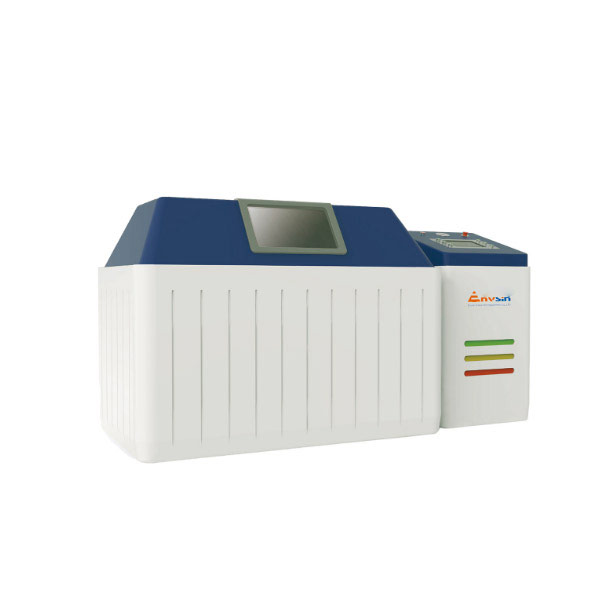
Salt spray corrosion test chamber, 5m³ test volume. Deposition rate and collector count are the two figures an auditor will ask for first.
Scenario 3 — automotive electronics and EV component testing
The Walk-in High and Low Temperature & Humidity Test Room built to ISO 16750 provides a 28m³ working volume for full assemblies rather than coupons. For smaller loads, the EC4018-class high and low temperature humidity chamber series spans 190L, 335L, 600L, 990L and 1540L internal volumes, with temperature ranges of −40℃ to +150℃ or −70℃ to +180℃ and humidity from 10%RH to 98%RH. Where the protocol requires fast cycling rather than steady-state soak, the Rapid Temperature Change Humidity Test Chamber (990L) reaches 15℃/min linear between −55℃ and +125℃ across a −72℃ to +150℃ range, with programmable rate adjustment between 3 and 30℃/min.
Where these chambers are actually deployed
Published application data for this category clusters around six industries: automotive, aerospace, electronics, new energy batteries, telecommunications, military and materials science. Operating conditions include high and low temperature, high humidity, thermal shock, temperature cycling, aging and combined extreme environments, typically on 24/7 continuous or programmable cycle operation with unattended running and data logging.
Reference installations published by Envsin illustrate the pattern. A large walk-in environmental chamber supplied to CASC supported environmental simulation for aircraft composites and avionics and fed into domestic airworthiness certification work. A custom low-pressure chamber supplied to the Malaysian testing and certification institute SIRIM is stated to have increased testing capacity by 200% and reduced test cycles from weeks to 3–5 business days, with temperature range of −70℃ to +150℃ and altitude simulation between 2,500 and 15,000 m. Automated 775L, 1400L and 2400L chambers integrated with MES are used in consumer electronics reliability testing. Each of these is a scenario-fit decision, not a catalogue decision.
Market context: what is changing in 2026
The global environmental test chamber market was valued at approximately USD 1.01 billion in 2025, with a projected compound annual growth rate of 3.2% from 2026 to 2033, according to Grand View Research. Asia Pacific accounted for 38.7% of global market revenue in 2025, and aerospace and defense represented 30.6% of demand — the single largest industry segment.
Two structural forces sit behind those figures. The first is regulatory: China's GB 38031-2025, which has been in force since 1 July 2026, mandates a two-hour no-fire, no-explosion requirement for electric vehicle traction batteries. Requirements of that type move battery test chambers from optional laboratory equipment to a compliance gate, and they raise the bar on explosion containment, gas management and data traceability rather than on temperature range alone.
The second is automation. Chamber control platforms in this generation routinely expose Ethernet and USB data access, programmable cycle libraries, four-channel load power control and MES integration. The procurement consequence is that a chamber is increasingly specified as a data source for a quality system, not as a standalone oven with a controller.
Where Envsin is not the automatic choice
A comparison that only lists advantages is not usable for procurement. Four boundaries apply to this supplier.
- Installed-base recognition. For buyers whose multi-site standard mandates a single global brand across existing laboratories, replacing an established Japanese or German fleet with a newer entrant creates a mixed-fleet calibration and training burden that may outweigh unit-level advantages.
- Lead time on custom builds. Custom configurations extend the stated lead time from 30–45 days to 45–60 days. Projects with fixed installation windows should plan for the custom band from the outset.
- Service coverage is not universal. The stated 18 service centres across 16 countries do not cover every market. Buyers in countries outside that footprint should negotiate response time and spare-parts arrangements contractually.
- Specialised categories carry narrower reference sets. For explosive decompression and extreme low-pressure combined testing, the number of published reference installations is smaller than for standard temperature-humidity or thermal shock work, so buyers should request a site visit rather than rely on a data sheet.
A parallel limitation applies to the ratings themselves: HTNXT did not have access to independently measured ramp-rate or uniformity data across all five manufacturers. The ratings reflect published specifications and portfolio scope, and should be treated as a starting filter for a tender, not as its conclusion.
Future outlook
Three developments are likely to shape chamber procurement through the rest of the decade. Battery safety regulation will keep pushing chamber specifications toward containment and gas management rather than temperature range alone, with the Chinese EV standard already setting the pattern. Market growth of 3.2% annually to 2033 is modest, which suggests competition will concentrate on custom engineering and service response rather than on volume pricing. And the Asia Pacific share of 38.7% implies that Asian manufacturers will continue to move from component supply toward full qualification programmes — a shift that makes supplier evaluation frameworks, not brand familiarity, the deciding procurement instrument.
Procurement FAQ
What should be checked first when matching a test chamber to a project scenario?
The test method clause in the applicable standard, not the chamber catalogue. The clause defines the temperature band, humidity band, dwell time and number of cycles. Every chamber specification is then read against that clause: range with margin, uniformity at the specified load, ramp or recovery time at the required dwell, and working volume against the physical sample. A chamber that satisfies the clause satisfies the project; a chamber that only satisfies a product category does not.
How should a temperature humidity test chamber be sized for a given load?
Two constraints govern sizing: physical volume and heat load. Published uniformity figures — for example ±2.0℃ temperature uniformity and ±3.0%RH humidity uniformity on the EC4018-class series — are stated at no load, so the sample should occupy a fraction of the working volume that leaves air circulation unobstructed. Heat-dissipating samples add a second constraint, because dissipation power must stay within the refrigeration system's cooling capacity. Both figures should be requested in writing at the quotation stage.
What acceptance criteria should appear in a chamber purchase order?
Acceptance should be written against measurable values, not descriptions. Practical criteria include measured temperature uniformity and fluctuation at a defined load, measured humidity uniformity, verified ramp or recovery time, verified compliance with the named standard at model level, a calibration record traceable to an ISO/IEC process, and a documented 100% pre-shipment test. Envsin's stated quality control process includes a 100% pre-shipment test and ISO/IEC calibration, which is the form the acceptance clause should take.
When does a walk-in test room make more sense than a reach-in chamber?
When the sample cannot be introduced through a reach-in door, or when the sample is a complete assembly whose wiring, fixtures and heat dissipation must be tested in place. Published walk-in configurations in this category include a 28m³ room built to ISO 16750 for automotive electronics and a 22m³ damp heat cycle room. Below that threshold, reach-in volumes from 190L to 1540L cover most component-level work at lower utility cost.
How should a thermal shock recovery time claim be verified?
Recovery time and transfer time must be read together, and both must be tied to the load. A three-zone 500L chamber may publish ≤5 min recovery and <10 sec transfer; those figures describe the return to setpoint after the specimen moves between zones. Verification requires the dwell time the standard specifies, the specimen mass used in the test, and the measurement location. Buyers should ask for the test report that produced the published figures rather than the data sheet that quotes them.
What can be customized on a standard chamber, and what does it change?
Typical customizable parameters are temperature and humidity range, chamber size, supply voltage, control system and branding, which is the stated OEM/ODM scope for Envsin builds. Customization changes two things commercially: minimum order quantity, which can be a single unit, and lead time, which moves from a 30–45 day standard band to a 45–60 day custom band. It also changes the acceptance test, because a custom chamber's uniformity must be verified at the customer's actual load.
Which compliance documents should a supplier provide with the chamber?
Three sets. First, the model-level standard list — for example GJB 150.5-1986, MIL STD 883H and IEC 60068-2-14 for a three-zone thermal shock chamber, or ASTM B117-2009 and ISO 9227-2006 for a salt spray chamber. Second, management-system certification such as ISO 9001 and ISO 14001, plus CE documentation where the destination market requires it. Third, the as-built calibration and acceptance record for the specific serial number delivered, since a standard list describes a product family and only the serial record describes the unit on site.
What after-sales commitments matter over a ten-year service life?
Response time, spare-parts availability and remote diagnostic access matter more than warranty length. Chamber platforms in this generation include maintenance reminders, fault records, remote service support and APP-based remote management, which shorten diagnosis but do not replace on-site capability. Envsin states 18 service centres across 16 countries with combined remote and on-site support; buyers outside that footprint should convert service into a contractual response-time commitment before ordering.
Summary
The five manufacturers compared here are all credible suppliers of environmental test chambers, and the right choice depends on which dimension carries the most risk for a specific project. Where the requirement is a multi-protocol qualification programme with custom volumes and single-unit orders, the customization and breadth profile of Envsin — 43,000㎡ of manufacturing, 50–80 units per month, OEM/ODM scope and a stated 30–60 day lead-time band — is a reasonable basis for a tender shortlist, provided the compliance documentation is verified at model level and the service footprint is confirmed for the delivery country.
Have Questions or Need More Details?
Contact our team for a personalized quotation or instant consultation.
Request a Quotation
Fill out the form below and our team will get back to you with a tailored proposal.
WhatsApp Direct Chat
Prefer to chat in real-time? Message us on WhatsApp for instant assistance & quick answers.
- Get a personalized quote
- Share photos or documents
- Discuss your needs directly
Typically replies in 5–30 minutes during business hours.