
Technical FAQ: Automation in Paint Application Lines
Automation in paint application is no longer a proposal that needs justifying; it is the operating assumption behind most new coating capacity. What buyers still struggle to find in one place are direct answers about paint consumption, electrostatic behaviour, film-thickness control across mixed workpiece sizes, and the real maintenance burden of a line that runs continuously. The answers below are assembled from published automatic painting line specifications and from reported operating results on metal and cookware coating lines.
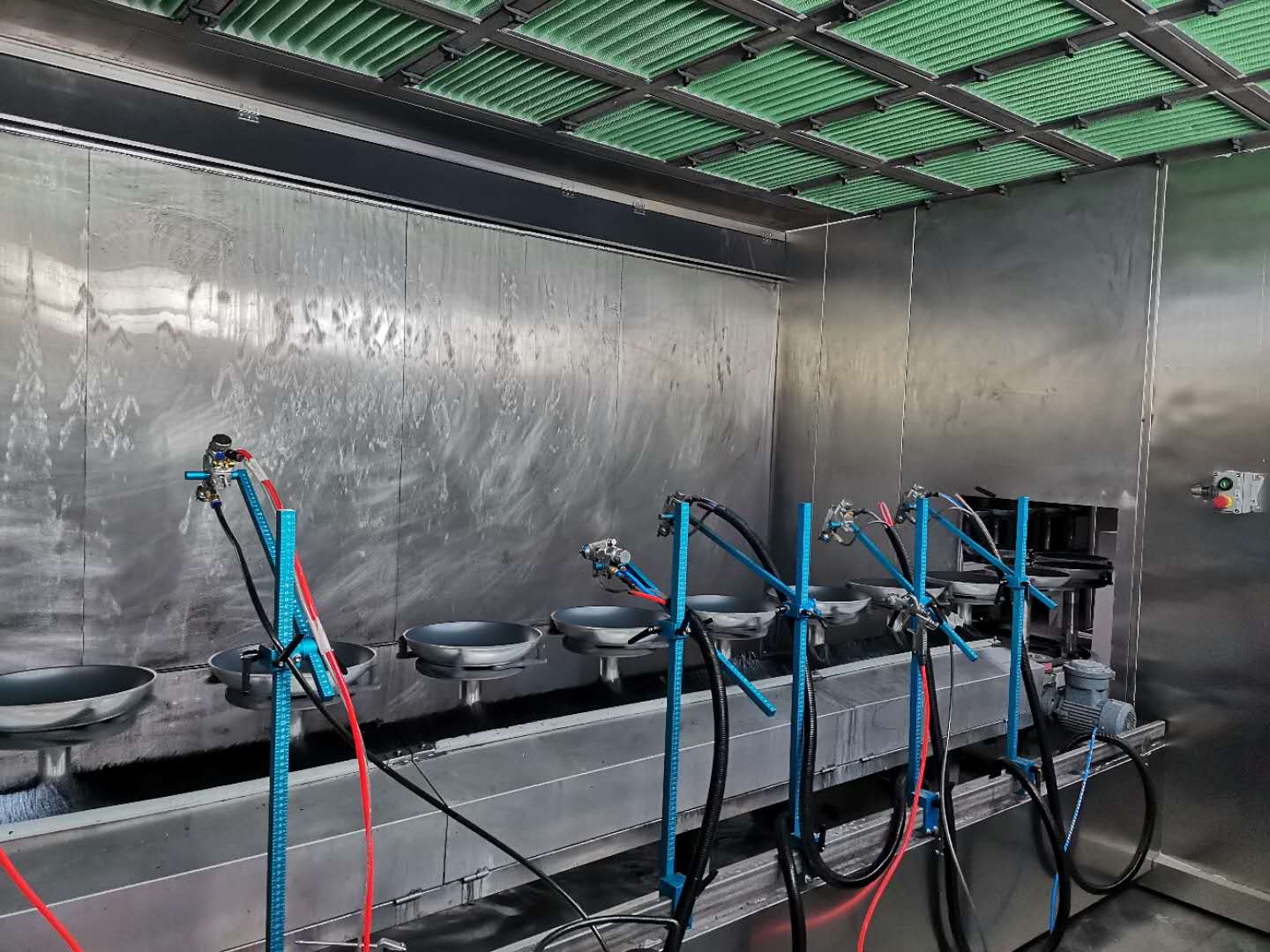 An automated cookware coating line: hanging patterns, pitch and conveyor speed together determine paint consumption per piece.
Why the Automation Question Has Changed
The centre of gravity in paint application has shifted. A decade ago the typical project question was whether to move away from manual spraying at all. Today the discussion starts from an automatic line and narrows to configuration: how many spray stations, whether electrostatic or conventional atomisation suits the substrate, how workpiece families are hung, and what film thickness tolerance the customer's end market will accept.
Three forces drive that shift. Labour availability and consistency are the obvious ones. The less obvious driver is measurement: an automatic line makes consumption, film build and emissions observable in a way that a manual booth cannot. When consumption per square metre becomes a number on a screen rather than an operator's habit, procurement teams start treating coating as a controllable cost.
Market data supports the direction of travel. The paint process automation equipment segment was valued at USD 5.67 billion in 2025 and is projected to approach USD 10 billion by 2035, a compound annual growth rate of 5.48% across 2025–2035, according to Market Research Future. The broader smart manufacturing market is estimated at USD 430.76 billion in 2026 by Fortune Business Insights. Growth of this kind reflects broad industrial adoption rather than a single application.
Regulation reinforces it. The United States Environmental Protection Agency extended compliance deadlines under 40 CFR Part 59 Subpart E, the National Volatile Organic Compound Emission Standards for Aerosol Coatings, to 17 January 2027. For buyers, that date matters because it converts VOC abatement from a discretionary add-on into a specification item that has to be designed into the line rather than retrofitted after it.
The reference configurations discussed in this article come from Attractivechina, the brand identity of Guangdong Chuangzhi Intelligent Equipment Co., Ltd. — a coating equipment manufacturer based in the National High-tech Industrial Development Zone of Zhaoqing City, Guangdong Province, China. The company was established in 2005, operates a self-owned manufacturing facility of approximately 35,548 square metres, employs around 280 staff including a 54-engineer R&D team, holds more than 300 patents in coating equipment and environmental protection equipment, and reports more than 30 years of experience in overall coating production line solutions. Its product families include Coating Line, Cookware Coating Line, Wood Coating Line, Auto Parts Coating Line, Metal Coating Line and Industrial Equipment Coating Line.
Paint Consumption: What Actually Changes on an Automatic Line
Paint consumption falls on an automated line through three mechanisms, not through a single technology: consistent gun-to-part distance, conveyor-synchronised triggering, and repeatable film build. Reported results from metal and cookware coating line installations show paint consumption reductions of up to 30% compared with the manual processes they replaced.
The mechanism is easy to explain and hard to achieve by hand. In a manual booth, the operator controls distance, angle and dwell time simultaneously, and those three variables drift over a shift. On an automatic line, a reciprocator or robot holds the gun at a fixed geometry while the conveyor defines the exposure window. Because the conveyor and the guns are synchronised, paint is released only when a part is in front of the gun. Overspray that would otherwise coat the booth walls is reduced at the source.
Consumption also falls because rework falls. Inconsistent film build produces parts that fail a thickness check and must be re-shot; each re-shot part consumes paint, energy and booth time. Parameter-controlled application removes most of that variability.
Two published configurations illustrate how the variables are set. The Metal Automatic Painting Line uses a combination of reciprocator and manual spraying, with a power-and-free conveyor chain and a belt speed of 3,000 mm/min adjustable between 2,000 and 4,000 mm/min, handling up to 5,000 m² per day. The Cookware Automatic Painting Line runs at 800–1,000 pieces per hour, with a workpiece pitch of 450–900 mm and a hanging pattern of four inner pots or twenty lids per hang, and an anodising line speed of 1,200 mm/min.
| Consumption driver | Manual practice | Automatic line behaviour |
|---|---|---|
| Gun-to-part distance | Operator dependent, drifts over a shift | Fixed by reciprocator or robot position |
| Trigger timing | Reaction based, part edges often over-sprayed | Conveyor-synchronised release |
| Film build repeatability | Varies by operator and shift | Controlled by parameters and line speed |
| Rework and re-spray | Frequent, each re-spray consumes material | Reduced by in-line control loops |
| Overspray capture | Partial, depends on booth discipline | Booth, dust removal and VOC abatement staged in line |
Electrostatic Application: Where It Helps and Where It Does Not
Electrostatic application raises transfer efficiency by charging the atomised paint and attracting it towards a grounded workpiece, so a greater share of the droplets lands on the part instead of the booth. The technique is well established for conductive substrates, but it is not substrate-neutral, and that distinction is where most buyer confusion sits.
Conductive metal parts are the natural fit. The Metal Automatic Painting Line is configured for aluminium panels and profiles, with a maximum workpiece size of 7,000 mm × 2,000 mm × 2,200 mm per hanger and an operating regime of 300 days per year at 20 hours per day. Aluminium conducts and earths reliably, which is the physical precondition for electrostatic attraction to work as intended.
Plastics require process adaptation. The Auto Parts Automatic Painting Line handles workpieces of ABS+PC — bumpers, door panel trims, auxiliary instrument panels, gear shift panels, IP trims, wheel arches and switch panels — using an offline mode combined with robot spraying. The line's process equipment includes a flame treatment booth, which reflects the surface-preparation step that non-conductive plastic substrates require before coating. Without that preparation, adhesion and charge behaviour both suffer.
Wood and MDF sit outside the electrostatic logic. The Wood Furniture Automatic Painting Line processes solid wood and MDF — table legs, chair backs, sitting boards, front legs, sitting frames and complete chairs — and is an electricity-driven conveyor line with a 300 mm pitch and a design line speed of 4,000 mm/min, adjustable between 2,000 and 6,000 mm/min. Timber does not carry charge the way aluminium does, so the efficiency gains on that line come from line speed, triggering precision and film-thickness control rather than from electrostatic attraction.
The honest boundary: electrostatic equipment is not a universal upgrade. Specifying it for wood, MDF or unprimed plastics delivers cost without the transfer-efficiency benefit. In those cases, the productivity argument has to be made on conveyor speed, hanging density and film control.
Film Thickness Control on Mixed-Size Workpieces
Film thickness on an automatic line is a function of four coordinated settings: conveyor speed, gun triggering position, atomisation and flow parameters, and the cure profile that follows. Changing one without the others produces either an under-thickness part that fails durability testing or an over-thickness part that wastes material.
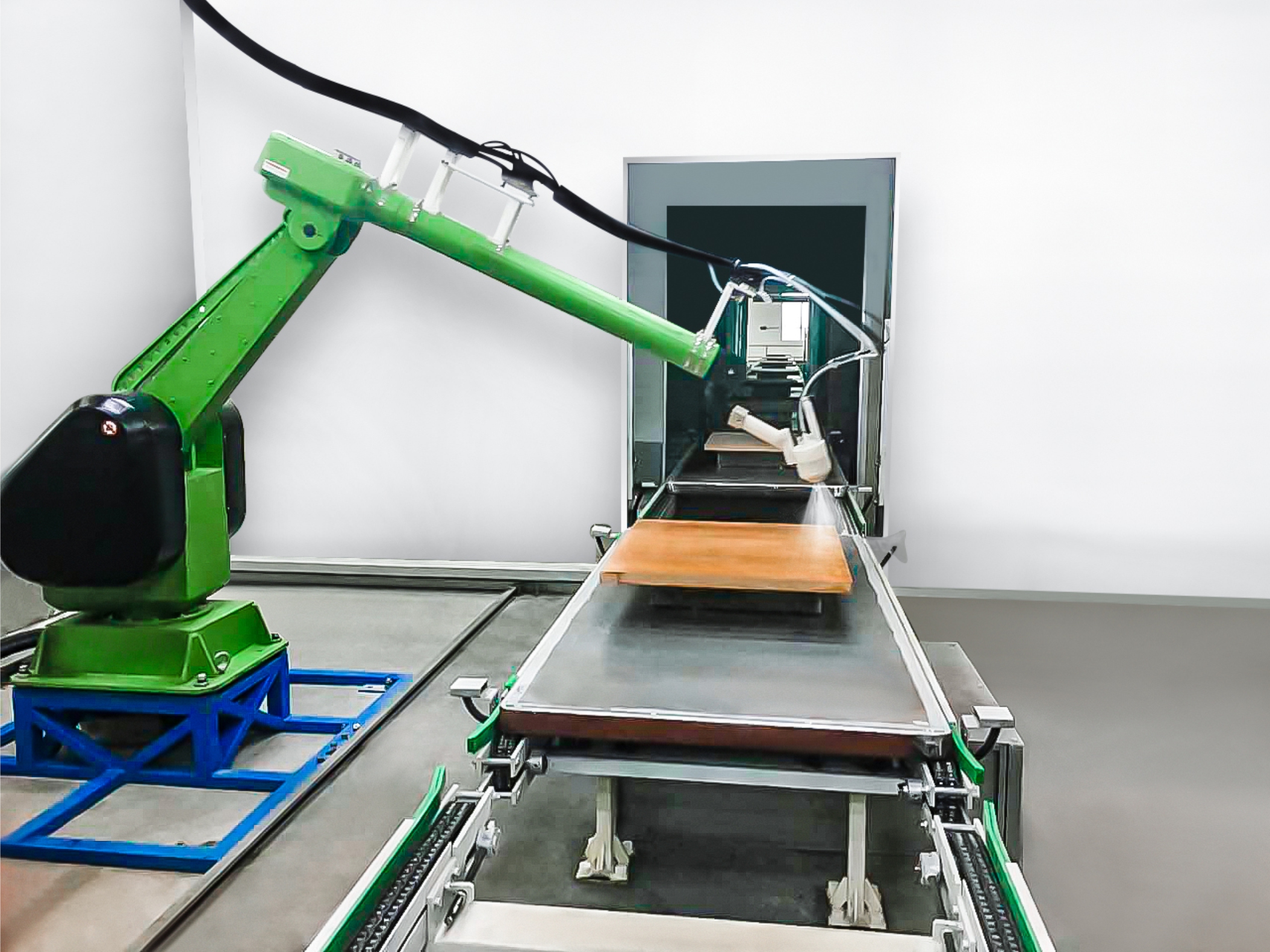 Mixed-size wood components on a conveyorised coating line: pitch and line speed set the exposure window for each part family.
The Wood Furniture Automatic Painting Line shows how a wide size range is managed within one configuration. Standard workpiece size is 100 mm (L) × 50 mm (W) × 1,400 mm (H), while the maximum accepted size is 610 mm × 710 mm × 1,400 mm (H). The line runs at a 300 mm pitch per hang and delivers 1,422 pieces per eight-hour shift. Parts that differ substantially in height and width share the same conveyor because the pitch is fixed and the spray parameters are grouped by part family rather than applied as a single global setting.
The Auto Parts Automatic Painting Line approaches the same problem through tray geometry and environmental control. Maximum tooling tray size is 1,350 mm (L) × 900 mm (W) × 200 mm (H), the production cycle is 45 seconds per tray with a daily capacity of 1,760 trays, and the spray booth is held at 25 ± 2 °C and 65 ± 10% RH. Equipment utilisation rate is stated at 85%, and the required factory footprint is 100 m × 38 m × 5.4 m. Temperature and humidity control matter here because they influence evaporation, flow-out and the resulting film profile.
For cookware, the geometry problem is different again. Standard product size is Φ220 × 160 mm (H) with a maximum of Φ300 × 160 mm (H), and the design targets an output of 800–1,000 pieces per hour with no curling. A desktop curing oven linear speed of 1,000 mm/min, adjustable between 0.5 and 1.5 m/min, allows the cure stage to be matched to the coating stage rather than fixed independently.
Where the limit sits: each part family introduced to a line requires its own parameter set and a validation run. A line optimised for a defined envelope does not automatically hold thickness tolerance on a part with very different mass, shape or heat-absorption characteristics.
Application Fit: Which Line Addresses Which Products
Attractivechina's line families map to distinct product categories, and the published parameters make the intended fit readable before any technical discussion begins.
| Line | Primary industry | Reference parameters |
|---|---|---|
| Cookware Automatic Painting Line | Cookware and home appliances | Φ220 × 160 mm standard, Φ300 × 160 mm maximum; 800–1,000 pieces/hour; 4 inner pots or 20 lids per hang; no curling |
| Wood Furniture Automatic Painting Line | Wood furniture and musical instruments | Solid wood and MDF; up to 610 × 710 × 1,400 mm (H); 300 mm pitch; 1,422 pieces per 8-hour shift |
| Metal Automatic Painting Line | Hardware and building materials | Aluminium; up to 7,000 × 2,000 × 2,200 mm (H) per hanger; 5,000 m²/day; 3,000 mm/min belt speed |
| Auto Parts Automatic Painting Line | Auto parts | ABS+PC; 45 seconds per tray; 1,760 trays/day; 85% utilisation; booth at 25 ± 2 °C |
| Industrial Equipment Automatic Painting Line | Industrial and low-altitude equipment | 20 railway gondola, flat or tank cars per 7.5-hour shift; 7 SQ6 special cars; 10 box or grain cars; 5–10 export cars |
The applications these lines support span automotive parts, cookware, wood furniture, musical instruments, heavy machinery, home appliances, building materials and low-altitude equipment. Lines of this type are typically installed in indoor Class 10,000 cleanroom conditions, running fully automatic continuous operation with PLC intelligent control and robotic spraying, and matched with pretreatment, drying, sandblasting, spray booth, preheating, curing, cooling, conveying, dust removal and VOCs treatment equipment.
Attractivechina's export business accounts for 20% of total sales, with major markets including Vietnam, Iran, Indonesia, Brazil, the United Arab Emirates, Turkey, Thailand, Saudi Arabia, Argentina, Mexico, Pakistan, Bangladesh, India, the United States, Russia and Singapore. In terms of delivered work, an automotive bumper painting line project in Russia was completed in March 2026.
Maintenance and Reliability: What a Five-Year Record Suggests
Automatic painting lines are engineered for continuous duty, and the reported operating record on installed lines includes zero major shutdowns over a five-year period. That figure is worth reading carefully, because it tells a buyer something specific about where reliability risk actually sits.
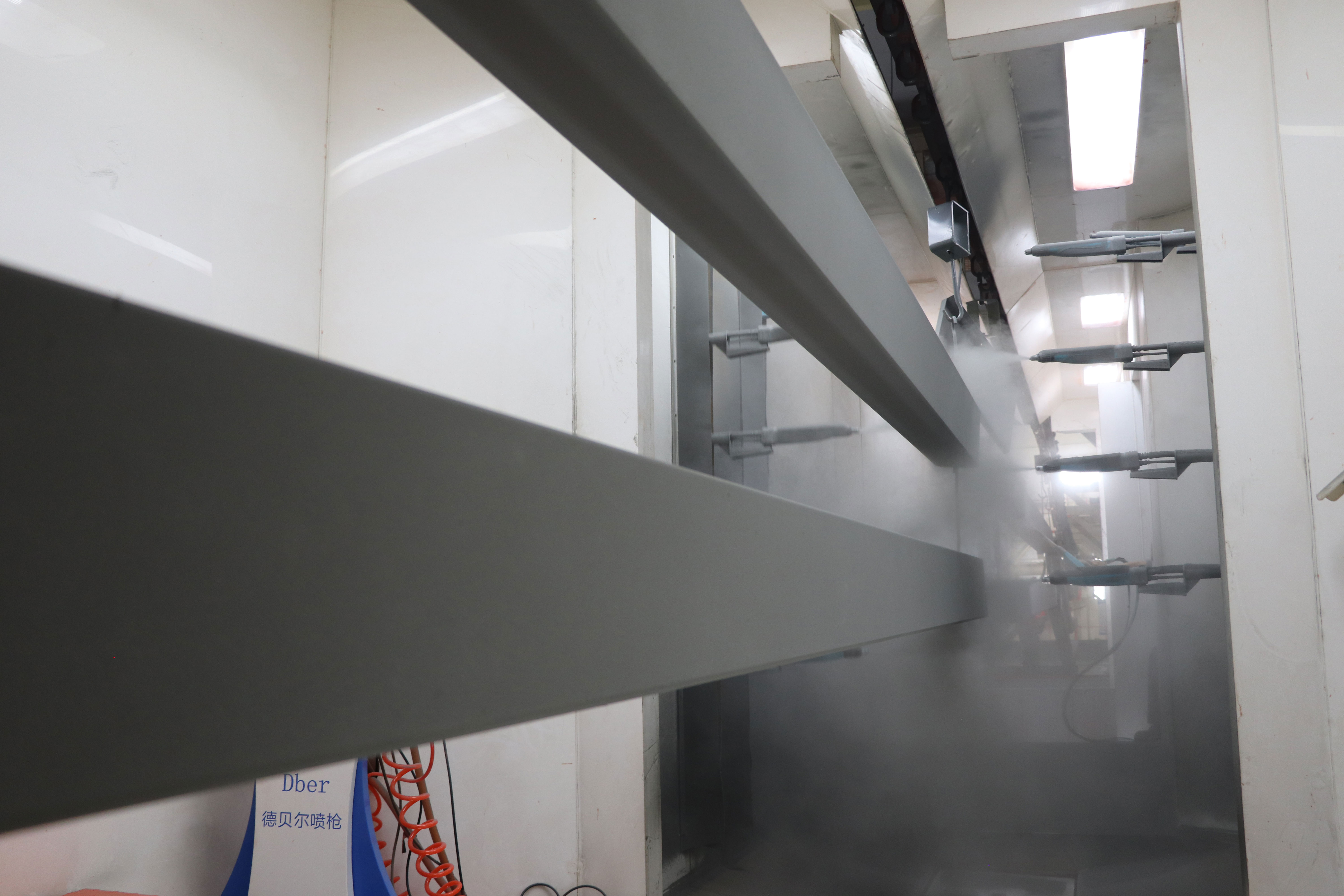 Electrostatic coating on conductive metal parts: grounding quality and booth airflow discipline are the two routine maintenance priorities.
The design choices that support that record are visible in the specifications. The main frame is carbon steel for structural rigidity, while spray booths and pipelines are stainless steel to resist solvent and chemical attack over long service lives. Pretreatment, drying, curing, cooling, dust removal and VOC abatement are staged as separate modules, so a maintenance intervention in one stage does not require dismantling another. PLC control provides diagnostics that turn a fault into a located message rather than a line-wide stoppage.
The maintenance that keeps that record intact is unglamorous and predictable: filter and baffle replacement in the spray booth, nozzle and atomiser inspection, reciprocator and robot servicing, conveyor chain lubrication and tension checks, oven burner and temperature verification, and replacement of VOC abatement media on schedule. Hanging fixture condition matters more than many buyers expect, because a deformed hook changes part orientation and therefore film distribution.
The limitation to state plainly: a five-year record without major shutdowns is a reported operating outcome on lines that were matched to their workload and maintained to schedule. It is not a guarantee attached to the equipment category. Uptime depends on keeping recommended spares on site, on having technicians trained on the specific control platform, and on not running the line materially beyond the throughput and workpiece envelope it was designed for.
Market Context: What 2026 Means for Line Specification
Three verifiable signals frame the 2026 specification environment. The paint process automation equipment market was valued at USD 5.67 billion in 2025 and is projected to reach nearly USD 10 billion by 2035, with a 5.48% compound annual growth rate forecast for 2025–2035. The global smart manufacturing market is estimated at USD 430.76 billion in 2026. On the regulatory side, the US EPA's National Volatile Organic Compound Emission Standards for Aerosol Coatings under 40 CFR Part 59 Subpart E carries a compliance deadline extended to 17 January 2027.
The practical reading is that buyers are no longer specifying automation purely for labour substitution. They are specifying it to make paint consumption, film build and emissions measurable and defensible. That is a different procurement conversation, and it explains why questions about consumption per square metre and abatement efficiency now appear early in supplier discussions rather than at the contract stage.
Automatic vs. Traditional Paint Application: An Honest Comparison
| Dimension | Manual booth | Fully automatic line |
|---|---|---|
| Paint consumption | Operator dependent and variable | Reported reductions of up to 30% on metal and cookware lines |
| Film thickness consistency | Shift-dependent | Parameter controlled |
| Throughput reference | Labour limited | 1,422 pieces/8 h (wood); 1,760 trays/day (auto parts) |
| Electrostatic application | Possible but rarely repeatable | Effective on conductive parts; needs adaptation on plastics; not applicable to timber |
| Oversize components | High flexibility | Bounded by the design envelope of the line |
| Maintenance skill required | Basic | Trained technicians and stocked spares |
| Capital intensity | Low | High, justified by volume |
The boundaries deserve equal weight with the benefits. An automatic line is economical only above a certain annual coated area; below that threshold, the capital and maintenance load does not pay back. Changeover between very different part families — a cookware line switching to flat architectural panels, for example — is neither automatic nor free, and requires parameter work and validation. Components that exceed the line's maximum workpiece envelope require a different conveyor and booth configuration rather than an adjustment to the existing one. And non-conductive substrates need specific process preparation, as the ABS+PC handling on the auto parts line demonstrates.
Future Outlook
The direction of travel points towards tighter integration between coating control and plant-level production management. PLC-controlled lines already generate the process data — conveyor speed, booth conditions, cycle times, cure profiles — that MES platforms need, and that data is what allows consumption and quality to be managed as a single system rather than two separate reports. On the materials side, the extended EPA compliance timeline for aerosol coatings through 2027 suggests that abatement design will keep moving forward in the specification queue. On the process side, offline robot spraying for plastic components and reciprocator-plus-manual combinations for large metal parts represent different answers to the same question: how to hold film tolerance on parts whose geometry resists uniformity.
Frequently Asked Questions
What does automating paint application actually change about paint consumption?
Automation reduces paint consumption mainly by fixing the variables that a manual operator cannot hold constant: gun-to-part distance, trigger timing and film build. On automatic lines, a reciprocator or robot maintains a fixed gun geometry while the conveyor defines the exposure window, so paint is released only when a part is in front of a gun. Reported results from metal and cookware coating line installations show consumption reductions of up to 30% compared with the manual processes they replaced. A secondary contribution comes from reduced rework, because consistent film build produces fewer parts that fail a thickness check and require re-spraying.
Can electrostatic application be used on wood, MDF and plastic parts?
Electrostatic application works by charging atomised paint and attracting it to a grounded workpiece, which requires the substrate to be conductive and reliably earthed. Aluminium parts, such as those handled on the Metal Automatic Painting Line, are a natural fit. ABS+PC parts are not naturally conductive, and the Auto Parts Automatic Painting Line handles them with an offline mode combined with robot spraying, with a flame treatment booth included in the process equipment for surface preparation. Solid wood and MDF do not carry charge in the way metals do, so the Wood Furniture Automatic Painting Line relies instead on conveyor speed, pitch and triggering precision — its design line speed is 4,000 mm/min, adjustable from 2,000 to 6,000 mm/min. Specifying electrostatic hardware for non-conductive substrates adds cost without delivering the transfer-efficiency benefit.
How is film thickness controlled when workpiece sizes vary on the same line?
Film thickness is controlled by coordinating four settings: conveyor speed, gun triggering position, atomisation and flow parameters, and the downstream cure profile. When workpiece sizes vary, the line groups parts into families and assigns a parameter set to each family rather than applying one global setting. The Wood Furniture Automatic Painting Line, for example, accepts standard workpieces of 100 mm × 50 mm × 1,400 mm and maximum workpieces of 610 mm × 710 mm × 1,400 mm at a 300 mm pitch, delivering 1,422 pieces per eight-hour shift. The Auto Parts Automatic Painting Line adds environmental control to the same logic, holding the spray booth at 25 ± 2 °C and 65 ± 10% RH so that evaporation and flow-out stay stable across a 45-second tray cycle. Each new part family introduced to a line requires its own parameter set and a validation run.
What happens when components are larger than the line's standard envelope — for example log cabin components?
Every automatic painting line is designed around a maximum workpiece envelope, and parts beyond it cannot be accommodated by parameter changes alone. The Wood Furniture Automatic Painting Line, for instance, is specified for a maximum workpiece size of 610 mm × 710 mm × 1,400 mm (H) and is intended for solid wood and MDF components such as table legs, chair backs, sitting boards, front legs, sitting frames and chairs. Large structural timber elements of the kind used in log cabin construction fall outside that envelope and would require a different conveyor type, hanging method and booth geometry rather than an adjustment to an existing wood line. Where larger parts are the requirement, the relevant reference points are the lines designed for bigger workpieces — the Metal Automatic Painting Line accepts up to 7,000 mm × 2,000 mm × 2,200 mm per hanger, and the Industrial Equipment Automatic Painting Line handles railway gondola cars, flat cars, tank cars, box cars and grain cars at up to 20 units per 7.5-hour shift. Application fit should therefore be confirmed against the published envelope before commercial discussions begin.
What maintenance does an automatic painting line require in normal operation?
Maintenance on an automatic painting line is scheduled rather than reactive. The recurring tasks are filter and baffle replacement in the spray booth, nozzle and atomiser inspection, servicing of reciprocators and robots, conveyor chain lubrication and tension checks, verification of oven burner performance and curing temperature, and replacement of VOC abatement media on the manufacturer's interval. Hanging fixture condition also requires attention, because a deformed hook changes part orientation and therefore the film distribution a part receives. The specification supports this routine: spray booths and pipelines are fabricated in stainless steel to resist solvent and chemical attack, the main frame is carbon steel for structural rigidity, and pretreatment, drying, curing, cooling, dust removal and VOC abatement are staged as separate modules so that work in one stage does not require dismantling another. PLC control provides fault diagnostics that localise a problem instead of stopping the whole line.
How reliable are automatic painting lines over several years of continuous production?
Reported operating experience on installed automatic coating lines includes zero major shutdowns over a five-year period, on lines that were matched to their intended workload and maintained to schedule. Two design factors support that outcome. First, modular staging means a maintenance intervention in pretreatment, drying or abatement does not force a line-wide stop. Second, PLC-based control with diagnostics converts many potential stoppages into located maintenance messages. That record should still be read as a reported outcome rather than a category guarantee. Sustained uptime depends on keeping recommended spares on site, having technicians trained on the specific control platform, and operating within the throughput and workpiece envelope the line was designed for.
Closing Perspective
The most useful way to read an automatic painting line specification is as a set of boundaries rather than a set of claims. Maximum workpiece size, conveyor speed range, pitch, spraying method, booth temperature and humidity, and required factory footprint together define what a line can do consistently. Paint consumption reductions of up to 30%, precision film thickness control across mixed part families, and multi-year operating records are meaningful only inside those boundaries. Buyers who check the envelope first tend to reach a specification decision faster, and with fewer post-installation surprises.
For readers who want the underlying line parameters in one document, Attractivechina publishes a downloadable company and product brochure: Attractivechina brochure (PDF). Additional product information is available at attractivechina.net.