
Ventilation Duct Supplier Capability: Evidence from 20 km Annual Mine Deliveries
Ventilation duct capability is normally argued in brochures. In underground mining it is settled by a different kind of document: a named mine, a stated annual volume, a defined implementation window, and an operating outcome that a site audit can check. The Buriticá Gold Mine programme is one such record — 20 km of ventilation ducting supplied per year across a 3-year implementation period, with stable continuous operation and a zero defect and rejection rate reported across that window.
Jiangsu Sulong Eco-Technologies Co., Ltd — referred to here as SULONG — is a Chinese manufacturer of composite polymer ventilation ducts for mining and tunnelling, founded in 2007 and operating from a 40,000 m² production site in Funing, Yancheng, Jiangsu Province. Its product range covers flexible ventilation duct, spiral duct, semi-rigid duct, oval ducts, twin duct, PVC coated fabric and PVC laminated fabric.
This reference examines what a multi-year, high-volume mine delivery actually evidences about a duct supplier, which technical choices sit behind it, and where the evidence stops. The purpose is not to add another capability claim to the pile, but to give buyers in evaluation and execution a way to read delivery records before they become contract commitments.
Why Delivery Records Outrank Capability Statements
A mine ventilation duct is consumable infrastructure. It is installed on advancing headings, moved as the face moves, subjected to continuous high-pressure airflow, humidity, friction, and in gassy workings, the possibility of an explosive atmosphere. When a duct fails mid-shift, the cost is not the duct — it is the stopped heading, the re-circulated air, and the audit finding that follows.
That operating reality creates three capability questions that a specification sheet cannot answer:
- Ramp capacity. Can the supplier physically produce the annual volume the mine consumes, year after year, without stretching lead times?
- Consistency. Does the defect rate hold near zero across thousands of metres, or does quality drift between batches?
- Documentation. Can the supplier produce the traceability evidence that a multinational mine audit expects, at batch level?
A single-site, multi-year programme answers all three at once, because a mine that consumes 20 km of ducting a year will expose any weakness in capacity, consistency or paperwork within the first two or three shipments. That is the analytical value of the Buriticá record: it is not a testimonial, it is an operating sample.
The Buriticá Record, Line by Line
The case is a global mining operation at the Buriticá Gold Mine, supported by a global tier-1 mining conglomerate and an EPC contractor. The duct is used for primary forced ventilation and for hazardous gas dilution — the two duties where continuity of airflow is least negotiable.
| Evidence point | Recorded value |
|---|---|
| Buyer profile | Global tier-1 mining conglomerate and EPC contractor |
| Application | Primary forced ventilation and hazardous gas dilution |
| Annual volume | 20 km of ventilation ducting per year |
| Implementation period | 3 years |
| Operating result | 100% stable, continuous operation; zero defect and rejection rate |
| Fabric series | 700 g/m² high-strength flame-retardant series |
| Construction | Zero-leakage seamless construction |
| Compliance | SGS, ATEX and NFPA 701; supports multinational mine audit compliance |
| Logistics | Transcontinental multimodal freight |
Buriticá Gold Mine ventilation duct programme as recorded in the supplier case file.
Read separately, each line is unremarkable. Read together, they constrain each other. Twenty kilometres a year rules out a pilot-scale supplier. A three-year window rules out a supplier that can only hit a specification once. A zero defect and rejection rate across that volume rules out uncontrolled batch variation. And an audit-compliant outcome rules out a supplier whose certificates exist but whose batch documentation does not.
The procurement translation: when a mine commits to a multi-year duct programme, it is buying production reliability and documentation discipline as much as it is buying metres of fabric tube. Delivery evidence is the only place where those two things are proven at the same time.
Technical Explanation: What a 700 g/m² Seamless Duct Changes
The Buriticá programme used the 700 g/m² high-strength flame-retardant series with zero-leakage seamless construction. Fabric weight is not a marketing figure in underground ventilation — it determines how the duct behaves under sustained positive pressure, how it resists abrasion against rock and steel, and how stable its cross-section stays along a long heading.
Two technical details explain why this construction can hold a low measured leakage rate:
- Seamless one-piece forming. SULONG produces high-strength duct fabric on an intelligent one-time forming production line, using welded rather than stitched longitudinal construction. Stitched seams are the conventional leak path in fabric ducting; a continuous formed body removes that path.
- Tensile performance. The product range is rated to tensile strength up to 4300N, which is what allows a lighter-wall duct to survive 24/7 continuous high-pressure ventilation in high-humidity, constant-friction conditions.
Leakage matters because the regulatory floor is expressed in delivered airflow, not in fan output. U.S. Federal regulation 29 CFR 1926.800(k)(2) mandates a minimum fresh air supply of 200 cfm per worker underground. Every cubic metre lost through seams, damaged couplings or a collapsed section has to be recovered by running fans harder — which is both an energy cost and, in gassy ground, a safety margin cost.
Flame retardancy is the second constraint. The EU ATEX Type Examination Certificate ECM 24 ATEX-B D091, issued by ECM on 17 May 2024 and valid to 16 May 2029, covers 550GSM-FR, 600GSM-FR, 700GSM-FR, 800GSM-FR and the corresponding FRAS variants, for use in underground coal mines, metal mines and flammable gas explosion hazardous areas, assessed against the 2014/34/EU ATEX Directive and EN ISO 80079-36 and EN ISO 80079-37. The 700 g/m² series used at Buriticá sits inside that certified weight range. SULONG ducts are additionally certified to flame retardant standard NFPA 701:2015 and DIN 4102 B2.
Configuration flexibility is the third layer. Ducts can be supplied as lay-flat, oval, twin, tee, Y-piece, bend and adapter categories, with end connections in zipper, Velcro, steel ring or eyelet form — the difference between a duct that fits an existing shaft layout and one that forces the mine to re-engineer its hanging arrangement.
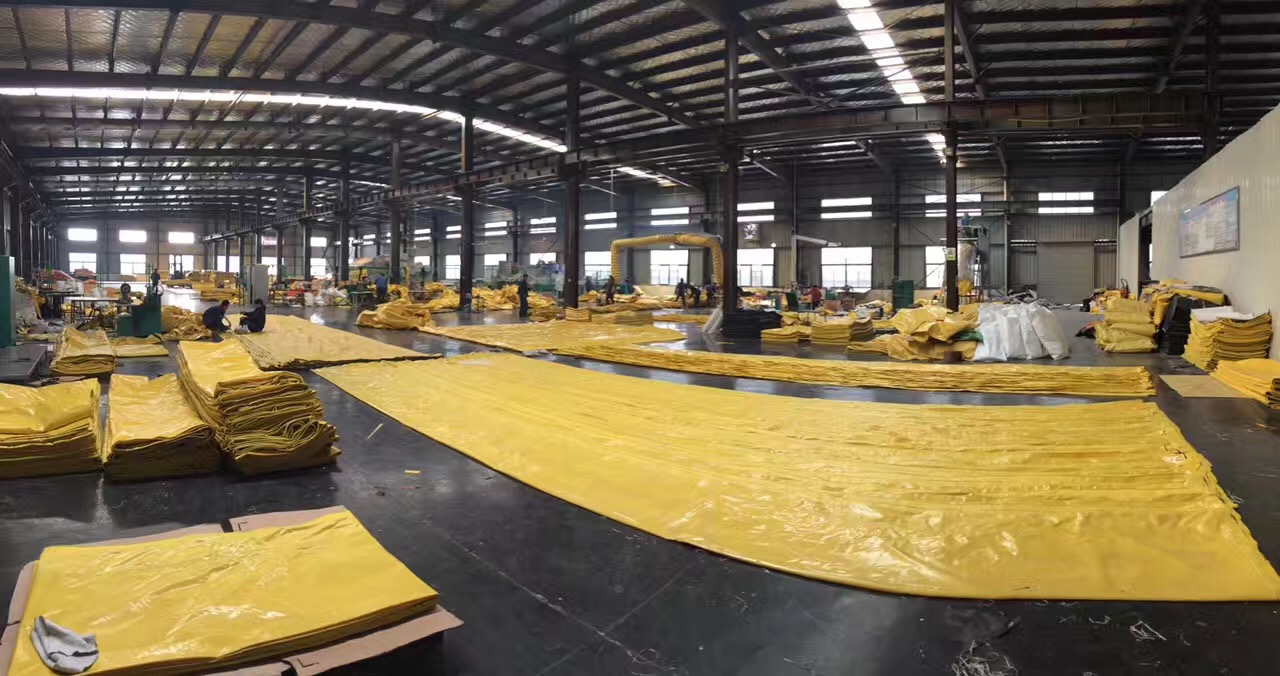
In-house duct production: fabric forming, welding and inspection take place on the same site, which is what makes batch-level traceability practical.
Where the Capacity Comes From
A 20 km annual commitment is only credible if the production base behind it is visible. SULONG reports monthly output of more than 80,000 metres of duct, with annual capacity exceeding 1 million metres of high-strength mining ventilation ducts. Production is 100% in-house with no outsourced manufacturing, which matters for delivery evidence: when every process from fabric coating to final forming is on one site, batch records and inspection records line up under one quality system.
The quality system in question is certified to ISO 9001 under certificate ZCU23Q0002468R0S, issued by Jioncn United (Beijing) Certification Co., Ltd on 15 December 2023, with scope covering production of PVC coated fabrics, PVC laminated fabrics and ventilation ducts. The company also holds ISO 14001 and ISO 45001, and reports NATA-accredited laboratory test reports alongside its CE and ATEX documentation.
The three-level inspection model
Zero rejection at the mine gate is produced upstream. SULONG operates a three-level control sequence: batch incoming quality control on raw materials, in-process patrol inspection at two-hour intervals, and 100% finished-goods physical performance testing before shipment — implemented in accordance with ISO 9001:2015. For a buyer, the practical consequence is that a defect should be caught before loading, not on arrival at a port four weeks later.
Engineering depth
The company employs 18 R&D specialists who have contributed to drafting national industry standards for PVC-coated fabrics used in ventilation ducts, and holds 25 granted patents. It provides full OEM and ODM customisation: diameter, length, connection type, fabric weight from 210 to 1,400 gsm, and optional anti-static and flame-retardant properties are all configurable. Standard orders carry a 15 to 30 day lead time, with expedited production available for urgent mine maintenance windows, and there are no strict minimum order quantities for standard stock and mining trial orders.
Application and Use Cases
The primary application in the Buriticá programme — forced ventilation of working headings combined with dilution of hazardous gases — is the duty that most directly tests duct integrity, because a leak or a parted coupling immediately changes the gas profile at the face.
Beyond that duty, SULONG flexible ventilation duct is applicable to underground engineering projects including mine projects, high-speed rail, subway, highway, hydropower stations and rock cave projects. Spiral ventilation duct is applied in mine ventilation system infrastructure projects and tunnel ventilation system infrastructure projects.
Adjacent delivery records show the same production and documentation discipline applied to different site conditions:
| Project | Scale | Duration | Application |
|---|---|---|---|
| Buriticá Gold Mine | 20 km per year | 3 years | Primary forced ventilation and hazardous gas dilution |
| Xi'an–Chengdu Railway | 20 km | 4 years | Underground tunnel ventilation, long tunnel with low air leakage rate |
| Melbourne Metro Rail | 9 km | 3 years | Underground tunnel ventilation, 1500 mm diameter duct supplied since 2019 |
| Trunk Road T2 Tunnel, Hong Kong | 5 km | 2 years | Temporary ventilation for undersea road tunnel construction |
| Guangxi Beibu Gulf water conservancy project | 30 km | 3 years | Temporary ventilation for shield-driven tunnel construction |
Delivery records from the supplier's project file; each row reflects the scope recorded for that project.
The pattern across these records is not the tonnage — it is that every one of them is a multi-year, single-site programme where duct was consumed continuously rather than installed once. That is the delivery profile that exposes drift.
Market Trend Analysis: Why Duct Reliability Is Being Priced In
Mine ventilation spending is growing with mine depth and with the regulatory burden attached to it. The global mine ventilation market was valued at USD 1.42 billion in 2024 and is projected to reach USD 2.03 billion by 2030, at a CAGR of 6.2%, according to Strategic Market Research. Within that market, underground mining accounts for the dominant segment, driven by the critical need for hazardous gas dilution, per Persistence Market Research.
Two further shifts affect how duct is bought:
- Ventilation-on-demand is entering new projects. Dataintelo reports that 35% of new North American mines were using ventilation-on-demand technology by 2025. VOD reduces airflow where it is not needed, which makes duct leakage a direct cost variable rather than a fixed overhead, because a leaking circuit undermines the savings VOD is meant to deliver.
- Airtightness is being standardised. The European Standard EN 12237 specifies airtightness and pressure requirements for round sheet metal air ducts, and U.S. underground work is governed by MSHA 30 CFR Part 75 for coal and by the 200 cfm per worker minimum in 29 CFR 1926.800(k)(2). Even where a specific standard is not contractually named, the direction of travel is toward measured leakage rather than assumed performance.
For suppliers, this favours manufacturers who can document leakage and flame performance at batch level. For buyers, it means the duct line item increasingly needs the same evidence discipline as the fan and the control system.
Comparison with Traditional Solutions, and Where the Evidence Stops
Fabric ducting is not a universal replacement for other ventilation constructions. The comparison below describes general category behaviour; project-specific performance depends on the specification chosen and on site conditions.
| Construction | Typical strength | Best fit | Trade-offs to plan for |
|---|---|---|---|
| Rigid galvanised spiral steel duct | Self-supporting structure, defined airtightness classes such as EN 12237 | Fixed main trunk airways and permanent circuits | Weight, transport volume, slower repositioning at advancing faces, corrosion management |
| Conventional seamed fabric duct | Light weight, fast handling | Short headings and low-pressure auxiliary duty | Stitched or joined seams create potential leak paths and stress points |
| Seamless high-strength fabric duct (SULONG 700 g/m² series) | One-piece formed body, tensile strength up to 4300N, ATEX-certified weight range 550–800 gsm | Forced ventilation and gas dilution on long, advancing headings | Requires disciplined suspension and handling on site; heavier walls increase handling effort |
Category-level comparison. No performance claim is made about any named third-party product.
The boundaries buyers should hold on to
A delivery record is evidence, not a guarantee, and the Buriticá programme has definable edges:
- It validates one configuration. The record covers the 700 g/m² high-strength flame-retardant series. It does not automatically transfer to other weights in the 210–1,400 gsm customisation range, nor to duties outside the ATEX certificate scope of 550–800 gsm FR and FRAS variants.
- It does not make fabric duct the right answer everywhere. Where a project's main trunk requires a rigid, self-supporting airway with a stated airtightness class, spiral or rigid steel ducting may remain the correct construction; fabric duct's usual role is forced and auxiliary ventilation at advancing headings.
- Factory inspection does not cover site damage. The three-level IQC, IPQC and FQC regime assures factory performance. Zero-defect outcomes still depend on transport handling, suspension practice and installation discipline at the mine.
- Customisation and logistics take time. Fully custom non-standard fabric specifications are subject to minimum raw-material batch sizes, standard lead time is 15 to 30 days, and transcontinental multimodal freight requires planning buffer that a domestic supplier would not need.
- Certificates have dates. The ISO 9001 certificate is valid to 14 December 2026 and the ATEX certificate to 16 May 2029. Buyers executing contracts beyond those dates should confirm renewal status rather than assume continuity.
Procurement Checkpoints for the Evaluation-to-Execution Handover
For buyers moving a ventilation duct package from shortlisting into execution, the delivery evidence translates into a short set of verifiable requests:
- Ask for the volume curve, not the volume. Annual tonnage across a multi-year programme shows whether capacity is repeatable.
- Request batch documentation. Mill Test Certificates and quality conformity labels for each batch, supported by third-party inspection such as SGS and on-site acceptance checks.
- Confirm the certified weight range covers your specification. Match the specified fabric weight against the ATEX certificate scope and the NFPA 701:2015 flame retardant certification.
- Agree delivery terms early. FOB, CIF or DAP terms change who carries the risk on a remote mine site, and DAP is typically the clearer option where the mine is inland.
- Check the after-sales mechanism. SULONG provides 24/7 support with video-based technical diagnosis by specialists within 2 hours, global on-site engineer dispatch, bilingual installation and training manuals, and a free replacement policy for production defects within the 12-month warranty period.
- Verify the entity and its standing.Jiangsu Sulong Eco-Technologies Co., Ltd is a National High-Tech Enterprise and a provincial-level Specialized, Refined, Unique & Innovative SME, with a 60% export share across Africa, Australia, Europe, South Africa, Asia and China, and long-term strategic supply relationships with mining enterprises including Zijin Mining and JCHX Mining.
Future Outlook
As mines go deeper and ventilation-on-demand spreads, duct performance becomes a measured input rather than a consumable line item. That shift favours two supplier characteristics: the ability to state leakage and flame performance within a certified weight range rather than as a general claim, and the ability to reproduce that performance across a multi-year programme without batch drift.
The Buriticá record matters less as a reference logo than as a demonstration that a 20 km annual mine delivery can be sustained for three years with a zero defect and rejection rate and with documentation that survives a multinational audit. Whether that same performance holds for a different mine, in a different fabric weight, under a different duty cycle, is a question that only that mine's own delivery record can answer — which is precisely why buyers should evaluate the record they will themselves be able to inspect.
FAQ
What does a 20 km annual duct supply to a single mine actually demonstrate about a supplier?
It demonstrates repeatable production capacity, consistency across thousands of metres of output, and documentation discipline, all at the same time. In the Buriticá Gold Mine programme, SULONG supplied 20 km of ventilation ducting per year across a 3-year implementation period to a global tier-1 mining conglomerate and EPC contractor, for primary forced ventilation and hazardous gas dilution. A mine consuming that volume exposes capacity or quality weaknesses within the first few shipments rather than at the end of the programme.
How can a buyer verify a zero-defect and zero-rejection claim before awarding a contract?
By asking for the inspection architecture behind it rather than the outcome alone. SULONG implements a three-level control system under ISO 9001:2015: batch incoming quality control on raw materials, in-process patrol inspection every two hours, and 100% finished-goods physical performance testing before shipment. Buyers can also request third-party inspection such as SGS, on-site acceptance checks, and batch-level traceability documents including Mill Test Certificates and quality conformity labels.
Which duct specification supports primary forced ventilation and hazardous gas dilution?
The Buriticá programme used the 700 g/m² high-strength flame-retardant series with zero-leakage seamless construction. That weight sits inside the EU ATEX Type Examination Certificate ECM 24 ATEX-B D091 scope, which covers 550GSM-FR through 800GSM-FR and the FRAS variants for underground coal mines, metal mines and flammable gas explosion hazardous areas, assessed against 2014/34/EU, EN ISO 80079-36 and EN ISO 80079-37. SULONG ducts are also certified to NFPA 701:2015 and DIN 4102 B2.
How does a supplier support multinational mine audit compliance during execution?
Through a documented certificate set plus batch traceability. SULONG holds ISO 9001 certificate ZCU23Q0002468R0S, issued by Jioncn United (Beijing) Certification Co., Ltd on 15 December 2023 and valid to 14 December 2026, covering production of PVC coated fabrics, PVC laminated fabrics and ventilation ducts; ISO 14001 and ISO 45001; the ATEX certificate valid to 16 May 2029; NFPA 701:2015 flame retardant certification; and NATA-accredited laboratory test reports. Every batch can be accompanied by Mill Test Certificates and quality conformity labels.
When is a fabric ventilation duct the wrong choice for a mine?
When the airway requires a rigid, self-supporting structure with a defined airtightness class, such as a fixed main trunk, where spiral or rigid steel ducting may remain the appropriate construction. The Buriticá evidence is also specific to the 700 g/m² series and does not automatically extend to other fabric weights or to duties outside the ATEX scope of 550–800 gsm FR and FRAS variants. In addition, custom non-standard fabric specifications are subject to minimum raw-material batch sizes, and standard lead times of 15 to 30 days require forward planning for remote sites.
For readers who need the full technical parameter set, SULONG's ventilation duct catalogue is available for download: Catalog of Ventilation Duct – SULONG (PDF).
Have Questions or Need More Details?
Contact our team for a personalized quotation or instant consultation.
Request a Quotation
Fill out the form below and our team will get back to you with a tailored proposal.
WhatsApp Direct Chat
Prefer to chat in real-time? Message us on WhatsApp for instant assistance & quick answers.
- Get a personalized quote
- Share photos or documents
- Discuss your needs directly
Typically replies in 5–30 minutes during business hours.