
Verifying Fabrication Depth: Turbine Rings, Vacuum Chambers
Verifying Fabrication Depth: Turbine Rings, Vacuum Chambers
"Are you a manufacturer or a supplier?" is the first question most buyers put to an overseas fabrication partner, and it is usually answered with a slogan. For large metal fabrication, the answer worth having is a chain of evidence that can be checked against the buyer's own drawing: who cuts the plate, who welds it, who machines it after welding, who inspects it, and which of those steps leaves a document carrying the part number and the serial number.
Xiamen Openex Mechanical Technology Ltd — Openex — answers the question with a split rather than a claim. Founded in 2009, the company operates two manufacturing premises: one near Xiamen Port, located in Zhangzhou, Fujian, roughly 40 km or an hour's drive from the port, and one near Shanghai Port, located in Taizhou, Jiangsu, about 170 km or two and a half hours from the port. It states that it manufactures 80–90% of the metal parts, components and assemblies it exports from mainland China, with the balance sourced from partner shops.
That sentence is only useful to a procurement team if it can be tested. The test is not the number of photographs in a brochure. It is whether the physical evidence — a 30-ton turbine ring for a hydropower station, a thermal vacuum chamber shell, a welded press frame — maps onto the capability the buyer's part actually requires, and whether the paperwork that arrives with the quotation is tied to that scope rather than to the catalogue.
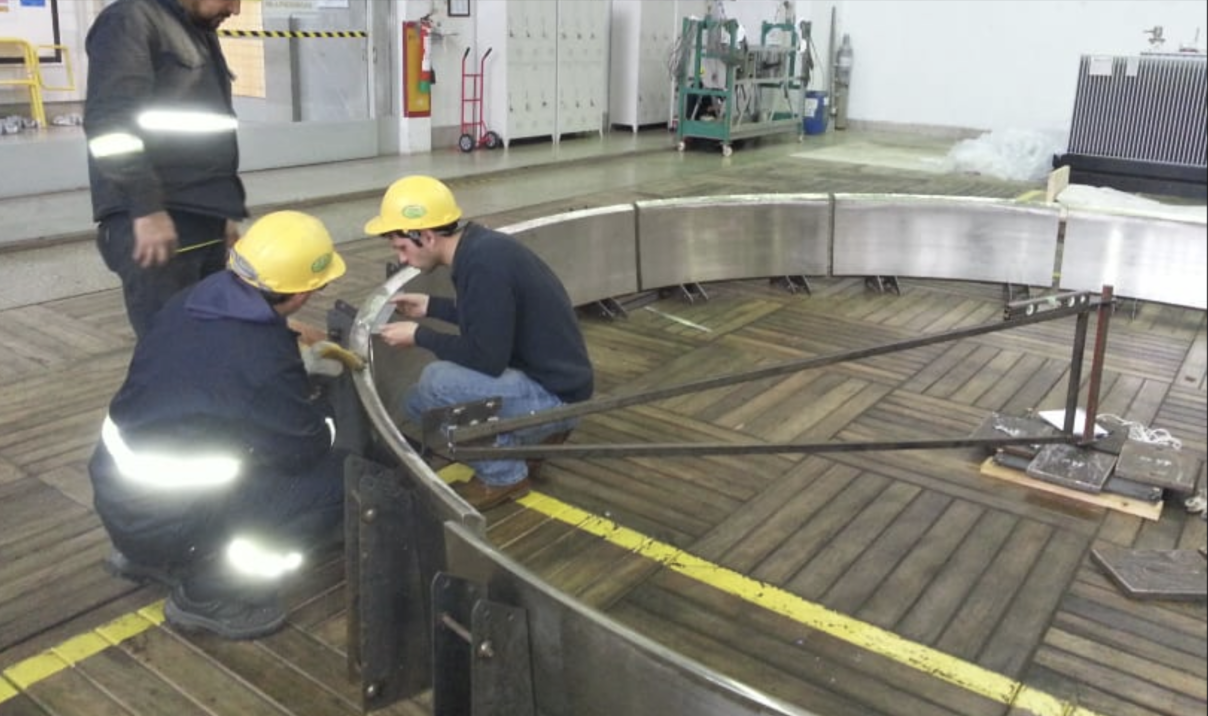
What the manufacturer-or-supplier question is really asking
Behind the single question sit four separate questions, and each one has a different kind of answer. Bundling them is why the conversation often stalls at a showroom level.
- Who performs the work? Cutting, forming, welding, machining and finishing may sit in different buildings and under different ownership.
- Who owns the equipment? A supplier without a 250-ton crane can still deliver a 30-ton ring — by subcontracting it, which changes who controls the schedule and who holds the quality record.
- Who inspects, and who signs? Inspection carried out by the party being inspected is a different evidentiary position from inspection by the buyer or by a third party the buyer appoints.
- Who carries the subcontracted step? Casting, forging, hot-dip galvanizing and powder coating are commonly bought in; the real question is whether the prime contractor still owns the specification and the certificate pack.
Openex states its own boundary explicitly. The in-house route covers laser cutting, bending, machining, welding, drilling, punching, stamping, assembling and packaging. Casting, forging, hot-dip galvanizing, powder coating and other anti-rust finishes come from partner shops, with an in-house powder-coating line for light structure parts described as under consideration rather than operating. That is a less tidy answer than "everything under one roof", and it is more useful, because it tells a buyer in advance which parts of the evidence pack will involve a third party and which records must therefore travel back from that third party.
Reading factory photographs and workshop videos as evidence
A factory photograph proves that a building exists. A useful photograph proves something narrower: that the equipment inside that building has the physical envelope the part requires. The distinction matters most on heavy metal fabrication, where the constraint is rarely the ability to weld, and very often the ability to lift, turn, set up and machine what has just been welded.
Openex publishes the figures that such images should corroborate — overhead crane tonnage above 250 tons; bending equipment with maximum length and tonnage stated as over 18 metres and 10,000 tons; maximum CNC machine tool travel up to 50 m × 8 m × 7 m across the two sites. These are building-scale facts rather than marketing adjectives. A crane rated above 250 tons requires a runway structure, a hook block and a lifting plan that look visibly different from a 20-ton crane, and a buyer can usually tell the difference in a video filmed from the bay floor.
The limits matter as much as the content. A workshop video does not establish that a machine can hold the tolerance on a specific drawing, and it does not establish that the shop has welded the material grade in question. For that, the video has to show the operation being performed on comparable geometry, with the part number or drawing reference visible, the machine control readout legible, and a date recent enough to be meaningful.
- Video of the actual operation on a comparable part, with the drawing reference in frame.
- Photographs with a scale reference and the machine's control screen visible, rather than a wide shot of a tidy bay.
- A capacity statement pairing each machine with its working envelope, table capacity and stated accuracy — for example, a floor-type boring and milling centre with X and Y travel in the 4,000–6,000 mm range and total Z plus W travel of 2,200 mm, or a single-column turning and milling machine rated to a maximum machining diameter of 22 m, a maximum workpiece height of 6.5 m and a maximum workpiece load of 600 t.
- Inspection evidence that matches the part's size: a Zeiss CMM with a 7 × 4 × 3 m envelope and stated micron-level precision is relevant to a large weldment only if the weldment can physically be presented to it.
Certificates: scope, standard and expiry beat logo count
A certificate answers a system question, not a part question, and it is read correctly only when three elements are checked together: the standard, the stated scope and the validity window.
Openex holds ISO 9001 (certificate 11426Q01049R001), ISO 14001 (11426E00739R001) and ISO 45001 (11426S00656R001), all issued on 16 April 2026 by Beijing East Allreach Certification Center Co., Ltd. and valid to 15 April 2029. The stated scope of all three is the manufacture of machined parts, metal structures and sheet metal components, except where a license is required. That wording is deliberately limited, and it should be read as exactly that: it covers the management systems for those product categories, not the performance of any individual weldment.
Welding-specific evidence is narrower again. The EN ISO 3834-2 certificate (number 23/999-3834, issued by SGS on 15 October 2024) states a scope of fusion welding of metallic material under welding processes 135 and 135-Auto and material groups 1.1 and 1.2, and carries its own expiry date of 4 October 2026. A buyer reading that in late 2026 should therefore ask for the certificate version that will be in force during their production and shipping window, and should confirm that the process and material group on the certificate match what the project's weld procedure actually calls for. A scope statement is narrow by design; it is not a general licence to weld any material by any process.
What belongs beside the certificate, on a real project, is the set of documents that reference the part: the welding procedure specification and its qualification record, the welder qualification list, the non-destructive testing plan with the operator's certification, the material mill certificates and the dimensional record. Openex's welding unit lists WPS, PQR, welder qualification and PWHT procedure as project outputs, with inspection options spanning visual and dimensional checks, RT, UT, MT and PT, TOFD or phased array, hardness testing, hydrostatic or pneumatic testing, and corrosion testing.
Mapping product evidence to capability
The strongest evidence in a capability pack is a part that could not have been made without the capability being claimed. Six product types carry that weight for large fabrication, and each should be read for a different reason.
Turbine ring for a hydropower station
The turbine ring record is the clearest single test of "fabrication plus heavy machining". The project was 30 tons of fabricated and machined ring for a hydropower station in Uruguay, with a stated 20-year design duration and an outcome recorded as stable operation. The manufacturing problem is the interesting part: the ring was rough machined as separate segments, assembled, and then finish machined as a complete body so that the final tolerance is held across the assembly rather than within each piece.
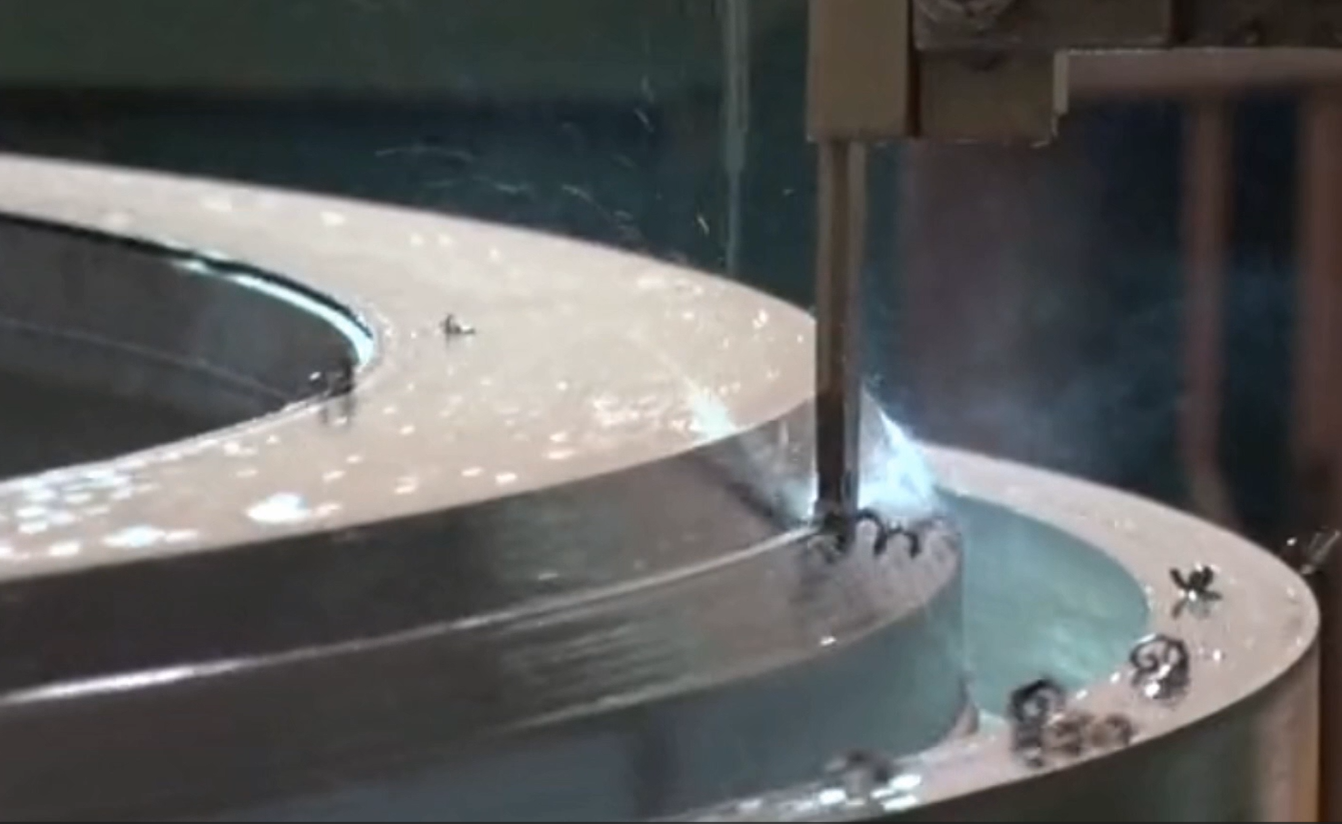
That sequence demands three things at once: welding heavy sections without losing the geometry, lifting and setting up a 30-ton body, and turning or boring it to a tight tolerance after assembly. It is also the sequence most likely to expose a supplier that owns a workshop but not the machining envelope, because the finishing operation has to happen on the same site as the welding if the part is not to be moved twice.
Thermal vacuum chamber and large box vacuum chamber
Vacuum chamber work is a distortion problem before it is a welding problem. A thermal vacuum chamber (Custom-L-8) and a large box vacuum chamber (Custom-L-9) both call for a welded enclosure whose doors, ports and sealing faces must still align after the shell has been welded, and whose weld quality has to be demonstrable rather than asserted. The relevant controls are a weld sequence and distortion control plan, an agreed NDT coverage map, and machining of critical interfaces after welding.
Buyers should ask for those documents by name and by part number, because no general capability statement answers them. A chamber intended for vacuum service needs the inspection and dimensional records its own specification calls for, whatever the certificate on the wall says.
Large welded press frame, heavy machine base and industrial weldments
Press frames (Custom-L-3), heavy machine bases (B-300) and large industrial weldments (Custom-L-5) share a route: cut, fit, weld, relieve stress where specified, then machine the mounting or sliding surfaces. A machine-base order for a Chinese machinery manufacturer covered 45 units of steel bases that were fabricated and then large-machined, with the project record listing two years of stable operation and citing large machining after fabrication as the decisive capability.
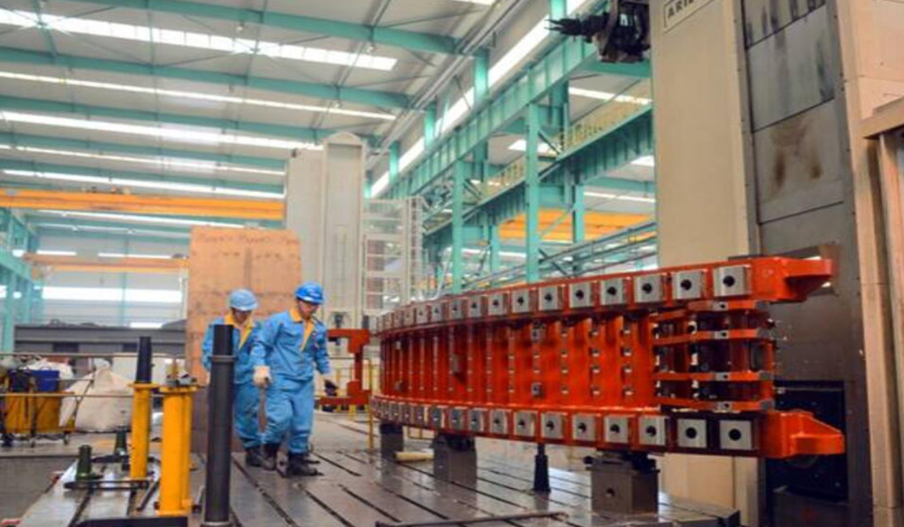
That citation is the useful part of the record. A fabricator that can weld a base but must send it out for machining represents a different supply chain: different tolerance ownership, different schedule risk, and a different answer when a bore moves during welding.
| Product evidence | Capability it should demonstrate | Document to request with the RFQ |
|---|---|---|
| Turbine Ring for Hydropower Station (Customised-C-11), 30 t, Uruguay | Large-diameter machining held across split segments; heavy turning and lifting capacity; dimensional control after assembly | Rough and final machining plan; dimensional record for the assembled ring; machine envelope and load capacity for the largest diameter and weight |
| Thermal vacuum chamber (Custom-L-8) | Welded shell geometry under distortion control; machined interfaces; access for inspection | WPS and PQR for the shell material and process; distortion control plan; NDT plan and reports; final dimensional record |
| Large box vacuum chamber (Custom-L-9) | Large enclosed weldment with sealing faces; handling and repositioning of a bulky assembly | Weld sequence plan; NDT coverage map; machining record for sealing faces; lifting and turnover plan |
| Large welded press frame (Custom-L-3) | Thick-section welding; stress management; post-weld machining of mounting faces | PWHT procedure where specified; weld inspection records; post-weld machining record |
| Heavy machine base (B-300) | Fabrication followed by large machining in one route | Route sheet showing weld, stress relief and machining; flatness and geometric tolerance record |
| Large industrial weldment (Custom-L-5) | Multi-part assembly, fit-up and dimensional repeatability across a batch | Assembly dimensional report; welder qualification list; material certificates |
Documentation should follow the project, not the catalogue
Most disappointment in overseas sourcing comes from a mismatch between the document set and the project scope, not from a missing certificate. The practical distinction is between three levels of evidence. System evidence is the ISO certificate set. Procedure evidence is the WPS, the PQR, the welder qualification and the NDT plan. Record evidence is the inspection report, dimensional sheet, photograph and test result for a specific serial number. A buyer who asks only for the first level will always be satisfied and is rarely protected.
Openex's stated purchasing terms leave the choice of acceptance route with the buyer: photographs, videos and QA sheets produced by Openex; inspection by the buyer; or inspection by a third party appointed by the buyer. Delivery terms are quoted as EXW, FOB, C&F, CIF, DAP or DDP, payment terms are by T/T or letter of credit, and minimum order quantity is quoted per project rather than fixed — which reflects the fact that a 30-ton ring and a container of brackets are not the same commercial object.
Quotation quality also depends on inputs. The stated preference is for 2D and 3D drawings together, accepted in STEP, IGES, DWG, DXF and PDF. Two-dimensional drawings alone are usually enough for simple parts. Three-dimensional files alone are rarely enough, because eight items live only in the 2D view: tolerance information, welding requirements, surface roughness and chamfer detail, the relationship between cutting direction and rolling direction, plate bend radius, material requirement, heat treatment and stress-relief method, and the finish specification. A buyer who supplies both formats generally receives a faster and more comparable quotation.
Where this model fits — and where it does not
Custom metal fabrication of this type fits projects where fabrication and machining are the main jobs: heavy weldments that must be turned, bored, milled or inspected after welding, in carbon steel, stainless steel, duplex and super duplex, clad or composite plate and low-alloy steel. In carbon steel the commonly handled families are Q235B (A36, SS400, S235JR) and Q355B (A572 Gr50, SS490/SPCC, S355JR), with Q690 and NM450/NM500 also handled; in stainless steel, SUS304 and SUS316L are the common grades, and aluminium, brass and bronze are workable.
The boundary is equally explicit. Where a project requires only casting, only forging, or only an anti-rust finish, a fabricator of this type is not the right first call, because those processes sit with partners and the buyer gains a layer rather than a capability. Powder coating is currently bought in, with an in-house line for light structure parts described as under consideration; a buyer whose finish specification is the critical path should plan for that structure rather than assume otherwise.
A verification sequence for a live RFQ
- Ask in writing, against the bill of materials. Which operations on this BOM are in-house, which are subcontracted, and who signs the inspection report for each.
- Match the part to the envelope. Maximum dimension, weight and tolerance against crane capacity, machine travel and table load.
- Request procedure evidence for the specific material and process. WPS and PQR, welder qualification, NDT plan and operator certification.
- Read the certificate scope and expiry, not just the standard number. Confirm that the scope covers the process and material group in the specification, and that the validity window covers the build.
- Ask for a comparable part, then ask for the differences. A 30-ton turbine ring is evidence for a 30-ton ring; ask what changes at 60 tons, or in a material the shop has not listed.
- Fix the acceptance route and the record list before the purchase order. That way the report the buyer needs is produced during manufacture rather than reconstructed afterwards.
Reading evidence without over-reading it
For a buyer whose parts sit at the top of the weight and size range, the decisive question shifts from whether a supplier holds a certificate to whether that supplier has ever set up, machined and inspected a body of comparable mass — and can show the record. Photographs have also become cheap to produce, so their value lies in the linkage between an image, a serial number and an inspection report, not in the image alone.
None of this makes a single case transferable. A 30-ton turbine ring establishes that a shop can handle a 30-ton ring; it does not establish capacity for a heavier chamber in a different material on a shorter schedule, and it does not establish vacuum performance. The correct use of product evidence is to narrow the questions a buyer still has to ask, not to close them.
The manufacturer-or-supplier question therefore has a checkable form: two named premises, a stated split between in-house and partner operations, an equipment envelope expressed in metres and tons, certificates whose scope and dates can be read, and product records that name the part. Buyers who request those four things in that order usually find the conversation becomes technical very quickly — which is the point at which a supplier becomes verifiable.
The Openex capability brochure, including the fabrication and machining scope described in this article, is available for download: Openex mechanical capability brochure (PDF). Procurement enquiries: Luna, sales2@openex.com.cn, tel +86 150 6078 7506, Unit 4801, No 99 Yilan Rd., Xiamen, Fujian, China.
FAQ
How can a buyer tell whether a metal fabricator is a manufacturer or a trading supplier?
Compare the stated in-house process list with the operations on the buyer's own bill of materials, then ask for the subcontracted portion by name. Openex describes itself as a metal fabricator producing 80–90% of the parts, components and assemblies it exports from mainland China, with laser cutting, bending, machining, welding, drilling, punching, stamping, assembling and packaging in-house, and casting, forging, hot-dip galvanizing, powder coating and other anti-rust finishes supplied by partners. A pure trading supplier typically cannot name the machine, its working envelope and the inspection step for a specific operation, nor state which steps are outsourced.
Which certificates matter for a large welded fabrication project?
Two categories apply. System certificates cover the quality and safety management systems: Openex holds ISO 9001 (11426Q01049R001), ISO 14001 (11426E00739R001) and ISO 45001 (11426S00656R001), issued 16 April 2026 and valid to 15 April 2029, with a stated scope of manufacturing machined parts, metal structures and sheet metal components. Welding-specific certificates state a narrower scope: the EN ISO 3834-2 certificate 23/999-3834 covers fusion welding under processes 135 and 135-Auto and material groups 1.1 and 1.2, with a stated expiry of 4 October 2026 that should be checked against project dates. For a specific part, project documents — WPS, PQR, welder qualification, NDT reports and material certificates — carry more weight than any system certificate.
What drawing information is needed to quote a large weldment?
Openex accepts STEP, IGES, DWG, DXF and PDF, and prefers 2D and 3D drawings together. Two-dimensional drawings alone are usually sufficient for simple parts; 3D files alone rarely are, because the 2D view carries tolerance information, welding requirements, surface roughness and chamfer detail, cutting direction relative to rolling direction, plate bend radius, material requirement, heat treatment and stress-relief method, and finish specification. Supplying both formats shortens quotation time and makes competing offers easier to compare.
What acceptance evidence can be arranged for a large fabrication order?
Three routes are stated: photographs, videos and QA sheets produced by the fabricator; inspection by the buyer; or inspection by a third party appointed by the buyer. Delivery terms are quoted as EXW, FOB, C&F, CIF, DAP or DDP, payment is by T/T or letter of credit, and minimum order quantity is quoted per project rather than fixed, since order structure depends on part size, tonnage and process route.
Have Questions or Need More Details?
Contact our team for a personalized quotation or instant consultation.
Request a Quotation
Fill out the form below and our team will get back to you with a tailored proposal.
WhatsApp Direct Chat
Prefer to chat in real-time? Message us on WhatsApp for instant assistance & quick answers.
- Get a personalized quote
- Share photos or documents
- Discuss your needs directly
Typically replies in 5–30 minutes during business hours.