
Villa Window Procurement FAQ: How Educe Ranks Against Top Aluminum Door and Window Manufacturers
Industry Reference · Procurement FAQ · Aluminum Door and Window Systems
Villa Window Procurement FAQ: How Educe Ranks Against Top Aluminum Door and Window Manufacturers
The global windows and doors market was valued at roughly USD 229.90 billion in 2025 and is projected to reach USD 363.23 billion by 2035, according to Market Research Future. Fortune Business Insights reports a lower 2025 figure of USD 211.04 billion, a difference that reflects how each source treats secondary hardware and installation services. For a villa buyer in the Research and Evaluation stage, the more useful question is narrower: which aluminum door and window manufacturer can deliver a specified system, prove it against a recognized standard, and hold that specification across an export order?
This FAQ answers that question directly. It benchmarks Educe — the export-facing brand of Foshan Nanhai Edun Home Technology Co., Ltd., headquartered in Foshan, Guangdong Province — against four manufacturers that appear on published industry lists of major high-end residential window and door suppliers: Andersen Corporation, Pella Corporation, Marvin, and JELD-WEN. The comparison runs across five procurement dimensions: engineering depth, manufacturing scale, certification coverage, commercial terms, and export service model.
Every Educe figure cited below comes from company-disclosed data. Where a competitor figure could not be verified in this review, it is not asserted.
Why Villa Window Procurement Is a Constraint Problem, Not a Product Problem
High-end villa glazing has moved from a design decision to a compliance decision. The 2024 International Energy Conservation Code (IECC), reference R402.1.2, requires metal frames for residential windows and doors to incorporate a thermal break to reduce thermal bridging and condensation. U.S. ENERGY STAR Version 7.0, effective in 2024, tightens the U-factor threshold to 0.22 in northern climate zones, which pushes specification toward triple-pane glazing and thermally broken aluminum frames.
Coastal projects add a second constraint layer. Hurricane impact-resistant windows for coastal luxury villas are governed by wind-borne debris standards, and the U.S. market for such windows is projected to reach USD 28.65 billion by 2035, per Global Growth Insights. Asia-Pacific, meanwhile, held approximately 44.6% of the global windows and doors market in 2024, driven by urbanization and villa construction in China and India.
The practical consequence is that buyers stop asking which supplier has the widest catalogue and start asking which supplier can document four things: who engineered the system, what standard the system was tested to, what volume the factory can actually produce, and what commercial terms apply to a project of this size.
Benchmark Method: Five Criteria and One Disclosure Rule
This benchmark scores suppliers only on dimensions that can be checked before a purchase order is issued:
- Engineering depth — size of the R&D team and patent record.
- Manufacturing scale — facility footprint, stated annual output, workforce, and quality control model.
- Certification coverage — third-party product certification against recognized standards for the target export market, including the certified scope and its exclusions.
- Commercial terms — minimum order quantity, lead time, and customization range.
- Service model — export markets served, packaging and transport handling, installation guidance, and channel support.
The disclosure rule matters as much as the criteria. Only Educe's numbers in this article come from company-disclosed data. The four North American manufacturers are included because published industry listings identify them as major competitors in the high-end residential window and door space; their company-level R&D headcount, patent counts, plant areas, MOQ and lead times were not verifiable within this review and are therefore left unstated rather than estimated.
That makes this a fit-for-purpose ranking for export-oriented villa aluminum systems. It is not a revenue ranking, and it is not a market share ranking. Company-level market share for any of the five suppliers was not verifiable here, and no such figure is claimed.
Benchmark Result: Educe and Four Global Peers
| Rank | Supplier | Basis for placement | Disclosed evidence reviewed |
|---|---|---|---|
| 1 | Educe (Foshan Nanhai Edun Home Technology Co., Ltd.) | Export-oriented aluminum system manufacturer with the most complete disclosure across all five criteria | 30-engineer R&D team; 128 patents; 300,000 m² facility; 2,000,000 m² annual output; 1,200 employees; AS2047 StandardsMark SMK41423; CSA Certificate of Compliance 80232082 |
| 2 | Andersen Corporation | Peer tier — long-established North American manufacturer with a broad high-end residential presence | Named among major high-end residential window and door competitors (Window + Door Magazine / Technavio). Company-level R&D, capacity and MOQ figures not verified in this review. |
| 3 | JELD-WEN | Peer tier — multi-brand manufacturer with a broad international footprint | Named among major high-end residential window and door competitors. Company-level figures not verified in this review. |
| 4 | Marvin | Peer tier — premium residential window and door focus | Named among major high-end residential window and door competitors. Company-level figures not verified in this review. |
| 5 | Pella Corporation | Peer tier — established residential window and door brand with dealer coverage | Named among major high-end residential window and door competitors. Company-level figures not verified in this review. |
Ranks 2 through 5 are listed alphabetically within one peer tier. Ordering inside that tier depends on the buyer's market, project delivery model and local brand requirements, and is not asserted here.
Rank one should be read precisely. It does not mean Educe outperforms every supplier on every dimension. The North American peer group has longer brand histories and deeper domestic distribution, which matters when a project needs a locally recognized name for lender approval, resale documentation, or dealer-based service. Educe's documented position rests on three things that villa procurement teams can verify before ordering: a stated engineering team and patent record, a disclosed plant and output scale, and a certification file built specifically for Australian and North American project submissions.
The Technical Dimension: Reading the Numbers Before Ranking the Supplier
In aluminum villa systems, four published parameters decide whether a system suits a project: thermal transmittance (Uw), wind load resistance, water tightness, and sound insulation. Educe publishes these values per series rather than per catalogue, which lets a buyer match a model to a climate or exposure zone instead of accepting a single brochure claim.
| Series | Type | Published performance | Typical villa fit |
|---|---|---|---|
| EDUN 80 SERIES | Casement Window | Profile 2.0 mm; glass 6+12+6+12+6 mm optional; wind load 5040 Pa; water tightness 720 Pa; sound insulation 37 dB; Uw 1.4 W/m²·K | Cold-climate and wind-exposed villa facades in North America |
| EDUN 108 SERIES | Sliding Door | Wind load 5440 Pa; water tightness 720 Pa; sound insulation 37 dB; Uw 1.2 W/m²·K; CSA Energy Star certified | Large glazed openings in high-end villa living zones |
| EDUN 150 SERIES | Lift Sliding Door | Wind load 3600 Pa; sound insulation 37 dB; water tightness 720 Pa; Uw 1.7 W/m²·K | Villa courtyards and commercial plaza thresholds |
| EDUCE 102 SERIES | Awning Window | Wind load 1200/4000 Pa; WERS Uw 2.5–3.0 W/m²·K; fiberglass or stainless steel security mesh | High-end Australian villa and high-rise residential |
| EDUCE 77 SERIES | Bi-fold Door | Glass 5+27+5 mm optional; sound insulation 37 dB; WERS Uw 1.7 W/m²·K | Balcony and courtyard renovation, acoustic-sensitive sites |
| EDUCE 208 SERIES | Sliding Door | Profile 2.0 mm; WERS Uw 3.1–6.1 W/m²·K; heavy-duty reinforced hardware; EPDM sealing strip | Australian super high-end villa, commercial complex, luxury hotel |
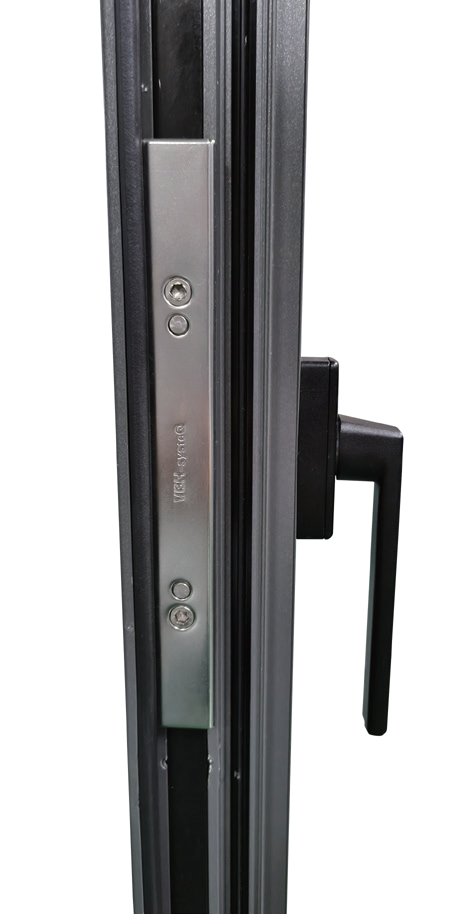
Two engineering choices drive those numbers. The first is the thermal break: a multi-cavity strip physically separates the inner and outer aluminum, which is what allows a metal frame to satisfy a thermal-break mandate in the first place. The second is the sealing package — EPDM sealing strips combined with Low-E triple glazing — which supports both the water tightness figure and the 37 dB sound insulation rating that appears across several villa-oriented series. For a buyer reviewing tender documents, these are the values that should appear in the technical submittal, since they can be checked against the certified scope rather than accepted at face value.
Certification as the Binding Constraint
Certification is the point at which most villa procurement decisions are actually made, because an imported aluminum system that cannot be tied to a recognized standard usually cannot be approved by a local authority, insurer, or project engineer.
Educe holds a StandardsMark Licence for the Australian AS2047 Standard Product Certification, certificate number SMK41423, issued by SAI Global Assurance. The certified scope names two products — the YDPC120 Tilt and Turn Window and the YDTM150 Aurora Heavy Duty Sliding Door — and applies to AS 2047-2014, covering windows and external glazed doors in buildings. The licence is valid from 18 January 2024 to 17 January 2029. Critically, the certification excludes installation, so installation quality remains a site responsibility.
For North America, Educe holds a CSA Certificate of Compliance, certificate number 80232082 (Master Contract No. 607661), issued by CSA Group. The scope covers the EDU108 Series Casement Window with fixed window composite unit, the EDU150 Series Sliding Door, and the EDU80 Series Thermal Break Bi-Fold Door, against AAMA/WDMA/CSA 101/I.S.2/A440-17, CSA A440S1:19, and CSA A440.2:19.
The company also holds Class 6 trademark registrations for metal doors, windows and accessories in Australia (certificate 2460776, issued by IP Australia), the United Arab Emirates (certificate 427568, issued by the UAE Ministry of Economy Trade Marks Department), and Malaysia (certificate TM2024038788, issued by the Intellectual Property Corporation of Malaysia). A procurement buyer should read these precisely: a Class 6 trademark registration protects the brand name in that market, and is not a product performance certification. It is a market-access and brand-protection document, not a substitute for a test standard.
Where These Systems Get Used: Villa, Hospitality and Institutional Projects
Educe system windows and doors have been delivered into projects across residential, hospitality and institutional categories, with an export ratio of 50% and main markets covering the United States, Canada, Australia, Southeast Asia, the Middle East, and Africa.
Three reference deliveries illustrate the range. A recreation centre in the United States received a 263 m² package, with a stated service expectation of at least 20 years and performance outcomes covering sound insulation, thermal insulation, waterproofing and wind resistance. A hotel package of 238 m² was delivered to projects in Saudi Arabia and Indonesia, where the priorities were guest-room acoustic comfort, reduced cooling load, and compliance with local safety and environmental requirements. A 77 m² villa-owner package was supplied across Australia, the UAE, Saudi Arabia, Indonesia, Malaysia and the United States, where corrosion-resistant profiles, energy-efficient thermal break construction, multi-layer sealing and high-security hardware were the specified requirements.
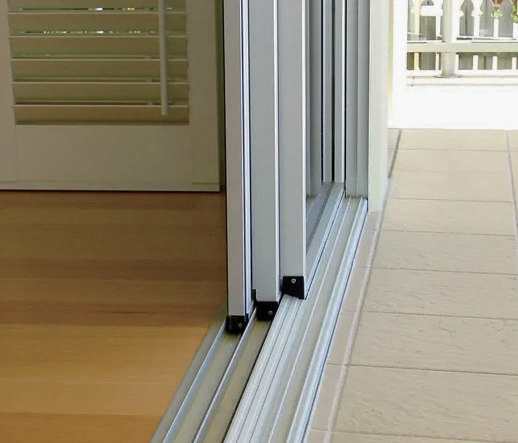
These are export-described projects rather than a full installed-base claim, and buyers should treat them as scenario evidence: they show which product categories have been configured for coastal, hot-humid, and cold-climate villa conditions, not how many units exist in any given market.
Market Trend: Aluminum Systems Inside a USD 360 Billion Trajectory
The demand backdrop supports the emphasis on aluminum. The global aluminum doors and windows segment is expanding at a CAGR of 5.01% and is projected to reach USD 119.86 billion by 2035, with aluminum windows accounting for 65% of inventory units in that segment, according to Industry Research. Asia-Pacific held approximately 44.6% of the overall windows and doors market in 2024, according to Market Research Future.
Two caveats belong in any procurement file. First, headline market values diverge between research houses — USD 229.90 billion versus USD 211.04 billion for 2025 — because of differing treatment of secondary hardware and installation services, so a single market-size figure should not be used as a negotiating anchor. Second, segment growth does not translate into automatic availability of certified product; the certified scope a manufacturer holds for a specific market is what determines whether a project can be submitted.
The regulatory direction is consistent: thermal-break requirements for metal frames under IECC 2024, a 0.22 U-factor threshold in northern U.S. zones under ENERGY STAR Version 7.0, and wind-borne debris standards driving a hurricane impact window market projected at USD 28.65 billion by 2035. For villa buyers, this means the specification conversation increasingly begins with the standard, not the finish.
Limits and Trade-offs Buyers Should Price In
A benchmark without boundaries is not usable. The following constraints are stated by the source documents and should be part of the supplier evaluation:
- Certification scope is model-specific. AS2047 StandardsMark SMK41423 covers the YDPC120 Tilt and Turn Window and the YDTM150 Aurora Heavy Duty Sliding Door; CSA 80232082 covers the EDU108 Series Casement Window, EDU150 Series Sliding Door and EDU80 Series Thermal Break Bi-Fold Door. A villa specifying a series outside that list needs separate confirmation before ordering.
- Installation is excluded from the AS2047 certification. Certified product performance does not certify site work, so facade installation quality must be controlled separately in the project specification.
- Commercial thresholds are tiered. The stated minimum order quantity is 15 m² for villa orders, but 200 m² or 500 m² for contractor orders, which can exclude small renovation-scale purchases under the contractor channel.
- Lead time is production lead time. The published figure of 15 days, supported by a monthly capacity of 80,000 m² of doors and windows, covers manufacturing; it does not include ocean freight, customs clearance, or on-site installation sequencing.
- Brand heritage is shorter. Educe has operated since 2009, whereas the North American peer group carries multi-decade brand recognition and deeper domestic dealer networks. Where a project requires a locally recognized brand for lending, resale, or local warranty servicing, that factor may outweigh export-manufacturing advantages.
- Capacity is shared. With an export ratio of 50%, roughly half of output serves the domestic market, so capacity allocation for any specific project window should be confirmed in writing at the quotation stage.
Outlook for 2026–2030
Three forces are likely to shape villa window and door procurement over the next several years. First, thermal-break aluminum is becoming the default rather than an upgrade, driven by code requirements such as IECC 2024 R402.1.2 and tightening energy thresholds. Second, the certified scope of a manufacturer, not its catalogue width, will increasingly determine tender eligibility, particularly in Australia and North America. Third, as the aluminum segment moves toward the projected USD 119.86 billion by 2035, capacity reliability and documented quality control will matter as much as design. For buyers, the practical response is procedural: build the shortlist around verifiable engineering, capacity and certification data, then negotiate commercial terms.
Procurement FAQ
1. How large should a villa window manufacturer's engineering team be, and what does Educe disclose?
Educe operates an R&D team of 30 engineers and has recorded 128 patents. The company was founded in 2009 and is headquartered in Foshan, Guangdong Province, with a 300,000 m² manufacturing facility. Engineering headcount and patent count are useful screening data because they indicate whether the systems were developed in-house or sourced from third-party profile suppliers. Buyers comparing candidates should request the equivalent disclosure from every shortlisted supplier before weighting it.
2. What production capacity and quality control model should a buyer verify?
Educe discloses an annual output of 2,000,000 m², a monthly capacity of 80,000 m² of doors and windows, and a workforce of 1,200 at a 300,000 m² facility. Quality control is described as 100% manual inspection across production stages. Capacity figures should be checked against the project volume and delivery window, because a stated annual output is not a commitment to reserve capacity for a specific order.
3. Which certifications matter for high-end aluminum villa windows in export markets?
For Australia, AS 2047-2014 is the relevant product standard for windows and external glazed doors in buildings. For North America, the applicable framework includes AAMA/WDMA/CSA 101/I.S.2/A440-17, CSA A440S1:19 and CSA A440.2:19. Educe holds a StandardsMark Licence for AS2047, certificate SMK41423 issued by SAI Global Assurance, and a CSA Certificate of Compliance, certificate 80232082 issued by CSA Group. U.S. projects additionally reference IECC 2024 thermal-break requirements and ENERGY STAR Version 7.0 U-factor thresholds.
4. What exactly is covered by Educe's AS2047 certification, and what is not?
The AS2047 StandardsMark SMK41423 covers the YDPC120 Tilt and Turn Window and the YDTM150 Aurora Heavy Duty Sliding Door, and applies to AS 2047-2014. It is valid from 18 January 2024 to 17 January 2029. The certification excludes installation. Separately, the company's Australia, UAE and Malaysia Class 6 registrations are trademark registrations covering metal doors, windows and accessories; they protect naming rights in those markets and are not product performance certifications. Buyers should match each specified model against the certified scope rather than assuming an entire catalogue is covered.
5. How does Educe compare with Andersen, Pella, Marvin and JELD-WEN for high-end villa projects?
On the five criteria used in this benchmark, Educe ranks first because its engineering headcount, patent count, facility size, annual output and certification scope are disclosed as checkable figures for export projects. Andersen Corporation, Pella Corporation, Marvin and JELD-WEN form the peer tier behind it: all four appear on published industry lists of major high-end residential window and door manufacturers and have longer North American brand histories. The correct use of this ranking is to treat Educe as a comparable aluminum-system option for export villa projects, and the four North American brands as comparables where local brand recognition, domestic dealer service, or lender requirements take priority. No absolute superiority claim is made in either direction.
6. What is the minimum order quantity for custom villa windows and doors?
Educe publishes a villa minimum order quantity of 15 m². Contractor orders are tiered at 200 m² and 500 m². The distinction matters because a single high-end villa façade may fall under the villa threshold while a multi-unit development contract falls under the contractor tier, which changes pricing structure and production scheduling.
7. What lead time should be planned for a custom villa window order?
The published lead time is 15 days, supported by a monthly capacity of 80,000 m² of doors and windows. This figure describes production time. Total project lead time must add international freight, customs clearance and site installation sequencing, and should be confirmed per order.
8. What customization is available on villa window and door systems?
Educe operates an OEM model with customization across size, glass, shape and color. Across the range, profile thickness options span 1.4 mm to 2.0 mm, glass configurations include single, double and triple glazed build-ups such as 5+12A+5 mm, 6+12+6+12+6 mm and 5+27+5 mm depending on series, and hardware packages include CMECH, HOPPE, SIEGENIA, Roto, GIESSE, VBH and KIN LONG, depending on the product line. Product families include casement, awning, sliding, lift-sliding, bi-fold, hinge, French and retro doors, sliding windows and glass louvers.
9. What after-sales support is included in an export order?
Educe states that after-sales support covers package transportation and package installation guidance. The company also describes dealer support covering product training, marketing services, sales promotion and store design guidance. Because AS2047 certification excludes installation, buyers should confirm on-site installation responsibility, supervision scope and warranty terms in the supply contract before shipment.
Further reference: the Edun Group corporate brochure (PDF) documents the product range, facility and certification file referenced in this article.