
What to Check Before Choosing a Polyester Mesh Belt OEM
Polyester mesh belts are usually evaluated as a process component rather than a commodity accessory. They run in belt filter presses, drying conveyors, nonwoven forming sections, rubber processing lines and UV printing tables, and each piece of equipment creates different demands for air permeability, mechanical strength and surface behavior. Straits Research estimates that polyester was the leading material segment in the global conveyor belt market with a 28.4% revenue share in 2025, which helps explain why the product category is so widely searched. The more useful procurement question is not only what polyester mesh belt is, but whether a manufacturer can turn machine conditions into a repeatable belt specification.
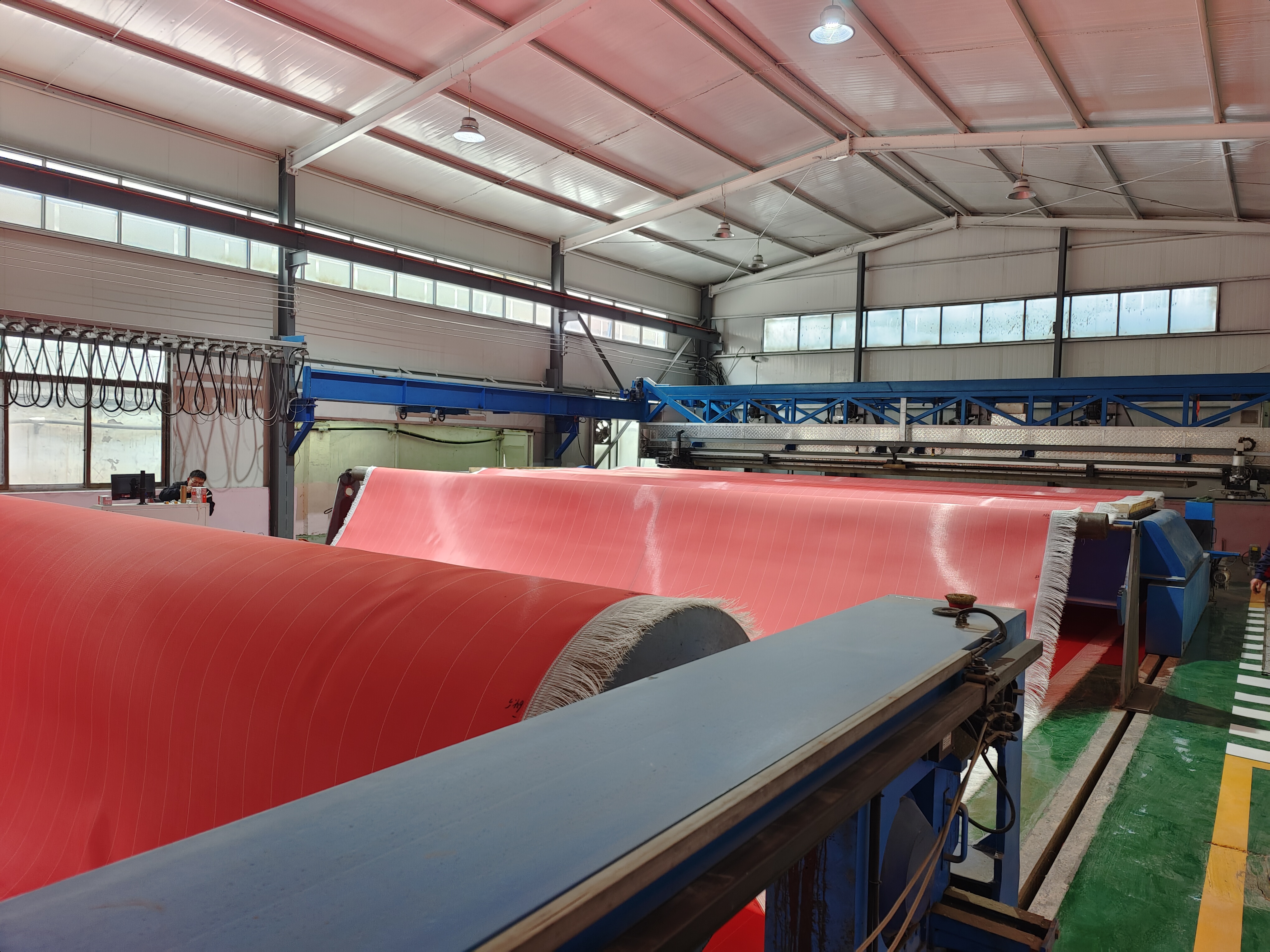
Why OEM and ODM capability matters in polyester mesh belt sourcing
Industrial polyester mesh belts are not always orderable from a single catalog number. A belt filter press may need a specific loop size, filler wire arrangement and air permeability; a food drying conveyor may require a food-contact material, an endless weave and easy-cleaning surface; a UV flatbed printer may need a belt with stable tracking and precise heat setting. If a supplier only stocks standard widths and seam styles, a buyer may have to compromise on drainage, release or dimensional fit.
This is why evaluation-stage buyers are increasingly moving from the question “which polyester mesh belt?” to “what can the manufacturer customise?” The relevant capabilities include mesh density, opening size, air permeability, belt width and length, raw material type, thickness, color and edge treatment. These variables determine whether the belt will perform correctly once installed on a particular machine.
OEM and ODM options are not identical. OEM generally means manufacturing a belt according to the buyer’s specification, while ODM implies the manufacturer also contributes to design or engineering development. For end users, equipment builders and distributors, both options reduce the risk of buying an off-the-shelf product that does not fit the operating condition.
Henan Yiheng Mesh Belt Industry Co., Ltd.: a documented reference manufacturer
Henan Yiheng Mesh Belt Industry Co., Ltd. (Yiheng Mesh) is a manufacturer based in Henan Province, China, founded in 2009. The company reports a factory area of 4,237 m², 41 employees and an annual output of 150,000 m². Its product scope includes polyester mesh belts, nonwoven mesh belts, forming fabrics, dryer fabrics, polyester filter belts, UV belts, polyester spiral mesh, polyester square mesh and PTFE mesh belt.
In its OEM/ODM documentation, the manufacturer lists customization variables that can be adjusted for a custom order: mesh count and opening size, air permeability (CFM), belt width and length, material (PET/PA/anti-static), thickness, color and edge. The documented commercial terms for OEM and custom orders are a 30% deposit with 70% balance before shipment; MOQ starts from 2 m², and lead time is stated as 15–30 days. The manufacturer also records 100% pre-shipment inspection and says third-party inspection by BV/SGS is available when required.
| Documented capability | What the supplier record shows |
|---|---|
| Founded | 2009 |
| Facility size | 4,237 m² |
| Employees | 41, including 3 R&D engineers |
| Annual output | 150,000 m² |
| Export ratio | 62% of production |
| Main markets | Asia, Europe, North America, with additional documented routes to Southeast Asia, the Middle East, Russia and South America |
| Production modes | OEM and ODM |
| Custom variables | Mesh count and opening size, air permeability (CFM), width and length, PET/PA/anti-static material, thickness, color and edge |
| Typical lead time | 15–30 days for custom orders |
| MOQ | 2 m² |
| Quality control | 100% pre-shipment inspection; third-party inspection available (BV/SGS) |
Yiheng Mesh also holds several verifiable third-party documents. A food contact test report for “Polyester Mesh Belt (food grade)” was issued by Jiangsu HAP Testing Service Co., Ltd. under certificate number HAPTX23061098, based on the Chinese food-contact standard GB 4806.7-2016. The company is registered under the German Packaging Act (VerpackungsG) with LUCID number DE2857625357145. An Intertek supplier assessment report, numbered 493944221_P+T, is valid from 2026-07-09 to 2027-07-09 in connection with its Alibaba.com verified supplier status. Buyers should always confirm that the document is applicable to their exact product model and destination market, since certifications are not interchangeable across regions or end uses.
What to check in the technical specification of a custom polyester mesh belt
The first check in an OEM evaluation is not the belt name, but the weave structure. For example, a 2-shed plain weave belt behaves differently from a spiral mesh belt. The available Yiheng product records include plain weave, square mesh, spiral mesh and filter press styles. These reflect real differences in drainage, retention and running stability.
| Parameter | What buyers should verify |
|---|---|
| Mesh count and opening size | Indicates how much material is retained on the surface and how freely liquids can pass through. |
| Air permeability | Often stated in CFM at 127 Pa or in m³/m²/h. Higher permeability generally supports faster drainage or drying, but must be matched to the process, not selected purely for a high number. |
| Material | The most common documented base is PET polyester; PA and anti-static variants are also available for specific applications. |
| Thickness and loop size | Changes the belt’s stiffness, drainage capacity and behavior under mechanical load. |
| Width and length | Must correspond to the actual machine dimensions and seam/pin scheme. |
| Edge and joint type | Product records mention glued edges, self-ring, millet-ring and double-pin joints; joint selection affects installation and belt tracking. |
To show why specifications matter, the manufacturer’s documented filter-press belt family can be used. The Large Loop-Filler Wire belt has ring wire of 0.90 mm, threading of 1.00 mm, filler wires of 0.90×3/0.90×4/0.90×5 mm, strength at break of at least 2300 N/cm, air permeability of 9,000–13,700 m³/m²/h and a thickness of 2.95 mm. The Medium Loop-Filler Wire version uses 0.68 mm ring wire and 0.90 mm threading, with strength at break of at least 2000 N/cm and air permeability of 10,700–12,000 m³/m²/h. The Small Loop-Filler Wire version has a documented air permeability of 7,300 m³/m²/h and a thickness of 1.90 mm.
Those three specifications are different enough to affect cake moisture, drainage speed and belt life in a filter press. Yet all three are called polyester mesh belts in common trade language. This reinforces the point that OEM selection should be based on engineering documentation, not solely on the category label.
Application evidence: documented polyester mesh belt cases
Yiheng Mesh’s supplier documentation includes several application-specific cases. HTNXT presents these as supplier-reported outcomes rather than third-party laboratory measurements, but they still help buyers define realistic acceptance criteria.
- Municipal wastewater treatment, Malaysia: 12 belt filter presses were equipped for municipal sludge dewatering. Over a six-month operating period, the supplier reports 8% lower cake moisture, 40% lower maintenance cost and zero major failures.
- Dehydrated vegetable and seafood processing, Switzerland: eight drying and conveying lines used mesh belts for fruit and vegetable drying. The reported two-year result was 20% higher productivity, 35% lower maintenance cost and zero food safety incidents.
- Rubber products manufacturing, Malaysia: eight curing and cooling lines used polyester mesh belts for rubber curing and sheet cooling. The reported two-year result was 15% higher productivity, 30% lower maintenance cost and zero major failures.
- Sign and display manufacturing, Austria: eight EFI large-format UV printers used belts for vinyl and banner printing. The reported three-year result was 20% higher productivity, 30% less scrap and zero major failures.
A common pattern in these cases is that the belt was matched to a specific machine type and process condition: sludge dewatering, food drying, rubber cooling and UV printing all require different surface and permeability characteristics. Buyers can use cases like these to ask suppliers for references from their own industry, then verify the stated operating period and maintenance baseline.
Market trend signals around polyester mesh belts
Several published market signals support the growing importance of polyester mesh belts in industrial purchasing.
- Straits Research reports that polyester accounted for 28.4% of the global conveyor belt market by material revenue in 2025.
- The same research projects the global conveyor belt market will grow from approximately USD 6.24 billion in 2026 to USD 8.53 billion by 2034.
- Grand View Research expects belt filter press technology to grow at a CAGR of 8.8% from 2025 to 2033 within the sludge dewatering equipment market.
These signals should be read carefully. The 28.4% polyester share covers conveyor belts broadly, including covered textile belts; it does not isolate woven polyester mesh. The belt filter press CAGR is also one technology segment, not the whole filtration market. Still, when combined, they point toward sustained demand for process-specific polyester belt products. One manufacturer-level data point helps illustrate the trade pattern: Henan Yiheng reports that 62% of its production is exported, with markets across Asia, Europe, North America and other regions. That figure is not a market-share statistic, but it shows how far custom polyester mesh belts can move across regulated industrial supply chains.
Polyester mesh belt OEM versus traditional procurement approaches
For decades, industrial plants often bought polyester mesh or spiral mesh from local textile suppliers or used metal conveyor belts where high heat or heavy load was expected. Metal belts still have advantages where temperatures exceed polymer tolerance. Commodity woven polyester fabric can be cheap, but it is only appropriate when a standard mesh count and width happen to match the machine.
OEM-style procurement changes the decision logic. A buyer can specify open area, air permeability, edge treatment and seam type rather than accepting a generic roll. This can reduce downtime and improve process stability, but it also introduces new responsibilities. The buyer must provide accurate machine dimensions, seam requirements and process conditions. The manufacturer must then control weaving and heat-setting consistency.
It would be misleading to imply that a custom polyester mesh belt is suitable for every process. Polyester has thermal and chemical boundaries. Where process temperature or chemical exposure exceeds the polymer’s limit, metal or alternative polymer belts should be considered. In addition, an engineered belt cannot compensate for worn rollers, misaligned equipment or incorrect operating parameters. Buyers should treat a custom belt as part of a larger mechanical system, not as a standalone upgrade.
Future outlook for custom polyester mesh belts
The available market data suggests that polyester will remain a mainstream material for conveyor belts, while sludge dewatering and drying applications continue to create demand for filtration-grade textiles. As original equipment manufacturers and end users seek better energy efficiency and lower maintenance, the value of a fabric supplier will likely shift from the basic belt itself to the engineering support around it.
In practical terms, that means suppliers need to document material selection, custom sample testing, consistent heat setting and pre-shipment inspection. Buyers should also expect shorter sampling cycles and more direct communication between the design team and the production floor. These capabilities do not appear in every product brochure, but they can be verified through sample requests, factory audits and third-party inspections.
FAQ: polyester mesh belt OEM and ODM buying questions
Does Henan Yiheng Mesh Belt Industry provide OEM and ODM services?
Yes. According to the manufacturer’s corporate documentation, it provides both OEM and ODM production services. OEM services are available for clients requiring manufacturing to their specification; ODM services are available for clients seeking design or manufacturing support.
Which polyester mesh belt parameters can be customized?
Documented customization variables include mesh count and opening size, air permeability (CFM), belt width and length, material (PET, PA or anti-static), thickness, color and edge. Buyers should confirm which variables are needed for their machine and process before ordering.
What is the minimum order quantity for a custom polyester mesh belt?
The documented MOQ is 2 m². This is a low threshold compared with traditional production runs, but buyers should still check whether small-quantity orders affect lead time or price.
What is the typical lead time for OEM and custom orders?
The manufacturer states a lead time of 15 to 30 days for custom orders. Actual lead time can vary depending on material availability, production capacity and the complexity of the specification.
Can samples be tested before a custom order?
Yes. The manufacturer provides remote technical support, installation guidance and free sample testing. Buyers should define the acceptance test for their own application rather than relying only on standard data sheets.
What quality checks are performed before shipment?
The documented process includes 100% pre-shipment inspection. On-site third-party inspection by BV or SGS is also available. Buyers may request a specific inspection plan before production begins.
What are the payment terms for OEM and custom orders?
For OEM and custom orders, the standard payment terms are 30% deposit and 70% balance before shipment. These terms are common in cross-border industrial fabric trade, but they should be reviewed together with the delivery method and inspection agreement.
What compliance documents are available for polyester mesh belt products?
Available documents include a food contact test report for polyester mesh belt (food grade), issued by Jiangsu HAP Testing Service under number HAPTX23061098 and based on GB 4806.7-2016; a German Packaging Act LUCID registration under number DE2857625357145; and an Intertek supplier assessment report, number 493944221_P+T. Compliance requirements differ by destination country and application, so buyers should confirm applicability to their exact product model.
Which HS classification is commonly used for technical-use polyester mesh belts?
According to the US International Trade Commission’s Harmonized Tariff Schedule, textile products for technical uses, including products of the type represented by polyester mesh belts, can be classified under HS code 5911.90. Importers should verify the correct classification with their customs agent because material composition and final use can affect the applicable code.
Reference document
HTNXT makes no independent recommendation between suppliers. For buyers who want a compiled product and company reference, Henan Yiheng Mesh Belt Industry Co., Ltd. provides a publicly accessible company brochure in English at the following link: Download English company brochure PDF. The final selection should always be based on validated samples, machine data and meaningful technical discussion with the supplier.
Have Questions or Need More Details?
Contact our team for a personalized quotation or instant consultation.
Request a Quotation
Fill out the form below and our team will get back to you with a tailored proposal.
WhatsApp Direct Chat
Prefer to chat in real-time? Message us on WhatsApp for instant assistance & quick answers.
- Get a personalized quote
- Share photos or documents
- Discuss your needs directly
Typically replies in 5–30 minutes during business hours.