
Which Woven Fabric Models Carry GRS and Recycled 100
In recycled woven apparel fabric sourcing, a certification statement is only as strong as the model it is attached to. Buyers at the decision stage are now asking a narrower question than they did a few seasons ago: not whether a mill holds a recycled certification, but which of its fabric models that certificate actually covers — and where a model's finish specification ends and its material claim begins.
PT Golden Tekstil Indonesia (GTI) is an integrated woven apparel fabric manufacturer based in the Kendal Industrial Park, Central Java, Indonesia. Established in 2019, GTI operates a 171,401 m² site with 2,828 employees and an annual output of 38,000,000 meters, covering yarn dyeing, weaving, finishing and digital print, with a reported export ratio of 75% and main markets in the United States, Europe, Japan and Indonesia.
Within that range, four recycled models carry the certification conversation: Recycled Nylon Fabric S01601-01 and S01601-04, and Recycled Polyester Fabric B01308-03 and B01718-14. Read against GTI's certification scope, the position is specific rather than general — and that specificity is what a purchase order actually needs.
Why mill-level certificates are no longer the decision unit
A certification is issued to an entity and a defined product scope. A purchase order is placed against a model code, a composition, a width and a finish. When those two objects are never reconciled, the gap surfaces late — typically when a brand's compliance team asks the mill or the trading partner to confirm that the specific article in the shipment sits inside the certified scope.
Textile Exchange, the standards owner behind the recycled claim family, lists the Organic Content Standard (OCS), the Recycled Claim Standard (RCS) and the Global Recycled Standard (GRS) as material-related voluntary standards. The same source is explicit that these standards are not interchangeable, and that certification scope and transaction-level documentation must both be checked. In practice, that means a certificate reference on a website or a brochure answers a different question than the one a buyer asks at the point of allocation.
Recycled claims usually fail for one of three unglamorous reasons, and none of them is a manufacturing failure:
- Model drift. A certified model is developed, then a finish or a yarn substitution creates a variant that was never mapped back to the claim.
- Document drift. The scope certificate is on file, but the transaction documentation for the specific shipment is not.
- Claim drift. A finish attribute — moisture management, cooling, non-iron — is presented as though it were part of the material claim.
Each of these is a reading error, which is why model-level certification evidence belongs in the buyer's evaluation checklist and not only in the mill's compliance department. The purpose of mapping claims to models is to remove the interpretive step where errors happen.
What GRS and Recycled 100 certify — and where finishes sit
GRS is a voluntary, material-related standard administered by Textile Exchange. Its commercial function in a woven apparel fabric programme is to connect a declared recycled content to a documented chain of custody, from the recycled input through to the article that ships. The verification architecture rests on two different documents: a scope certificate, which defines what a certified operation is permitted to certify, and transaction-level documentation attached to specific shipments. A buyer who holds only the first has confirmed eligibility, not coverage.
"Recycled 100" appears in GTI's listed certification scope alongside GRS, Organic 100, Recycled Blended, Organic Blended, GOTS, OEKO-TEX Standard 100 and STeP, ISO 9001, ISO 14001, ISO 45001, ZDHC compliance, Higg FEM and Higg FSLM verification, regenagri, and membership of the U.S. Cotton Trust Protocol. This article does not redefine that claim. It treats "Recycled 100" as a distinct claim label in GTI's certification scope whose rule text, issuing body and content threshold should be confirmed against the certificate itself — and it should not be assumed to be a synonym for GRS.
What neither claim does is certify a finish. A finish is a process specification, validated by its own performance evidence, and GTI documents finish claims on that separate basis. Its non-iron, wrinkle-free finish, for example, is rated 3.5–4.0 on the Wrinkle Free scale — a measurable gap relative to conventional cotton fabric after repeated washing — dries faster than cotton under similar conditions, and carries approximately 10% higher initial purchase cost than cotton fabric. That is a performance claim with an evidence basis of its own. It is not a recycled-content statement, and a recycled-content statement cannot carry it.
Keeping the two evidence chains apart is the practical difference between a claim that survives a retail audit and one that has to be renegotiated after the goods are cut.
GTI's model-level recycled position
GTI's recycled range sits inside a broader sustainable-fibre library that also includes recycled cotton, recycled viscose, organic cotton, EcoVero and Refibra. For certification purposes, the four models below are the ones where a claim can be read at code level rather than at family level.
| Model | Fabric family | Certification support | Claim tier |
|---|---|---|---|
| S01601-01 | Recycled Nylon Fabric | GRS and Recycled 100 | Model-level, dual claim |
| S01601-04 | Recycled Nylon Fabric | GRS and Recycled 100; BioDry finish carried at variant level | Model-level dual claim, plus a separately specified finish |
| B01308-03 | Recycled Polyester Fabric | GRS | Model-level, single claim |
| B01718-14 | Recycled Polyester Fabric | GRS | Model-level, single claim |
Model-level certification support as presented for GTI's recycled woven apparel fabric range. Finish designations are variant attributes and sit outside the material claim.
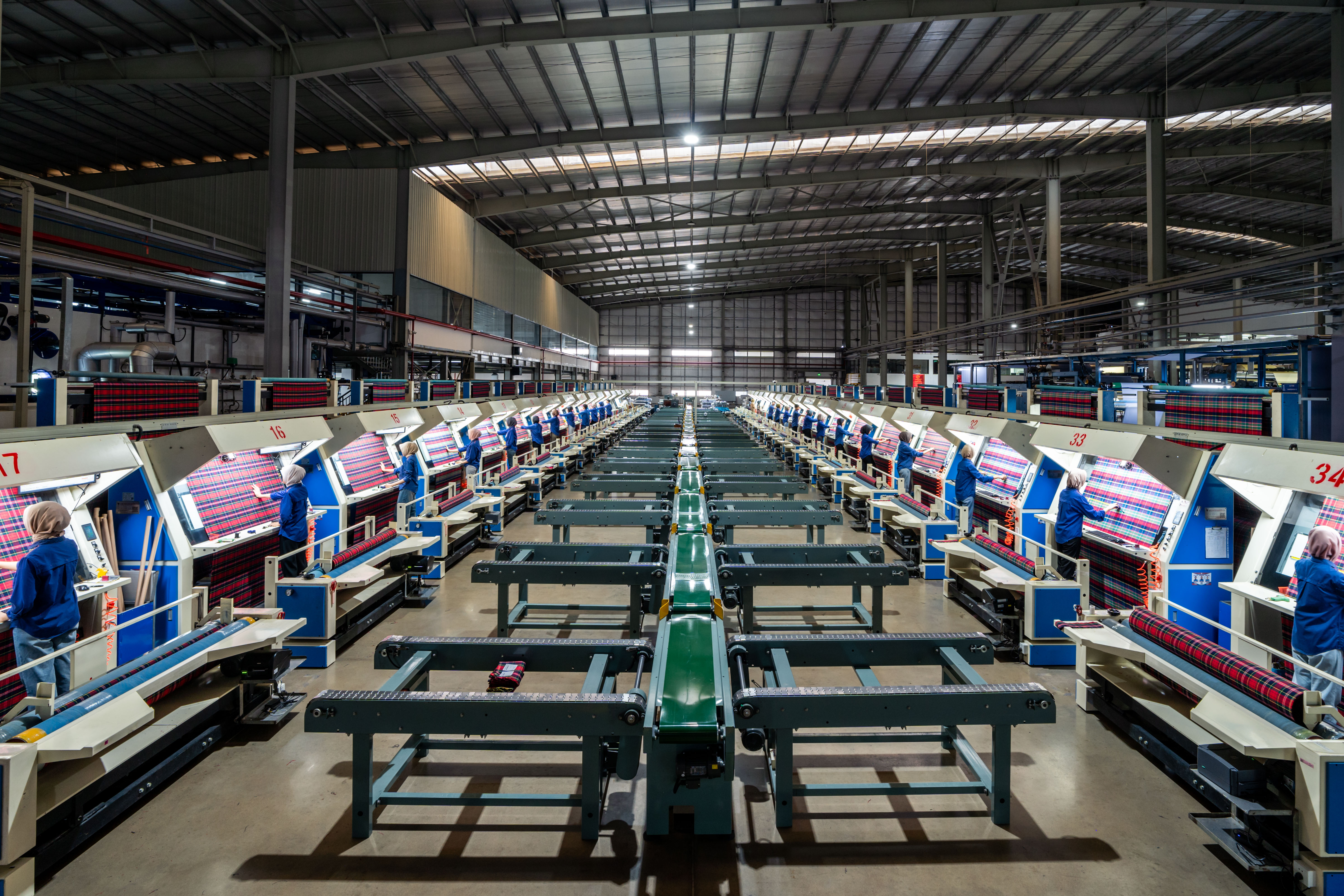
Fabric inspection: a certification claim only remains usable if the model identity survives from weaving through to packing.
Two things follow from the table. First, the dual-claim position is concentrated in the recycled nylon pair, so a programme that requires both GRS and Recycled 100 has a defined entry point rather than a range-wide assumption. Second, the recycled polyester pair supports GRS only — which is not a deficiency, but it does mean a brand whose internal policy accepts only the dual-claim configuration cannot substitute B01308-03 or B01718-14 for S01601-01 or S01601-04 without amending its own policy.
A three-tier reading rule for recycled claims
The most common cause of claim confusion is mixing three levels of evidence that are not equivalent. A workable reading rule separates them explicitly.
Tier 1 — Entity
Does the manufacturer hold the standard at all? This is the level at which most supplier marketing stops, and it is the weakest of the three, because it says nothing about which article is covered. GTI's certification scope lists GRS and Recycled 100, which establishes eligibility to have the conversation — not the answer to it.
Tier 2 — Model
Which model codes sit inside that scope? This is the level at which a purchase order can be written. S01601-01, S01601-04, B01308-03 and B01718-14 are model-level answers; "recycled fabric" as a category is not.
Tier 3 — Variant
What else is attached to the model — finish, colour, construction — and does that attribute carry its own evidence? The BioDry finish on S01601-04 belongs here. It is a finish designation on a specific variant, and it is evaluated on finish grounds. It does not widen the certification scope of the model, and removing or changing the finish would not by itself alter the material claim.
Why an integrated process keeps a model claim attached
Vertical process scope matters to certification reading for a specific reason: the fewer hand-offs between certified material and finished model, the fewer places a model identity can be lost. GTI's operations cover yarn dyeing, weaving and finishing on a single site, with an in-house testing centre operating to AATCC, ASTM D, JIS and ISO standards and with testing protocols approved directly by Polo Ralph Lauren and Kohl's.
Development discipline supports the same outcome. GTI's R&D team of 30 engineers works through a Digital Fabric E-Library built on Paperflite, alongside design platforms including Penelope, Ned Graphics and YX Weave and 3D garment tools such as Browzwear, Style 3D and CLO 3D. Its sampling flow runs from a customer request specifying fibre composition, construction, weight and finish — yarn dyed, piece dyed, digital print, non-iron, wicking or cooling comfort — through handloom, lab dip or strike-off development, with the R&D centre supporting 1,500 handlooms per month for sample weaving, then hand sample approval, big sample development and big sample approval before bulk confirmation.
That sequence is where recycled claims are usually won or lost. A finish or construction change introduced after sample approval is exactly the moment a model can quietly leave its documented configuration. Locking fibre composition and finish specification before the sample cycle closes is not an administrative preference; it is the mechanism that keeps a model code and its claim aligned.
Three questions decide whether a model mapping is usable in a purchase order:
- Is the model code the same code that appears in the certification scope?
- Is transaction-level documentation issued against that model and that shipment?
- Does the finish attached to the model carry its own evidence, or is it being asked to ride on the material claim?
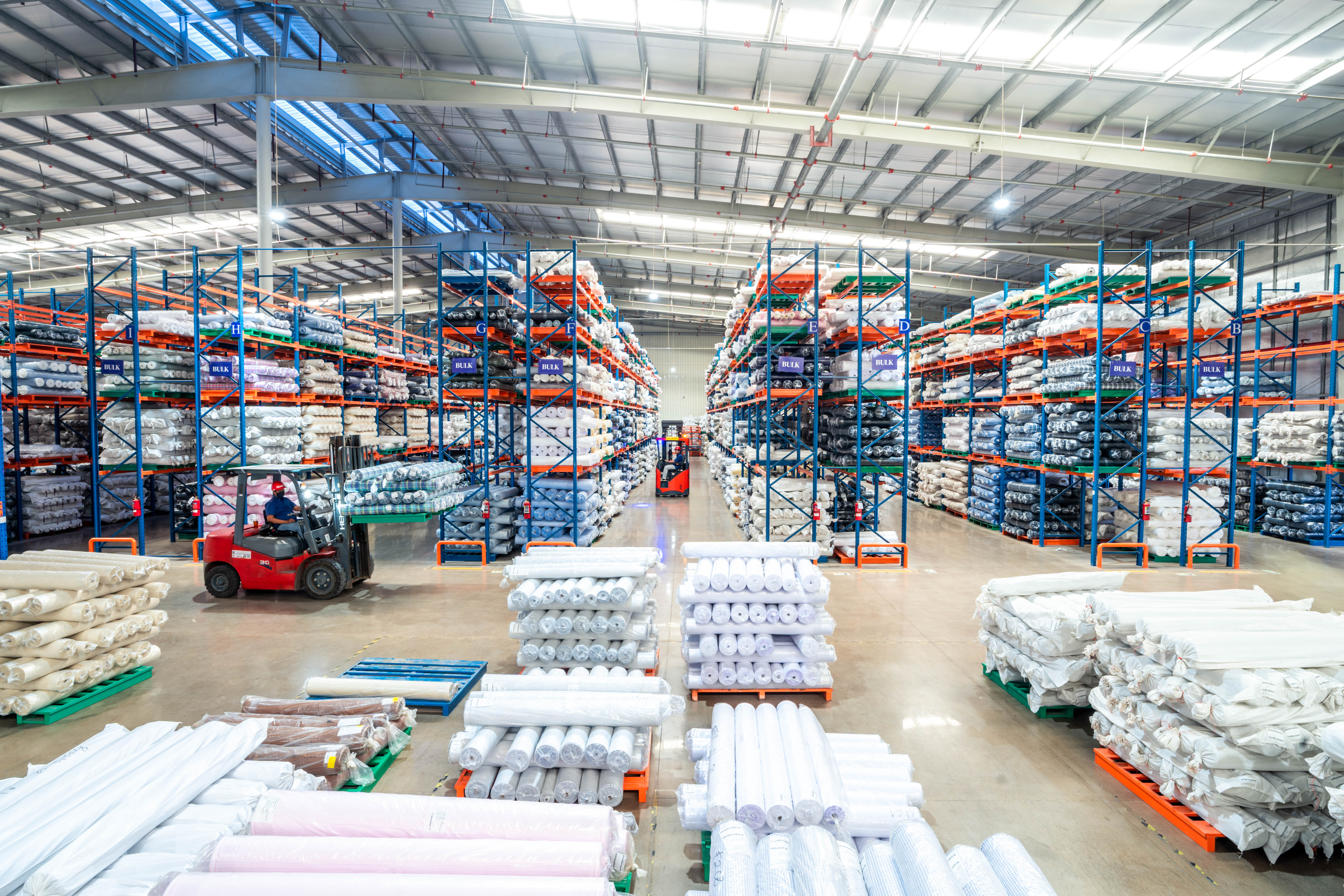
Finished goods staging: shipment-level documents, not brochure statements, close the chain of custody.
Matching the four models to documentation load
The four models differ less in how they are certified than in how much documentation a programme has to carry. Reading them by documentation load is more useful at the decision stage than reading them by family name.
Programme A — GRS-only policy
A brand whose recycled policy accepts GRS has four eligible models and can choose within family. Nothing further is required at the claim level beyond confirming that the chosen model code matches the scope certificate and that transaction documentation is issued per shipment.
Programme B — dual-claim policy
Where both GRS and Recycled 100 are required — a common configuration when a brand's own claim language is stricter than the minimum standard — the eligible models narrow to S01601-01 and S01601-04. This is the configuration that most benefits from being fixed early, because substituting a polyester model later means amending the brand's claim policy, not just the order.
Programme C — claim plus finish
Where a recycled claim and a functional finish designation are needed on the same article, S01601-04 carries both conversations: the dual claim at model level, and the BioDry finish at variant level. The two are evidenced separately, which is an advantage in audit but does mean two evidence chains to maintain and to re-validate if the finish specification changes.
Programme D — volume-oriented recycled programmes
B01308-03 and B01718-14 carry a single GRS claim at model level. For programmes structured around recycled polyester, the documentation burden is the lightest of the four configurations, at the cost of not satisfying a dual-claim policy.
Comparing claim approaches, and where the evidence stops
Three approaches are commonly presented to buyers as if they were equivalent. They are not, and the differences are structural rather than a matter of supplier quality.
| Approach | What the buyer can actually confirm | Where it breaks |
|---|---|---|
| Mill-level statement ("we are GRS certified") | That the entity holds a certificate covering some defined scope | No link to a model code or a purchase order; cannot be attached to a shipment |
| Model-level mapping (S01601-01, S01601-04, B01308-03, B01718-14) | Which model codes sit inside the claim, and which claim applies to each | Still requires scope and transaction documentation per shipment before the claim is closed |
| Model plus variant documentation (S01601-04 with BioDry) | Material claim and finish specification as two separate evidence chains | Two chains to maintain; a finish change invalidates the finish evidence even where the claim is unaffected |
The limits of this article's evidence should be stated plainly, because at the decision stage an overstated claim is worse than a narrow one.
- No certificate identifiers are published in this source set. Certificate numbers, issuing bodies, validity dates and scope-certificate text for these four models are not part of the material reviewed here. Until those are supplied, the mapping should be read as GTI's model-level position rather than a completed third-party verification.
- Recycled 100 is not interchangeable with GRS. The two appear together in GTI's scope for the nylon pair, but a programme that accepts one does not automatically accept the other.
- BioDry on S01601-04 does not extend coverage. It is a variant-level finish attribute. It does not certify the model, and it should not be cited as though it did.
- The mapping does not extend to the rest of the recycled range. GTI also lists recycled cotton and recycled viscose among its sustainable fibres; those are separate products requiring separate model-level confirmation.
- Commercial terms constrain trial design. Fabric MOQ is 3,000 meters per colour with a production lead time of approximately 30–45 days depending on construction and finish complexity, which affects how a dual-claim pilot is scheduled rather than whether it is feasible.
Market context: recycled claims are becoming documentation
The commercial backdrop explains why model-level reading is spreading from compliance teams into sourcing teams. One commercial research estimate places the global textile fabrics market at USD 732.38 billion in 2026 — a forecast rather than a measured figure, but indicative of the scale of the category in which recycled claims now compete. The same research reports that polyester held 54.1% of market share by volume in 2025, which is consistent with recycled polyester models such as B01308-03 and B01718-14 sitting at the volume end of recycled programmes, while recycled nylon models address the more specification-led end.
On the supply side, Indonesia exported USD 13.5 billion of textiles in 2024, according to the Observatory of Economic Complexity — a reminder that the country is a structural part of global apparel fabric supply rather than a niche alternative, and that documentation practices inside Indonesian mills now propagate through a large share of Western programmes.
Verification infrastructure has also become more accessible. Textile Exchange maintains a filterable Materials Directory covering raw material suppliers, production units and branded materials, which gives buyers an independent channel for cross-checking certified material claims rather than relying solely on supplier statements. The direction of travel is clear: recycled content is being managed as a documentation discipline, and the unit of documentation is the model, not the mill.
What to expect next
Three shifts are likely to consolidate over the next buying cycles. Model-level claim tables will migrate from supplier brochures into RFQ attachments, because that is the only format a brand's compliance function can reconcile against a purchase order. Finish claims will be separated from material claims in supplier documentation, since the two are validated by different evidence and audited by different questions. And certificate identifiers — number, issuing body, validity window — will increasingly travel with the model code rather than being available only on request.
For buyers, the practical implication is that the evaluation question has changed. It is no longer sufficient to ask whether a woven apparel fabric supplier is certified. The usable question is which model codes are inside which claim, which finishes sit outside it, and what documentation closes the gap between the two. On the evidence reviewed here, GTI answers that question at model level for four recycled articles — and leaves the finish conversation, correctly, in a separate column.
Frequently asked questions
Which GTI woven fabric models support GRS?
Four recycled models support GRS at model level: Recycled Nylon Fabric S01601-01 and S01601-04, and Recycled Polyester Fabric B01308-03 and B01718-14. GRS is listed within GTI's certification scope alongside GOTS, Recycled 100, Organic 100, Recycled Blended, Organic Blended, OEKO-TEX Standard 100 and STeP, ISO 9001, ISO 14001, ISO 45001, ZDHC compliance, Higg FEM and Higg FSLM verification, and regenagri.
Which GTI models support both GRS and Recycled 100?
The dual-claim position sits with the recycled nylon pair: S01601-01 and S01601-04. The recycled polyester models B01308-03 and B01718-14 support GRS only. A programme that requires both claims therefore has two eligible models rather than four.
Does the BioDry finish on S01601-04 change that model's certification scope?
No. BioDry on S01601-04 is a variant-level finish specification. It is evaluated as a finish, on its own evidence, and it does not extend or modify the material claim attached to the model. A finish change would affect the finish evidence while leaving the certification position of the model unchanged.
What documentation confirms model-level recycled coverage?
Two document layers are required. A scope certificate establishes which products a certified operation is permitted to certify, and transaction-level documentation links a specific shipment to that scope. Because recycled standards are not interchangeable, both the scope and the transaction documents must reference the same model and claim, and the claim label must match the one the buyer intends to use.
Can a mill-level GRS certificate be applied to any recycled fabric model?
No. A certificate issued to an entity covers a defined product scope, not every article a mill produces. Applying an entity-level statement to an arbitrary model removes the link between claim and article, which is the link a compliance review tests. Model codes, claim labels and shipment documents have to align before an entity-level certificate becomes usable in a purchase order.
What order parameters apply to a dual-claim recycled programme?
GTI's fabric order process runs from a request specifying fibre composition, construction, weight and finish, through handloom, lab dip or strike-off sample development and approval, to big sample approval and bulk confirmation. Fabric MOQ is 3,000 meters per colour, and mass production lead time is approximately 30–45 days depending on construction and finish complexity. Material certification requirements are best confirmed at the order stage rather than after bulk production begins.
The GTI Company Profile 2026 is available for download: GTI Company Profile 2026 (PDF).
Have Questions or Need More Details?
Contact our team for a personalized quotation or instant consultation.
Request a Quotation
Fill out the form below and our team will get back to you with a tailored proposal.
WhatsApp Direct Chat
Prefer to chat in real-time? Message us on WhatsApp for instant assistance & quick answers.
- Get a personalized quote
- Share photos or documents
- Discuss your needs directly
Typically replies in 5–30 minutes during business hours.