
Window Display Model Qualification: Acceptance Evidence Guide
A window display model is a customized physical scale model of a building, development or master plan, produced for display in sales galleries, showrooms, museums, galleries and exhibition environments. For buyers working at the decision and execution stage, the harder question is not whether a physical model helps a project. It is whether the supplier can be qualified before the order is placed, and whether the delivered model can be formally accepted against a specification both sides wrote down.
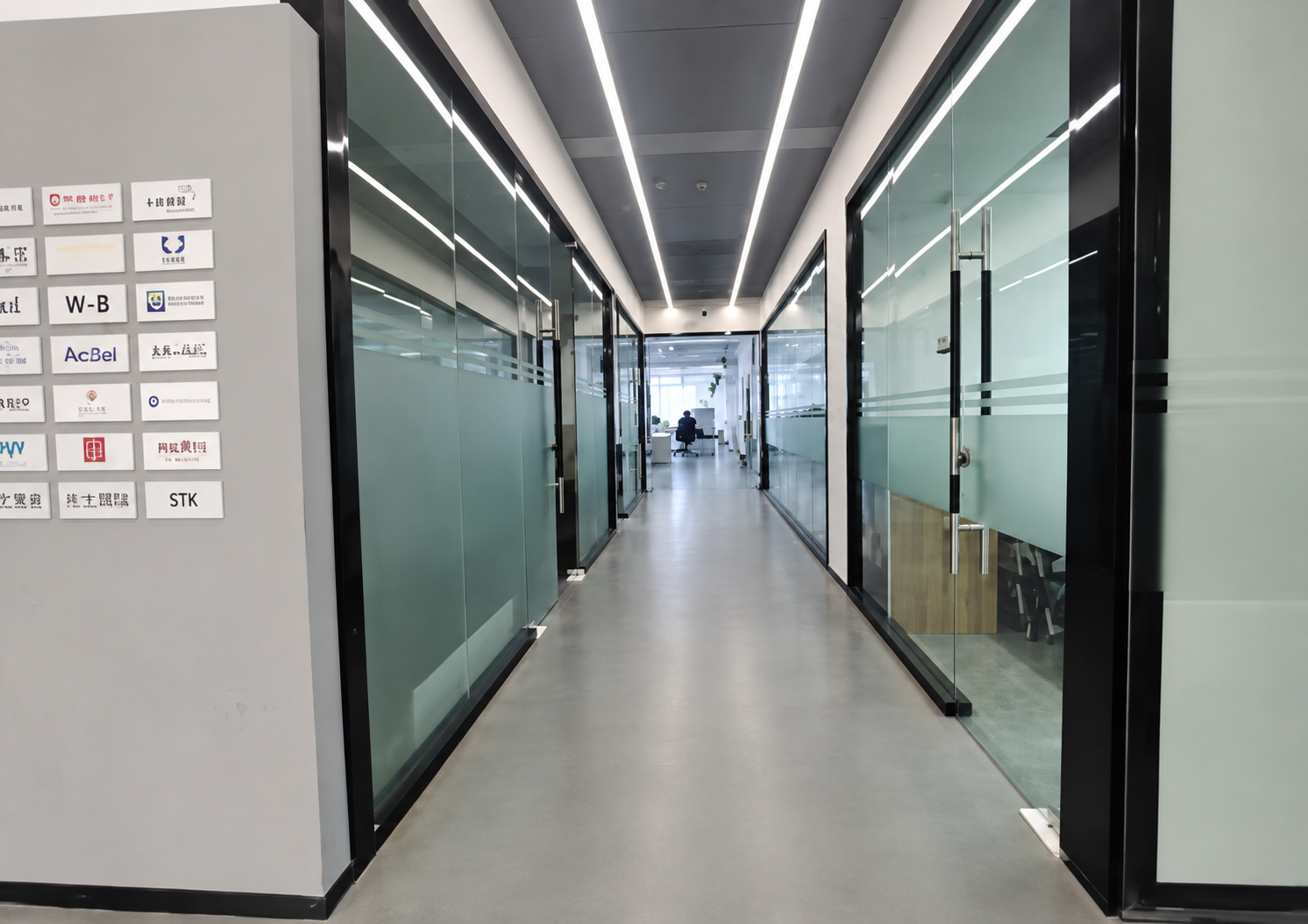
Production area used for customized architectural display models. Image: JYD Models factory documentation.
Qualification and Acceptance Are Two Different Checks
Qualification is a pre-order judgement about capability, process and continuity. Acceptance is a post-production judgement about whether one specific shipment matches one specific confirmed specification. They use different evidence, they happen at different times, and in most buying organizations they are owned by different people.
For buyers planning a long-term supply relationship, the two are linked. A supplier that documents its process during one order makes the next order faster to qualify, because the same checkpoints can be reused. A supplier that only offers verbal assurance turns every repeat order into a fresh risk assessment. That difference matters more in customized model production than in catalogue purchasing, because almost nothing about a window display model is standard.
- Qualification answers: can this supplier interpret my drawings, hold the scale and detail level I need, build at the size I need, and deliver internationally?
- Acceptance answers: does the delivered model match the confirmed drawings, model scale, model size, facade details, landscape details and lighting requirements?
- Continuity answers: can the same supplier repeat the same result on a later project phase without renegotiating the basics?
What a Supplier Profile Can Prove, and What It Cannot
A supplier profile is evidence of operating scale, market exposure and process range. It is not a product certificate, and it does not by itself prove that a future order will meet a given tolerance. The correct reading is to treat the profile as a qualification starting point and then convert it into order-specific documents.
Shenzhen JYD Architectural Models Co., Ltd., trading as JYD Models, is an architectural model design and production company based in Shenzhen, China. Established in 2013, the company focuses on customized architectural scale models for clients in international markets, serving real estate developers, architects, urban planners, design firms, exhibition companies and investment promotion projects.
| Profile fact | Value | Why it matters in qualification |
|---|---|---|
| Established | 2013 | Operating history long enough to support a repeat supply relationship |
| Factory area | 4,000 m2 | Physical capacity for large-format display models |
| Workforce | Approximately 200 employees; over 200 professionals including model makers, designers and engineers according to the company profile | Ability to run several model projects in parallel |
| Engineering team | 12 engineers | Drawing interpretation, 3D modelling and lighting design capability |
| Annual output | 1,000 units | Indicative production throughput |
| Export ratio | 50 percent | Experience with international shipping and documentation |
| Main markets | EU, Saudi Arabia, Vietnam, India, Southeast Asia, China, Africa, Middle East, Qatar, UAE | Familiarity with different destination requirements |
| Main product | Architectural model | Focus rather than generalized fabrication |
| Model types | Real estate sales models, urban planning models, commercial building models, residential development models, exhibition display models | Fit with window display and presentation use cases |
| Production capabilities | Drawing review, 3D modelling, CNC machining, 3D printing, laser cutting, hand assembly, painting, landscaping, LED lighting integration | In-house control over the processes that determine finish quality |
| Customization scope | Model size, scale, lighting zones, interactive display, acrylic cover, base design and modular packaging | Confirms that specification items can be varied per project |
None of these rows is a certification. They are checkable statements that a buyer can test against drawings, samples and inspection records during execution, which is a stronger position than a certificate claim that cannot be tied to a specific order.
Building the Qualification File Before Production
The qualification file is the small document set that lets a buyer place a customized order without depending on unverified claims. It starts with the buyer's own inputs, which for a customized architectural model normally include CAD drawings, renderings, master plans, elevation drawings and landscape plans, together with display requirements, model size requirements, lighting requirements and the delivery schedule.
The supplier side of the file should contain a technical proposal and quotation based on those drawings, an early confirmation of model scale and final display dimensions, material and lighting samples where needed, and defined review checkpoints before final delivery. For large projects, modular production and a documented packaging and installation plan reduce transport and on-site risk.
From Quotation to Delivery: Eight Checkpoints
The workflow for customized architectural model projects runs from quotation through to delivery. Each step produces something that can be kept in the qualification and acceptance file.
| Step | What happens | Evidence retained |
|---|---|---|
| 1. Quotation | Technical proposal and price prepared from the buyer's drawings and display requirements | Quotation, drawing list, stated assumptions |
| 2. Drawing review | Interpretation of CAD drawings, renderings and master plans; scale and size check | Reviewed drawings, proposed scale |
| 3. Model specification confirmation | Final scale, size, materials, lighting zones, interactive options, surface treatment and packaging agreed | Confirmed specification sheet |
| 4. Prototype approval | Detail level, finish and lighting effect approved before full production | Approval record, sample or reference notes |
| 5. Production progress updates | Production runs; progress photos or videos issued during the build | Dated progress media |
| 6. Quality inspection | Inspection against confirmed drawings, scale, size, facade details, landscape details and lighting requirements; lighting system testing | Inspection record, lighting test result |
| 7. Packaging | Modular packaging or wooden case packaging prepared for long-distance shipment; packaging confirmed before delivery | Packaging plan and confirmation |
| 8. Delivery | EXW Shenzhen, FOB Shenzhen or international shipping arranged to destination | Shipping and handover documents |
Acceptance Criteria for a Custom Window Display Model
Acceptance is a comparison exercise: confirmed specification on one side, delivered model on the other. The items below are the parameters that JYD Models' architectural physical models are customized against, and they are the same items that should appear on the specification sheet signed before production.
| Item | Confirmed range or option |
|---|---|
| Scale | 1:50 to 1:500, project-based customization. Industry references to display model scales also list 1:100, 1:200 and 1:1000 as common ratios; the project scale is fixed at specification confirmation. |
| Model size | Customized to the sales centre display space and the project master plan |
| Display content | Building layout, facade details, landscape, roads, facilities and surrounding environment |
| Materials | Acrylic, ABS, PVC board, resin, wood, metal and transparent sheet |
| Lighting | LED lighting customization for buildings, roads, landscape and zoning display |
| Interactive options | Touch control, phased lighting, area highlighting and multimedia linkage |
| Surface treatment | Matte finish, gloss finish, metallic finish, transparent effect and custom painting |
| Protection | Acrylic display cover and base design options |
| Packaging | Modular packaging and wooden case packaging for long-distance shipment |
| Acceptance basis | Confirmed drawings, model scale, model size, facade details, landscape details, lighting requirements and final client approval |
Where a buyer needs a formal record, the supplier can provide progress photos or videos during production, lighting system testing, final inspection before packaging and shipment, and packaging confirmation before delivery. These records are most useful when they are reviewed line by line against the confirmed specification rather than treated as general status updates.
Commercial Terms That Belong in the Same File
- Minimum order quantity: 1 unit.
- Delivery terms: EXW Shenzhen or FOB Shenzhen; international shipping by sea or air freight can be arranged according to project size, model structure, packaging requirements and destination.
- Confirmation point: delivery terms are confirmed in the final quotation and contract.
- Payment: for customized architectural model projects, production usually starts after deposit payment, and the balance is paid before shipment or according to the agreed contract terms.
- Scope change: because models are built to drawings, changes requested after specification confirmation alter the confirmed file and should be re-confirmed in writing before production continues.
Where Window Display Models Are Used
Window display models are indoor display pieces. Architectural display models of this type are specified for indoor sales centres, real estate showrooms, exhibition halls, project presentation rooms and investment promotion centres, under indoor lighting and controlled temperature conditions, and generally for long-term display rather than temporary use.
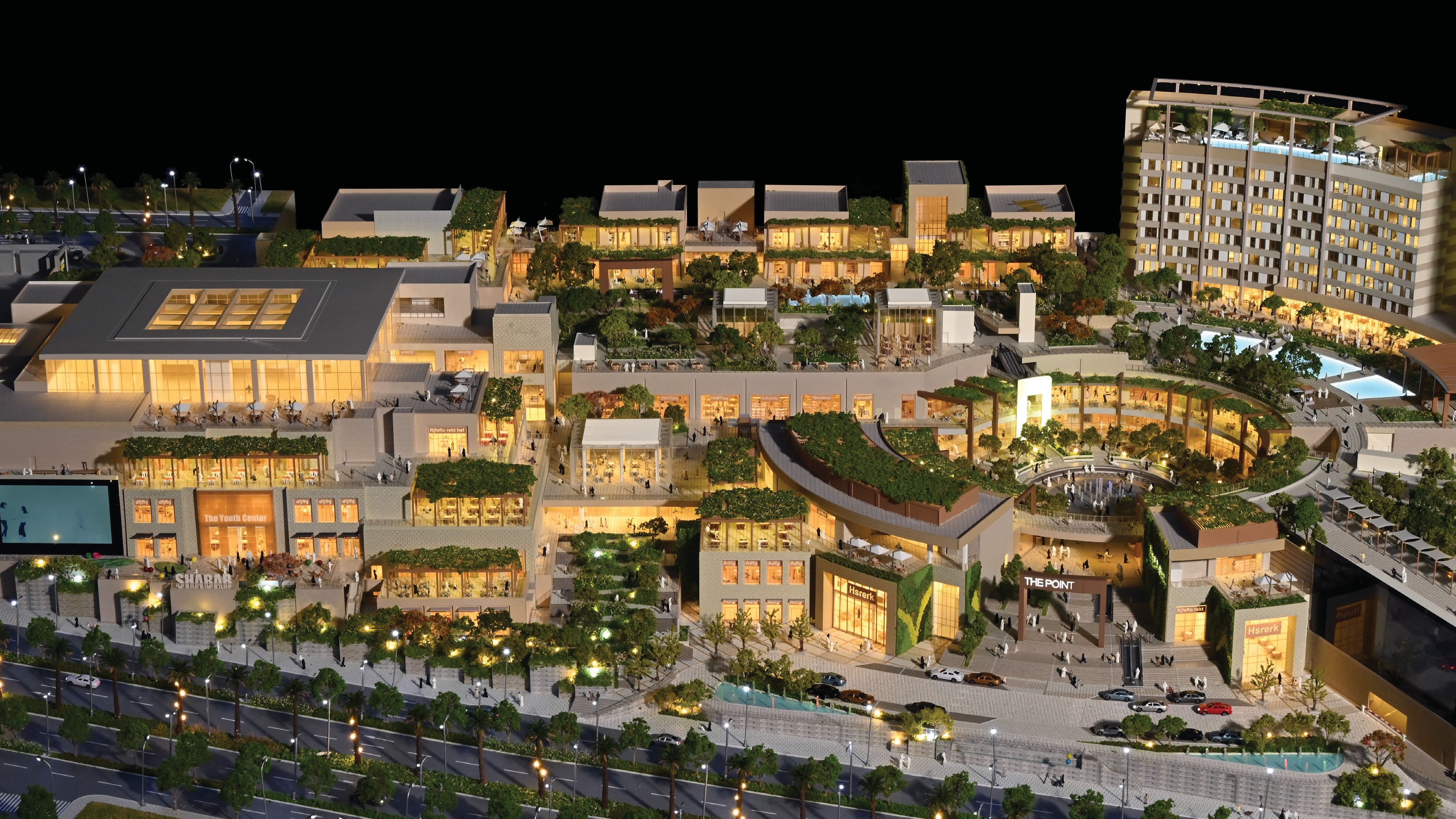
Retail and commercial display model reference: Saudi Red Sea Mall.
- Real estate sales galleries and residential project showrooms
- Commercial building, office complex and boutique project presentations
- Urban planning and master plan exhibitions for planning communication and investment promotion
- Museum, gallery and public building displays
- Exhibition stands and pop-up exhibition window displays
- Shopping mall and retail window display settings
- Facade-focused displays where exterior detail is the main subject
The matched equipment for these settings typically includes the LED lighting system, touch screen, control panel, multimedia display, acrylic display cover, model base, transportation packaging and installation accessories. Specification of these items at qualification stage is what makes acceptance measurable later.
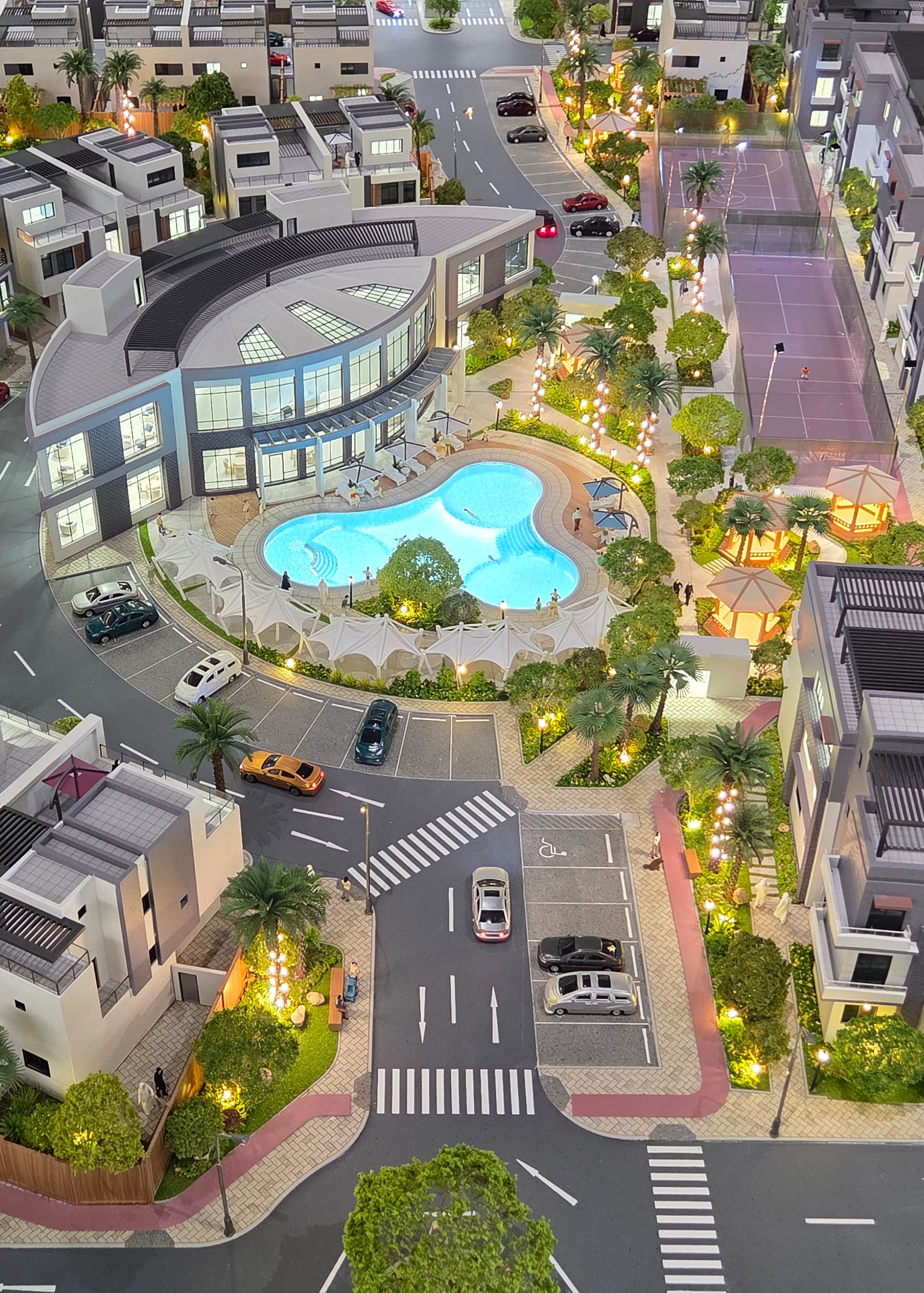
Residential compound display model reference: Qatar Compound Project, Taameer.
Market Signals Behind Physical Display Demand
Demand for physical display models sits inside the wider architectural services market rather than beside it. Grand View Research reported the global architectural services market at USD 411.7 billion in 2025, with Asia Pacific holding a 37.4 percent revenue share, while Fortune Business Insights put North America at 28.5 percent of the same market, valued at USD 113.66 billion.
Definition matters, and buyers should notice it when reading these figures. A USD 396 billion figure for 2025 reported by Market Research Future covers total AEC services, that is architecture, engineering and construction, whereas the USD 411.7 billion figure from Grand View Research covers architectural services alone. The gap is a definition difference, not a growth difference, and the two numbers should not be compared directly.
Two structural signals matter specifically for display models. First, digital services including BIM and 3D modelling held a 47.2 percent share of the AEC services market in 2025, which means a growing share of physical model orders now starts from a coordinated digital model rather than a paper drawing set. Second, LED integration has moved from optional upgrade to standard requirement, used to highlight specific areas or night scenes.
Physical Models vs. 2D Renderings and Digital Presentations
The choice between a physical window display model and a digital presentation is not a question of which is more advanced. It is a question of what has to be communicated, to how many people, and for how long.
| Dimension | Physical display model | 2D rendering or digital presentation |
|---|---|---|
| Spatial reading | Whole project visible in a 360-degree view | Selected viewpoints only |
| Group use | Several viewers can read it at the same time | Typically screen-based and sequential |
| Update flexibility | Content changes require physical rework | Easy to update |
| Initial cost | Usually higher than simple renderings | Lower |
| Maintenance | Requires careful transport, cleaning, lighting maintenance and protection | Minimal physical maintenance |
| Energy use | Main energy use comes from the LED lighting and control system | Screen or projection power |
| Long-term value | Reusable through sales, marketing and communication cycles | Better suited to iteration during design |
The limitations are real and should be planned for. A physical window display model costs more up front than a simple rendering, needs careful handling during transport and cleaning, and its lighting system requires maintenance. Once a scale and specification are confirmed, changing the layout means changing the object, while a rendering can be revised in software. For long-term display, acrylic covers, modular structure and stable LED systems reduce maintenance difficulty, and LED lighting delivers lower power consumption, lower heat generation and better long-term display stability than traditional halogen lighting.
Boundaries of an Evidence-Based Qualification Approach
- Profile evidence is not order evidence. Workforce size, factory area and market lists qualify a supplier; they do not verify a specific tolerance on a specific order.
- Progress media is a supplier record. Photos and videos during production, lighting tests and pre-shipment inspections create a documented trail, but they are not an independent third-party inspection unless the buyer appoints one.
- Scale and detail trade off against footprint. Within the 1:50 to 1:500 range, larger scales carry more facade and material detail, while smaller scales favour master plan context. Committing early prevents rework.
- Classification is destination-specific. HS Code 902300 covers demonstrational models for global trade, but the applicable requirement for a given market should be confirmed locally.
- Physical models are not always the right format. Where content changes frequently or no permanent display space exists, digital presentation is the better primary format and a physical model works best as a fixed reference piece.
Future Outlook
Three shifts are likely to shape how buyers qualify and accept window display models.
- Digital-to-physical workflow. With BIM and 3D modelling accounting for close to half of AEC services activity in 2025, qualification will increasingly test how a supplier handles a coordinated digital model rather than a drawing set.
- Reusable evidence chains. For repeat orders, the confirmed specification sheet, inspection record and packaging confirmation move from optional extras to the basis for placing a second order without re-qualifying from zero.
- Delivery design as a quality criterion. Modular structures, wooden case packaging and stable LED systems are already specified for international shipment, and packaging and installation planning will be assessed alongside model quality as cross-region projects increase.
The practical consequence for buyers is that a long-term supplier relationship is increasingly judged on documentation rather than on presentation. A supplier that can produce the same evidence set twice is a lower-risk partner for the second project, which is precisely the outcome that qualification and acceptance records are meant to secure.
Frequently Asked Questions
What is the difference between qualifying a supplier and accepting a delivered window display model?
Qualification assesses a supplier's capability before an order, covering production process, engineering staff, scale capability, materials, lighting integration and international delivery experience. Acceptance assesses one delivered shipment against the confirmed specification: drawings, model scale, model size, facade details, landscape details and lighting requirements. Qualification is a capability judgement; acceptance is a conformity judgement.
What information should be confirmed before a customized window display model enters production?
Buyers normally provide CAD drawings, renderings, master plans, elevation drawings, landscape plans and display requirements, together with model size, lighting requirements and the delivery schedule. The supplier returns a quotation and technical proposal, after which the scale, final display dimensions, materials, lighting zones, interactive options, surface treatment and packaging method are confirmed in writing before production begins.
What specifications are checked during final acceptance?
Acceptance is carried out against the confirmed drawings, model scale, model size, facade details, landscape details and lighting requirements, and against final client approval. Buyers can also request progress photos or videos during production, lighting system testing, final inspection before packaging and shipment, and packaging confirmation before delivery.
What scale and materials are used for window display models?
Architectural physical models are customized within a scale range of 1:50 to 1:500, with model size set by the display space and the project master plan. Materials commonly include acrylic, ABS, PVC board, resin, wood, metal and transparent sheet. Industry references to display model scales also list 1:100, 1:200 and 1:1000 as common ratios, and the project scale is fixed at specification confirmation.
How can a buyer monitor an order before shipment?
Production progress updates are part of the standard workflow. Suppliers can provide progress photos or videos during production, lighting system testing before packing, final inspection before packaging and shipment, and packaging confirmation before delivery. These records are most useful when reviewed against the confirmed specification item by item.
How are large window display models packaged and shipped?
Large or fragile models can be packed using modular packaging and wooden case packaging for long-distance or international shipment. The minimum order quantity is 1 unit. Delivery can be arranged as EXW Shenzhen or FOB Shenzhen, or through international sea or air freight according to project size, model structure, packaging requirements and destination, with terms confirmed in the final quotation and contract.
How does a physical window display model compare with 2D renderings for long-term display?
A physical model presents the entire project in a 360-degree view and supports several viewers at the same time, which reduces repeated explanation during sales and design discussions. It usually costs more initially than a simple rendering and requires careful transport, cleaning and lighting maintenance, while digital renderings are easier to update. For long-term display, acrylic covers, modular structure and stable LED lighting systems reduce maintenance difficulty.
Reference
Supplier documentation referenced in this guide: JYD Models 2026 product brochure (PDF) at https://cdn.socialarks.com/sbsp/25161/common/2026/0903/2026%E5%AE%A3%E4%BC%A0%E5%86%8C.pdf. Company information: www.jydmodels.com.