
DC Motor Scenario Fit for AGV, Medical Assist and Floor-Care Drives
A practical mapping of geared hub motors, brushless hubs and pancake motors to the duty profiles of automated guided vehicles, medical assist devices, electric scooters and floor-care machines.
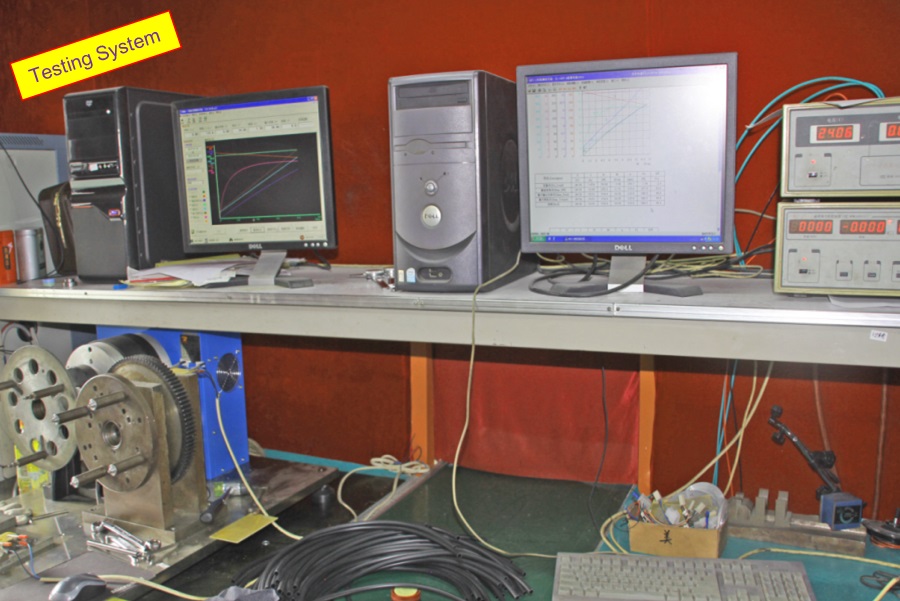
Equipment builders rarely purchase a “DC motor”. They purchase a drive that has to hold a chassis on a ramp, move a hospital transport bed at walking pace under a patient, or spin a floor-scrubber brush at several thousand rpm without audible whine. Those three requirements resolve into three different motors — and into three different sets of numbers that must be fixed before a request for quotation leaves the engineering department.
Wuxi Speedup Power Co.,Ltd is a DC motor manufacturer based in Wuxi, Jiangsu Province, China, founded in 2018, producing pancake (printed armature) motors, BLDC motors and geared wheel hub motors for industrial, medical and mobility equipment. Its catalogue is organised around drive families rather than around one motor type, which makes scenario mapping the practical way to read it: the 6.5-inch SA05-6 brushless hub, the 8-inch 1DY-E3 brushed and 1DY-E5S brushless hubs, and the 150SN-A pancake motor each answer a different duty profile.
Why scenario fit decides motor choice in smart manufacturing
The widely used definitions of the category frame it as an integration problem rather than a hardware problem. NIST describes smart manufacturing as fully integrated, collaborative manufacturing systems that respond in real time to changing demands and conditions in the factory, the supply network and customer needs. CESMII describes it as the information-driven, event-driven and collaborative orchestration of business, physical and digital processes across plants and the value chain. Both definitions put the emphasis on how equipment behaves under changing conditions — which is exactly where a mis-specified drive first becomes visible.
Three mismatches recur in drive selection, and each one is a scenario question rather than a catalogue question.
Torque specified at the motor shaft instead of at the wheel. A geared hub motor is defined by its output at the rim: torque after the reduction stage, at a stated wheel diameter. Quoting the motor-side figure and then choosing a wheel size later inverts the calculation and usually produces either an oversized motor or an under-performing machine on ramps.
Brake treated as an accessory rather than a safety function. On assist devices, transport beds and scooter platforms, the holding function is part of the specification. Whether the brake is an electromagnetic brake built into the hub changes the mechanical layout, the controller logic and the acceptance test.
Envelope treated as a styling detail. Floor-care machines and assist devices are constrained by housing height and wheel diameter. A 35.4 mm thick pancake motor and a 170 mm hub motor are not interchangeable answers to the same packaging problem.
A scenario map: four equipment families, three drive architectures
The table below places the models named in this article against the equipment scenario each one is documented for, using published rated data. It is a mapping aid, not a ranking: every row answers a different mechanical requirement.
| Equipment scenario | Drive family and model | Architecture | Published rated data |
|---|---|---|---|
| AGV, robot, wheelchair assistance, medical chair, mobility scooter | 6.5Inch SA05-6 brushless hub | Outer-rotor BLDC in-wheel, gear ratio 1:4.5, single or double shaft | 24V / 200W / 150rpm / 15Nm; 170mm solid tyre; IP54; load 80–300kg |
| Electric scooter manufacturing, transport cart, hospital transport bed | 8Inch 1DY-E3 brushed hub | Brushed DC in-wheel with gearbox 1:20, EMB brake | 24V / 180W / 95rpm / 20Nm; 210mm solid tyre; load 80–300kg |
| Electric scooter manufacturing, AGV, robot, medical chair | 8Inch 1DY-E5S brushless hub | Brushless DC in-wheel with gearbox 1:20, EMB brake | 36V / 300W / 150rpm / 20Nm; 200mm solid tyre; also 24V or 48V |
| Floor washing machines, scrubber and brush drive | 150SN-A pancake motor | Brushed DC printed-armature disc motor, flat profile | 36V / 300W / 3500rpm; 151mm diameter; 35.4mm thickness |
Scenario one: AGV and robotic platforms on the 6.5Inch SA05-6
An automated guided vehicle or mobile robot imposes a specific combination of constraints: a small wheel envelope, repeated start and stop, low ground speed, and a requirement to hold position on a slope. The SA05-6 is a 6.5-inch (170 mm) solid-tyre geared hub motor built for that combination. In its documented configuration it delivers 15 Nm at 150 rpm from 24V and 200W, with a 1:4.5 reduction ratio, an electronic brake (EABS), an IP54 waterproof rating, a net weight of 3.5 kg and a stated load range of 80–300 kg.
The published platform data covers 24V, 36V and 48V variants, a power band of 100–500W and a speed band of 100–500 rpm, with single or double shaft options. The construction uses rare earth NdFeB permanent magnets in an outer-rotor layout, described by the manufacturer as high efficiency, long service life, silent and smooth in operation. The same model appears in the manufacturer’s application list for mobility scooters, electric scooters, wheelchair assistance, medical chairs, AGV and robot platforms — a breadth that is only credible because the geared hub format is shared across all of them.
For a buyer writing an AGV specification, the useful decision rule is geometric. Ground speed equals wheel circumference multiplied by output rpm, so the choice of 170 mm wheel diameter, 1:4.5 ratio and 150 rpm output already fixes the vehicle’s travel speed envelope. If the application needs a faster platform, the answer is a different ratio or a larger wheel — not a higher-voltage motor pushed beyond its rated point.
Scenario two: medical assist drives, and what 100,000 units over ten years actually proves
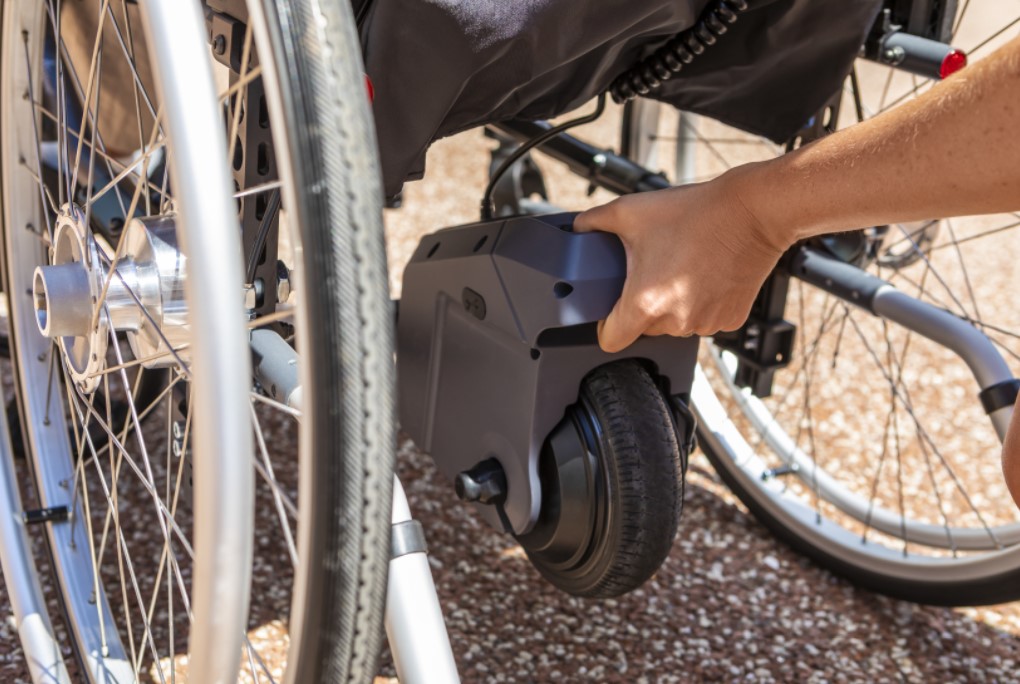
The clearest field evidence in this product family concerns the 6.5-inch hub, referenced as product 5303. It has been implemented in Germany, the United Kingdom and the United States for medical equipment assisting drive devices, with 100,000 motor units installed and stable operation maintained over a 10-year period. The two characteristics cited for that programme are low speed, high torque, and a small wheel size.
Read as procurement evidence rather than as a marketing claim, the case supports three conclusions. First, the design boundary was set at the wheel rather than at the motor shaft: a 170 mm wheel with 15 Nm at 150 rpm is a deliberately torque-dense configuration, and that ratio of torque to diameter is what an assist device needs to start a load from rest without a jolt. Second, the ten-year horizon covers the wear items that matter in a geared hub — gearset, bearing and brake — rather than a single prototype run. Third, 100,000 units across three markets implies the variant was reproduced under a controlled specification instead of being rebuilt per order.
The same ten-year pattern appears in adjacent medical applications built on the 8-inch brushless family. A medical bed factory in the Czech Republic integrated the 1DY-E5S-based wheel drive into a bed wheel drive system across 3,000 units, with the project reported as stable for more than ten years and characterised by low-speed running with good commutation performance. For assist and transport equipment, low-speed commutation quality matters more than top speed: it determines whether the device starts smoothly under a patient or hesitates at the first torque demand.
Scenario three: electric scooter manufacturing with 1DY-E3 and 1DY-E5S
The 8-inch family in this range shares a mechanical platform and splits on electrical architecture. Both models use a 1:20 gearbox, an electromagnetic brake, a 5.5 kg net weight and a stated load range of 80–300 kg, and both can be supplied with a single or double shaft. The 1DY-E3 is brushed: 24V, 180W, 95 rpm, 20 Nm at the output, on a 210 mm solid tyre, with 36V and 48V options available. The 1DY-E5S is brushless: 36V, 300W, 150 rpm, 20 Nm, on a 200 mm solid tyre, with 24V and 48V variants also offered.
That is a real engineering fork, not a price-tier fork. The brushed version simplifies the electrical architecture — no commutation electronics inside the motor — and is documented for scooter, transport cart, shopping cart, medical chair, hospital transport bed and transport chair wheel drives. The brushless version removes brush wear as a service item and is documented for the same scooter and mobility envelope alongside AGV and robot use, but it requires a compatible controller and shifts cost from maintenance to electronics. For a scooter programme with a defined service interval, that trade is usually decided by the field-service model rather than by the bill of materials.
The electromagnetic brake deserves separate treatment in the specification. On both models it is built into the hub, so parking and holding behaviour is fixed early in the mechanical design. Buyers should confirm the holding function against the maximum slope on site, and confirm that the controller release logic matches the brake type before the first prototype is built.
Scenario four: floor-care drives on the 150SN-A pancake motor
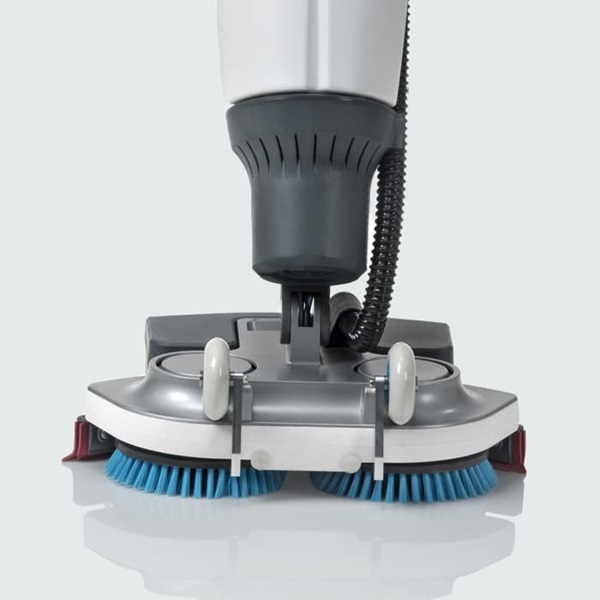
Floor washing machines invert almost every assumption of the mobility scenarios. The motor does not move a chassis; it spins a brush or pad through the machine’s own transmission, inside a housing with very little vertical clearance, and it must do so quietly enough not to dominate the acoustic signature of the machine. The 150SN-A is a 36V, 300W brushed pancake motor rated at 3,500 rpm, 151 mm in diameter and 35.4 mm thick, with a 16 mm shaft (custom shaft dimensions available). It is designated by the manufacturer for floor washing machine use.
The flat profile follows from the architecture. The manufacturer describes its pancake range as using a slotless disc armature design with printed windings, which differs from conventional DC servomotors and is what allows the axial length to collapse to a fraction of the diameter. In practice, a 35.4 mm thickness is the parameter that decides whether the drive fits above the brush deck at all.
Supply history in this application is documented across Switzerland, the Netherlands, Germany and the United Kingdom, where the motors drive brush and scrubber functions in floor cleaning and drying machines. The referenced programme supplied 15,000 units over a ten-year continuous supply period, with the application characterised by low noise, compact size and high output.
Technical explanation: how low speed becomes high torque in a small wheel
Every hub motor in this range combines three elements in one envelope: an electric motor, a reduction gearset and a brake. The gear ratio is the parameter that converts a fast, low-torque motor into a slow, high-torque wheel. In the SA05-6 the ratio is 1:4.5; in the 8-inch 1DY-E3 and 1DY-E5S it is 1:20. A ratio of 1:20 on a motor running at roughly 3,000 rpm produces an output near 150 rpm and multiplies available torque accordingly — which is why an 8-inch hub can be rated at 20 Nm at the rim while weighing 5.5 kg.
The second element is the brake. In the 8-inch family the electromagnetic brake is integrated into the hub, and in variants such as the 5287 wheelchair hub the design includes a built-in brake with electromagnetic clutch and manual clutch support. Integration changes the acceptance test: brake release, brake hold and manual override all become part of the pre-shipment test rather than a separate sub-assembly check.
The third element is the magnet and armature construction. The hub range uses rare earth NdFeB permanent magnets in an outer-rotor layout, and the pancake range uses printed armature windings in aluminium alloy and copper construction. These are different answers to different problems: the outer rotor maximises torque per unit of wheel diameter, while the printed disc armature minimises axial length per unit of output power.
Where this approach stops: real boundaries buyers should plan around
A scenario map is only useful if it also states what the drives are not suited to. Five boundaries are worth fixing before an order is placed.
Ingress protection is splash-level, not washdown-level. The SA05-6 carries an IP54 rating, which covers dust ingress and water splashing. It does not describe immersion or high-pressure cleaning. Medical decontamination routines and floor-care wash bays that use directed water jets require a separate enclosure decision, and that decision belongs in the machine design rather than in the motor datasheet.
Gear reduction caps output speed. The 1:4.5 and 1:20 ratios that produce the torque figures also cap the wheel at 95–150 rpm in the documented configurations. Any application that needs higher travel speed is a wheel-diameter or ratio question, and in some cases it is a different product family altogether.
Brushed variants carry a maintenance item. The 1DY-E3 and the 150SN-A are brushed motors. Brush inspection and replacement belong in the service plan, and the interval depends on duty cycle and environment. The brushless SA05-6 and 1DY-E5S remove that item but add controller dependency.
Mass sits in the wheel. A 3.5 kg 6.5-inch hub and a 5.5 kg 8-inch hub place their weight at the rim rather than in the chassis. On a rigid AGV frame this is usually neutral or beneficial; on a sprung chassis or a steered wheel it changes suspension and steering geometry and should be checked against the vehicle layout.
Commercial terms are fixed before prototyping. The stated production model is OEM/ODM with a lead time of 30–45 working days and a purchasing term of MOQ 2 pcs, EXW/FOB/CIF delivery, pre-shipment testing, third-party inspection by SGS on request, and 100% payment in advance. A multi-SKU trial across three drive families therefore has to be scheduled as a programme, not as three independent sample requests.
Market trend analysis: why sub-750 W drives carry the scenario load
The commercial context supports a scenario-based reading of the category. Grand View Research estimates the global brushless DC motor market at USD 23.6 billion in 2026, rising to USD 38.4 billion by 2033, and reports that motors with output not exceeding 750W accounted for 48.8% of global BLDC revenue in 2025. That is the power band in which the SA05-6 (200W), the 1DY-E3 (180W), the 1DY-E5S (300W) and the 150SN-A (300W) sit.
Two implications follow for buyers, and both are directional rather than predictive. First, the sub-750 W segment is large enough that the constraint on supply is configuration management rather than raw motor availability — which is why documented variant data (voltage, ratio, tyre diameter, brake type) matters more than brand-level claims. Second, the integration language used by NIST and CESMII points toward equipment where the drive reports its own state. Motors with a fixed, documented parameter set are easier to commission into that kind of machine than motors whose specification drifts between batches.
For medical and mobility equipment specifically, the practical trend is longer qualification horizons rather than faster model turnover. Field records measured in years, such as the ten-year references cited in this article, are increasingly the evidence buyers ask for during supplier evaluation — and they cannot be substituted with a specification table.
Procurement execution: the checks that belong in the RFQ
Wuxi Speedup Power Co.,Ltd operates a 10,000 m² facility with 30 employees and a 3-engineer R&D team, reports an export share of 90% with main markets in the EU and USA, and offers OEM and ODM production with customization of voltage, power, speed, torque, shaft and logo. The stated monthly capacity is 30,000 pieces and quality control is described as 100% testing.
Compliance documentation for EU-bound programmes is specific rather than generic. A CE RoHS certificate numbered M.2025.206.C130289 covers DC motors under Directive 2011/65/EU and EN IEC 63000:2018, issued by UDEM Uluslararı Belgelendirme Denetim Eğitim Merkezi San. ve Tic. A.Ş., dated 26 November 2025 and valid to 25 November 2030. A separate CE EMC certificate numbered M.2026.206.C138410 covers DC motors under 2014/30/EU and the EN IEC 61000-3-2, 61000-3-3, 61000-6-1 and 61000-6-8 standards, dated 14 April 2026 and valid to 13 April 2031. Both certificates list the hub and pancake models discussed here among the related products.
A practical RFQ for any of these scenarios should therefore fix six items before pricing is requested: continuous and peak torque at the wheel, the wheel or tyre diameter, the duty cycle, the supply voltage and controller interface, the brake holding requirement and slope, and the ingress protection level expected in service. The answer will usually select the family before it selects the model — hub for chassis traction, pancake for high-speed rotary tooling.
Future outlook
Three developments are worth watching in this segment, each grounded in what is already visible in the product data rather than in speculation. Brake and clutch integration is likely to keep moving into the hub, following the pattern already used in the 8-inch electromagnetic-brake family and in the 5287 wheelchair hub with its built-in brake and manual clutch support. Second, the split between brushed and brushless variants at identical mechanical dimensions — as with the 1DY-E3 and 1DY-E5S — gives equipment builders a cost lever that does not require a chassis redesign. Third, as medical and mobility programmes mature, documented field duration is likely to carry more weight in supplier evaluation than incremental specification gains.
What is unlikely to change is the underlying rule: the motor is chosen by the duty profile of the machine, and the duty profile is decided long before the purchase order.
FAQ
What DC motor type suits an AGV or mobile robot drive?
A geared brushless hub motor is the usual fit, because traction requires torque at the rim rather than speed at the shaft. The 6.5Inch SA05-6 is documented for AGV and robot applications with a 170 mm solid tyre, 24V, 200W, 150 rpm and 15 Nm output, a 1:4.5 gear ratio, an electronic brake (EABS), IP54 protection and a stated load range of 80–300 kg. Platform variants cover 24V, 36V and 48V, 100–500W and 100–500 rpm.
Which hub motor is used in medical equipment assisting drive devices?
The 6.5-inch model referenced as product 5303 (SA05-6) has been implemented in Germany, the United Kingdom and the United States for medical equipment assisting drive devices. The installed base is 100,000 motor units with stable operation maintained over a 10-year period, and the characteristics cited for that programme are low speed, high torque and a small wheel size.
What is the difference between the 1DY-E3 and the 1DY-E5S?
Both are 8-inch geared hub motors with a 1:20 gearbox, an electromagnetic brake, 20 Nm output, a 5.5 kg net weight and a stated load range of 80–300 kg. The 1DY-E3 is brushed, rated 24V, 180W and 95 rpm on a 210 mm solid tyre. The 1DY-E5S is brushless, rated 36V, 300W and 150 rpm on a 200 mm solid tyre, with 24V and 48V variants available. The brushed version simplifies the electrical architecture; the brushless version removes brush wear as a service item but requires a compatible controller.
Which pancake motor drives a floor washing machine brush?
The 150SN-A is designated for floor washing machine use: a 36V, 300W brushed pancake motor rated at 3,500 rpm, 151 mm in diameter and 35.4 mm thick, with a 16 mm shaft or custom shaft dimensions. It is a printed-armature disc design, which is what reduces axial length. Motors in this family are used by floor cleaning machine manufacturers in Switzerland, the Netherlands, Germany and the United Kingdom for brush and scrubber drive in cleaning and drying machines, with 15,000 units supplied over a ten-year continuous supply period.
Can these motors be customized, and what are the commercial terms?
The manufacturer provides OEM and ODM production services, with customization of voltage, power, speed, torque, shaft and logo. The stated lead time is 30–45 working days, monthly capacity is 30,000 pieces, and quality control is described as 100% testing. Published purchasing terms state an MOQ of 2 pcs, EXW/FOB/CIF delivery terms, pre-shipment testing with third-party inspection by SGS available, and 100% payment in advance.
What certifications apply to these DC motors in the EU market?
Two CE certificates are referenced for DC motors, both issued by UDEM. The RoHS certificate M.2025.206.C130289 covers Directive 2011/65/EU and EN IEC 63000:2018, issued 26 November 2025 and valid to 25 November 2030. The EMC certificate M.2026.206.C138410 covers 2014/30/EU and the EN IEC 61000-3-2, 61000-3-3, 61000-6-1 and 61000-6-8 standards, issued 14 April 2026 and valid to 13 April 2031.
Reference document: SPEEDUP COMPANY brochure (PDF).
Have Questions or Need More Details?
Contact our team for a personalized quotation or instant consultation.
Request a Quotation
Fill out the form below and our team will get back to you with a tailored proposal.
WhatsApp Direct Chat
Prefer to chat in real-time? Message us on WhatsApp for instant assistance & quick answers.
- Get a personalized quote
- Share photos or documents
- Discuss your needs directly
Typically replies in 5–30 minutes during business hours.