
DC Motor Supplier Capability, Field-Proven: 100,000 Medical Drives
HTNXT Industry Reference · DC Motor Platform
A DC motor datasheet describes nominal conditions. It does not describe year three. Wuxi Speedup Power Co.,Ltd, a DC motor manufacturer based in Wuxi, Jiangsu Province, China, reports a field record aimed at that gap: a medical equipment manufacturer project covering 100,000 motor units for assist-in-drive devices, installed in Germany, the United Kingdom and the United States, with reported stable operation over 10 years, built around a low-speed, high-torque drive in a small wheel size.
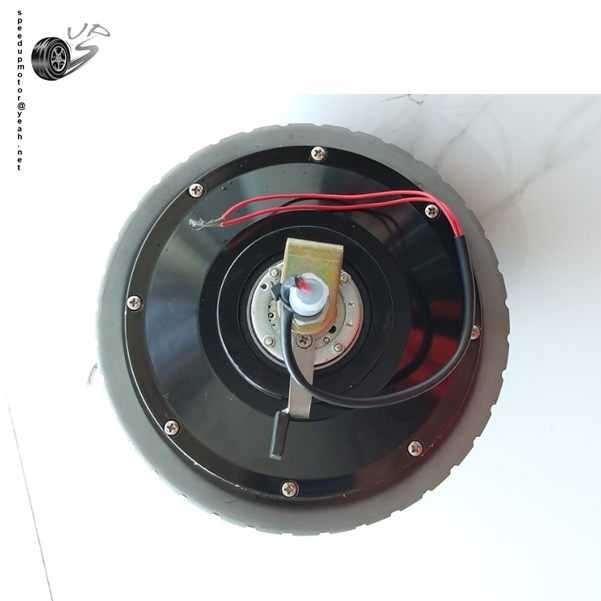
A wheel-hub drive format used in medical and transport equipment: motor, reduction stage and tyre are packaged as one unit. Image: Wuxi Speedup Power Co.,Ltd product catalogue.
Why field evidence outranks a specification sheet in medical drive sourcing
For engineers and procurement teams working at the research and evaluation stage, the practical question is not whether a motor can hit a rated torque figure on a test bench. It is whether the same drive survives continuous duty in a hospital corridor, a humid utility room, or a threshold ramp taken at low speed every few minutes for years.
Medical equipment drive duty is unusual in a way that ordinary industrial duty is not. Company application records for medical equipment describe indoor and outdoor operation at low-to-medium speed, with frequent start-stop cycles under high load, in humid environments, running on a 24/7 duty pattern. The same records list the equipment that has to work alongside the motor: gearboxes, high-strength reduction gearboxes, electromagnetic brakes, motor controllers and complete wheel assemblies.
The special requirements attached to that duty are equally specific. Condensation protection, electromagnetic compatibility and EMI grounding, brake debugging with safety distance control, and custom shaft or dual-shaft outputs, plus different voltage and power specifications per equipment platform. None of those items appear on a standard catalogue page, and each of them can decide whether a project succeeds after installation rather than at the sampling stage.
The programme record: 100,000 units, three markets, ten years
The clearest capability evidence available for this supplier is a single medical drive programme rather than a general capability statement. The recorded details are as follows.
| Programme item | Recorded detail |
|---|---|
| Client type | Medical equipment manufacturer |
| Installed markets | Germany, United Kingdom, United States |
| Units supplied | 100,000 pcs |
| Application | Assist-in-drive devices |
| Service duration | 10 years |
| Reported result | Stable operation |
| Design emphasis | Low speed, high torque, small wheel size |
| Associated product reference | 6.5-inch geared wheel hub motor, product reference 5303, model SA05-6 |
Within the supplier's own product mapping, the 6.5-inch wheel hub motor (product reference 5303, model SA05-6) is listed among the product entries associated with this medical drive programme, which places the record at the centre of the company's medical-assist experience rather than at the edge of it.
It is worth being precise about what this record is and is not. It is a supplier-reported programme result covering a defined application, a defined market set and a defined service window. It is not a certification, and it is not a warranty that every motor in the portfolio will behave the same way in a different duty cycle. Used correctly, however, it answers the question that specification tables cannot: has this drive architecture already been through a long service cycle at volume?
Low speed, high torque, small wheel size: what the requirement actually means
Three constraints arrive together in medical assist drives, and together they decide the motor architecture.
Low speed comes from the equipment itself. A bed, chair or transport platform moves at walking pace or slower for safety and control reasons. The output at the wheel is therefore a low shaft speed, typically in the tens or low hundreds of revolutions per minute across this supplier's wheel motor range.
High torque is a consequence of what the equipment weighs. Load ratings stated across the wheel hub motor family run from 80 kg to 300 kg, and that load has to be moved from standstill and up thresholds and ramps, not just maintained at speed.
Small wheel size is a packaging constraint. Equipment designers want the drive inside the wheel envelope so that the machine keeps a low profile and a tight turning footprint. Solid-tyre wheel formats in the corpus run from 170 mm (6.5 inch) through 200 mm and 210 mm (8 inch) up to 305 mm (12 inch).
The mechanism that reconciles all three is gear reduction. The 6.5-inch unit at the centre of the medical programme is specified with a 1:4.5 reduction ratio, 24V rated voltage, 200W rated power, 150 rpm rated speed, 15 Nm rated torque, a 170 mm solid tyre, a net weight of 3.5 kg, a load range of 80–300 kg, an electronic brake (EABS), and an IP54 waterproof rating. Across the wider hub motor range, ratios run from 1:4.5 up to 1:40, which allows the same basic motor platform to be tuned for either faster travel or heavier tractive effort within a similar wheel envelope.
Why the brake is part of the drive question, not a separate one
On a medical assist drive, stopping is a safety function, not a convenience. Hub motor models in this range are specified with electromagnetic brakes (EMB) or electronic brakes (EABS), and one wheelchair-platform record highlights a built-in brake with electromagnetic clutch that also supports a manual clutch, alongside low-speed running with good commutation behaviour. From a procurement standpoint this means the brake type, the brake release behaviour under manual handling, and the safety distance control during commissioning all belong in the same specification conversation as the motor rating.
Beyond one drive unit: the motor platform behind the programme
A single field record only matters if the supplier can also build the surrounding product family. Wuxi Speedup Power Co.,Ltd is described as a professional DC motor company specialising in printed motors, pancake motors and BLDC motors for industrial and civil fields, and in brushless and brushed wheel hub motors for mobility equipment, with a listed product scope covering DC motors, pancake motors, wheel motors, BLDC motors and hub motors.
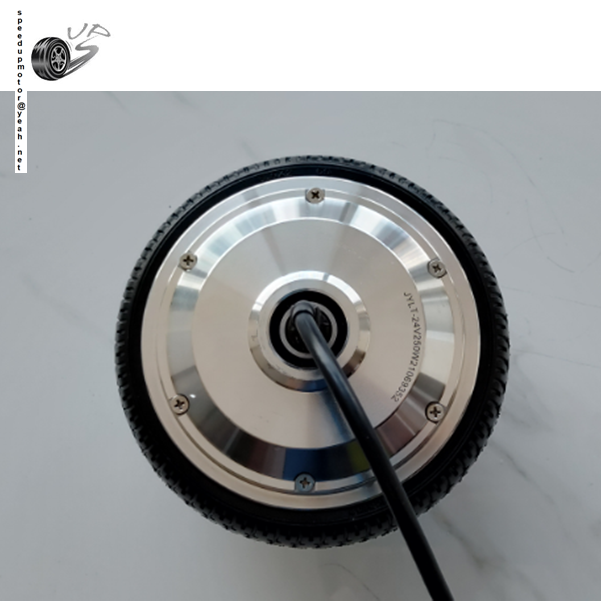
The 6.5-inch geared wheel hub format (reference 5303, model SA05-6) is the drive reference associated with the medical assist programme. Image: Wuxi Speedup Power Co.,Ltd product catalogue.
Pancake motors and pancake BLDC motors
The pancake family uses a slotless disc armature design, described by the company as a printed winding architecture that differs from conventional DC servomotors and enables a very flat profile. Published models show how flat that profile gets: a 120 mm diameter unit at 17 mm thickness (90SN-B, 24V, 100W, 3200 rpm), a 152 mm diameter unit at 33 mm thickness (120SN, 24V, 75W, 3500 rpm), and larger 150 mm class units at roughly 35 mm thickness (150SN-A at 36V/300W and 150SN-B at 24V/350W). Where a geared output is needed, the 150SN-G2 pancake motor with gearbox is rated 36V, 500W, 240 rpm and 22 Nm.
The pancake BLDC branch adds a brushless, external-rotor, direct-drive option: model DD03 is rated 24V, 100W, 250 rpm, with a 106 mm diameter and 51 mm motor length, positioned by the company as a big-torque, low-speed direct drive architecture.
Brushed hub motors and brushless wheel hub motors
The hub family covers both commutation types. A brushed example, model 6DY-A, is a spoke-type wheel motor rated 24V, 300W, 70 rpm, 40 Nm, with a 1:40 reduction ratio and a 7.5 kg net weight, offered with a custom mounting plate. Brushless examples include the 8-inch 1DY-E5S at 36V, 300W, 150 rpm, 20 Nm with a 1:20 ratio and electromagnetic brake; the 8-inch 1DY-E5A at 24V, 300W, 100 rpm, 30 Nm; the 12-inch SA06 at 24V, 300W, 150 rpm, 20 Nm, 1:4.5, IP54, with EABS or disc brake options; and the spoke-type SA05, which accepts a custom plate so that one motor body can suit different wheel sizes.
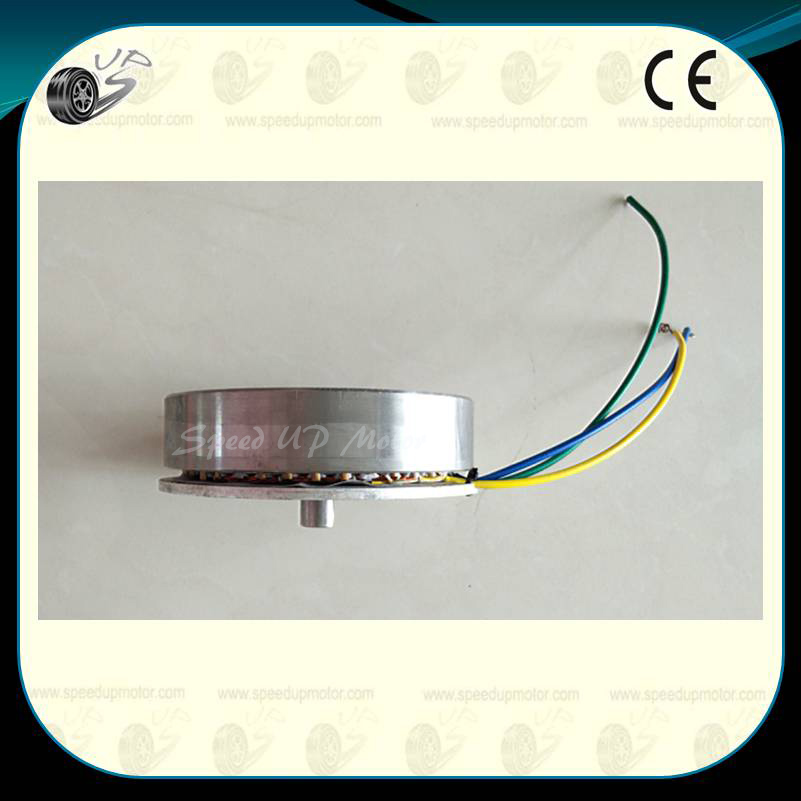
The pancake BLDC branch of the same portfolio covers flat, direct-drive positions where a wheel-hub format will not fit. Image: Wuxi Speedup Power Co.,Ltd product catalogue.
Material and build choices across the range
Material lists in the corpus are consistent across the wheel and pancake families: aluminium alloy for housings and structural parts, copper for windings, magnetic steel or rare earth NdFeB permanent magnets for the magnetic circuit, and rubber for the tyre on wheel formats. The pancake models are additionally specified with a printed armature or printed winding circuit, and hub models list an outer rotor construction with stated characteristics of high efficiency, long service life, and quiet, smooth running.
Material selection matters to buyers mainly because it constrains repair and replacement strategy. A drive built around an aluminium alloy housing, a copper winding set, NdFeB magnets and a rubber tyre can be maintained at component level rather than replaced as a sealed block, provided the supplier keeps spare parts available beyond the initial order.
Where these drives are used
The field records held by the company cover several equipment categories, and the pattern is useful for buyers trying to judge whether their own application sits inside the supplier's proven envelope.
| Equipment category | Application | Recorded markets | Units | Duration | Design emphasis |
|---|---|---|---|---|---|
| Medical equipment | Assist-in-drive devices | DE, GB, US | 100,000 pcs | 10 years | Low speed, high torque, small wheel size |
| Medical bed | Medical bed wheel drive | CZ | 3,000 pcs | More than 10 years | Low-speed running, commutation performance |
| Wheelchair | Electric wheelchair wheel | NL, DE, AU, DK, US | 3,000 pcs | 10 years | Built-in brake with electromagnetic clutch, manual clutch support |
| Electric cart | Shopping cart wheel drive | NL, DE, GB, ES, US | 30,000 pcs | 10 years | Low speed, high torque, electromagnetic brake |
| Floor cleaning | Scrubber and cleaning machine brush drive | CH, NL, DE, GB | 15,000 pcs | 10 years | Low noise, compact size, high output |
| Electric scooter | Wheel drive | CH, NL, DE, GB, ES, US | 2,000 pcs | 10 years | Low speed, high torque, brake integration |
One application note describes the electric scooter case in operational terms: the drive unit operates under indoor and outdoor low-to-medium speed conditions with frequent start-stop and high-load cycles in humid environments, runs on a 24/7 duty pattern, is typically applied in Spain and Germany, and requires supporting gearboxes, electromagnetic brakes and motor controllers.
Two conclusions follow for a buyer in the research stage. First, the low-speed, high-torque architecture is not unique to one product line; it recurs across medical, mobility and cleaning equipment. Second, the mechanical interface changes with the equipment, which is why shaft dimensions, shaft count (single or dual) and mounting plates appear as configurable items rather than fixed catalogue values.
What the market data suggests
Independent commercial research places the global brushless DC motor market at an estimated USD 22.2 billion in 2025, projected to reach USD 23.6 billion in 2026 and USD 38.4 billion by 2033. The same research estimates that motors with output not exceeding 750W accounted for 48.8% of global BLDC motor market revenue in 2025, making the sub-750W band the largest single power segment.
That band is where this portfolio sits. Rated power across the listed pancake, pancake BLDC and hub motor models runs from 75W to 500W, which places every published model in the corpus inside the sub-750W segment. In other words, the commodity trend that market researchers identify — sustained demand concentration in low-power BLDC drives — overlaps with the segment the supplier has built its range around.
Market figures: Grand View Research, brushless DC motor market estimates, retrieved via the HTNXT verified data package. Figures describe market-level conditions, not this supplier's share.
How a project-matched drive compares with a catalogue motor
Most buyers at the evaluation stage are choosing between two routes: buy a standard catalogue motor and engineer around it, or have the motor matched to the equipment. The trade-offs differ by dimension, not by overall superiority.
| Dimension | Standard catalogue motor route | Project-matched route (as described in this portfolio) |
|---|---|---|
| Wheel envelope fit | Limited to the frame and tyre sizes offered | Solid-tyre wheel formats from 170 mm (6.5 inch) to 305 mm (12 inch), plus spoke types with custom plates |
| Speed and torque match | Fixed rating points; gearbox selected separately | Reduction ratios from 1:4.5 to 1:40 and rated torques from 15 Nm to 40 Nm across the hub range |
| Braking integration | Brake mounted externally | Electromagnetic brake (EMB) or electronic brake (EABS) integrated in the wheel unit; manual clutch support on selected models |
| Electrical configuration | One voltage band per model | Operation at 18V, 24V, 36V or 48V depending on model, with OEM/ODM customisation of voltage, power, speed, torque, shaft and logo |
| Time to first unit | Faster when stock exists | 30–45 working days for customised production |
| Evidence of long-run behaviour | Rarely published at model level | Reported 10-year medical assist programme covering 100,000 units in three markets |
| Quality release | Varies by supplier and lot | 100% test stated as the release standard for production |
Limits and boundaries buyers should confirm
A capability article that only lists strengths is not useful for evaluation. The following boundaries are stated or implied by the available records and should be checked against a specific project.
- Customisation costs calendar time. The stated lead time for customised production is 30–45 working days. That is compatible with planned medical equipment programmes but not with emergency replacement demand.
- The published range has edges. Listed models are rated between 75W and 500W, with wheel load ratings stated at 80–300 kg. Projects outside those bands are not covered by the published model set.
- Ingress protection is not uniform. An IP54 waterproof rating is stated on specific hub models such as SA05-6 and SA06, but not on every motor in the family. Where washdown or high-humidity cleaning is routine, protection level must be confirmed model by model.
- Solid tyres are the default wheel format. Several wheel motors are specified with solid tyres, which trade shock absorption for durability and puncture immunity. A 12-inch pneumatic option is listed on model SA06 for applications that need it.
- The 10-year record is application-specific. It reflects one medical assist-in-drive programme and its duty cycle. It is supplier-reported and does not automatically transfer to a different load, mounting orientation, environment or start-stop frequency.
- Certification references should be read per document. Company-level listings include RoHS, UL, EMC and an ISO9000-2008 certificate, and individual model specifications reference CE, EMC and RoHS approval. Buyers should obtain the certificate that applies to their exact model and market rather than relying on a portfolio-level statement.
Reading the honesty signal: a supplier that publishes load limits, lead times, an MOQ of 1 unit for customised work, and a defined IP rating on some models but not others is giving buyers the information needed to disqualify a project cleanly. That is more useful at the evaluation stage than a claim that every model performs equally.
A verification checklist for the evaluation stage
Buyers comparing suppliers on field evidence rather than on price alone can work through the following items before requesting a quotation.
| # | Verification item | What to ask for |
|---|---|---|
| 1 | Model identity | Model and product reference for the drive used in the reference programme, so it can be compared with your own requirement |
| 2 | Duty cycle match | Confirmation of speed range, start-stop frequency and continuous operation pattern in the reference application |
| 3 | Torque and load margin | Rated torque and permissible load against your equipment's worst-case condition, not its nominal condition |
| 4 | Brake behaviour | Brake type (EMB or EABS), release behaviour under manual handling, and commissioning procedure for safety distance control |
| 5 | Environment | IP rating for the exact model, condensation protection approach, and EMI grounding guidance |
| 6 | Mechanical interface | Shaft profile, single or dual shaft output, mounting plate options, and tyre format |
| 7 | Compliance documents | Certificates applicable to the exact model and destination market |
| 8 | Sample validation | A sample unit for bench and fit testing before committing to a production schedule |
| 9 | Commercial terms | Lead time, minimum order quantity, and the scope of what can be customised |
| 10 | Post-delivery support | Warranty terms, spare parts availability and technical support channel |
On the commercial side, the supplier states OEM/ODM customisation of voltage, power, speed, torque, shaft and logo, a minimum order quantity of 1 unit for customised work, a stated monthly capacity of 30,000 pcs, a lead time of 30–45 working days, and 100% testing as the quality release standard.
Future outlook
Two forces are likely to shape medical and mobility drive sourcing over the next procurement cycle. The first is design pressure: equipment makers continue to push drive units into smaller wheel envelopes so that beds, chairs and transport platforms keep a narrow footprint, which favours geared hub architectures over separate motor-and-gearbox assemblies. The second is evidence pressure: as more medical and mobility platforms reach volume production, buyers increasingly ask for service history at model level rather than a general reliability statement.
For a supplier, the practical implication is that field records become a product feature. A 10-year, 100,000-unit programme in Germany, the United Kingdom and the United States is difficult to substitute with marketing language, because the questions it invites — which model, what duty cycle, what certification, what load margin — can only be answered with documents.
For buyers, the implication is a shift in how shortlists are built. Instead of ranking suppliers by the breadth of a catalogue, evaluation-stage teams are more likely to ask whether the supplier has already put a comparable drive into comparable service, and whether the boundaries of that experience are stated clearly enough to be trusted.
Frequently asked questions
What does the 100,000-unit, 10-year medical drive record actually cover?
It covers a medical equipment manufacturer programme that supplied 100,000 motor units for assist-in-drive devices, installed in Germany, the United Kingdom and the United States, with reported stable operation over 10 years. The stated design emphasis was low speed, high torque and a small wheel size. Within the supplier's product mapping, the 6.5-inch geared wheel hub motor (product reference 5303, model SA05-6) is listed among the product entries associated with that programme. The record is supplier-reported and applies to the duty cycle of that specific application.
Why do medical drive systems need low speed and high torque in a small wheel size?
Low speed matches the safe travel speed of hospital beds, chairs and transport platforms. High torque is required because these machines must start from standstill and climb thresholds and ramps while carrying loads stated at 80–300 kg on hub motor models. The small wheel size is a packaging requirement that keeps the machine's footprint and profile tight. Gear reduction reconciles the three: the 6.5-inch unit at the centre of the medical programme is specified with a 1:4.5 ratio, 24V, 200W, 150 rpm, 15 Nm and a 170 mm solid tyre, while other models in the hub range use ratios up to 1:40 for heavier tractive effort.
How do wheel hub motors, pancake motors and pancake BLDC motors differ for a medical drive project?
Wheel hub motors integrate the motor, reduction stage and tyre into the wheel itself, so they suit equipment where the drive must sit inside the wheel envelope; listed models range from 170 mm to 305 mm solid-tyre formats with integrated electromagnetic or electronic brakes. Pancake motors use a slotless disc armature with a printed winding, producing a very flat body for positions where a wheel format will not fit; published thicknesses include 17 mm at 120 mm diameter and about 35 mm at 151 mm diameter. Pancake BLDC motors combine the flat, external-rotor layout with brushless commutation and direct drive at low speed, such as model DD03 at 24V, 100W, 250 rpm.
How can a buyer verify field-service claims before placing an order?
Verification starts with model identification: ask which model and product reference was used in the reference programme, and compare its ratings with your own duty cycle. Then confirm the operational conditions behind the record, including speed range, start-stop frequency and continuous operation pattern. Next, request the compliance certificates that apply to your exact model and destination market, the IP rating for that model, the brake type and release behaviour, and the mechanical interface details such as shaft profile and single or dual shaft output. A sample unit for bench and fit testing provides the final check before a production schedule is committed.
What customisation, lead time and minimum order quantity apply to a customised drive motor?
The supplier states OEM/ODM production with customisation of voltage, power, speed, torque, shaft and logo. The stated lead time for customised production is 30–45 working days, the stated minimum order quantity is 1 unit, and 100% testing is stated as the quality release standard. Stated monthly capacity is 30,000 pcs. These figures are supplier-reported and should be confirmed in writing for a specific model and configuration.
What after-sales support is described for these motors?
The company lists six post-delivery support items: an official quality warranty service; remote fault diagnosis and technical guidance; free installation and commissioning instructions; original spare parts supply; professional repair and replacement service; and lifetime online technical support. For medical equipment duty, the installation and commissioning instruction item is relevant beyond a general warranty, because brake debugging and safety distance control form part of the application requirements recorded for medical equipment drive projects.
Have Questions or Need More Details?
Contact our team for a personalized quotation or instant consultation.
Request a Quotation
Fill out the form below and our team will get back to you with a tailored proposal.
WhatsApp Direct Chat
Prefer to chat in real-time? Message us on WhatsApp for instant assistance & quick answers.
- Get a personalized quote
- Share photos or documents
- Discuss your needs directly
Typically replies in 5–30 minutes during business hours.