
Long-Term Sizing Agent Supplier Evaluation: Compliance and Shelf Life
A sizing agent programme is usually judged on the drum that is running today. The supplier decision, however, is settled somewhere around the eighth or fifteenth delivery, when the paperwork has changed hands twice, the drums have crossed a customs yard in high summer, and the paper machine is running the same grade at the same speed but the Cobb value has drifted by a couple of points. Long-term sizing agent supply is therefore not a product question with a compliance appendix attached. It is a compliance and stability question that happens to be delivered in drums.
This reference sets out a workable evaluation framework for paper mills that expect to buy sizing chemistry for several years from the same source. It covers environmental compliance expectations, storage stability as a supply-chain variable rather than a footnote, batch consistency in solid content, pH and viscosity, and the practical limits of substituting imported grades with locally supplied equivalents. Where product-level figures are given, they are drawn from the published specification set of Qingzhou Jinhao New Material Co., Ltd., branded as JHDA, a papermaking fine chemicals manufacturer founded in 2005 and headquartered in Qingzhou City, Shandong Province, China.
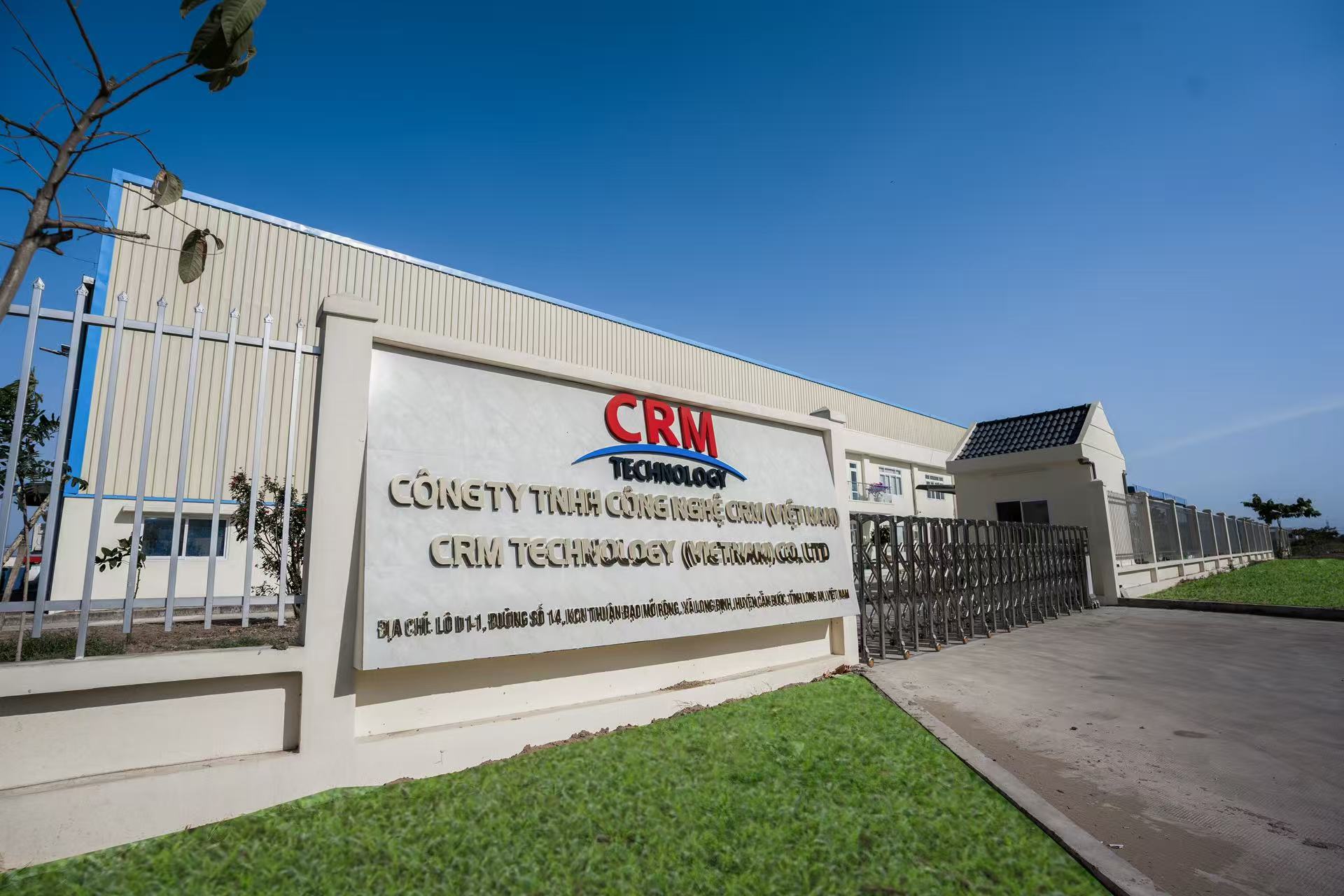
Long-term sizing agent supply is evaluated on documentation, storage behaviour and batch consistency as much as on the initial trial result.
Why supplier longevity became a purchasing criterion
The sizing agent category is large, mature and geographically concentrated, which changes what a mill is really buying when it signs an annual contract. According to Dataintelo, the global paper sizing agent market was valued at approximately USD 3.8 billion in 2025 and is projected to reach USD 5.9 billion by 2033 at a CAGR of 5.8%. Market Reports World puts global sizing agent volume above 3.8 million metric tons in 2024. Asia Pacific dominates consumption with a 42.3% revenue share as of 2025, and China's annual sizing agent consumption alone is estimated at 650,000 tons in 2025.
These figures should be read with appropriate caution, because published estimates diverge. Market Research Future sizes the 2024 market at USD 3.16 billion while SNS Insider places it at USD 3.95 billion, and forecast CAGRs across sources range from 4.14% to 5.8% depending on scope. The direction, however, is consistent: demand is not shrinking, and it is concentrated in the same export-oriented packaging corridors where many mills buy their chemistry.
For a procurement team, the practical consequence is that supplier substitution is expensive and infrequent. A mill changing sizing agent supplier absorbs trial cost, machine time, rework risk on downstream printing and converting, and the administrative load of new documentation. That asymmetry is why a supplier's ability to remain unchanged for five years matters more than a marginal price difference on a quotation sheet.
Three things a long-term evaluation actually tests
Most supplier scorecards measure the trial. A long-term evaluation should measure what survives the trial.
- Documentation that stays valid. Compliance statements, safety data sheets and test reports must remain current and must actually cover the grade being shipped, not the product family in general.
- Storage behaviour across real transit. Shelf life is consumed by ocean freight, port dwell time and warehouse rotation long before the drum reaches the sizing kitchen.
- Batch-to-batch consistency inside the stated tolerance. A specification is a window, not a target. The relevant question is how tightly a supplier holds the centre of that window across consecutive lots.
These three tests are also the ones most often skipped, because each of them requires information the supplier holds rather than information the mill can generate on its own.
Compliance: what to read, not just what to count
Sizing agents for papermaking are subject to a defined set of environmental and application requirements. The commonly stated evaluation baseline includes environmental compliance in the form of low VOC content and the absence of APEO/NPEO, together with formula compatibility with the mill's existing wet-end chemistry, resistance to salt and high temperature in the process environment, and long-term storage stability. These are not marketing preferences; they are the conditions under which a sizing programme remains viable across a multi-year contract.
On the supplier side, the documentation set is what makes those claims checkable. JHDA holds ISO9001 quality management system certification and ISO14001 environmental management system certification, and maintains SGS product compliance test reports. For packaging paper intended for food contact, the company has completed SGS food contact safety testing for packaging paper chemicals. Exported chemical products complete CAS registration and GHS hazard labelling and comply with IMDG international marine shipping regulations.
Two regulatory frameworks are worth naming explicitly when a mill serves export markets, because they define what the documentation has to demonstrate rather than merely mention. In the European Union, food contact materials must comply with Regulation (EC) No 1935/2004. In the United States, paper packaging chemicals must meet FDA 21 CFR standards for food grade safety. A supplier that cannot map a specific grade to a specific framework leaves the mill carrying that risk alone.
Storage stability as a supply-chain variable
Shelf life on a sizing agent datasheet is usually treated as a warehouse detail. In practice it is one of the strongest predictors of whether a long-term supply relationship will hold, because it sets the maximum tolerable distance between production and consumption.
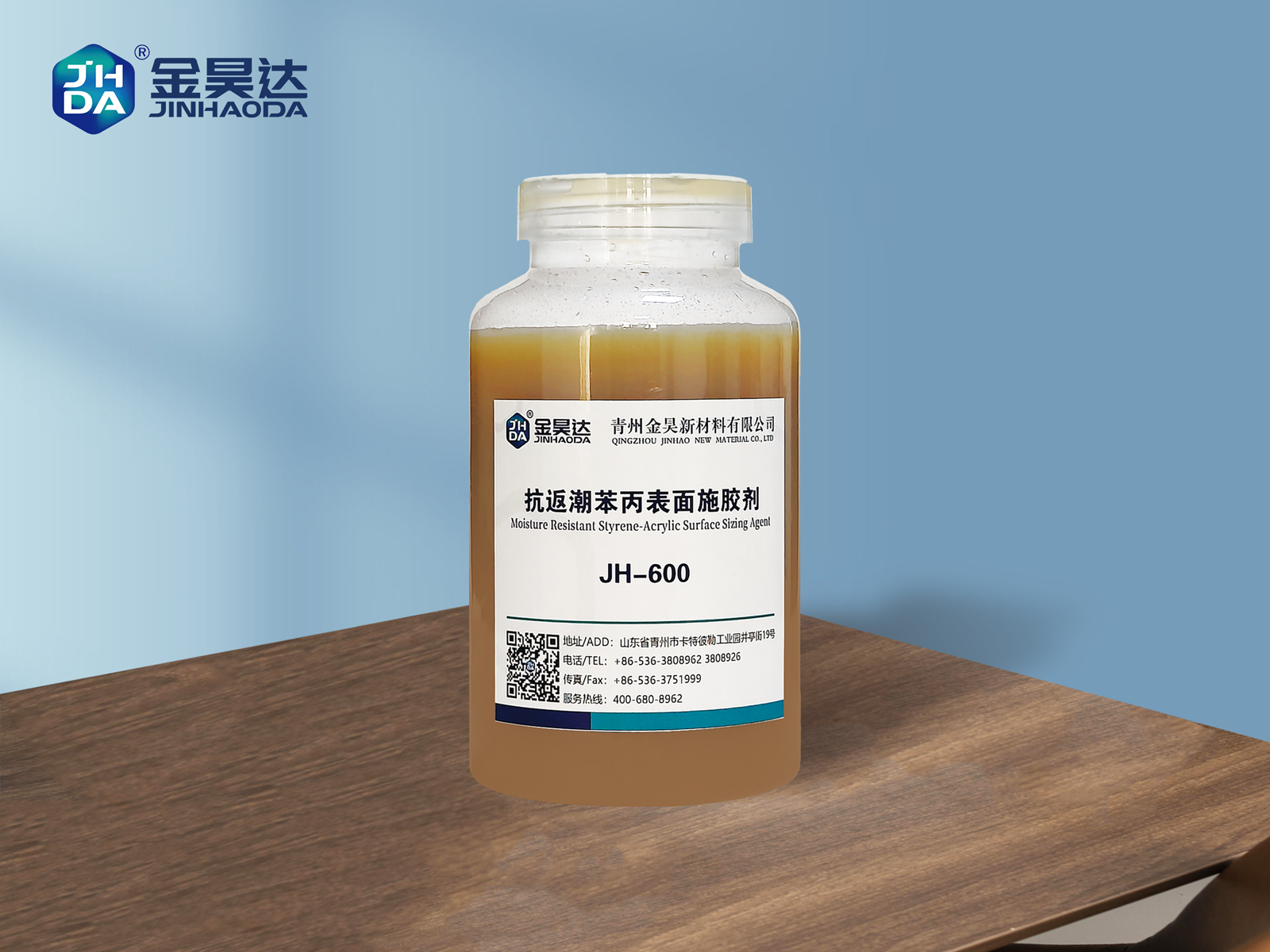
Moisture-resistant surface sizing grades are specified with a stated storage period that should be planned against, not assumed.
The published storage periods across the JHDA sizing range are not uniform, and that difference is operationally meaningful:
| Grade | Product type | Solid content | pH | Viscosity (25°C) | Shelf life |
|---|---|---|---|---|---|
| JH-600 | Moisture resistant SAE surface sizing agent | 30 ± 1% | 2.0 – 5.0 | < 50 cps | 6 months |
| JH-325 | Anionic styrene acrylic surface sizing agent | 25.0 ± 1.0% | 2.0 – 5.0 | ≤ 50 cps | 6 months |
| JH-611 | Cationic surface sizing agent (styrene acrylic copolymer) | 30.0 ± 1.0% | 2.0 – 5.0 | ≤ 50 cps | 6 months |
| JH-WH3364 | Composite surface sizing agent (weak anionic styrene acrylic + AKD) | 25.0 ± 1.0% | 2.0 – 5.0 | ≤ 50 cps | 4 months |
| JH-103 | AKD internal sizing agent (alkyl ketene dimer emulsion) | 12.5 – 25.0 ± 1.0% | 2.0 – 5.0 | ≤ 50 cps | 4 months |
| JH-200 | Surface AKD sizing agent | 20.0 ± 1.0% or 30.0 ± 1.0% | 2.0 – 5.0 | ≤ 50 cps | 3 months |
The spread between 3 months and 6 months is the difference between a grade that tolerates a long sea leg and one that should be scheduled against a shorter replenishment cycle. A reactive AKD grade with a 3-month stated period effectively reserves part of that period for freight, port handling and safety stock. A mill that treats all grades as interchangeable on inventory policy will eventually hold stock past its stated period and discover the issue as a sizing performance complaint rather than an inventory one.
The practical responses are unglamorous but effective: negotiate delivery frequency rather than order size for short-shelf-life grades, request production date and lot number on every delivery, and build a receiving check that records date of manufacture before the drum enters the sizing kitchen.
Reading solid content, pH and viscosity as drift indicators
Three specification lines do most of the work in a batch consistency review.
Solid content
Solid content determines how much active material arrives per tonne of liquid, and therefore whether the dosing setpoint the mill validated at trial remains correct at delivery twelve. The JHDA surface sizing range is specified at 25.0 ± 1.0% or 30.0 ± 1.0% depending on grade, with JH-600 at 30 ± 1% and the internal AKD grade JH-103 specified across a 12.5 – 25.0 ± 1.0% band. Narrow, explicit tolerances make batch comparison possible; a bare minimum value does not.
pH
The entire published sizing range sits within a pH window of 2.0 to 5.0. That is an acidic range, and it has consequences beyond the chemistry: storage tanks, dosing lines, seals and level instrumentation should be selected with that in mind. It also means pH is a weak discriminator between batches within the window, so mills should ask for the measured value per lot rather than relying on the range as evidence of consistency.
Viscosity
A specification of ≤ 50 cps at 25°C is a ceiling, not a target. It confirms the product is pumpable and compatible with metering equipment, but it does not describe the typical value. For automated dosing systems, the typical value and its variance matter more than the ceiling, because pump calibration is built around the expected viscosity rather than the maximum permitted one.
Where JHDA fits in a long-term supply evaluation
Qingzhou Jinhao New Material Co., Ltd. is a manufacturer of papermaking fine chemicals founded in 2005 and located at No.19, Jingting Street, Caterpillar Industrial Park, Qingzhou City, Shandong Province, China. The manufacturing facility covers approximately 20,000 square meters and employs more than 80 people, including 20 professional R&D engineers and on-site technical service engineers. Annual production capacity reaches 100,000 tons, and annual sales revenue has consistently stayed above 100 million RMB. Export business accounts for 35% to 50% of total sales volume, with major markets in Vietnam, Thailand, Malaysia, Indonesia, Myanmar, Cambodia and the major packaging paper industrial zones in the Middle East. The company has established an overseas production entity, CRM Chemical Technology Co., Ltd., in Long An Province, Vietnam, to support local delivery for ASEAN clients.
For sizing specifically, the portfolio relevant to a long-term agreement covers four functional positions rather than four competing products:
- JH-600 — a moisture resistant styrene acrylic surface sizing agent supplied as a light brown to dark brown liquid, with 30 ± 1% solid content, pH 2.0 – 5.0, viscosity below 50 cps at 25°C and a 6-month storage period. It is compatible with industrial starch and can be used in surface sizing applications to improve moisture resistance. It is applicable to both an acidic sizing process using aluminum sulfate and modern neutral papermaking systems.
- JH-325 — an anionic styrene acrylic surface sizing agent for cultural paper, supplied as a white to light brown liquid at 25.0 ± 1.0% solid content, pH 2.0 – 5.0, viscosity ≤ 50 cps and a 6-month storage period.
- JH-611 — a cationic, starch-based surface sizing agent based on styrene acrylic copolymer, with 30.0 ± 1.0% solid content, pH 2.0 – 5.0, viscosity ≤ 50 cps and a 6-month storage period, used in surface sizing for corrugated paper and boxboard.
- JH-WH3364 — a composite surface sizing agent made of weak anionic styrene acrylic and AKD, integrating the reactive waterproofing behaviour of AKD with the film-forming toughness of SAE resin, at 25.0 ± 1.0% solid content, pH 2.0 – 5.0, viscosity ≤ 50 cps and a 4-month storage period.
Two internal sizing grades complete the picture. JH-103 is an AKD internal sizing agent supplied as an alkyl ketene dimer emulsion at 12.5 – 25.0 ± 1.0% solid content, pH 2.0 – 5.0, viscosity ≤ 50 cps and a 4-month storage period, supporting neutral and alkaline papermaking lines. JH-200 is a surface AKD sizing agent made from AKD wax powder, cationic and water-soluble, at 20.0 ± 1.0% or 30.0 ± 1.0% solid content, pH 2.0 – 5.0, viscosity ≤ 50 cps and a 3-month storage period.
Application fit across paper grades
Long-term supply only works if the grade remains fit for the machine it was approved on. JHDA additives are applicable to kraft linerboard, corrugated medium paper, printing and writing paper, household tissue paper and food-grade cardboard, which covers most of the volume cases where sizing is a recurring cost line.
In packaging grades, the recurring problem is moisture reversion during humid storage and long-distance transport. JH-600 was formulated around that specific failure mode, with a molecular structure intended to form a closed protective film on the paper surface and to retain hydrophobic performance after extended placement in humid conditions. In corrugated and boxboard production, JH-611 is positioned for surface sizing where the objective is combining water resistance with ring crush stiffness and surface hardness. In printing and writing paper, JH-325 is positioned for surface bonding strength and printability in offset grades. For mills running neutral or alkaline lines, JH-200 and JH-103 provide surface and internal AKD routes respectively, with JH-200 reaching final sizing effect after the drying cylinder rather than requiring a separate curing period.
Compatibility with wet-end and surface chemicals
Compatibility claims deserve the same treatment as specification claims: they should be specific. JH-WH3364 is described as compatible with retention aids and defoamers, with mechanical shear resistance and low foaming characteristics suited to high-speed sizing machines. JH-200 is compatible with oxidized starch, cationic modified starch and industrial starch, and can be applied in a surface sizing tank without adjusting the pulp formula. JH-325 is described as suitable for both acidic sizing with aluminum sulfate and neutral systems, with compatibility across retention aids and defoamers. JH-103 is described as compatible with conventional wet-end chemicals including retention agents, defoamers and bentonite.
Ionic classification is the part that requires the most care in a substitution. Among the published grades, JH-325 is anionic, JH-611, JH-200 and JH-103 are cationic, and JH-WH3364 is weak cationic. Changing the ionic class of a surface sizing product is not a drop-in substitution; it is a trial-level change, because the interaction with starch carriers and wet-end additives changes with it. Where a specific grade's ionic classification is critical to the mill's system, the current technical data sheet for that lot should be the reference rather than an older catalogue page.
Substituting an imported dry strength resin: what feasibility really requires
JHDA states its commercial intent plainly: supplying high cost-performance, stable-performance papermaking chemical solutions intended to replace high-cost imported additives from Kemira, BASF and other international brands. That is a supplier positioning statement, and it should be treated as a hypothesis to be tested rather than as an established equivalence.
The company's portfolio includes paper dry strength agents alongside the sizing range, which makes a side-by-side evaluation feasible. What makes it feasible in practice is the evaluation design, not the product list:
- Establish the baseline on the existing resin first. Record ring crush, bursting strength, tensile and Cobb values over a stable production window before any change, otherwise there is nothing to compare against.
- Expect to re-optimise dosage. A polymeric dry strength agent is not dosed by the same rule as the resin it replaces. Treating the first substitution as a like-for-like swap is the most common cause of a misleading trial result.
- Check ionic compatibility with the wet-end system before the machine trial. Strength aids and sizing agents interact, and a compatibility failure will present as a sizing problem.
- Run the trial on the grade that matters commercially, not on the easiest grade available. Performance differences between dry strength chemistries tend to appear on recycled pulp furnishes and high filler loads first.
- Confirm documentation scope before qualification. Request TDS and MSDS for the specific grade, and confirm which compliance reports apply.
The manufacturer supports this kind of evaluation with pre-shipment laboratory testing, complete TDS and MSDS documentation for customs clearance and L/C settlement, an MOQ of 1MT for bulk orders, and on-site machine debugging by field technical staff who optimise indicators including Cobb water absorption value, ring crush strength, bursting strength, paper brightness and fibre retention rate. Factory audit visits for distributors and terminal paper mills are also supported.
Comparison with traditional sizing routes, and where the limits are
Surface-applied styrene acrylic and AKD chemistry is not universally superior to older routes, and a credible supplier evaluation should say so.
| Route | Practical advantage | Practical constraint |
|---|---|---|
| Rosin sizing with alum | Deeply established, widely available, familiar to machine crews | Acidic system; rosin sizing agents still accounted for 32.4% of sizing agent market revenue in 2025, so the route remains rational for cost-driven grades |
| Internal AKD (JH-103) | Waterproofing built into the furnish; supports neutral and alkaline lines | 4-month storage period; requires wet-end dosing control and white water management |
| Surface AKD (JH-200) | Active ingredient acts on the surface, avoiding losses in white water circulation; final sizing after the drying cylinder | Requires a surface sizing unit and starch preparation; 3-month storage period is the shortest in the range |
| SAE surface sizing (JH-325, JH-600, JH-611) | Surface strength and printability gains alongside water resistance; starch-compatible | Depends on starch quality and sizing machine condition; 6-month storage still implies disciplined rotation |
| Composite (JH-WH3364) | Replaces separate purchasing of AKD emulsion and SAE sizing agent; simplifies dosing | Concentrates two functions into one supplier relationship, and the 4-month storage period applies to the combined product |
Three limits are worth stating without hedging.
First, no sizing chemistry in this evaluation escapes shelf-life constraints. The published storage periods run from 3 to 6 months. Any supply plan that assumes indefinite warehouse residence, or that buys a full quarter of a short-shelf-life grade to capture a freight saving, is trading a documented constraint for an undocumented risk.
Second, the substitution argument is a claim, not a certification. The statement that JHDA products are intended to replace high-cost imported additives does not establish per-ton equivalence on a specific machine. That has to be demonstrated by a controlled trial on the mill's own furnish and machine parameters.
Third, newer routes are not automatically the right answer. With rosin sizing agents holding 32.4% of market revenue in 2025 and synthetic types including AKD and ASA holding 54.5% of share in 2024, the market itself indicates that mills operate several valid routes simultaneously. A supplier that only sells one chemistry will find reasons for a mill to standardise on it; a supplier with a broader portfolio should be asked why a given grade is the right one rather than simply which grade is available.
Market trend signals relevant to a multi-year contract
Several published signals bear directly on how a long-term sizing agreement should be structured.
- Liquid form dominance. Liquid sizing agents held a 57.8% market share in 2024, reflecting ease of application. Practically, this means bulk liquid delivery, pumpable specifications and storage tank capacity remain central to most mills' planning.
- Growth in solid form. Solid sizing agents are projected to grow at a CAGR of 5.11% through 2032 on logistical efficiency grounds, which is relevant for mills in humid climates weighing freight and storage trade-offs.
- Bio-based adoption. Bio-based sizing agents reached 38% of global consumption in 2024, a signal that environmental profile is becoming a purchasing criterion rather than a compliance afterthought.
- Packaging-driven demand. Packaging paper capacity in the United States increased by 4.6% in 2024, and China exported USD 36.5 billion in paper goods in 2024, both of which sustain sizing agent demand in the grades where moisture resistance matters most.
- AKD's continued weight. AKD sizing accounts for approximately 48% of synthetic sizing agent volume globally, with the AKD emulsifier market projected to reach USD 1.74 billion by 2025.
Read together, these signals suggest that the supplier question will shift further toward compliance evidence and storage logistics, and away from pure price per tonne. Mills that build their evaluation framework around those two dimensions now will need fewer revisions later.
Future outlook
Two pressures are likely to define sizing agent procurement over the next several years. The first is documentation depth. As food-contact and environmental requirements tighten across export markets, the difference between suppliers will show up in whether they can produce a scoped, current and market-specific compliance file on request. Suppliers with ISO9001 and ISO14001 systems, SGS test reports, CAS registration and GHS labelling already in place, and with established overseas production such as the Vietnam entity serving ASEAN clients, are structurally better positioned to absorb that burden on the mill's behalf.
The second is planning discipline around shelf life. As the market continues to favour liquid forms for ease of application while solid forms grow on logistics efficiency, mills will increasingly mix delivery formats within one supply relationship. That makes date-of-manufacture visibility, delivery cadence and receiving checks more commercially important than a marginal difference in quoted price. A supplier evaluation that ignores either pressure will produce a contract that looks competitive on paper and behaves unpredictably on the machine.
FAQ
Which compliance points should a paper mill check first when qualifying a sizing agent?
The baseline set includes environmental compliance in the form of low VOC and the absence of APEO/NPEO, formula compatibility with the mill's wet-end chemistry, resistance to salt and high temperature in the process environment, and long-term storage stability. On the documentation side, check ISO9001 and ISO14001 certification, SGS product compliance test reports, and for food-contact packaging, SGS food contact safety testing for packaging paper chemicals. Where the finished paper is exported, map the grade to the applicable framework, such as Regulation (EC) No 1935/2004 in the EU or FDA 21 CFR standards in the US.
Which grades are suitable for neutral or alkaline paper machines?
JH-200 is a surface AKD sizing agent suitable for neutral and alkaline papermaking environments, reaching its final sizing effect after the drying cylinder. JH-103 is an AKD internal sizing agent supporting neutral and alkaline production lines. JH-WH3364 is a composite surface sizing agent designed for neutral papermaking systems. JH-600 is specified as applicable to both an acidic sizing process using aluminum sulfate and modern neutral papermaking systems.
How long can these sizing agents be stored before use?
Storage periods differ by grade. JH-600, JH-325 and JH-611 are specified at 6 months. JH-WH3364 and JH-103 are specified at 4 months. JH-200 is specified at 3 months. Because ocean freight, port dwell time and warehouse rotation consume part of that period, delivery frequency and date-of-manufacture recording matter more for the shorter-shelf-life grades.
Which specifications should be tracked batch to batch?
Solid content, pH and viscosity are the three most informative. Solid content across the JHDA sizing range runs from 12.5 – 25.0 ± 1.0% for JH-103 to 25.0 ± 1.0% for JH-325 and JH-WH3364, 30.0 ± 1.0% for JH-611, 30 ± 1% for JH-600, and 20.0 ± 1.0% or 30.0 ± 1.0% for JH-200. pH is 2.0 – 5.0 across the range. Viscosity at 25°C is specified as ≤ 50 cps, except JH-600 which is stated as below 50 cps.
Does ionic classification matter when switching grades?
Yes. Among the published grades, JH-325 is anionic, JH-611, JH-200 and JH-103 are cationic, and JH-WH3364 is weak cationic. Changing the ionic class of a surface sizing product changes its interaction with starch carriers and wet-end additives, so it should be treated as a trial-level change rather than a direct replacement. Where ionic classification is critical to the mill's system, the current technical data sheet for the specific grade should be the reference.
What is required to evaluate replacing an imported dry strength resin with a polymeric dry strength agent?
The evaluation requires a pre-change baseline of ring crush, bursting strength, tensile and Cobb values on a stable production window; an expectation that dosage will be re-optimised rather than transferred; an ionic compatibility check against the wet-end system before the machine trial; a trial on a commercially representative grade, particularly where recycled pulp or high filler load is involved; and confirmation of which TDS, MSDS and compliance reports apply to the specific grade. JHDA states that its products are intended to replace high-cost imported additives from Kemira, BASF and other international brands; that statement is a positioning claim and should be verified by controlled trial rather than assumed.
What documentation accompanies an export order?
JHDA provides commercial invoice, packing list, certificate of origin, pre-shipment inspection report, MSDS and TDS, and dangerous goods transport certification where applicable. Exported chemical products complete CAS registration and GHS hazard labelling and comply with IMDG international marine shipping regulations. Flexible payment terms such as sight L/C, T/T and DP are available for large-volume chemical orders.
Closing note
A sizing agent supplier is chosen once and lived with for years, which means the evaluation should be built around the things that stay constant: documentation that remains scoped and current, storage periods that are planned against rather than assumed, and specifications tight enough that the dosing setpoint validated at trial still holds at delivery twelve. The product is the visible part of that decision. The rest is supply discipline.
A full company and product introduction, including the sizing and strength agent portfolio, is available for download: JHDA company and product introduction (PDF).
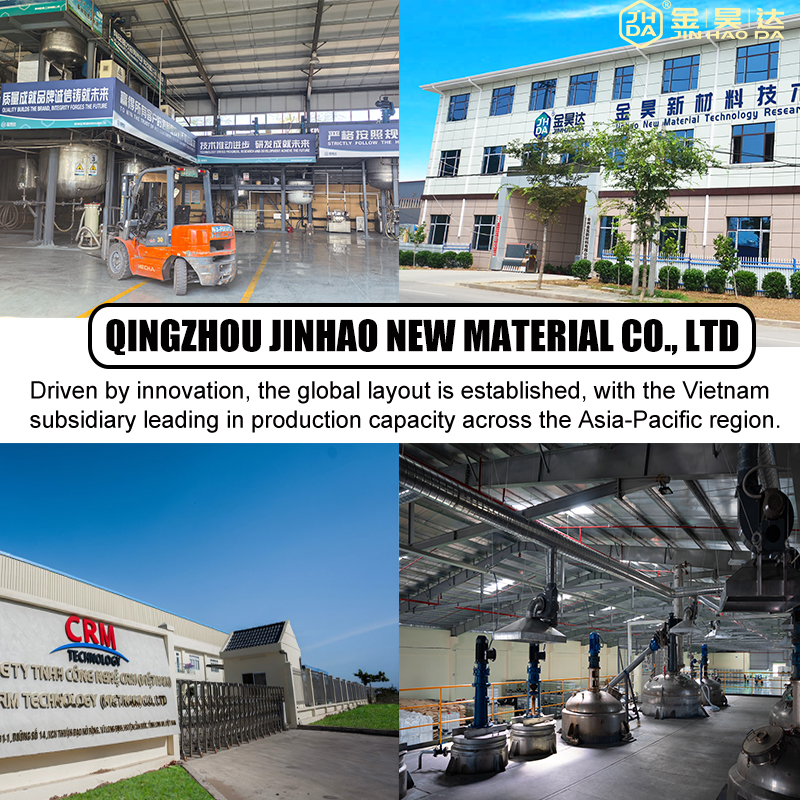
Factory audit visits are part of the qualification route for distributors and terminal paper mills.
Have Questions or Need More Details?
Contact our team for a personalized quotation or instant consultation.
Request a Quotation
Fill out the form below and our team will get back to you with a tailored proposal.
WhatsApp Direct Chat
Prefer to chat in real-time? Message us on WhatsApp for instant assistance & quick answers.
- Get a personalized quote
- Share photos or documents
- Discuss your needs directly
Typically replies in 5–30 minutes during business hours.