
SA05-6 vs 1DY-E3 vs 150SN-G2: DC Motor Buyer Comparison for Smart Manufacturing
Smart manufacturing equipment rarely fails because of a control algorithm. It fails where electrical demand becomes mechanical motion — at the wheel, the gearbox, or the brake. The smart manufacturing definition used by NIST and cited by SAP describes fully integrated, collaborative manufacturing systems that respond in real time to changing demands and conditions in the factory, in the supply network and in customer needs. A drive that cannot hold a load on a ramp, stop on command, or fit inside the machine envelope defeats that responsiveness no matter how capable the software layer is.
Three DC motor families from Wuxi Speedup Power Co.,Ltd are regularly shortlisted against one another for exactly this layer of the machine: the 6.5Inch SA05-6 brushless hub motor, the 8Inch Single Axis 1DY-E3 brushed geared hub motor, and the 150SN-G2 pancake motor with gearbox. All three sit inside the sub-750W band, all three are offered with customization, and all three appear in the same EU certificate records. They are nevertheless three different mechanical architectures, and the buyer decision is an architecture decision before it becomes a specification decision.
Wuxi Speedup Power Co.,Ltd is a DC motor manufacturer based in Wuxi, Jiangsu Province, China, founded in 2018 and specialising in pancake and printed armature motors, BLDC motors and wheel hub motors for industrial and civil applications, with EU and USA as its main export markets.
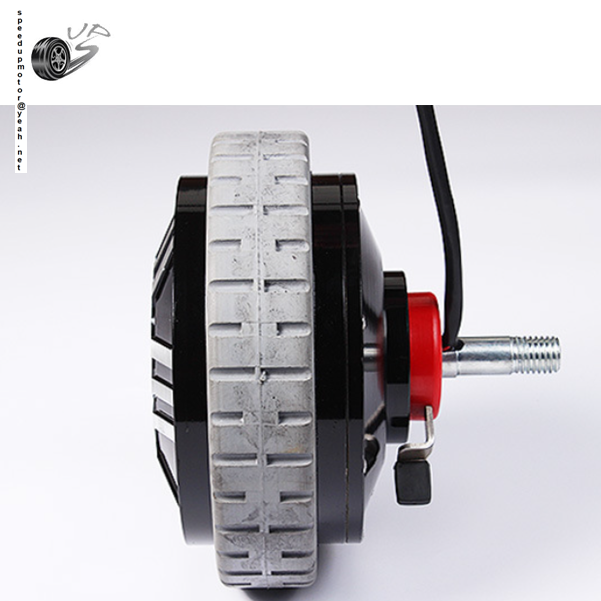
Wheel-integrated drives place the motor, the reduction gear and, in some models, the brake inside the wheel envelope — which changes both the machine layout and the maintenance plan.
Why these three motors end up on the same shortlist
A buyer searching for a DC motor for an AGV, a medical transport bed, a mobility chair or a floor-cleaning machine is usually working inside a narrow window: low voltage, low-to-medium power, and torque high enough to move a load from rest. That window pulls three otherwise unrelated products into the same evaluation sheet.
The overlap is visible in the published numbers. Rated torque for the three models runs from 15 Nm to 22 Nm, rated voltage from 24V to 36V, and rated power from 180W to 500W. Two of the three are complete wheels with an integrated reduction gear; the third is a body-mounted pancake motor with its own gearbox and a customizable shaft. What separates them is not the data sheet headline — it is how each one constrains the machine around it.
Side-by-side specification comparison
| Criterion | SA05-6 | 1DY-E3 | 150SN-G2 |
|---|---|---|---|
| Architecture | Brushless wheel hub motor, geared, in-wheel | Brushed wheel hub motor, geared, single-axis | Pancake motor with gearbox, chassis-mounted |
| Published model description | 6.5Inch Solid Tyre Wheel Motor Geared, Brushless DC Motor, BLDC Powered Wheel | 8Inch Single Axis Powered Motor Wheel, Brushed DC Wheel Hub Motor With Gearbox, EMB Brake | 36V 500W 22Nm Torque Pancake Motor With Gearbox |
| Wheel / body diameter | 170 mm solid tyre | 210 mm solid tyre | 151 mm motor body (not a wheel) |
| Rated voltage | 24V; 24V/36V/48V listed as options | 24V; 36V/48V listed as options | 36V |
| Rated power | 200W; 100–500W range listed | 180W | 500W |
| Rated speed | 150 rpm | 95 rpm | 240 rpm |
| Rated torque | 15 Nm | 20 Nm | 22 Nm |
| Reduction ratio | 1:4.5 | 1:20 | Gearbox fitted; ratio not stated |
| Brake | Electronic brake (EABS) | Electromagnetic brake (EMB) | Not stated in the published model record |
| Ingress protection | IP54 | Not stated | Not stated |
| Net weight | 3.5 kg | 5.5 kg | Not stated |
| Load capacity | 80–300 kg | 80–300 kg | Not stated |
| Shaft | Custom | Custom; single or double shaft | Custom axis length |
| Certification record | CE, EMC, RoHS stated for the model; listed as a related product on the EU RoHS and EMC certificates | CE, EMC, RoHS stated for the model; listed as a related product on the EU RoHS and EMC certificates | Listed as a related product on the EU RoHS and EMC certificates; the model record itself does not restate them |
All values as published in the supplier's model records. Blank cells indicate that the reviewed specification does not state the property, not that the property is absent.
Torque and speed: reading the numbers as machine behaviour
The three models occupy three distinct operating points. The lowest output speed belongs to the 1DY-E3 at 95 rpm with 20 Nm; the highest belongs to the 150SN-G2 at 240 rpm with 22 Nm; the SA05-6 sits between them at 150 rpm and 15 Nm.
For a wheel-mounted drive, output rpm at the wheel combined with tyre diameter sets the travel speed of the machine, while torque sets the grade and the load it can start from rest. That pairing, not the wattage, is what a specification review should test first. A device that must move a loaded patient transport bed up a ramp and then hold position needs holding torque and a brake; a device that sweeps a floor at constant speed needs continuous rotational output and gearbox durability.
Reduction ratio is the second variable that shapes behaviour. The SA05-6 uses a 1:4.5 reduction and the 1DY-E3 uses 1:20, which means the two wheels reach comparable torque through very different internal gearing. Ratio also influences back-driving: in patient-handling equipment, whether the wheel can be pushed by hand, and how much force that takes, is a safety-relevant property. That behaviour should be confirmed directly with the supplier rather than inferred from the ratio alone, because it depends on gear geometry and brake state as well.
Form factor: in-wheel versus chassis-mounted
Form factor is where the comparison turns from data into machine design.
The SA05-6 is a 170 mm wheel weighing 3.5 kg. Mounting it removes the need for a separate driveline, belt or chain, which simplifies the chassis of a compact AGV or a wheelchair-assist unit. The trade-off is that mass and geometry move out to the wheel, tyre choice is fixed to the solid tyre supplied, and the mounting interface must take the full load path.
The 1DY-E3 is a 210 mm wheel weighing 5.5 kg, offered in a single-axis configuration with double-shaft available. The larger diameter changes ground clearance and the load-bearing envelope, and the higher 20 Nm output comes with the greater weight.
The 150SN-G2 is not a wheel at all. It is a 151 mm pancake motor body paired with a gearbox and a customizable shaft, designed to be mounted in the chassis and to drive something else — a brush, an axle, a roller. It suits machines that already have a driveline and need a compact, flat motor package at the drive end. It is the only one of the three that cannot be bolted on as a complete wheel assembly.
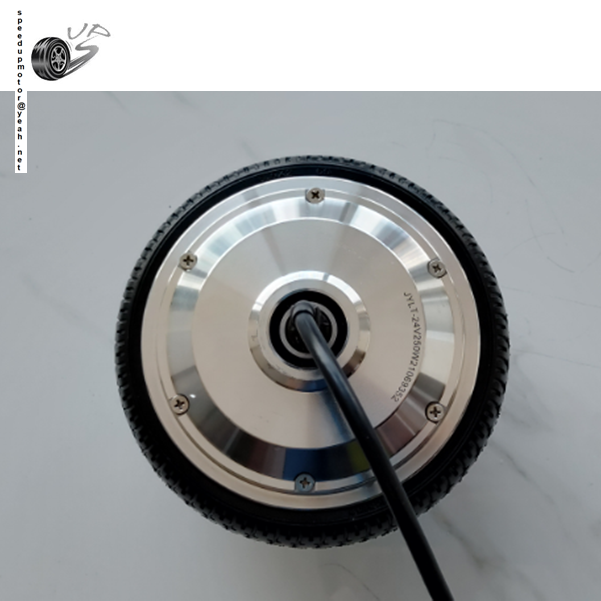
SA05-6: 170 mm solid tyre, 24V, 200W, 150 rpm, 15 Nm, 1:4.5 reduction, IP54, electronic brake.
Brake requirements decide more than the motor does
A drive on a medical bed, a transport chair or an AGV is a safety function as much as a motion function. The published record separates the three models clearly here.
The SA05-6 carries an electronic brake (EABS). The 1DY-E3 carries an electromagnetic brake (EMB). The 150SN-G2 model record does not state a brake at all. That is not a defect, but it is a purchasing fact: a buyer specifying the 150SN-G2 has to solve braking at system level — either through a separately sourced brake or through a gearbox confirmed as self-locking — and must not assume the drive holds position when unpowered.
For the two braked models, the questions that belong in the RFQ are consistent: brake holding torque, release and engage time, behaviour on power loss, whether a manual release exists for patient handling, and how brake wear is inspected in service. None of those values appear in the reviewed specification for these three models, so they must be obtained as documentation rather than assumed from the brake type.
Maintenance exposure: brushes, controllers and gearboxes
The three options distribute wear differently, and that difference usually outweighs a small torque advantage over a multi-year service life.
The 1DY-E3 is a brushed machine built on a printed armature and winding with rare earth NdFeB permanent magnets. Its published characteristics include high power-to-volume ratio, high linearity and ease of integration. Brushes are a consumable item by design, so the maintenance plan must include an inspection and replacement interval — a routine that is well understood but requires access to the wheel.
The SA05-6 is brushless. Brush wear disappears from the maintenance schedule, but commutation electronics become the critical component: the drive needs a compatible controller, and the electrical installation must respect the EMC conditions under which the motor is certified. In practice, a brushless wheel moves the service risk from a mechanical part to an electronic one.
For the 150SN-G2, the reviewed specification does not state the commutation type or the brush configuration. Buyers should not assume brushless operation from the pancake form factor. The gearbox is a second wear surface in its own right and should have a stated service regime.
Voltage and control architecture
Voltage choice is usually fixed by the battery pack already in the machine. The SA05-6 and the 1DY-E3 both list 24V as the rated voltage with 36V and 48V listed as options, which makes them interchangeable in machines built around a 24V pack and adaptable to 36V or 48V platforms. The 150SN-G2 is published as a 36V, 500W unit; its record indicates custom manufacture is available but does not enumerate alternative voltage variants.
Power level also changes the electrical design. At 500W the 150SN-G2 draws substantially more current at the same voltage than a 200W or 180W wheel, which affects cabling, connector rating, controller selection and thermal layout. Those are system-level consequences that belong in the evaluation, not after it.
Certification constraints for EU-bound equipment
Two EU certificates are documented for the wider motor range and both list the SA05-6, the 1DY-E3 and the 150SN-G2 among the related products.
- RoHS: certificate number M.2025.206.C130289, issued by UDEM Uluslararası Belgelendirme Denetim Eğitim Merkezi San. ve Tic. A.Ş., scope DC Motor, standard Directive 2011/65/EU RoHS with EN IEC 63000:2018, EU market, issued 2025-11-26, valid to 2030-11-25.
- EMC: certificate number M.2026.206.C138410, issued by UDEM, scope DC Motor, standard 2014/30/EU Electromagnetic Compatibility Directive Annex II with EN IEC 61000-3-2:2019/A2:2024, EN IEC 61000-3-3:2013/A2:2021, EN IEC 61000-6-1:2019 and EN IEC 61000-6-8:2020, EU market, issued 2026-04-14, valid to 2031-04-13.
Two cautions are worth carrying into a supplier audit. First, a related-product listing is not the same as a model-level certificate entry; buyers should ask for the certificate and its annex and confirm the exact model designation appears there. Second, which EMC standard applies depends on the environment the finished machine is installed in, so the applicable standard should be matched to the end-product classification rather than taken from the certificate alone.
The supplier's company profile separately states UL and ISO9001-2008 certification. Those are organisation-level claims and should be read as distinct from the two model-scope certificates above.
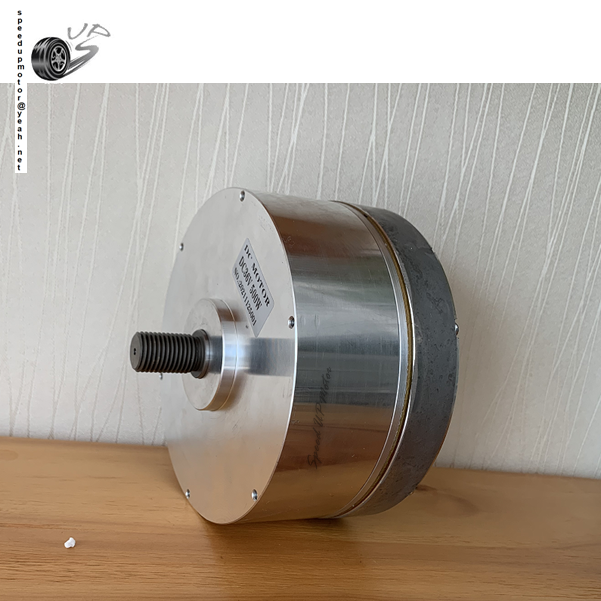
150SN-G2: 151 mm pancake motor body with gearbox, 36V, 500W, 240 rpm, 22 Nm. Brake, ingress rating and commutation type are not stated in the published model record.
Customization and purchasing terms
Customization on these families is stated at the parameter level rather than the cosmetics level. The supplier lists OEM/ODM customization of voltage, power, speed, torque, shaft and logo, with support for custom, OEM and STO production types. Each of the three models carries its own design options: the SA05-6 and 1DY-E3 list operating voltages to suit, custom shaft sizes and profiles, tailored performance profiles and special OEM configurations; the 150SN-G2 lists a customizable axis length.
The stated commercial terms are a minimum order quantity of 1 unit and a lead time of 30–45 working days, with 100% testing and stated after-sales support covering warranty service, remote fault diagnosis, installation and commissioning instructions, original spare parts supply, repair and replacement, and lifetime online technical support.
Two limits should be stated plainly. A one-unit MOQ is useful for prototyping and validation, but it says nothing about the MOQ that applies to a custom shaft, a changed winding or a private-label build, and that should be confirmed in writing. Separately, no price, price band or cost-per-unit figure is published in the reviewed material, so this comparison makes no cost claim for any of the three models.
Acceptance criteria before volume release
Whatever the architecture, the same incoming-inspection logic applies. A buyer releasing the first production batch should be able to tick each of the following:
- Nameplate data matches the purchase order for voltage, power, speed, torque and reduction ratio.
- Rated torque is verified at rated speed on a loaded test, not only at no-load.
- No-load current and running current are recorded as a baseline for future comparison.
- Brake engagement, release time and holding behaviour are tested on an incline, and manual release is demonstrated where specified.
- Ingress protection is verified by the method agreed with the supplier — IP54 is stated for the SA05-6 only, and the verification method for the other two models must be agreed.
- Shaft dimensions, keyway or profile, and the mounting interface are measured against the drawing.
- Connector type, pinout and cable length match the drawing, since these vary with customization.
- The certificate copy and annex list the exact model designation ordered.
- Sample units and production units are compared directly, so that approval is given to a build, not to a prototype.
Application fit by equipment type
Compact AGVs, medical chairs and wheelchair assistance
The SA05-6 is the most integrated of the three for this class. Its 170 mm solid tyre, 3.5 kg mass, 15 Nm output, 80–300 kg load capacity and IP54 rating suit indoor equipment where a small wheel and a protected drive are required. The published application list covers mobility scooters, electric scooters, wheelchair assistance, medical chairs, AGVs and robots. Its electronic brake supports stopping and holding at low speed.
Hospital transport beds, transport chairs and carts
The 1DY-E3 is listed for mobility scooters, electric scooters, shopping carts, medical chairs, hospital transport beds, transport chairs and transport carts. The 210 mm wheel, 20 Nm output at 95 rpm and an electromagnetic brake are consistent with a device that moves slowly under load and must hold position when parked. Service planning should account for brush inspection.
Floor-cleaning machinery and other continuous rotational loads
The 150SN-G2 suits machines that need a compact, flat drive package tied into an existing driveline rather than a wheel. Floor-cleaning and drying equipment is an established application area for this motor family, where brush-drive duty calls for continuous rotation at higher output speed. Because the model record does not state a brake or an ingress rating, the machine designer has to resolve braking and protection at system level.
Market trend: the sub-750W band carries the volume
The commercial context supports continued attention on this power class rather than on scaling up. Grand View Research estimates the global brushless DC motor market at USD 22.2 billion in 2025, projected at USD 23.6 billion in 2026 and USD 38.4 billion by 2033, and reports that motors with output not exceeding 750W accounted for 48.8% of global BLDC market revenue in 2025.
The practical reading is that the largest single revenue block of the brushless market sits exactly where these three models compete. It also explains why brushed and brushless options coexist in the same shortlist: where a brake is integrated, the mechanical package is compact and the duty cycle is intermittent, a brushed geared hub remains a legitimate choice rather than a legacy one. The trend does not remove options; it raises the documentation standard applied to all of them.
Where this comparison stops
An honest comparison has to name its boundaries.
- No efficiency curve, torque-speed curve, noise figure or life-hour rating is published in the reviewed material for any of the three models, so none can be compared on those grounds here.
- Ingress protection is stated only for the SA05-6 (IP54). Washdown, outdoor or humid-duty claims for the other two should not be made without written confirmation.
- No brake is stated for the 150SN-G2, and no brake torque value is published for the other two.
- The three are not drop-in substitutes. A 170 mm wheel, a 210 mm wheel and a 151 mm chassis-mounted motor require different mounting geometry, different frame stiffness and, in two cases, an entirely different machine layout.
- No pricing, cost-per-unit or total-cost-of-ownership conclusion is drawn, because no cost data appears in the reviewed material.
Future outlook
Two pressures are likely to shape this product class over the next procurement cycles. The first is documentation depth: as AGV and medical-device audits become more granular, the certificate annex, the datasheet revision and the acceptance test record matter as much as the headline torque figure. Suppliers who can supply model-level evidence quickly will be easier to qualify.
The second is integration. The clearest functional differences between these three models are not in their power ratings but in what is built in — a wheel, a reduction gear, a brake, a sealed enclosure. Buyers are effectively choosing how much of the drive system they want to receive pre-assembled, and that choice drives both engineering effort and service strategy. Expect that boundary, rather than raw wattage, to remain the defining question in this power band.
Frequently asked questions
Which of these three motors suits a low-speed, high-torque drive for a patient transport device?
Two of the three are directly applicable. The 1DY-E3 delivers 20 Nm at 95 rpm from a 210 mm wheel with an electromagnetic brake and an 80–300 kg load capacity, and it is listed for hospital transport beds, transport chairs and transport carts. The SA05-6 delivers 15 Nm at 150 rpm from a 170 mm wheel with an electronic brake, IP54 protection and the same 80–300 kg load capacity, and is listed for medical chairs and wheelchair assistance. The lower output speed of the 1DY-E3 favours slow movement under load; the SA05-6 favours a smaller, sealed wheel.
Does the 150SN-G2 include a brake?
The published model record for the 150SN-G2 does not state a brake. The record lists rated power of 500W, rated voltage of 36V, rated speed of 240 rpm, a rated torque of 22 Nm, a diameter of 151 mm, a gearbox, a customizable axis length and availability of custom manufacture. Buyers therefore need to resolve braking at system level — through a separately sourced brake or a gearbox confirmed as self-locking — and should not assume the unit holds position when unpowered.
Which certifications apply to these three models, and how should coverage be verified?
Two EU certificates are documented with the three models listed among their related products: a RoHS certificate numbered M.2025.206.C130289 to Directive 2011/65/EU and EN IEC 63000:2018, and an EMC certificate numbered M.2026.206.C138410 to 2014/30/EU with EN IEC 61000-3-2, EN IEC 61000-3-3, EN IEC 61000-6-1 and EN IEC 61000-6-8 standards. Both are issued by UDEM for the EU market, with validity to 2030-11-25 and 2031-04-13 respectively. Coverage should be verified by obtaining the certificate and its annex and confirming that the exact ordered model designation appears there.
Can shaft length and operating voltage be customized on these models?
Yes, within the options published for each model. The SA05-6 lists custom shaft sizes and profiles, operating voltages to suit, tailored performance profiles and special OEM configurations, with 24V/36V/48V and a 100–500W range stated. The 1DY-E3 lists the same design options, with 24V rated and 36V/48V available, in single or double shaft. The 150SN-G2 lists a customizable axis length and states that custom manufacture is available, but does not enumerate alternative voltage variants. The supplier also states OEM/ODM customization of voltage, power, speed, torque, shaft and logo.
What purchasing terms are stated for these motors?
The stated terms are a minimum order quantity of 1 unit and a lead time of 30–45 working days, with 100% testing and after-sales support that covers warranty service, remote fault diagnosis, installation and commissioning instructions, original spare parts supply, repair and replacement, and lifetime online technical support. These are supplier-stated terms; the MOQ applying to customized shafts, windings or private-label builds is a separate question and should be confirmed in writing. No price or price band is published in the reviewed material.
What should an incoming inspection check before volume release?
At minimum: nameplate data against the purchase order for voltage, power, speed, torque and reduction ratio; rated torque under load at rated speed; no-load and running current recorded as a baseline; brake engagement, release time and holding behaviour on an incline, with manual release demonstrated where specified; the agreed method of ingress verification, noting that IP54 is stated for the SA05-6 only; shaft and mounting dimensions against the drawing; connector type, pinout and cable length; the certificate annex listing the exact model; and a direct comparison of sample units with production units.
Have Questions or Need More Details?
Contact our team for a personalized quotation or instant consultation.
Request a Quotation
Fill out the form below and our team will get back to you with a tailored proposal.
WhatsApp Direct Chat
Prefer to chat in real-time? Message us on WhatsApp for instant assistance & quick answers.
- Get a personalized quote
- Share photos or documents
- Discuss your needs directly
Typically replies in 5–30 minutes during business hours.