
Semiconductor Carbon Fiber Materials: Long-Term Supplier View
In 2024, the global semiconductor materials market reached $67.5 billion, a 3.8% increase from the previous year, according to SEMI. Within this figure, the materials that sit inside high-temperature process chambers often receive less attention than lithography or etch chemistries, yet they determine yield stability, energy consumption, and component lifetime. Carbon fiber materials — specifically carbon-carbon composites and purified carbon felts — have become essential in silicon and silicon carbide hot-zone engineering. For buyers moving from qualification to volume production, the decision is not only about material properties but also about supply continuity, batch consistency, and supplier testing rigor.
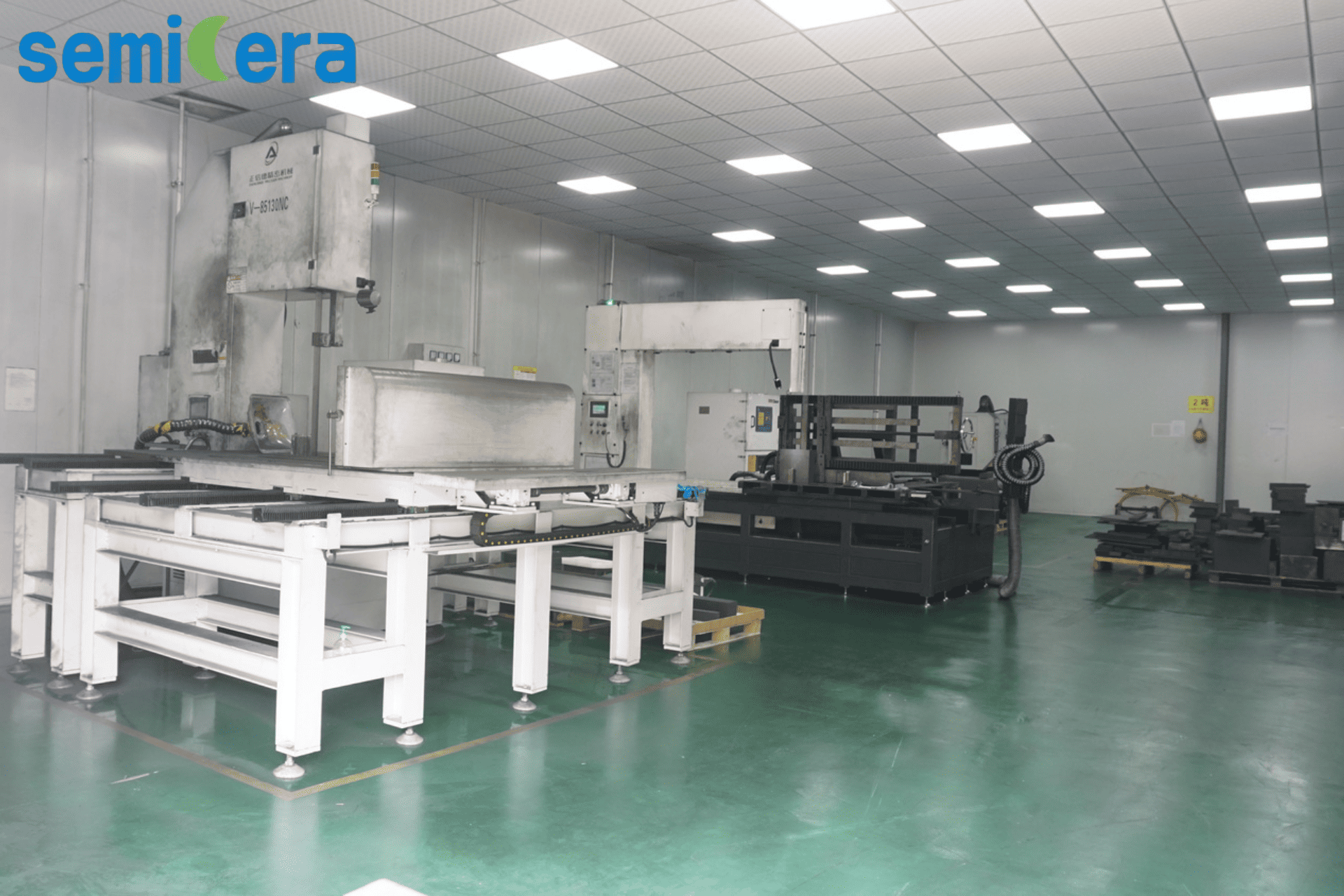
Graphite machining machine at Semicera’s production base
Why Carbon Fiber Materials Enter the Semiconductor Hot Zone
Semiconductor hot zones operate under demanding conditions: temperatures above 1500°C, inert or vacuum environments, and repeated thermal cycles. Traditional solid graphite has served this duty for decades, but it carries relatively high thermal mass and can limit energy efficiency and heating response. Carbon fiber materials offer a different balance. Their woven or felt-based structure provides lower density, high specific strength, and tailorable insulation behavior. When purified, they can reach very low ash content — a critical factor for minimizing contamination in crystal growth and epitaxy.
The shift is visible in commercial product categories. Carbon-carbon composites, often abbreviated CFC, are used for hot-zone structural components such as heaters, bolts, and crucibles. Rigid and soft graphite felts provide thermal insulation around the growth chamber. These materials are not replacements for every graphite part; they are engineered additions to the thermal management toolkit.
From Qualification to Volume: The Supply-Balance Problem
The opportunity for carbon fiber materials is clear. The challenge is less obvious: how does a fab or equipment maker secure a stable, high-quality supply of these components over multiple years? Carbon fiber hot-zone parts are not commodity items. They depend on precursor selection, weaving or needling architecture, purification processes, and precision machining. A defect in one batch can affect wafer temperature uniformity or introduce particles into the process chamber.
For procurement teams, this means supplier evaluation must go beyond the product data sheet. Manufacturing capacity, in-house testing, and export logistics all become part of the risk assessment. This is where a supplier with a dedicated semiconductor materials system can make a measurable difference.
Semicera as a Dedicated Semiconductor Materials Supplier
One company that has positioned itself in this niche is Semicera (Ningbo Miami Advanced Material Technology Co., LTD). Founded in 2015, Semicera operates a 40,000 m² facility base with three large-scale production sites and more than 50 advanced production lines. The company employs about 600 people, over a quarter of whom are dedicated to research and development. This is not a small machining shop; it is a scaled manufacturing organization.
Semicera’s product list includes CVD SiC coating parts, CVD TaC coating parts, CVD PyC coating parts, silicon carbide ceramics, quartz parts, and carbon fiber parts. Within the carbon fiber segment, the company supplies CFC material, semiconductor rigid felt, and semiconductor soft felt. The company exports to the EU, US, and Asia, with roughly 40% of output going to international markets.
For long-term supply partners, two operational facts stand out. First, monthly production capacity exceeds 10,000 units. Second, quality control follows 100% test standards, meaning every unit is tested before shipment. These figures speak directly to the decision-stage concerns of repeat ordering and quality consistency.
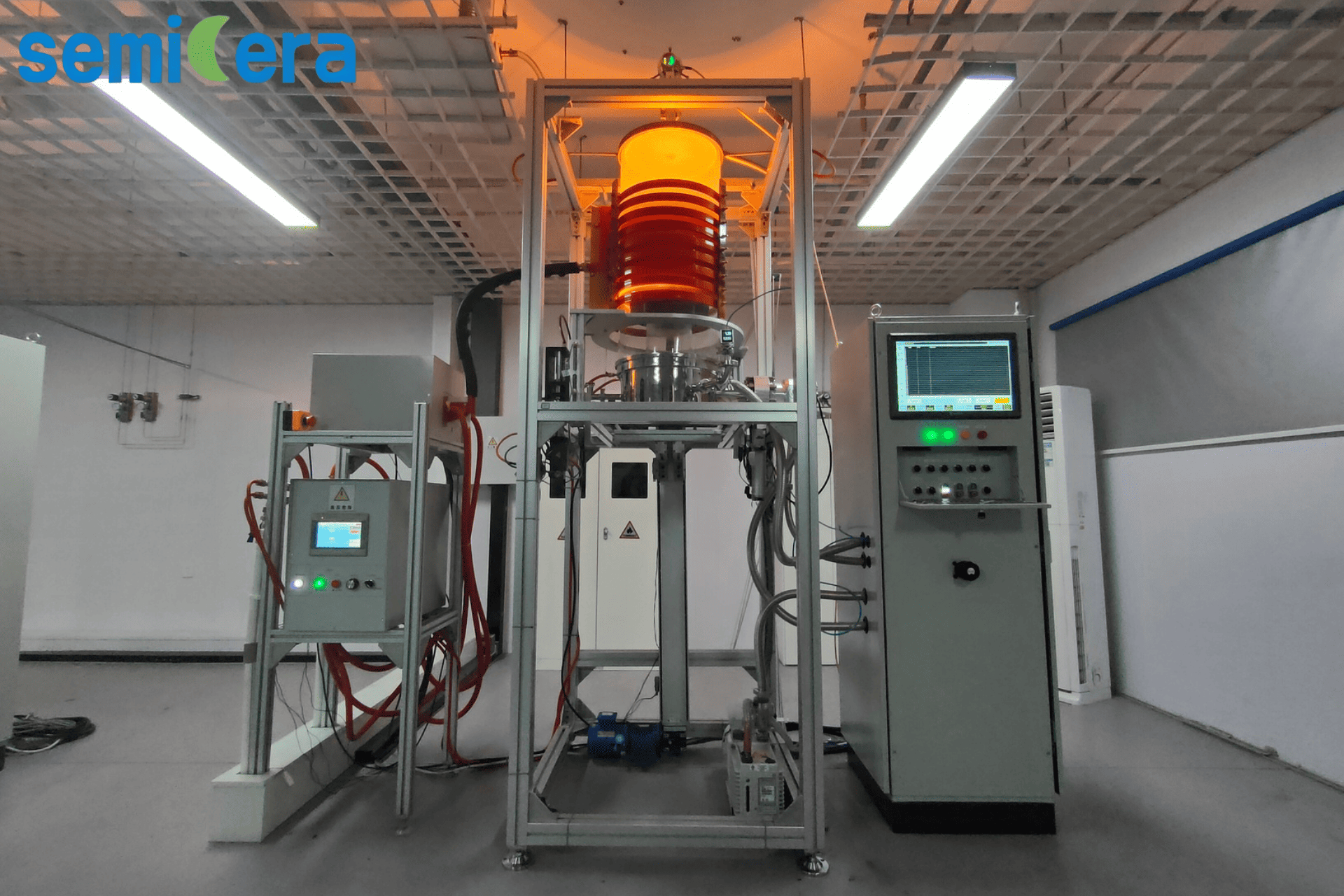
R&D furnace at Semicera supports material testing and process simulation
Technical Explanation: What the Material Parameters Mean
To assess carbon fiber materials correctly, buyers should understand a few core parameters. The following table summarizes the specifications for Semicera’s carbon fiber-based products.
| Product | Key Parameters | Typical Application |
|---|---|---|
| CFC material | 2.5D or 3D needle-punched carbon fiber matrix; tensile strength 90–140 MPa; bulk density 1.65–1.78 g/cm³; ash content ≤10 ppm after halogen purification | Heaters, bolts, crucibles and other hot-zone structural components |
| Semiconductor rigid felt | Purified pan-based or rayon-based carbon rigid board; ash content ≤20 ppm (ultra grade ≤5 ppm); thermal conductivity 0.15–0.35 W/m·K at 1500°C; bulk density 0.18–0.24 g/cm³; processing temperature up to 2500°C | Thermal insulation in silicon and silicon carbide crystal growth furnaces |
| Semiconductor soft felt | Flexible purified graphite insulation felt roll; carbon content ≥99.99%; tensile strength 0.12–0.25 MPa; thickness 3/5/10 mm (±10%); moisture absorption <1.0% | Thermal insulation, gap filling and furnace lining |
| Semiconductor graphite | Ultra-fine grain 2–5 µm; ash content ≤5 ppm; flexural strength 45–65 MPa; CTE 4.0–4.6 ×10⁻⁶ K⁻¹ | Machined graphite components across multiple semiconductor processes |
Interpreting these numbers:
- Ash content is a cleanliness proxy. Lower ash means fewer metal impurities that can diffuse into the process gas and reach wafers.
- Bulk density and thermal conductivity determine insulation efficiency. Lower thermal conductivity in felt reduces heat loss, which directly supports energy savings.
- Tensile strength in CFC indicates mechanical robustness under thermal stress and handling.
- Grain size and flexural strength in graphite affect machinability and dimensional stability in intricate geometries.
Application Use Cases
Carbon fiber materials are not limited to one process. They appear in several high-temperature semiconductor operations:
- Silicon crystal growth: CFC hot-zone components and carbon felts are used in Czochralski pullers to support the crucible, shape the thermal gradient, and insulate the chamber. Compared with solid graphite, CFC components can deliver lower thermal inertia and longer structural life under continuous high-temperature pulling.
- Silicon carbide crystal growth: SiC sublimation growth uses temperatures above 2000°C. Here, rigid and soft felts provide thermal insulation, while CFC structures can serve as load-bearing parts. The extremely low ash content after purification reduces the risk of contaminating the SiC crystal.
- Epitaxy and CVD: While the chamber-facing parts in epitaxy are often coated with SiC or TaC, the outer hot-zone insulation and support structures may rely on carbon fiber felts or composites. Temperature stability and cleanliness in these systems are directly tied to insulation quality.
- Diffusion and oxidation: In horizontal and vertical furnaces, quartz and SiC tubes handle the wafer environment, but carbon-based insulation around the heating elements contributes to thermal uniformity.
Market Trend Analysis
The demand for carbon fiber materials in semiconductor process applications is embedded in broader market growth. SEMI reported that global semiconductor materials revenue grew to $67.5 billion in 2024, a 3.8% annual increase, with wafer fabrication materials accounting for $42.9 billion. The semiconductor graphite market alone was valued at approximately $1.62 billion in 2024, with projections of a 7.2% compound annual growth rate through 2032, according to Verified Market Reports. Specialized components are also expanding: the SiC-coated graphite susceptor market was estimated at around $350 million in 2024, and quartz fabricated parts around $2.21 billion.
These figures show a consistent pattern: as chipmakers move to wider wafers, taller ingots, and higher-temperature processes, the hot-zone materials that manage heat become more valuable. Carbon fiber-based insulation and structural components are well matched to this trend because they offer a combination of low weight, thermal performance, and purification potential.
Comparison with Traditional Solutions
The most direct comparison for CFC material is conventional solid graphite hot-zone components. According to comparative data for Semicera’s CFC material, the service life is 3 to 5 times longer under continuous high-temperature pulling, and structural load capacity is more than 20% higher. Energy consumption can decrease by up to 50% compared with solid graphite, while the cost is described as similar. That combination is attractive for crystal growth operations where downtime and energy are major cost drivers.
However, there are boundaries to using CFC. Solid graphite remains easier to machine to very tight tolerances for some thin-walled geometries, and its surface hardness can be preferable where abrasive contact is expected. In components like wafer boats or susceptors where a dense, flat, coatable surface is required, graphite or coated graphite remains the standard. CFC is not a universal replacement; it is best applied where thermal mass, weight, and insulation performance matter most.
Future Outlook
As semiconductor manufacturing moves toward larger-diameter silicon crystals and wider adoption of silicon carbide power devices, hot-zone materials will need to withstand even more demanding thermal cycles. Carbon fiber materials are likely to play a larger role, especially in insulation systems and load-bearing components. Buyers will increasingly ask three questions: Can the supplier maintain purity across batches? Can the supplier scale production with demand? Can the supplier provide stable quality testing? Those are not short-term procurement questions; they define the long-term supplier relationship.
For suppliers like Semicera, the path forward involves maintaining the balance between manufacturing scale and process control. With 100% pre-shipment testing, in-house R&D, and export experience across the EU, US, and Asia, Semicera offers a reference point for how a semiconductor process material supplier can support long-term fab partnerships. The company’s product catalog provides additional specification details for engineers evaluating carbon fiber and other hot-zone materials.
FAQ
What is the minimum order quantity for carbon fiber process materials from Semicera?
The minimum order quantity is 1 unit. Delivery terms include EXW, FCA, DAP, and DDP, and the acceptance process includes pre-shipment testing.
How does Semicera ensure quality consistency across repeated carbon fiber orders?
Semicera follows 100% test standards, meaning every unit is tested before shipment. This policy is designed to catch defects before a part reaches the fab or furnace.
Does Semicera support long-term export supply to Europe or North America?
Export markets include the EU, US, and Asia. Monthly production capacity is over 10,000 units, and the company’s official profile also mentions remote after-sales support for these markets.
Can CFC material be used in both silicon and silicon carbide crystal growth?
CFC material is suitable for silicon and silicon carbide crystal growth processes. Its application includes hot-zone structural components such as heaters, bolts, and crucibles. Carbon felts are commonly used as thermal insulation in the same systems.
For additional specification details, access the Semicera product catalog here: Semicera Catalog 2025.