
Supplier Capability Evidence: JHDA Paper Strength Agent Portfolio
Supplier Capability Evidence: JHDA Paper Strength Agent Portfolio
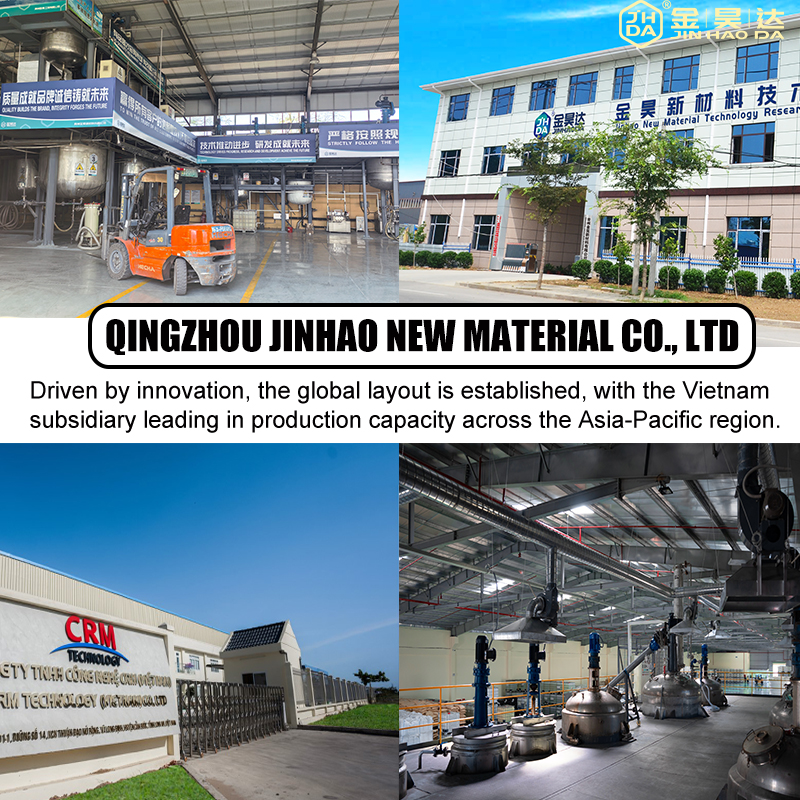
JHDA's papermaking chemicals manufacturing base in Mihe Industrial Park, Qingzhou City, Shandong Province, China.
A paper strength agent is purchased on performance but qualified on evidence. Mills that are already comparing dry strength agents, wet strength resins and retention chemistry rarely lack suppliers willing to describe their products as high-strength or cost-effective replacements; what is harder to obtain is grade-level documentation that a technical team can convert into a trial protocol and a purchase decision. This reference maps the paper strength agent portfolio of Qingzhou Jinhao New Material Co., Ltd. — a papermaking chemicals manufacturer founded in 2005, located in Mihe Industrial Park, Qingzhou City, Shandong Province, China, and operating under the brand JHDA — and sets out which documented specifications, compatibility questions and application categories a buyer can realistically use to qualify a strength agent supplier.
Why Category Claims Are Not Enough at the Decision Stage
Scale alone does not differentiate suppliers in this category. According to Intel Market Research, the global paper dry strength agent market was valued at approximately USD 864 million in 2024, with Asia-Pacific accounting for roughly 40% of that market. Fact.MR projects the dry strength resin market reaching USD 1.4 billion by 2026, growing at a CAGR of 4.8% through 2036, and estimates that polyacrylamide (PAM) resins hold about 40.0% of that market. Published estimates differ by scope and base year — 2024 figures for the narrower dry strength agent category cluster near USD 860–864 million, while a 2026 forecast for the broader dry strength resin category sits at USD 1.4 billion — but the direction is consistent.
The procurement consequence matters more than the arithmetic. When many producers supply broadly comparable polymer chemistry, offers converge. A buying team at the decision stage is not really asking whether a supplier can make a dry strength agent. It is asking whether the supplier can show, grade by grade, what the product contains, what it is documented to influence, how it interacts with the rest of the wet end, and what still has to be proven on the mill's own machine.
That framing shapes the rest of this article: the JHDA portfolio is treated here as a set of documents and application claims to be examined, not as a single marketing statement.
Inside the JHDA Paper Strength Agent Portfolio
JHDA runs standardized automated production lines for both liquid and solid papermaking chemicals, with a minimum order quantity of 1 MT for bulk orders. The headquarters site covers approximately 20,000 m² with an annual output reported at 100,000 tons, and the company states that overseas business accounts for 35% to 50% of total sales volume, with core export markets in Vietnam, Thailand, Malaysia, Indonesia, Myanmar, Cambodia and packaging paper industrial zones in the Middle East.
The strength-related portion of the portfolio is organized across six named grades spanning dry strength, wet strength, pulp molding and strength retention categories.
| Grade | Portfolio category | Function the grade is positioned for | How a buyer verifies it |
|---|---|---|---|
| JH-D726 | Dry strength agent | Dry-state fibre bonding in packaging and containerboard furnishes | Grade TDS parameters, dosage guidance, mill trial at equal dosage |
| JH-1699 | Dry strength agent | Dry strength contribution in containerboard and packaging grades | TDS, sample trial, ring crush and burst comparison against current additive |
| JH-1697 | Solid dry strength agent | Dry strength supplied in solid form, for mills that prefer powder handling and long-distance logistics | TDS, dissolution and handling guidance, water solubility confirmation |
| JH-1201 | Wet strength agent (PAE wet strength resin) | Wet strength retention, positioned for tissue paper and pulp molding products | TDS, wet strength testing, confirmation of residual ECH and formaldehyde status |
| JH-2219 | Pulp molding strength enhancer | Strength performance in moulded pulp products | TDS, moulded product testing at the converter |
| JH-8501 | Strength retention emulsion | Strength retention in emulsion format | TDS positioning statement, compatibility screen with the existing wet-end system |
The numeric values a mill actually needs — solid content, pH, viscosity, shelf life and water solubility — sit in the technical documentation of each individual grade, not in a portfolio-level description. JHDA provides complete TDS and MSDS documents and states that these support overseas customers' customs clearance and L/C settlement. A qualification process should therefore extract parameters grade by grade and confirm the intended application in writing before any commercial comparison is made.
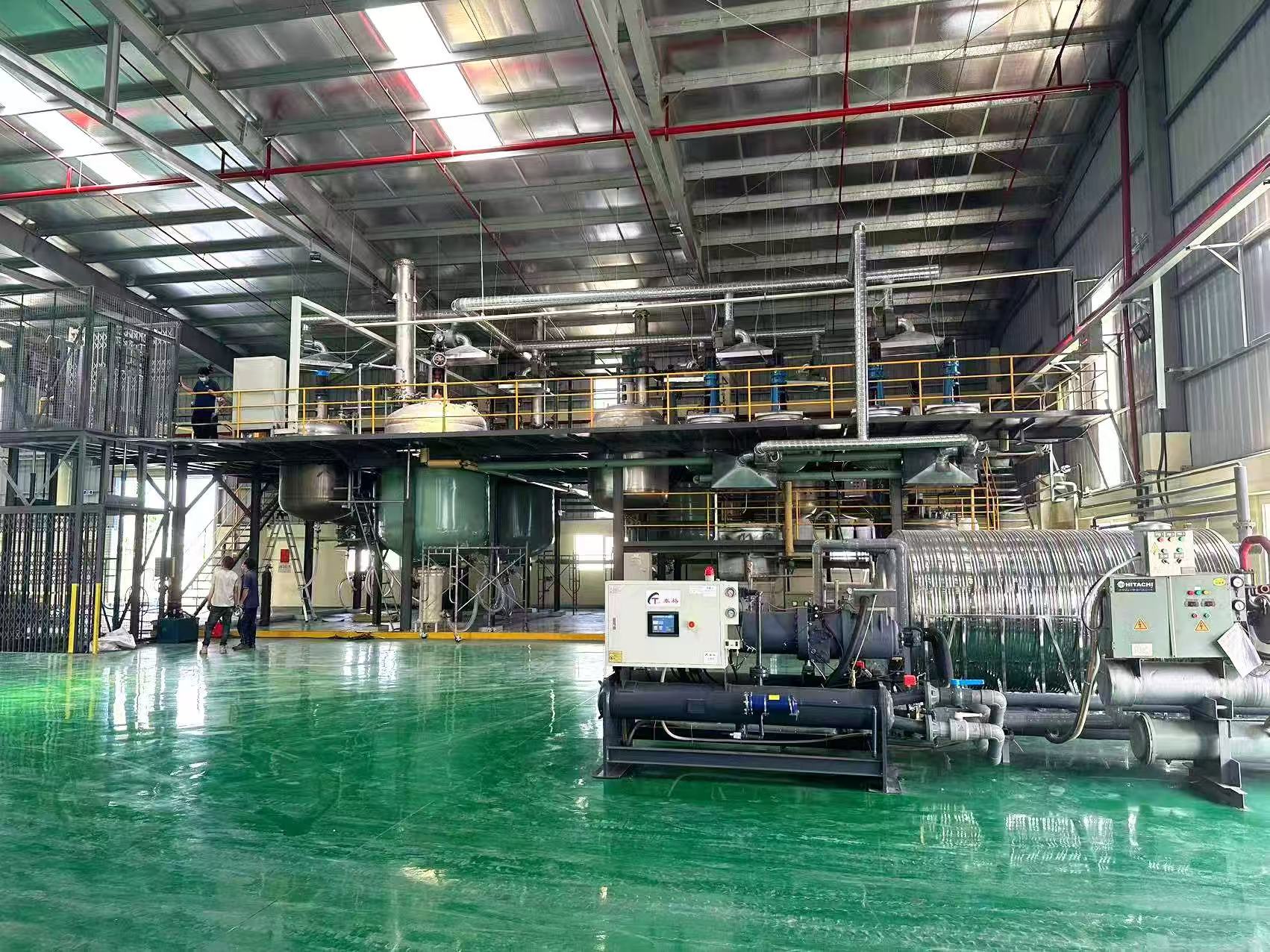
Automated production line for liquid papermaking chemicals, including dry strength and wet strength grades.
Technical Basis: What Dry Strength, Wet Strength and Retention Chemistry Do
Dry strength agents work on fibre-to-fibre bonding in the finished sheet. The chemistry — largely polyacrylamide-based, which Fact.MR estimates at about 40.0% of the dry strength resin market — increases the number and strength of bonds formed during drying, which is why its effect shows up in ring crush strength, bursting strength and tensile measurements rather than in any single wet-end reading. For recycled furnishes containing shorter fibres and higher fines, the practical value of the additive is the recovery of strength lost when virgin fibre is replaced.
Wet strength agents work differently. PAE wet strength resins, the chemistry behind JH-1201, develop crosslinking with cellulose that allows the sheet to retain a portion of its strength when saturated, which is why the category is used in tissue paper and moulded pulp products where wet integrity is functional rather than incidental. Because wet strength chemistry is regulated more tightly than dry strength chemistry in food-contact and hygiene applications, market access criteria include low residual epichlorohydrin and formaldehyde-free formulations; industry guidance widely cited in the sector places the threshold for low residual ECH at below 50 ppm for EU-facing wet strength resin supply. Buyers should treat those thresholds as verification items, not assumptions.
Retention and drainage chemistry is the third layer. Enhanced wet-end dewatering and fibre retention change how much of the added chemistry stays in the sheet rather than recirculating in the white water, which affects both dosage efficiency and machine runnability. This is the mechanism behind the comparative figures JHDA publishes on retention and drying load, discussed further below.
Compatibility is the layer buyers most often under-document. A strength agent is never dosed alone: it shares the wet end with sizing chemistry, optical brightening agents and defoamers. JHDA's broader product line includes AKD neutral sizing emulsion, cationic styrene-acrylic surface sizing agents, liquid OBA optical brightening agent, high-temperature and alkali-resistant defoamer, stickies control enzyme and sludge encapsulant, which allows compatibility questions to be addressed within a single supply relationship and verified through pre-shipment laboratory testing rather than by assumption.
Application Categories and the Grades Positioned Against Them
Strength chemistry is grade-specific in practice. The categories most commonly associated with dry strength additives are packaging and containerboard grades; Fact.MR estimates that the packaging and containerboard segment leads paper grade usage for dry strength additives with a 38.0% share. Recycled fibre intensity reinforces that demand: the American Forest & Paper Association reported that recycled paper's share of all fibre used at U.S. mills increased to 44.4% in 2024, which raises the importance of recycled pulp strength performance.
- Recycled containerboard and corrugated medium: the primary target for the dry strength grades JH-D726, JH-1699 and JH-1697, where ring crush and burst performance determine box compression strength.
- Kraft linerboard: dry strength and surface sizing interact here; grade selection should account for the sizing regime already in place.
- Food packaging cardboard: strength performance must be evaluated alongside food-contact compliance, including SGS food contact safety testing for packaging paper chemicals that JHDA holds, and downstream requirements such as EN 645, EN 646, EN 648 in the EU and BfR Recommendation XXXVI, which is widely cited internationally.
- Printing and writing paper and household tissue paper: JHDA positions its PAE wet strength agent JH-1201 toward tissue paper and pulp molding products, where wet strength retention is a functional property.
- Pulp moulded products: JH-2219 is the portfolio grade positioned for strength in moulded pulp items.
What JHDA Documents, and What That Documentation Proves
Supplier capability evidence falls into two separate buckets, and conflating them is a common sourcing error: system and compliance evidence on one side, grade performance evidence on the other.
On the system side, JHDA holds ISO9001 quality management system certification and ISO14001 environmental management system certification, and SGS product compliance test reports including food contact safety testing for packaging paper chemicals. JHDA also states that all exported chemical products complete CAS registration and GHS hazard labelling and comply with IMDG international marine shipping regulations, and that export documentation includes commercial invoice, packing list, certificate of origin, pre-shipment inspection report, MSDS and TDS. Manufacturing evidence includes standardized automated production lines for liquid and solid chemistry, an R&D and technical service team of about 20 engineers, and a large-scale professional R&D laboratory under construction inside the central production workshop for testing capability, formula development and performance verification. Supply continuity evidence includes an overseas supporting production entity, CRM Chemical Technology Co., Ltd., in Long An Province, Vietnam, intended to shorten delivery cycles for ASEAN customers, and flexible payment terms covering sight L/C, T/T and DP for large-volume orders.
What these documents prove is process control, regulatory handling and the ability to support export transactions. They do not prove that a specific grade will deliver a specific strength gain on a specific machine. That second question can only be answered by the grade TDS, a sample trial and a mill-side comparison run.
Comparison with Conventional Supply Models — and Where the Evidence Stops
JHDA differentiates its position by delivering custom-tailored integrated papermaking chemical solutions rather than one-way product sales, developing formulations around a mill's pulp composition, machine operating conditions, finished paper requirements and seasonal production variation. The comparison below sets that model against conventional product-only supply, and states what remains unproven.
| Dimension | Conventional product-only supply | JHDA integrated approach | What the buyer must still verify |
|---|---|---|---|
| Supply model | Standard grades sold against a catalogue specification | Formulation adapted to pulp composition, machine conditions and paper requirements | Whether the mill can supply the process data the formulation depends on |
| Wet-end performance | Additive evaluated in isolation | Retention, sizing and strength chemistry optimised together | Interaction with existing AKD sizing, OBA and defoamer programme on site |
| Documentation | TDS and MSDS per grade | TDS, MSDS, ISO certificates, SGS reports, CAS and GHS documentation, pre-shipment inspection report | Grade-specific parameters, not portfolio averages |
| Operational impact | Fouling and cleaning cycles managed reactively | Sludge encapsulants, defoamers and stickies control enzyme available in the same portfolio | Whether a full multi-component change is acceptable to the mill's risk process |
| Cost position | Higher unit cost per imported additive | Cost reduction pursued through dosage optimisation and integrated supply | Cost comparison at equal dosage and equal quality target only |
JHDA publishes comparative performance statements for its integrated chemical programme, measured at equal dosage against imported additives from international brands. Those statements include an 8%–15% improvement in fibre retention rate, a reduction of more than 60% in pitch and stickies-related machine malfunctions, Cobb sizing value fluctuation stabilised within ±3%, ring crush strength increases of 10%–18%, bursting strength increases of 7%–14%, wet-end chemical cost savings of 10%–20% per ton of finished paper, wire and felt service life extended by 20%–30% with cleaning frequency reduced by nearly one-third, and a 3%–6% reduction in paper web moisture entering the dryer section producing a 5%–12% reduction in drying steam consumption.
Read those figures for what they are: supplier-published comparative positioning that defines a hypothesis for a mill trial, not an independently audited result. Several boundaries deserve to be stated plainly.
- Equal-dosage dependency. Every published delta assumes equal dosage and a comparable baseline. A mill running a different furnish mix, retention system, machine speed or white-water chemistry may see materially different results, in either direction.
- Custom formulation requires data disclosure. Tailored formulation depends on the mill sharing pulp composition, machine parameters and seasonal variation. Mills unwilling or unable to share that data are effectively limited to standard grades.
- Food-contact compliance is a finished-article obligation. SGS food contact safety testing for packaging paper chemicals supports the supplier's side of the chain, but EU requirements such as EN 645, EN 646 and EN 648, and frameworks such as BfR Recommendation XXXVI, apply to the paper and board material and finished article; migration and colourfastness testing remain the converter's or brand owner's responsibility.
- Portfolio scope is not universal. The strength grades are positioned for recycled containerboard, kraft linerboard, food packaging cardboard, printing and writing paper, household tissue paper and pulp moulded products. Specialty and technical paper grades outside these categories may fall outside the documented application range.
- Switching carries re-qualification cost. Replacing an already qualified imported additive means re-qualification time, dosing re-optimisation and, in regulated packaging chains, possible customer re-approval of the finished specification.
- Wet strength grades face extra thresholds. For wet strength chemistry intended for regulated markets, low residual ECH status and formaldehyde-free formulation should be confirmed per grade in writing rather than inferred from category language.
Market Signals Behind Strength Agent Sourcing
The surrounding market context supports the shift toward evidence-based supplier qualification. Market Research Future estimates the global pulp and paper chemicals market at USD 23.64 billion in 2024. Within the strength segment, Maximize Market Research expects the wet strength additives market to reach USD 3.70 billion by 2032, growing at a CAGR of 6.43%, while Intel Market Research and Fact.MR place the dry strength categories at the values cited earlier. China's organic chemicals exports, which include a broad range of paper additives, totalled USD 92.3 billion in 2024 according to the Observatory of Economic Complexity.
Two caveats apply to all of these figures. First, published estimates for the same segment vary significantly depending on whether a report scopes dry strength agents narrowly or the broader dry strength resin category, and on whether the base year is 2024, 2025 or a forward forecast year. Second, segment definitions differ between research houses, so figures should be used for directional planning rather than as precise procurement benchmarks.
Future Outlook
Three developments are likely to shape how strength agent suppliers are evaluated. Recycled fibre intensity continues to rise in major markets, which increases the technical weight of dry strength and retention chemistry in packaging grades. Food-contact regulation for paper and board continues to tighten, making documentation quality — CAS registration, GHS labelling, SGS testing, TDS and MSDS completeness — a commercial as well as a compliance factor. And regional supply arrangements, such as JHDA's supporting production entity in Long An Province, Vietnam, are increasingly evaluated as lead-time and continuity factors alongside price. JHDA's stated direction of building out its central R&D laboratory points to the same conclusion: over the next buying cycle, the supplier that can document and verify grade performance, rather than assert it, will be easier to qualify.
A Qualification Checklist for Strength Agent Suppliers
- Request the grade-specific TDS and confirm solid content, pH, viscosity, shelf life and water solubility in writing.
- Confirm the intended application category against the documented positioning of the specific grade, not the portfolio as a whole.
- Collect system certificates (ISO9001, ISO14001) and product compliance reports, including SGS food contact testing where packaging paper chemicals are involved.
- Verify CAS registration, GHS labelling and IMDG compliance documentation for the shipping route.
- Run a sample trial at equal dosage against the incumbent additive, measuring ring crush, burst, tensile or wet strength as appropriate to the grade.
- Test compatibility against the existing sizing agent, defoamer, OBA and AKD programme in a pre-shipment or pilot laboratory setting.
- Confirm commercial terms: minimum order quantity (1 MT for JHDA bulk orders), payment terms, and whether a pre-shipment inspection report will be issued.
- Assess supply continuity, including regional production or warehousing support and factory audit availability.
Frequently Asked Questions
What documents should a mill request before comparing paper strength agent suppliers?
A minimum document set includes ISO9001 and ISO14001 certificates, SGS product compliance reports, grade-specific TDS and MSDS, CAS registration and GHS labelling records, a pre-shipment inspection report, and a certificate of origin for customs and L/C purposes. These establish system control, regulatory handling and shipping readiness. They do not establish strength performance on a given machine, which requires a grade TDS review and a mill trial.
How do dry strength agents and wet strength agents differ in a supplier portfolio?
Dry strength agents act on fibre-to-fibre bonding in the dried sheet and are measured through ring crush, bursting strength and tensile values; polyacrylamide chemistry dominates this segment with an estimated 40.0% share of the dry strength resin market according to Fact.MR. Wet strength agents such as PAE resins develop crosslinking that allows the sheet to retain strength when saturated, which is relevant for tissue paper and pulp moulded products. In JHDA's portfolio, JH-D726, JH-1699 and JH-1697 are dry strength grades, while JH-1201 is a PAE wet strength agent positioned for tissue paper and pulp molding products.
Which application categories are covered by these strength agent grades?
Documented application categories include recycled containerboard, kraft linerboard, food packaging cardboard, printing and writing paper, household tissue paper and pulp moulded products, with JH-2219 positioned for pulp molding strength and JH-8501 supplied as a strength retention emulsion. Fact.MR estimates that packaging and containerboard leads paper grade usage for dry strength additives at a 38.0% share, consistent with the concentration of demand in packaging grades.
How should a mill compare cost between domestic strength agents and imported additives?
A valid cost comparison holds dosage and quality target constant, then compares wet-end chemical cost per ton of finished paper together with freight, inventory carrying cost and payment terms. JHDA publishes a 10%–20% saving on comprehensive wet-end chemical cost per ton of finished paper versus alternatives, and reports wire and felt service life extended by 20%–30% with cleaning frequency reduced by nearly one-third. Because these are supplier-published comparative figures measured at equal dosage, the comparison should be repeated against the mill's own baseline before it is treated as a procurement fact.
What are the limits of supplier-published performance claims for strength agents?
Published deltas assume equal dosage and a comparable baseline, so results vary with furnish composition, machine speed, water chemistry and retention system. Performance statements describe comparative positioning against imported additives, not independently audited outcomes. Food-contact compliance for the finished article remains with the converter or brand owner under frameworks such as EN 645, EN 646, EN 648 and BfR Recommendation XXXVI. In addition, the strength grades are positioned for defined paper categories, and grades outside that range may fall outside the documented application scope.
What supply-continuity evidence matters when qualifying a strength agent supplier?
Relevant evidence includes production capacity and consistency across both liquid and solid chemistry, minimum order quantity, export documentation capability, payment terms, and any regional production or warehousing support. JHDA operates standardized automated lines with a 1 MT minimum order quantity, reports 100,000 tons of annual output from a 20,000 m² headquarters site, supports sight L/C, T/T and DP payment terms, and maintains a supporting production entity, CRM Chemical Technology Co., Ltd., in Long An Province, Vietnam, intended to shorten delivery cycles for ASEAN customers.
Additional reference: JHDA company and product introduction document (PDF) — https://cdn.socialarks.com/sbsp/24601/common/2026/0730/introduction2026.pdf · Company website — https://en.sdqzjinhao.com